
PVC patches Sizing and Backing Options Explained
PVC patches are usually specified by their widest measurement, with common sizes ranging from about 2 to 4 inches. Sew-on, iron-on and Velcro backing suit different garments and uses. Sew-on is the safest long-term choice for nylon shells and regular washing, while Velcro is best for removable badges. The Customized Patches supplies UK orders from a 5-piece minimum and provides a free digital mockup, usually within 12 hours, before production.
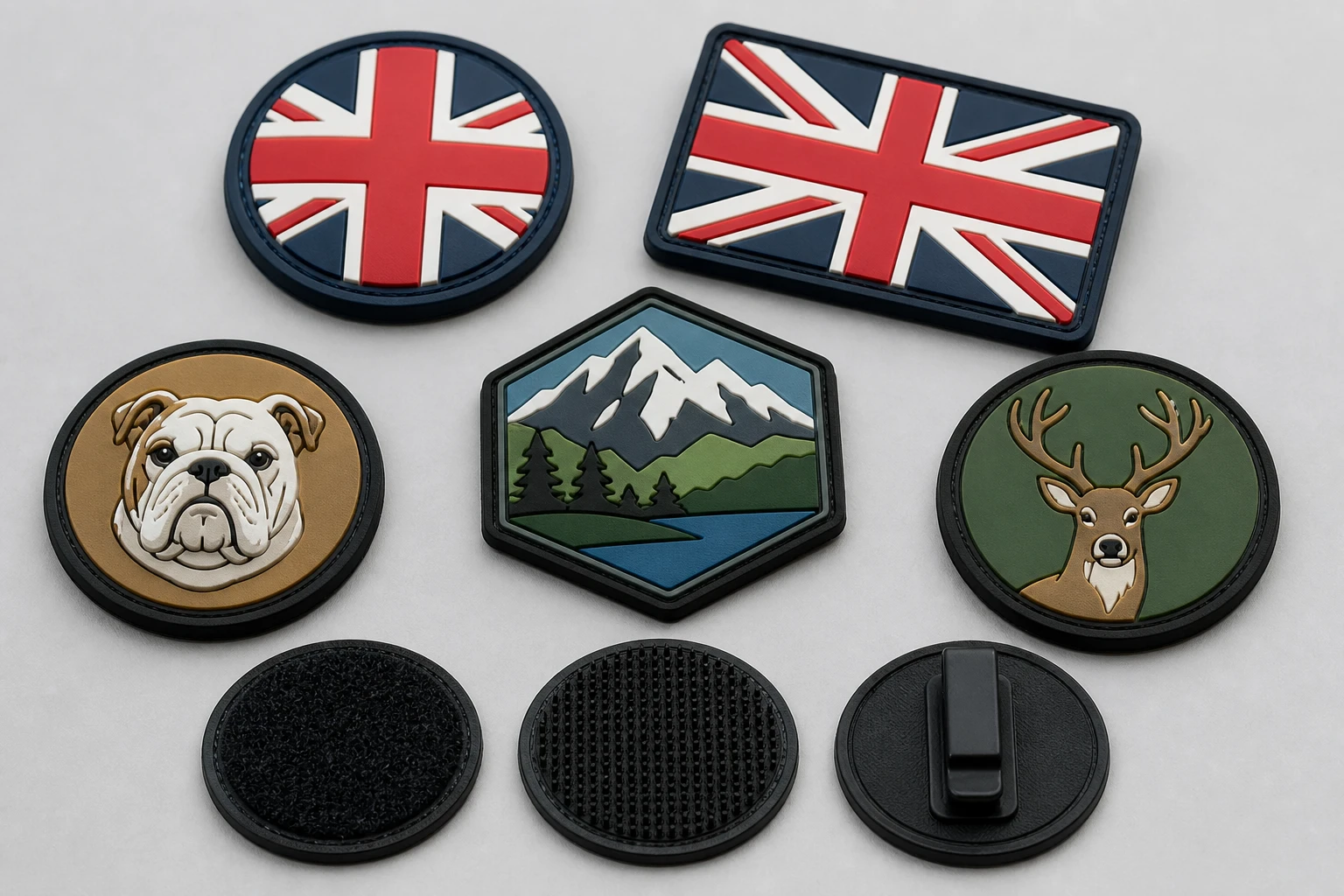
Key takeaways
- Measure PVC patches by the widest point, then check the finished height and garment placement.
- A 2 to 3 inch patch usually suits a chest, sleeve or cap; larger designs need enough surface area to sit flat.
- Sew-on backing is the most dependable choice for frequent washing, while Velcro is designed for removable badges and panels.
- The Customized Patches has a 5-piece minimum per design, supplies a free digital mockup usually within 12 hours, and produces only after approval.
PVC patches are sized by their widest point, with 2 to 4 inches covering many chest, sleeve, cap and bag applications. The right backing depends on the garment and how the patch will be used: sew-on is dependable for regular washing, iron-on suits selected smooth fabrics, and Velcro works best for removable badges.
The practical choice is not simply the biggest patch that fits. You need enough area for the logo to read, a border that does not crowd the artwork, and a backing that matches nylon shells, wool coaches, polo shirts, uniforms or a Velcro panel. The Customized Patches has a 5-piece minimum per design, supplies a free digital mockup usually within 12 hours, and produces only after approval.
How PVC patches are measured
Most custom patches are quoted from the widest finished measurement. For a rectangular badge, that normally means the width. For a tall crest, it may be better to specify both width and height so the proportions are clear. A circular patch is usually described by its diameter, such as 3 inches.
Measure the patch itself, not just the central logo. The raised PVC border, outer edge and any tab or hook section form part of the finished footprint. If your artwork is 2.75 inches wide but the border adds room around it, the final patch may need to be quoted as 3 inches.
Width, height and shape
A standard size can make ordering straightforward, but the shape still matters. A wide rectangular brand mark may work at 3.5 by 1.5 inches. A shield-shaped football crest could need 2.75 by 3.25 inches to avoid making the badge too narrow. A long text-only design often needs extra width rather than extra height.
- Round badge: quote the outside diameter, for example 2.5 or 3 inches.
- Rectangle: provide width and height, including the raised border.
- Shield or crest: provide the widest and tallest points, because the outline is not even.
- Tab or morale patch: check the full width, including any side tab or pull detail.
- Irregular logo: send the artwork and a rough preferred size so a production mockup can show the true proportions.
Why the same inch measurement can look different
A 3-inch round badge has a different visual weight from a 3-inch-wide horizontal badge. The round badge fills more height, while the horizontal badge may look smaller on a jacket even though its width is identical. This is why we check both the measurement and the intended placement rather than treating every 3-inch patch as interchangeable.
A paper cut-out is a useful check. Print the proposed outline at full size, cut it out and place it on the actual garment. Test it on a football jacket, school blazer, work polo or kit bag, not only on a computer screen. Screens can make a design appear larger than it will look beside a pocket or sleeve seam.
Choosing a practical PVC patches size
There is no single correct size for every order. A small badge can be neat and professional on a hospitality polo, while the same badge may disappear on the back of a motorcycle jacket. The useful starting point is the distance at which people need to recognise the design.
| Typical finished size | Common UK use | Advantages | Points to check |
|---|---|---|---|
| 1.5 to 2 inches | Caps, small sleeve marks, children’s clothing and compact bags | Fits restricted areas and keeps a light visual weight | Small lettering and narrow gaps may not remain clear |
| 2 to 2.5 inches | Polo shirts, shirt sleeves, school blazers and small chest placements | Good for simple logos and compact club badges | Avoid packing in too many internal details |
| 2.5 to 3.5 inches | Football jackets, workwear, outdoor clothing and kit bags | Useful balance of visibility and easy placement | Check pockets, seams and curved panels |
| 3.5 to 4.5 inches | Large chest badges, back panels and motorcycle club designs | Allows stronger lettering and larger symbols | Needs more flat garment area and may feel heavy on fine fabric |
| 5 inches or more | Large back badges, display pieces and statement designs | Best viewing distance and room for detailed layouts | Confirm weight, attachment area and whether the garment can support it |
For a football club ordering a left-chest badge, 3 inches wide is often a sensible first mockup. A school blazer may need a smaller 2 to 2.5-inch crest to sit neatly below the lapel. A biker club may choose a much larger back patch, but the jacket panel should be measured first because seams and existing merrowed crests can reduce the usable space.
Small is not automatically cheaper or better. If the artwork contains a mascot, thin lettering and several colour layers, reducing it too far can make the design difficult to read. PVC gives a clean raised finish, but it cannot create unlimited detail in a tiny area. Simplifying the artwork is often more useful than asking for a very small version of the full logo.
Backing options: sew-on, iron-on and Velcro
Backing is the part that decides how the patch meets the garment. It affects fitting, washing, removal and the type of fabric that can carry the patch. A good PVC design on the wrong backing can still become a frustrating order.
| Backing | Best suited to | Benefits | Trade-offs and cautions |
|---|---|---|---|
| Sew-on | Nylon shells, work jackets, uniforms, bags and regular washing | Reliable permanent attachment; suitable for many fabric types | Needs stitching around the edge; removal leaves needle holes |
| Iron-on | Smooth cotton or polyester garments and light-to-moderate use | Quick application without visible stitching | Heat and adhesive may not suit nylon, waterproof coatings or repeated dryer cycles |
| Velcro | Tactical clothing, removable ID badges and loop panels | Allows patches to be changed or removed for washing and different roles | Needs a compatible loop area; extra thickness can catch on clothing |
| Sew-on with loop or hook arrangement | Specialist uniforms and removable systems | Can combine secure stitching with planned interchangeability | Must be specified clearly so the hook-and-loop sides are correct |
Sew-on PVC patches
Sew-on is normally the safest recommendation for a nylon shell, waxed-style outer layer, heavy work jacket or kit bag. The patch is secured through the edge, so the bond does not rely on heat-sensitive adhesive. It is also the sensible route for garments expected to be washed regularly or used outdoors.
The sewing method matters. A domestic machine may struggle with a thick PVC edge, especially on a curved sleeve. Many customers either use a specialist alterations service or ask their uniform supplier to attach the badges. Leave enough border for the needle to pass without cutting into the artwork.
Iron-on PVC patches
Iron-on backing is convenient, but it is not a universal answer. It generally performs better on smooth, heat-tolerant fabrics where the adhesive can make full contact. A textured fleece, waterproof nylon, coated rain shell or heavily ribbed garment can make that contact unreliable.
It is common to see iron-on badges peel after a dryer cycle, especially where the garment was hot, damp or folded before the adhesive had fully settled. That failure is not always a fault in the patch; the fabric, application temperature and washing instructions all affect the result. If the badge matters for a season of fixtures or daily workwear, sew-on is usually the lower-risk choice.
Velcro-backed PVC patches
Velcro is made for removable patches. It suits cadet units, outdoor teams, security clothing and tactical garments that have a loop panel already sewn to the garment. It also helps businesses use one garment for different events, departments or names.
Not sure whether sew-on, iron-on or Velcro will hold your logo on its intended garment? Send the artwork and placement details for a free digital mockup, usually within 12 hours, so the size and backing can be checked before production.
GET A FREE MOCKUPCheck which side is required before approving the order. The patch normally carries the hook side and the garment carries the loop side, but an existing uniform system may use a different arrangement. A Velcro patch also sits slightly proud of the garment, so check that the extra thickness is acceptable near collars, seat belts or equipment straps.
PVC, embroidered, woven or printed: which finish fits?
PVC is a good fit for bold shapes, raised lettering, outdoor branding and designs that benefit from a wipe-clean surface. It gives a defined edge and a tactile finish. It is not the best answer simply because it is fashionable; the design and garment should justify the material.
| Patch type | Surface and appearance | Good choice for | Main limitation |
|---|---|---|---|
| PVC patches | Raised, smooth and defined; can use multiple relief levels | Outdoor brands, tactical clothing, equipment bags and bold logos | Very fine details and tiny text need simplifying |
| Embroidered patches | Thread texture with a traditional stitched appearance | Football clubs, school blazers, workwear and classic crests | Small text can close up; thread texture is not ideal for every modern logo |
| Woven patches | Flatter surface with fine woven detail | Small lettering, labels and designs needing a flatter finish | Less raised impact than PVC and may not give the same outdoor look |
| Printed patches | Flat ink or printed image | Photographic artwork, gradients and highly detailed illustrations | Printed is flatter; that is the point, but it may not provide the raised badge effect |
| Chenille patches | Soft, high-pile yarn texture | Varsity lettering, sports jackets and bold collegiate designs | Not suited to fine detail or a smooth technical appearance |
A football club with a traditional crest may prefer embroidered patches or 3D embroidered patches. A business with a small line of text may find woven patches clearer at the same size. A brand using a photographic mountain scene should look at printed patches rather than forcing the image into raised PVC layers.
For outdoor or equipment use, PVC often makes practical sense because the surface is easy to wipe and the raised design gives the badge a clear outline. For a school blazer or wool coaches jacket, thread may look more at home. The right answer depends on the garment, not only the logo.
Artwork details that affect size and backing
PVC artwork needs to be prepared with the finished dimensions in mind. Strong blocks of colour, readable lettering and clear separation between layers produce a better result than a complex image reduced until every feature is competing for space.
- Use clear outlines between adjoining colours so the layers remain distinct.
- Keep small text to a readable size and ask for a mockup at the intended finished measurement.
- Allow for a border that supports the patch and gives sewing room where sew-on backing is required.
- Tell us if a logo must match an existing Pantone reference, uniform colour or brand guideline.
- Mark any raised or recessed areas clearly in the artwork or notes.
- Do not assume a thin line in a digital file will remain equally thin in the finished PVC.
- Check whether the patch will sit on a curved sleeve, because the design may need a less extreme width-to-height ratio.
A simple artwork file is useful, but the production mockup is where the practical questions are answered. The mockup should show the proposed size, shape, colour arrangement and backing note. If you need to compare PVC with thread, the easiest route is to ask for both options against the same logo.
Our guide on How to Design Artwork for PVC patches That Production-Ready covers artwork decisions in more detail. It is particularly useful for brands with small lettering, layered logos or a badge intended for several garment types.
Matching the patch to real UK garments
The garment changes the recommendation. A patch on a polo is not treated the same way as one on a waterproof jacket. Fabric thickness, stretch, heat tolerance, washing method and the shape of the placement area all need to be considered before the backing is selected.
Football kits and team jackets
A team badge on a tracksuit jacket usually needs a clean 2.5 to 3.5-inch footprint, depending on the chest area and the badge proportions. Check for zips, sponsor marks and the seam between body and sleeve. If the jacket is thin or stretchy, a large heavy badge may pull the fabric rather than sit flat.
Cadet, outdoor and tactical clothing
Cadet units and outdoor groups often use loop panels, making Velcro-backed PVC a natural fit. Confirm the panel dimensions before ordering and keep the patch slightly inside the edge so it does not catch on webbing or straps. A removable patch is useful, but the hook-and-loop connection needs enough area to resist lifting at the corners.
Hospitality polos and work uniforms
For hospitality polos, a smaller left-chest badge can look more considered than a large statement patch. A simple 2 to 2.5-inch design is often easier to place below a collar and away from a button placket. Sew-on may suit heavier workwear, while iron-on can be considered for suitable smooth fabrics where laundering is controlled.
School blazers and wool coaches
Wool and blazer fabrics can be thick, textured or heat-sensitive. A traditional stitched badge may be preferred visually, and sew-on attachment is usually easier to trust than iron-on adhesive on a textured surface. Keep the size proportionate to the pocket, lapel and existing school crest.
Biker vests and motorcycle jackets
A large back badge needs a properly measured panel. Existing biker and motorcycle club patches may already include a merrowed crest, rocker or name strip, so measure the remaining gap rather than ordering from a generic template. Heavy PVC can work well for a bold modern club mark, but the leather or textile surface still needs a secure attachment plan.
Ordering PVC patches in the United Kingdom
A useful quote includes the design, finished width and height, quantity, backing, garment type, delivery postcode and any colour requirements. State whether the dimensions include the border. If there are several sizes for one club or business, list each as a separate line so the quote and mockup do not combine them by accident.
- Send the cleanest available artwork, preferably a vector file or a high-resolution image.
- Give the intended finished size in inches and identify the widest point.
- Name the garment or item: nylon shell, polo, blazer, bag, jacket, cap or Velcro panel.
- Choose sew-on, iron-on or Velcro, or ask for a recommendation based on the garment.
- Confirm quantity per design, remembering that the minimum is 5 pieces per design.
- Review the free digital mockup, usually supplied within 12 hours.
- Check spelling, colour separation, dimensions, border and backing before approving.
- Approve the final specification so production can begin.
Name sew-on, iron-on or Velcro on the quote and include the garment type. The Customized Patches will show the correct backing on a free digital mockup, usually within 12 hours, and production starts only after you approve the specification.
GET A FREE MOCKUPThe 5-piece minimum is per design, not a requirement to order five identical patches across every artwork file. If a club needs a senior badge, junior badge and staff badge, treat those as separate designs for quotation purposes. We can explain how the quantities affect the order rather than assuming every artwork belongs in one run.
Lead time depends on the design, quantity, backing and the point at which artwork is approved. A fast mockup is not the same as a promised dispatch date. The sensible way to plan a tournament, launch or uniform rollout is to request the quote early, approve the artwork promptly and confirm the current production schedule before committing to an event date.
Common sizing and backing mistakes
Most problems can be avoided before production. The usual issue is not that the patch is badly made; it is that the measurement was taken from the logo rather than the finished badge, or the backing was chosen without checking the fabric.
- Ordering from a screen image without checking the size on the real garment.
- Measuring only the central artwork and forgetting the border.
- Choosing a large back patch before measuring around seams, zips and existing badges.
- Using iron-on on a waterproof nylon shell or a fabric that cannot take the required heat.
- Requesting Velcro without confirming that the garment has a compatible loop panel.
- Keeping tiny text in a complex design instead of simplifying it for the finished size.
- Assuming a quick mockup means the full production order will also be immediate.
- Approving a visual without checking the specified backing and attachment method.
A patch can also look fine in isolation and wrong in a group. For a team order, compare one paper outline against the full kit or uniform. Check whether the badge lines up with sponsor marks, shirt pockets or existing crests. Consistent placement often matters as much as the patch dimensions.
If you are still comparing materials, read The Difference Between PVC patches and embroidered patches, Explained. If the order is nearly ready, PVC patches Checklist: What to Confirm Before You Order gives you a short specification list to send with the artwork.
A straightforward specification to send for a quote
A clear specification saves messages later. You do not need to know every production term before contacting us, but these details help us recommend a realistic option for your garment.
- Design name or reference, such as senior football crest or staff polo badge.
- Finished width and height in inches, including the outer border.
- Shape: round, rectangle, shield, tab, custom outline or another form.
- Number of pieces required for each separate design.
- PVC colour and any need for raised, recessed or contrasting areas.
- Backing: sew-on, iron-on, Velcro or a request for advice.
- Garment or product receiving the patch and how it will be washed or used.
- Required delivery destination within the United Kingdom.
- Event, launch or uniform date, if there is one.
If you are unsure between PVC and another finish, send the same artwork for comparison. PVC patches can be assessed beside leather patches, printed patches or thread-based options. A side-by-side mockup is more useful than choosing from a product name alone.
For businesses building a wider identity system, our guide on How PVC patches Can Strengthen Your Brand Identity looks at repeated use across clothing, bags and equipment. Customers in different parts of the country can also see the available UK city pages for regional ordering information.
Final decision: start with the garment, then the patch
The best PVC patch specification starts with the surface that will carry it. Measure the usable area, decide how far away the design needs to be read, then select a size that leaves room around seams and existing branding. After that, choose sew-on, iron-on or Velcro based on washing, heat and removability.
For many UK workwear, club and outdoor orders, a 2.5 to 3.5-inch patch with a clear border is a sensible starting point. That is only a starting point, not a rule. A free digital mockup usually within 12 hours will show whether the badge looks right on the intended garment, and The Customized Patches will produce only after approval.
If you are comparing a traditional finish with PVC, visit the embroidered patches product hub or read PVC patches: Everything UK Buyers Need to Know. For a step-by-step ordering route, see A Step-by-Step Guide to Ordering PVC patches.
Frequently asked questions
What is the most common size for PVC patches?
Many PVC patches are ordered between 2.5 and 3.5 inches wide, which suits chest badges, team jackets, workwear and kit bags. The correct size depends on the available garment area, the shape of the artwork and how far away the design needs to be read. Always check the finished outline, including the border.
Should PVC patches be sew-on or iron-on?
Sew-on is usually the safer choice for nylon shells, heavy work jackets, bags and garments washed regularly. Iron-on can suit smooth, heat-tolerant fabrics, but adhesive may peel after a dryer cycle or fail on waterproof and textured materials. The garment should decide the backing rather than convenience alone.
Are Velcro-backed PVC patches removable?
Yes. Velcro-backed PVC patches are designed to attach to a compatible loop panel and be removed or replaced. They suit cadet units, tactical clothing, outdoor equipment and uniforms with interchangeable identification. Confirm the hook-and-loop arrangement and measure the panel before ordering.
Can small PVC patches include text?
Small PVC patches can include text if the lettering is simple and large enough for the finished size. Very fine type, tight spacing and long wording may lose clarity when reduced below about 2 inches. A free digital mockup helps you check the actual proposed dimensions before approval.
What is the minimum order for PVC patches from The Customized Patches?
The minimum order is 5 pieces per design. Separate artwork, such as a senior team crest and a staff badge, is normally treated as separate designs. The Customized Patches provides a free digital mockup usually within 12 hours and produces only after the mockup and specification are approved.
How do I choose between PVC patches and embroidered patches?
Choose PVC patches for a raised, smooth, clearly outlined finish that suits bold logos, outdoor clothing and equipment. Choose embroidered patches for a traditional stitched appearance on football jackets, school blazers and workwear. Woven or printed options may be better for small detail, gradients or a flatter surface. Compare the garment, artwork and washing conditions before deciding.
Ready to produce custom patches for your UK team or brand?
GET A FREE MOCKUP