
How to Design Artwork for PVC patches That Production-Ready
Production-ready artwork for PVC patches uses clear vector shapes, strong contrast, readable lettering, separate colour areas and a defined finished size. Avoid hairline details, tiny text and complex gradients. Send the artwork with the garment use, backing choice and quantity so The Customized Patches can create a free digital mockup, usually within 12 hours, before production.
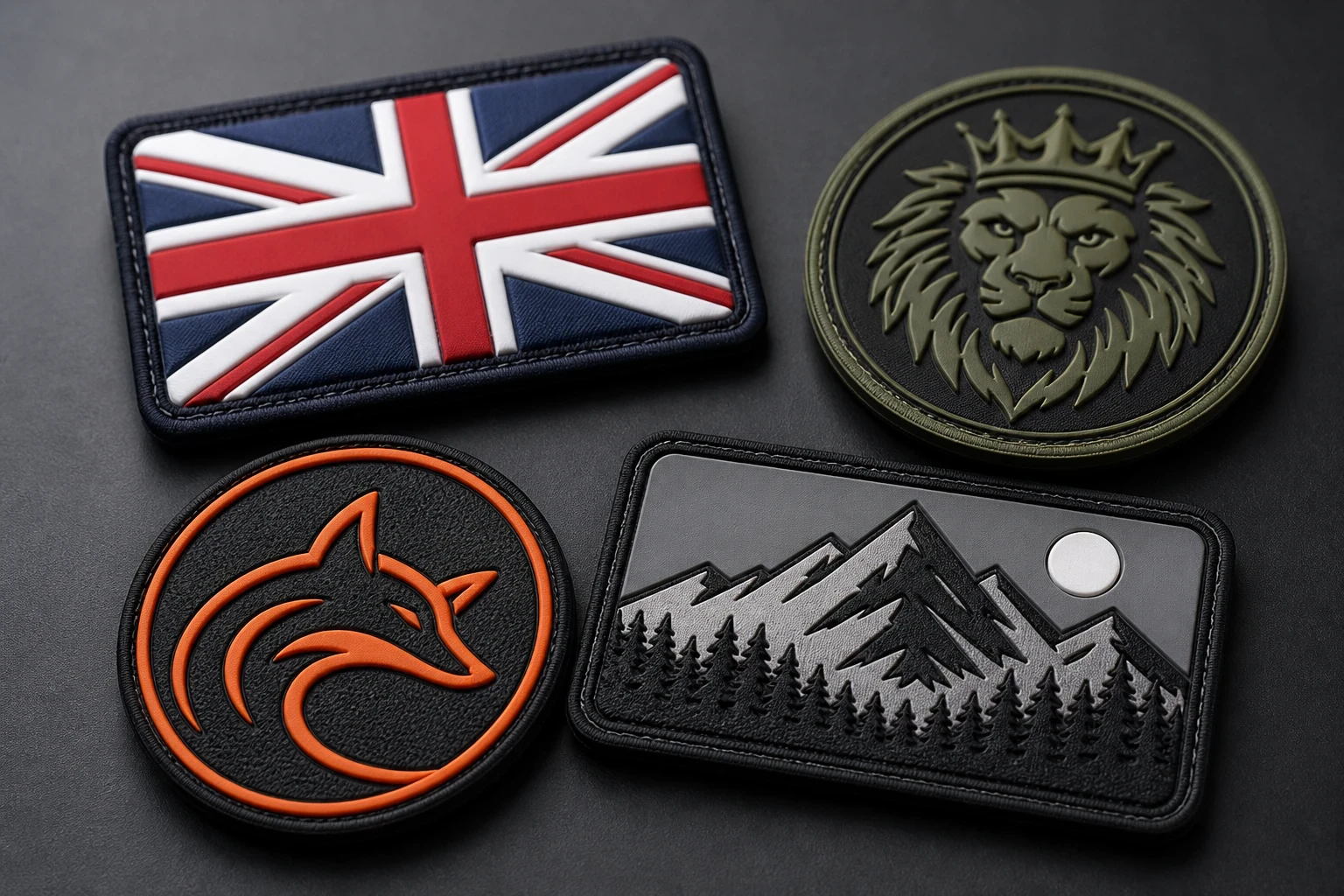
Key takeaways
- Use bold, separated shapes rather than hairline details, tiny text or soft gradients for PVC patches.
- Set the finished patch size in inches before judging whether lettering and symbols will remain readable.
- A 5-piece minimum applies per design, and The Customized Patches produces only after digital mockup approval.
- The free digital mockup is usually supplied within 12 hours, giving you a chance to correct artwork before production.
Production-ready artwork for PVC patches needs bold shapes, clear colour separation and lettering that still reads at the finished size. The safest approach is to simplify the design before manufacture, specify the patch dimensions in inches and show the patch on the garment it will actually be worn on.
The Customized Patches works with UK football clubs, cadet units, hospitality teams, biker groups, school uniform suppliers and growing brands. We check the artwork as a production job, not just as a screen image. A fine line that looks fine on a large monitor can disappear in a small rubber badge, particularly on a dark nylon shell or a curved sleeve.
Start with the garment and the job the patch must do
Before opening design software, decide where the patch will live. A PVC patch on a tactical bag has different needs from one on a hospitality polo. A removable badge for a Velcro panel can use a hook backing, while a crest for a school blazer may need sew-on backing so it stays secure through regular washing.
Tell us if the garment is a nylon shell, fleece, wool coach jacket, cotton sweatshirt, polo, high-visibility layer or blazer. Fabric thickness, heat sensitivity and surface texture can affect the sensible backing choice. Iron-on that looks suitable on a flat cotton sample may peel after a dryer cycle, and heat is not always appropriate for coated nylon.
Think about viewing distance too. A football club crest on a chest panel is usually seen from a few feet away. A small equipment identifier may be handled at arm's length. If the design carries a squad name, unit number or short instruction, that text must be judged at the finished patch size, not at 400% zoom.
PVC patches artwork: what production can and cannot hold
PVC is well suited to strong outlines, block colour, raised borders and simplified badges. It gives a firm, tactile surface and can protect artwork from the casual rubbing that wears down a printed paper-like finish. It is not a magic way to reproduce every detail in a complex illustration.
The most common artwork problem is a design built from very thin strokes. Hairline borders, tiny stars, narrow gaps and delicate script can merge during production or become difficult to read once the patch is flexed. Make important lines heavier, open up enclosed spaces and remove details that do not help recognition.
- Use solid shapes for main lettering, icons, borders and numbered identifiers.
- Keep small internal gaps open so adjacent PVC sections do not visually merge.
- Avoid relying on a subtle shadow or gradient to separate two elements.
- Use a strong border when the design needs a clear silhouette on a busy garment.
- Simplify photographic, hand-drawn or highly textured artwork before asking for a quote.
- Check the patch in one-colour black as a quick test of its basic shape and hierarchy.
That does not mean every PVC badge must look plain. A layered mountain, animal head or club emblem can still have character. The production question is which details carry the identity and which details are only visible because the artwork is enlarged on a monitor.
Raised and recessed details
Raised PVC can add a useful distinction to a border, word or symbol. Use it deliberately. If every small part is raised, the design can become busy and the hierarchy disappears. A raised outer rim with a flatter centre is often easier to read than a badge where all elements compete for height.
Tell us which parts should stand proud and which parts should remain flat. A simple annotated PDF or note on the artwork is helpful, but the digital mockup is the practical check. We can show the proposed treatment before anything is made.
Set the size before choosing lettering
A patch that is 3 inches wide has less room than one that is 5 inches wide, even if both use the same logo. Start with the available garment area and the viewing distance, then build the lettering around that space. Do not squeeze a long club name into a narrow shield simply because the original logo contains it.
For a chest badge, measure the usable area between seams, pockets and zips. For a sleeve, allow for the curve and movement of the arm. A patch that technically fits a sleeve may look oversized once the arm is bent. A shoulder badge may also need a curved top edge or a shape that sits comfortably beside a seam.
| Artwork feature | Safer production choice | Common risk | Useful check |
|---|---|---|---|
| Main lettering | Bold sans-serif or clearly spaced custom lettering | Thin strokes close up or fill in | View at the finished size in inches |
| Small text | Short words, initials or a number | Long names become unreadable | Ask if every character is essential |
| Fine outline | A thicker solid border | The line breaks or merges | Test the design in one colour |
| Small gaps | Open spaces between colour areas | Adjacent sections look like one shape | Inspect dark and light versions |
| Gradients and shading | Flat colour blocks or selected raised areas | The intended tonal change is lost | Describe the effect rather than relying on a screen gradient |
| Photographic detail | A simplified emblem or silhouette | Faces, fur and texture lose definition | Consider printed patches if the detail is the main feature |
There is no single correct patch size for every project. A 2.5-inch badge can work for a small chest mark, while a large back emblem may need 8 inches or more. Send the intended dimensions rather than asking us to guess from a low-resolution image. If you are still choosing the material, compare PVC patches with embroidered patches before finalising the artwork.
Printed is flatter; that is the point. If the design depends on a continuous photograph, fine tonal detail or a very small amount of text, a printed construction may be more suitable. If you want a tactile, wipe-clean badge with raised sections and a strong outline, PVC may be the better fit. The right answer depends on the artwork and garment, not a blanket preference.
Build a colour system that survives the real garment
Screens can make colours look brighter than they appear on fabric. A vivid orange on a phone may sit differently beside a navy jacket than it did on the artwork. Name your brand colours where possible, and tell us if a close visual match matters more than using the exact screen value.
Contrast matters more than having lots of colours. White lettering on black is easy to read. Mid-blue lettering on dark purple may be technically different but visually weak. On camouflage or patterned fabric, even a well-designed badge benefits from a strong outer border or a contrasting base.
Not sure whether the detail will work in PVC or needs a flatter printed treatment? Send the artwork and intended size for a free digital mockup, usually within 12 hours, so you can compare the result before production.
GET A FREE MOCKUP- List the background, border and main artwork colours separately.
- Check light text on dark and dark text on light before choosing one version.
- Do not use a gradient as the only way to distinguish two shapes.
- Keep a one-colour fallback if the patch may later be used in a different colourway.
- Tell us if the same badge will be made for both black and white garments.
- Review the artwork beside the actual garment colour, not only on a white artboard.
For a brand rollout, prepare a small colour schedule. For example: black base, warm white lettering, red raised border and grey centre mark. This reduces uncertainty when a designer, club committee or purchasing manager is reviewing the proof.
Prepare files that a production desk can use
A clean vector file is helpful because it keeps edges sharp and lets the artwork be inspected at different sizes. Adobe Illustrator, SVG, EPS and editable PDF files can be useful, depending on how the artwork was built. A high-resolution PNG can also help us understand the intended design, but it may not reveal how thin a line really is.
Name the file clearly and include the finished width, height, quantity and preferred backing in the email. If the artwork has several versions, label them as black garment, white garment, front, back or approved colourway. Avoid sending five files called final-logo-newest-final2.
What to include with the artwork
- The original logo or artwork file, ideally in an editable format.
- The finished patch dimensions in inches, including any requested shape.
- The order quantity per design and the number of different designs.
- The garment type and approximate placement.
- The preferred backing: sew-on, iron-on, hook-and-loop Velcro or another option discussed with the manufacturer.
- A note showing any raised PVC, recessed areas, border treatment or cut-out spaces.
- The delivery postcode and required date if the patches are for an event or kit issue.
If you only have a JPEG from a website, send it anyway. We can review what is possible and explain where redrawing or simplification may be needed. Do not trace a tiny social-media image yourself and assume it will be production-ready; compression can hide the original proportions and colour detail.
Choose the edge and backing as part of the design
The edge is not an afterthought. A clean cut edge can suit a modern equipment badge, while a shaped border can make a traditional crest feel finished. A merrowed crest has a stitched rolled edge and is more commonly associated with embroidered construction; PVC uses its own moulded edge treatment. The artwork should show the intended outline clearly.
Backing is a practical decision. Sew-on is dependable for many jackets, uniforms and blazers, but it takes more time to attach. Iron-on is convenient on suitable fabrics, although heat, washing and dryers can affect adhesion. Hook-and-loop is useful for removable identification on bags, tactical garments and Velcro panels, but it adds thickness and needs a compatible loop surface.
| Backing | Good fit | Artwork or garment note | Trade-off |
|---|---|---|---|
| Sew-on | School blazers, jackets, club kit and long-term use | Allow room around the border for stitching | Takes longer to attach |
| Iron-on | Suitable cotton and some uniform applications | Confirm fabric and care instructions before choosing | Can peel after poor application or dryer heat |
| Hook-and-loop Velcro | Tactical bags, removable identifiers and Velcro panels | Show which side is required and check panel dimensions | Needs a compatible loop panel and adds thickness |
For a biker jacket or motorcycle club vest, tell us how the patch will be attached and whether it sits alongside existing badges. A large back patch, rocker bars and smaller chest marks need consistent spacing. See the guide to biker and motorcycle club patches if the design is part of a larger club layout.
Review the mockup before approving production
A mockup should answer practical questions, not just make the patch look attractive. Is the spelling correct? Does the outline follow the intended shape? Are the raised areas shown? Is the backing right for the garment? Does the badge look too large beside a pocket or too small on a jacket back?
The Customized Patches provides a free digital mockup usually within 12 hours. The 5-piece minimum applies per design. We produce only after approval, so this is the point to ask for changes rather than hoping a small issue will disappear in manufacture.
- Check every word, number, initial and apostrophe.
- Confirm the finished width and height in inches.
- Compare the mockup with the real garment colour and placement.
- Check that the backing matches the garment and how the patch will be used.
- Look for thin borders, closed gaps, crowded lettering and unclear symbols.
- Confirm the quantity for each separate design.
- Approve the final mockup only after all requested changes are shown.
Ask someone who has not stared at the artwork for an hour to read it at normal size. This catches missing letters and crowded details surprisingly often. For a team order, send the approved mockup to the person responsible for kit, procurement or club sign-off so there is one agreed version.
Ordering PVC patches in the United Kingdom
When requesting a quote, provide the design count, quantity per design, finished dimensions, backing, edge preference, garment use and delivery postcode. Ten patches across two designs is not the same production brief as ten patches of one design, so separate the quantities clearly. The minimum is 5 pieces per design.
Lead time depends on the number of designs, artwork approval, specification and the production schedule. If the patches are for a tournament, parade, product launch or school term, say so at the quotation stage. UK-wide shipping can then be planned around the date rather than treated as an afterthought.
For cost context, read How Much Do PVC patches Cost in the UK? and use A Step-by-Step Guide to Ordering PVC patches when several people are involved in approval. A clear brief generally saves more time than trying to shave detail from the artwork after a proof has already been prepared.
Name sew-on, iron-on or Velcro on the quote and tell us the garment. We show the proposed backing and artwork treatment on a free digital mockup, usually within 12 hours; production starts only after you approve it.
GET A FREE MOCKUPCommon artwork failures
A cadet unit once sent a badge with a narrow ring of text around the edge. It looked legible as a large PDF but became crowded at the requested chest size. Shortening the wording and making the ring thicker produced a clearer badge without losing the unit identity.
Football clubs often have the opposite problem: too many elements in one crest. Dates, initials, a ball, a shield, a sponsor mark and three colours may all be important to the committee, but they cannot all carry equal visual weight on a small sleeve patch. We normally ask which part must be read first.
Hospitality teams commonly need a discreet logo on a polo or jacket. A dense embroidered-style drawing may work better as a woven patch or a simplified PVC mark, while a photorealistic food image may suit a printed patch more closely. Printed is flatter; that is the point, and it can be the honest choice.
- Tiny text copied directly from a full-size brand lock-up.
- A white keyline that disappears against a pale garment.
- A border too close to the outer edge for clean separation.
- A detailed animal, map or landscape reduced without simplification.
- A backing selected without checking the fabric or washing routine.
- Several colourways supplied without saying which one is approved.
- A patch ordered for a Velcro panel without confirming hook or loop compatibility.
The answer is not always to increase the patch size. A bigger badge may clash with a pocket, seam or existing crest. Often the better fix is fewer words, a heavier line, a simpler centre mark or a different patch material.
A practical final checklist for PVC patches
Before sending artwork, print it or view it on screen at roughly the finished size. Put it beside the garment if possible. If the logo cannot be recognised at that point, production will not rescue it by making the patch more tactile.
- The design has a defined finished size in inches.
- The most important word or symbol is obvious at normal viewing distance.
- Text has been proofread by somebody other than the original designer.
- Thin lines, small gaps and tiny details have been checked or removed.
- Colours have enough contrast against the intended garment.
- The edge, raised areas and any cut-outs are clearly specified.
- The backing suits the fabric, attachment method and care routine.
- The quantity is stated as pieces per design, with at least 5 pieces for each design.
- The free digital mockup has been reviewed and approved.
- No production should begin until the approved version is confirmed.
If the project is still at the material-selection stage, the comparison in PVC patches vs embroidered patches: Which Is Right for Your Project? can help. For a more traditional thread-led finish, see 3D embroidered patches or chenille patches. The best result comes from matching the artwork, garment and attachment method together.
Get a production check before you commit
Good patch artwork is not artwork that only looks impressive on a large screen. It is artwork that keeps its identity when reduced to the finished badge, placed on the right garment and handled in daily use. That means making a few firm decisions early: size, text, colour, edge, raised detail and backing.
The Customized Patches serves customers across the United Kingdom with custom patches for teams, brands, clubs and businesses. Send the design, quantity and garment details for a free digital mockup usually within 12 hours. There is a 5-piece minimum per design, and we produce only after the mockup has been approved.
Frequently asked questions
What file format is best for PVC patches?
An editable vector file such as AI, SVG, EPS or an editable PDF is usually the most useful because shapes and edges can be inspected at different sizes. A high-resolution PNG or JPG is still worth sending if that is all you have. The key issue is not the extension alone; the artwork must show clear shapes, readable text and a defined finished size.
How small can lettering be on PVC patches?
There is no safe universal lettering size because the result depends on the font, word length, patch dimensions and surrounding detail. Short bold text is more reliable than a long thin name. View the design at the finished size in inches and ask for a digital mockup before production. If the wording is not essential, removing it often improves the badge.
Can PVC patches reproduce gradients or photographs?
PVC can reproduce simplified colour areas, but it is not normally the first choice for photographic detail or subtle gradients. A simplified silhouette, bold emblem or layered colour design is more suitable. If continuous tones and fine visual detail are central to the artwork, compare printed patches before choosing the construction.
What is the minimum order for PVC patches?
The minimum is 5 pieces per design. If you order three different club badges, each badge is treated as its own design and must meet the 5-piece minimum. State the quantity for every design when requesting a quote so the production brief and pricing are clear.
How quickly can I see a PVC patch mockup in the UK?
The Customized Patches provides a free digital mockup usually within 12 hours. Timing can vary if the brief is missing the size, backing, quantity or artwork information. Production begins only after the customer approves the mockup, so changes should be requested during the proof stage.
Should I choose sew-on, iron-on or Velcro backing?
Choose based on the garment and how the patch will be used. Sew-on is a dependable option for jackets, blazers and long-term wear. Iron-on can be convenient on suitable fabrics but may peel after poor application or dryer heat. Hook-and-loop Velcro suits removable badges and compatible panels on tactical garments and bags. Tell the manufacturer the fabric and care routine before finalising the backing.
Ready to produce custom patches for your UK team or brand?
GET A FREE MOCKUP