
PVC patches for Small Businesses: A Practical Guide
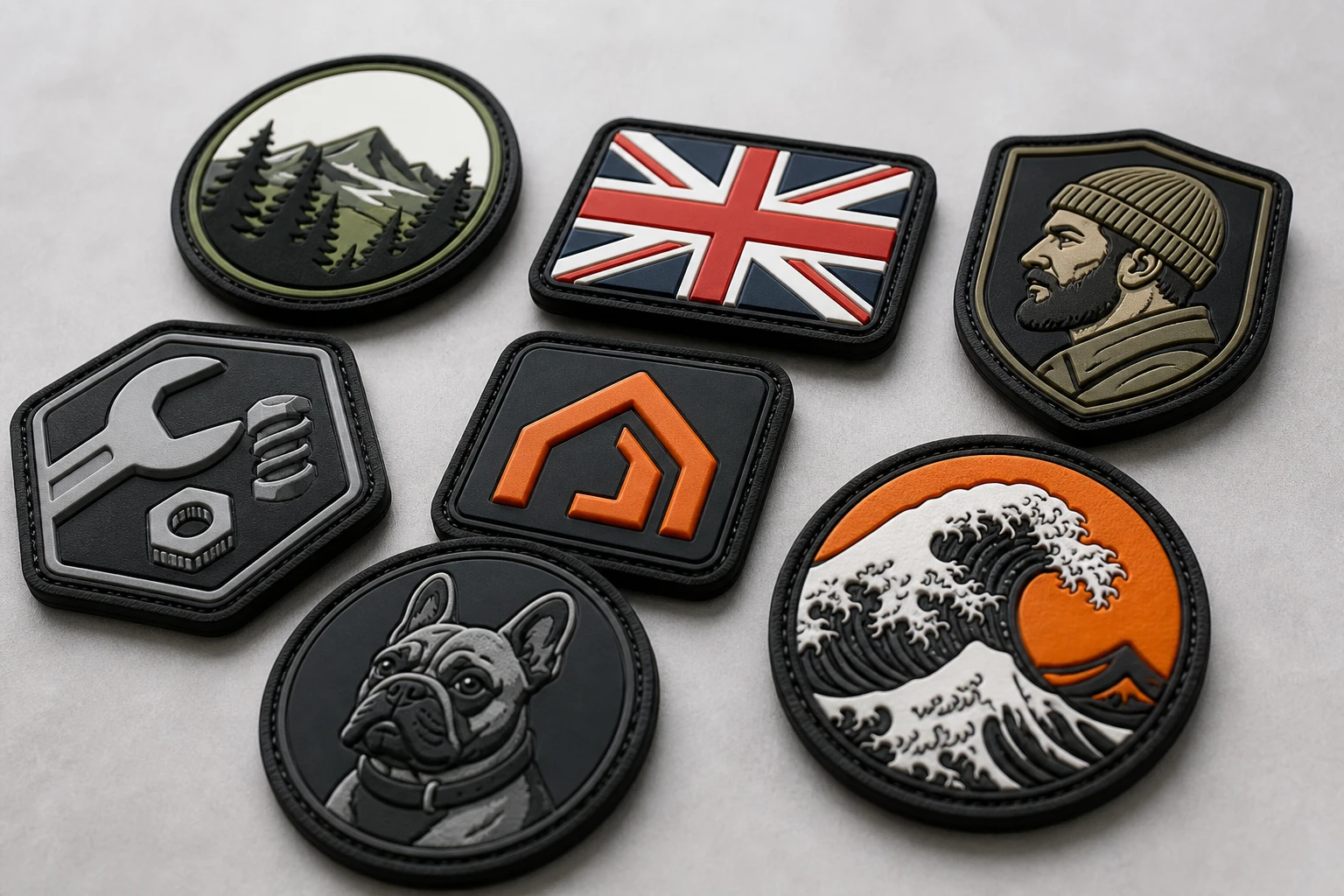
PVC patches are durable, moulded badges made from soft or firm PVC, a rubber-like material suited to outdoor clothing, workwear, bags and branded equipment. For UK small businesses, they offer raised detail, strong colour and simple cleaning. The Customized Patches requires five pieces per design and provides a free digital mockup, usually within 12 hours, before production.
Key takeaways
- PVC patches suit small businesses that need washable, weather-tolerant branding with raised detail and clear block colours.
- A 5-piece minimum applies to each design, while size, number of colours, layers, edge style and backing affect the quotation.
- The Customized Patches sends a free digital mockup usually within 12 hours and produces only after approval.
- Choose sew-on, iron-on or Velcro according to the garment and expected use; the wrong backing can make a good patch fail in service.
PVC patches are a practical choice for small businesses that need branded badges for workwear, bags, uniforms or outdoor equipment. They are made from moulded PVC, so the surface is wipe-clean, the colour is consistent, and raised details can remain legible where thread would become crowded. For UK orders, The Customized Patches has a 5-piece minimum per design and sends a free digital mockup usually within 12 hours before production.
The main decision is not simply PVC or another material. You need to match the patch to the garment, the artwork, the washing routine and the way people will use it. A café may need a neat badge on a polo, a landscaping firm may need branding on a waterproof jacket, and a small clothing label may want removable patches on Velcro panels. Each job can call for a different size, backing and level of raised detail.
Why PVC patches work for small businesses
Small businesses often need branding that works across more than one product. A single mark may appear on a staff jacket, delivery bag, rucksack, cap and point-of-sale display. PVC handles that variety well because it has a smooth face, a defined edge and a finish that does not rely on loose thread standing proud of the surface.
The material is particularly useful for businesses exposed to rain, mud, dust or frequent handling. A mobile coffee company can wipe a badge clean after a wet market day. A cycle workshop can use it on a mechanic's jacket without expecting the badge to look like a delicate woven label. A dog-walking business can put the same mark on waterproof shells and equipment bags.
- Raised lettering and symbols can give a simple logo a clear physical shape.
- Smooth PVC is easy to wipe clean after ordinary outdoor use.
- Strong colour separation suits bold logos, club marks and simplified icons.
- Sew-on and Velcro options allow the same design to move between garments or bags.
- The 5-piece minimum makes a short test run possible for a small business rather than forcing a large first order.
There are limits. PVC is not the best answer for every logo or every garment. Detailed illustrations may need a printed surface, and a heritage brand may prefer the texture of embroidery or leather. The right decision comes from the mark and the working conditions, not from treating one patch type as a universal replacement.
PVC patches: choosing the right specification
Start with the area available on the garment. A patch that looks balanced on a 2.5-inch sleeve may feel lost on the back of a coach jacket, while a large chest badge can overwhelm a fitted hospitality polo. Measure the usable space rather than guessing from the logo file. A photograph with a ruler beside the target area is helpful at quotation stage.
The second decision is construction. A flat PVC face gives a clean, restrained finish. Raised layers add height to a border, letter or icon, while recessed areas create contrast without adding another colour. These choices can make a simple mark easier to recognise, but they also affect the quotation and the artwork approval.
| Specification | What it changes | Practical small-business use |
|---|---|---|
| Patch size | Visibility, proportion and price | Small chest or sleeve marks often suit roughly 2 to 3 inches; larger back or bag designs need more room. |
| PVC layers | Height, separation and visual emphasis | Use a raised layer for a short word, border or icon that must stand apart from the base. |
| Colour count | Appearance and production complexity | Two or three strong colours usually suit a simplified trade logo or club badge. |
| Border | Edge definition and perceived shape | A raised or defined border helps a badge read against a dark nylon shell. |
| Backing | How the patch attaches and whether it can be removed | Sew-on is dependable; iron-on suits suitable fabrics; Velcro is useful for changing equipment badges. |
| Edge shape | The outline visible on the garment | A merrowed-style edge is associated with thread patches, while PVC usually uses a moulded cut edge or defined border. |
Artwork should be simplified with the final size in mind. Tiny wording that is readable on a screen may close up on a 2-inch badge. Fine gaps can disappear when neighbouring shapes are moulded close together. If the logo includes a long strapline, ask whether it genuinely needs to appear on the patch; often the stronger option is the symbol and business name only.
For a deeper preparation checklist, see How to Design Artwork for PVC patches That Production-Ready. If you are comparing the material with thread, the The Difference Between PVC patches and embroidered patches, Explained guide sets out the visual and practical differences.
PVC, embroidery, woven and printed patches compared
The material comparison matters because small businesses often use patches as part of a wider uniform or product system. The badge should look intentional beside the fabric, zip, label and other branding. Printed is flatter; that is the point when a detailed image, gradient or fine illustration needs to remain visible.
Embroidery brings texture and a traditional uniform feel. It suits football clubs, school blazers, hospitality polos and many work jackets, although very small lettering can become difficult to reproduce. Woven patches give a flatter woven surface with cleaner small text, while PVC is better suited to raised, wipe-clean and outdoor-facing designs.
| Patch type | Best suited to | Main advantage | Trade-off |
|---|---|---|---|
| PVC | Outdoor workwear, bags, caps, tactical-style equipment and modern logos | Raised detail, wipe-clean surface and clear solid colours | Can look too industrial for a soft heritage identity; complex artwork may need simplifying |
| Embroidered | Football clubs, school blazers, hospitality uniforms and traditional workwear | Tactile thread texture and familiar uniform appearance | Very fine lettering and dense artwork can lose clarity |
| Woven | Small labels, detailed flat marks and compact text | Fine woven detail on a relatively flat face | Does not provide the raised rubber-like effect of PVC |
| Printed | Photographic marks, gradients, illustrations and highly detailed artwork | Flatter surface with more freedom for tonal detail | Can feel less tactile and may not suit a rugged equipment look |
| Leather | Premium goods, craft brands, bags and heritage products | Natural material and understated branded appearance | Colour and fine detail behave differently from PVC or thread |
You can review alternative finishes through woven patches, printed patches and leather patches. For a softer, more traditional crest, embroidered patches may be the better fit. Some businesses use two materials across the range rather than forcing every application to look identical.
Choosing a backing for uniforms, bags and equipment
Backing is where a visually good patch can fail in real use. A shop may specify iron-on because it is quick, then discover that the garment is a nylon shell with a water-resistant finish. Heat can affect the shell, and the adhesive may not get the even contact it needs. The same issue appears on coated bags and some technical fabrics.
Sew-on is usually the dependable option for a permanent attachment. It works well on many jackets, polos, cotton twill bags and heavier uniforms, provided the item can be stitched without damaging a lining or waterproof construction. Ask the person applying the patch to stitch through the border or designated sew area rather than across the central logo.
- Choose sew-on for a long-term badge on a football jacket, work shirt, school blazer or sturdy bag.
- Choose iron-on only when the garment manufacturer permits heat and the surface can accept the adhesive.
- Choose Velcro for removable team identifiers, equipment bags, tactical-style garments and shared loan items.
- Tell the patch maker if the target is a nylon shell, waterproof coat, wool coach jacket, fleece, cap or coated fabric.
- For a removable system, confirm that the garment already has a compatible loop panel or ask for the matching attachment arrangement.
A wool coaches jacket needs a different conversation from a cotton polo. Wool can compress under stitching and may show needle holes if the application is rushed. A nylon shell can pucker, while a heavily padded bag may need a practical edge and stitch route. Send a clear garment description with the quote so the backing recommendation is based on the item, not a guess.
Designing a PVC patch that stays readable
A small-business logo often starts as a wide digital file designed for a website or van. A patch is a different viewing surface. It is handled at arm's length, partly covered by a zip or strap, and seen against changing fabric colours. The design should be tested at the intended size before anyone approves production.
Not sure whether your logo needs raised PVC detail or a flatter thread finish? Send the artwork and the garment or product photo. The Customized Patches will provide a free digital mockup usually within 12 hours, and production starts only after you approve it.
GET A FREE MOCKUPUse hierarchy rather than squeezing everything in
Give the main symbol or business name the most space. Remove secondary wording if it becomes a narrow line. If the company name is long, consider a wider horizontal shape instead of a compact circle. A clean border gives the eye somewhere to stop and helps the badge separate from a black jacket.
Plan colour against the garment
A dark navy PVC base can disappear on a navy jacket, even if the logo file looks clear on a white screen. Choose enough contrast for the intended garment, and check whether the badge will sit on hi-vis, camouflage, denim, white cotton or a black bag. Brand colours still matter, but legibility comes first.
Treat fine detail honestly
Tiny stars, hairline borders and narrow gaps are common trouble spots. They may merge into the surrounding PVC or lose their shape at final size. A production mockup should show the proportion and construction clearly, but it is not a substitute for asking how a fine feature will be made.
The PVC patches Checklist: What to Confirm Before You Order is useful for checking the final artwork, size, backing and delivery details. It is worth spending a few minutes here rather than discovering after delivery that the old logo file contained the wrong phone number.
Quantity, price and the 5-piece minimum
The Customized Patches accepts a minimum of 5 pieces per design. That is useful for a new business testing a badge on a small run of jackets, but the quantity still needs to be stated clearly. Five pieces of one approved design is different from five mixed designs, so list each artwork separately on the enquiry.
PVC patch pricing depends on more than the number of units. Size, shape, number of colours, raised levels, border treatment, backing and delivery requirements all affect the quote. A simple 2-inch badge with two colours is a different production job from a large multi-layer patch with several raised elements and a removable Velcro backing.
- Quantity per design, including any separate colourways or staff versions
- Finished width and height in inches
- Flat or raised construction
- Number of PVC colours and any special colour matching request
- Sew-on, iron-on or Velcro backing
- Shape, border and any cut-out area
- Garment or product type
- UK delivery address and required date
For a realistic quotation, send the artwork with those details rather than asking for a price from a logo alone. A photograph of the intended placement can prevent a second round of questions. The guide How Much Do PVC patches Cost in the UK? explains the main pricing variables without pretending that one flat figure applies to every specification.
Ordering PVC patches in the United Kingdom
The ordering process is straightforward if the brief is complete. Start with the artwork, quantity and intended use. Then confirm the dimensions in inches, construction, backing, colours and delivery address. If the patch is going on a team kit or a seasonal uniform, include the date it must be in hand rather than only the date you hope to place the order.
- Send the logo or patch artwork and describe the garment, bag or equipment.
- State the number of pieces required for each individual design; the minimum is 5 pieces per design.
- Confirm the approximate finished size in inches and whether the patch should be flat or raised.
- Choose sew-on, iron-on or Velcro backing after considering the fabric and care routine.
- Review the free digital mockup, usually supplied within 12 hours.
- Check spelling, dimensions, colours, border, backing and placement.
- Approve the final mockup in writing so production can begin.
- Arrange UK delivery and inspect the patches against the approved design when they arrive.
The approval step is not a formality. Production begins only after approval, so this is the point to correct a reversed colour, a missing border, an incorrect business name or a backing that does not suit the garment. Keep the approved mockup with the order record, especially if the same design will be reordered later.
For a fuller walkthrough, use A Step-by-Step Guide to Ordering PVC patches. Businesses comparing other finishes can also browse the UK city pages for local delivery information and patch services across the United Kingdom.
Common mistakes small businesses can avoid
The most frequent mistake is ordering from a screen preview without checking the physical placement. A logo can look balanced at full size and become cramped on a sleeve. Measure the patch area, allow room around zips and seams, and remember that a shoulder badge may be viewed from an angle rather than straight on.
Another mistake is selecting the backing in isolation. Iron-on that peels after a dryer cycle is not a theoretical problem; it is a familiar failure on garments that were washed or heated outside the adhesive's suitable conditions. A patch on a nylon shell may lift at the edge if the surface, temperature or pressure is unsuitable.
- Using a low-resolution screenshot when a clean vector or high-resolution logo is available
- Trying to keep a full strapline on a small badge
- Choosing a colour that disappears against the main garment
- Ordering a permanent sew-on badge for a kit that needs regular reallocation
- Assuming every waterproof jacket can accept iron-on heat
- Approving a mockup without checking the actual dimensions
- Combining different designs in the quantity without stating the split
- Leaving the delivery date until after the production decision
Name sew-on, iron-on or Velcro on the quote, and include the garment or product type. We show the correct backing and proportions on a free digital mockup usually within 12 hours, then produce only after you approve the design.
GET A FREE MOCKUPA useful production habit is to name the intended application in plain language: “2.75-inch PVC badge for a black nylon shell, Velcro backing, five pieces for a trial.” That sentence gives a clearer starting point than “please quote our logo.” If the project grows later, the original specification becomes a sensible reference for the reorder.
Examples for UK small businesses
A local outdoor instructor might use a raised mountain symbol on a waterproof rucksack and a sew-on version for staff jackets. The rucksack badge needs a backing that will not interfere with straps, while the jacket badge may need to sit neatly beside a company name. The same artwork can work, but the application should be checked separately.
A hospitality company may prefer embroidered badges for smart polos and PVC patches for delivery bags or outdoor event crew. The embroidered version gives the uniform a familiar textile feel; the PVC version is easier to wipe down after transport. There is no need to make both surfaces identical if the wider identity remains consistent.
For a football club, the crest may contain enough fine detail to favour embroidery or woven construction, particularly on a school blazer or formal presentation jacket. A simplified PVC training badge could still work on kit bags, rain jackets or equipment cases. A biker or motorcycle club may also need to compare a traditional biker and motorcycle club patches approach with a hard-wearing PVC version.
A small clothing brand may use removable Velcro PVC patches as part of a limited collection, allowing customers to change the badge on a cap or overshirt. In that case, the loop panel, patch dimensions and edge clearance are as important as the logo itself. The patch should sit flat and should not catch on nearby stitching or hardware.
Care, application and reorder advice
Follow the care instructions for the garment first. PVC itself is easy to wipe, but the backing and the fabric underneath still matter. Avoid assuming that a badge is suitable for high heat simply because the face is water-resistant. For iron-on applications, use the recommended temperature and pressure, and do not apply heat directly to a raised face unless instructed.
Sew-on patches should be checked at the edges after washing or heavy use. If a corner lifts, repair it early rather than allowing the thread to pull across the rest of the border. Velcro patches benefit from keeping the hook and loop areas free from lint, especially on fleece, wool and heavily used workwear.
Keep a copy of the approved mockup and the original artwork. When a small business reorders six months later, the saved dimensions and backing prevent an accidental change. If the logo, garment or colour has changed, request a new mockup rather than assuming the old specification remains suitable.
A sensible decision for your next patch order
Choose PVC patches when the job calls for a clean moulded face, raised detail, bold colour and straightforward cleaning. They are a strong fit for outdoor workwear, bags, caps, equipment and modern business marks. They are less suitable when the design depends on photographic shading, delicate thread texture or extensive small wording.
The Customized Patches can quote from the artwork, intended use and quantity. The order has a 5-piece minimum per design, the free digital mockup is usually supplied within 12 hours, and production takes place only after approval. That process gives a small business a chance to see the proposed proportions and backing before committing the garments to application.
If you are still weighing finishes, compare PVC with 3D embroidered patches for raised thread texture or chenille patches for a soft, bold varsity surface. The practical answer is the one that survives the garment, the artwork and the way your customers or staff will use it.
Frequently asked questions
What are PVC patches used for by small businesses?
PVC patches are used for work jackets, waterproof clothing, bags, caps, rucksacks, equipment cases, uniforms and removable Velcro panels. They suit businesses that want a wipe-clean surface, clear solid colours and raised logo detail. Outdoor instructors, trades, hospitality teams, clothing brands, clubs and event crews can all use them.
What is the minimum order for PVC patches from The Customized Patches?
The minimum order is 5 pieces per design. If you need different artwork, colourways or staff versions, list each design separately because the minimum applies to each approved design rather than the total number of patches across unrelated designs.
How quickly can I receive a PVC patch mockup in the UK?
The Customized Patches provides a free digital mockup usually within 12 hours. The mockup should be checked for spelling, size, colours, construction, border and backing. Production starts only after the customer approves the design, so changes should be requested at the mockup stage.
Are PVC patches better than embroidered patches?
Neither is automatically better. PVC suits raised detail, bold colours, outdoor use and wipe-clean equipment, while embroidered patches provide thread texture and a familiar uniform finish. A football crest on a blazer may suit embroidery, whereas a modern badge on a waterproof bag may suit PVC. Compare the material with the garment and artwork.
Which backing should a small business choose for PVC patches?
Choose sew-on for a permanent attachment on suitable jackets, polos, blazers or sturdy bags. Choose iron-on only when the fabric and care instructions allow heat and adhesive. Choose Velcro for removable badges on equipment, shared garments or existing loop panels. Tell the manufacturer if the garment is nylon, wool, waterproof, padded or coated.
How should I prepare artwork for PVC patches?
Send the clearest logo file available and state the finished size in inches. Simplify very small wording, narrow gaps and fine lines that may close together at production size. Confirm the base colour, raised areas, border, backing and garment. A free digital mockup usually arrives within 12 hours, giving you a chance to correct the design before production.
Ready to produce custom patches for your UK team or brand?
GET A FREE MOCKUP