
10 Questions to Ask Before Ordering PVC patches
Before ordering PVC patches, confirm the design, finished size, number of raised layers, colours, backing, garment, quantity, price, delivery date and approval process. The Customized Patches supplies UK customers from a 5-piece minimum per design and normally provides a free digital mockup within 12 hours. Production starts only after approval.
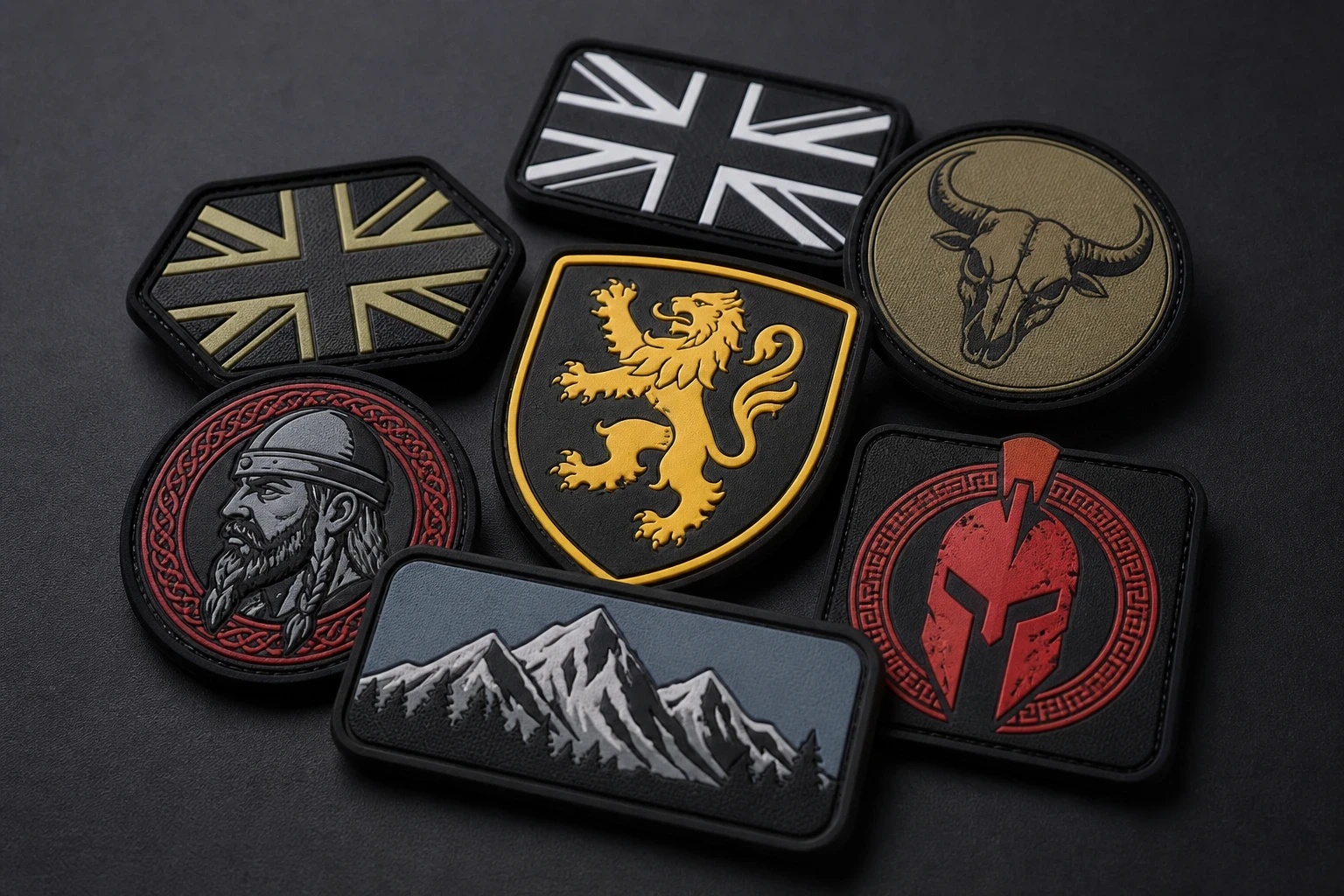
Key takeaways
- PVC patches are best specified by finished size, layer height, colour count, backing and garment use, not by artwork alone.
- The Customized Patches accepts a 5-piece minimum per design for UK orders.
- A free digital mockup is usually supplied within 12 hours, and production begins only after the customer approves it.
- Sew-on, iron-on and Velcro backings suit different garments; the correct choice depends on the fabric, washing routine and intended use.
The best PVC patches order starts with ten checks: artwork, size, layers, colours, backing, garment, quantity, cost, delivery and approval. PVC patches are a good fit for outdoor clothing, tactical kit, Velcro panels and logos that need a raised, wipe-clean finish.
The Customized Patches serves teams, brands, clubs and businesses across the United Kingdom. There is a 5-piece minimum per design, a free digital mockup usually arrives within 12 hours, and production starts only after you approve the final version.
1. Are PVC patches right for the garment and job?
Start with the garment, not the badge shape. PVC works particularly well on nylon shells, waterproof outerwear, kit bags, workwear and removable Velcro panels. The material has a rubber-like feel and can be wiped clean, so a football club travelling in poor weather or an outdoor brand testing kit may prefer it to thread.
That does not make PVC the automatic answer. A school blazer often looks better with a traditional merrowed crest. A wool coaches jacket may suit a softer embroidered patch, while a fine photographic design may need a printed patch. Printed is flatter; that is the point. It can preserve a shaded image that would be difficult to build as raised PVC.
What should you tell the maker?
- The garment or item, such as a nylon shell, polo shirt, rucksack, cap, wool jacket or kit bag.
- Whether the patch will be washed, exposed to rain, handled roughly or removed regularly.
- Whether it must match an existing crest, uniform badge or brand colour.
- Whether the patch needs to remain flexible, sit flat or provide a visibly raised finish.
A biker vest, for example, may need a large back piece and smaller front identifiers, with the backing selected around leather or denim. A hospitality polo may need a neater, lighter badge that survives routine washing without making the chest feel bulky. Giving this context at quote stage prevents a technically possible patch from becoming the wrong patch.
2. What size should the PVC patch be?
Measure the space available and the size of nearby badges. Patch dimensions are usually discussed in inches, and the finished width and height affect readability, price and how much detail can be retained. A 2-inch badge behaves very differently from a 4-inch back patch, even if both use the same logo.
Do not judge scale from a phone screen. Print the design at its intended size or place a paper version on the actual garment. Check the smallest letters from the distance at which people will see them. A club badge on a chest pocket needs different lettering from a large motorcycle club back panel.
Width, height and shape
Tell the maker whether your measurement is the maximum width, maximum height or the overall shape including the border. A tall crest, circular logo and long rectangular name strip each use space differently. If the badge must sit inside a Velcro field, measure the panel rather than guessing from the garment photograph.
| Typical use | Useful starting size | Main check |
|---|---|---|
| Chest logo on a polo or jacket | About 2 to 3 inches wide | Small wording must remain legible without dominating the garment. |
| Sleeve or upper-arm badge | About 2.5 to 3.5 inches wide | Check sleeve curvature and the available flat area. |
| Cap or compact equipment panel | About 1.5 to 2.5 inches wide | Reduce fine lines and avoid crowded lettering. |
| Large back or biker vest badge | About 4 to 10 inches wide | Confirm the panel, seam position and whether the badge needs a centre split. |
| Removable Velcro identifier | Match the hook-and-loop field | Leave enough clearance for stitching, corners and repeated removal. |
These are starting points, not fixed rules. The right size depends on the artwork and placement. The free digital mockup gives you a practical chance to see the badge against its intended scale before you commit to production.
3. How much raised detail can the design carry?
PVC patches are made in layers, so ask which details will be raised and which will remain at the base level. A simple raised border can give a logo strong definition. Several heights can create a more sculpted result, but they also add decisions and may make a crowded design harder to read.
Very small text, narrow gaps and thin outlines are the usual trouble spots. A line that looks clear in a vector file may become too fine once it is converted into a mould. Avoid squeezing a full address, long slogan or complicated illustration into a small badge. Keep the wording that people actually need to read.
What makes artwork production-ready?
- Use clear, closed shapes rather than overlapping objects that have not been separated.
- Identify the base, border, raised lettering and raised icons.
- Check that letters have enough space between them at the finished size.
- Supply a clean vector file where possible, while also sending a visual reference.
- State which details are essential and which can be simplified if space is tight.
A football club may need the year and initials to remain sharp, while a brand badge may care more about a raised symbol than tiny supporting text. Our guide on How to Design Artwork for PVC patches That Production-Ready covers the file checks in more detail.
4. Which colours and effects are available?
Ask how your colours will be separated into PVC components. Digital artwork can contain gradients, transparency and thousands of shades, but a moulded patch normally needs clear colour areas. A dark navy beside black, for instance, may need a strong border or a lighter dividing line to remain visible.
Give colour references if the badge must match an existing kit or brand guide. A screen display is not a reliable production specification. Also ask about special effects such as glow, reflective elements, metallic-looking finishes or different surface levels, as these may depend on the design and the production method.
Do not overlook the border
The border is not just decoration. It frames the artwork, helps separate colours and affects the cutting shape. A thick border can make a small badge look deliberate; a very narrow border may disappear into a dark garment. If you are replacing an older badge, send a photograph and its measurements so the new version can be compared properly.
5. Which backing suits the garment?
Backing is a practical choice, not a finishing afterthought. Sew-on backing is dependable for jackets, uniforms and items that will be washed repeatedly. Iron-on backing is convenient for some garments, but heat, fabric coatings and dryer cycles can affect adhesion. It is common to see iron-on badges peel after a dryer cycle when the garment and application method were not compatible.
Velcro backing is useful for tactical clothing, training kit and removable identifiers. It needs a matching loop panel on the garment, and the patch should be sized to that panel rather than the other way round. Adhesive backing can suit temporary displays or low-wear applications, but it is not a substitute for stitching on a frequently laundered uniform.
| Backing | Good fit | Points to confirm |
|---|---|---|
| Sew-on | Nylon shells, uniforms, denim, wool coaches and long-term use | Allow a sewing edge and check seams, pockets and curved areas. |
| Iron-on | Suitable smooth fabrics where heat can be applied safely | Check the care label, coating, heat tolerance and whether stitching is still advisable. |
| Velcro | Tactical clothing, equipment panels and interchangeable names or identifiers | Measure the loop field and confirm the hook side is fitted to the patch. |
| Adhesive | Temporary display, packaging or low-wear use | Confirm expected duration and surface cleanliness; it may not suit washing. |
If you are comparing finishes rather than only backing, see PVC patches vs embroidered patches: Which Is Right for Your Project?. It explains why a raised moulded badge, a thread-based crest and a flat printed design solve different problems.
Not sure whether your logo needs raised layers, flatter printed detail or a simpler border? Send the artwork and intended garment for a free digital mockup, usually within 12 hours, so you can compare the finished direction before production.
GET A FREE MOCKUP6. What quantity and minimum order apply?
Confirm quantity per design, not just the total number of patches. The Customized Patches has a 5-piece minimum per design. Five circular club badges and five different names are not normally the same order, because each design requires its own artwork and production setup.
If a team needs 18 player identifiers, list which parts remain identical and which change. A shared crest with variable names may need a different quote from one repeated crest. The same applies to a business ordering several departments, a cadet unit ordering rank identifiers or a brand ordering a main logo alongside seasonal versions.
Why quantity affects the quote
The mould and setup work are spread across the run, so quantity can affect the unit price. Size, number of colours, layers, backing and packing also matter. A small batch is still possible from five pieces per design, but it should be quoted against the exact specification rather than an assumed standard badge.
For a first run, order enough to cover fitting tests and expected replacements if the badge will be used on active kit. For a club, that might mean one for each current player plus a small reserve. For a business, consider whether the same artwork will be used on staff garments, bags and event equipment.
7. What should the price include?
Ask for a quote based on the final specification: finished dimensions in inches, shape, PVC layers, colours, backing, quantity, packaging and UK delivery. A price for a flat 2-inch sew-on badge cannot be fairly compared with a larger multi-level Velcro patch.
Also ask whether artwork preparation or revisions are included. A clear logo may need only a minor production adjustment, while a hand-drawn image with tiny text may need a more careful redraw. The point is not to avoid sensible artwork work; it is to know what is being changed before the order is approved.
| Specification | Why it can change the price | What to provide |
|---|---|---|
| Overall size | More material and a larger mould area may be required. | Finished width and height in inches. |
| Number of colours | More colour areas require more separation and production detail. | Brand references or clear visual samples. |
| Raised layers | Multiple heights add mould complexity. | A marked-up image showing raised elements. |
| Backing | Sew-on, iron-on, adhesive and Velcro use different components. | Garment type and whether the patch is removable. |
| Quantity | Setup costs are distributed over the run. | Number of pieces per design, with variations listed separately. |
| Delivery | The address, packing and required date affect planning. | UK postcode and the date the patches must arrive. |
For more detail on budgets and the factors behind them, read How Much Do PVC patches Cost in the UK?. A useful quote is one you can check line by line, not simply the lowest figure on a screen.
8. How will the patch be checked before production?
Ask to see the final shape, dimensions, colours, raised details and backing in one approved mockup. The Customized Patches normally sends a free digital mockup within 12 hours. Use it as a production check, not just a visual courtesy.
Look closely at spelling, punctuation, border thickness, logo proportions and the direction of any text. Check the mockup against the real garment, especially if the patch will sit near a zip, seam, pocket or curved sleeve. A badge can look balanced in isolation and crowded once placed on a narrow chest panel.
What approval means
Approval should cover the actual version you want made. If the artwork changes after approval, the size, cost or production timing may need to be reviewed. Production starts only after approval, which protects both sides from an unconfirmed sketch becoming the finished batch.
Keep the approved file and any written notes. If several people are involved, appoint one person to confirm the final design. This avoids the familiar problem of a club committee approving one colour while the supplier receives an older file from another email thread.
9. What is the lead time and delivery plan?
Give the required arrival date when you request a quote, not after approval. Production timing depends on the design, quantity, backing, current workload and delivery destination. A small repeat order with unchanged artwork may be simpler to schedule than a first order containing several new moulds.
Build in time for design questions, mockup changes and fitting tests. If a football tournament, product launch, wedding, trade show or school presentation is fixed in the calendar, say so clearly. UK-wide delivery still needs a complete address and enough time for the parcel to reach the right person.
A sensible order timeline
- Send the artwork, quantity, dimensions, backing, garment details and required date.
- Review the quotation and ask about any unclear specification.
- Receive the free digital mockup, usually within 12 hours.
- Request any changes and check the revised version.
- Approve the final design in writing.
- Allow production and delivery time based on the confirmed quote.
- Check the parcel against the approved design when it arrives.
The free mockup is usually quick, but it is not the same as finished production. Do not treat the 12-hour mockup window as a delivery promise for the physical patches. The confirmed quote is the right place to agree the production and shipping schedule.
10. Who will approve and use the finished patches?
The final question is often the one that prevents rework: who has authority to approve the design, and who will fit or wear it? A brand manager may approve the logo, while a warehouse team knows that an adhesive badge will not suit a dusty work jacket. A school may need the uniform supplier to confirm the available sewing area.
Ask one person to gather comments and return one clear instruction. If a committee sends conflicting changes, production cannot sensibly guess which version is final. Keep the garment owner, designer and buyer aligned on the same size, backing, quantity and delivery date.
Final pre-order checklist
- The artwork wording and spelling are final.
- The finished width and height are stated in inches.
- The shape and border are clear.
- Raised layers, colours and special effects are identified.
- The backing matches the garment and care routine.
- The quantity is stated per design and meets the 5-piece minimum.
- The UK delivery address and required arrival date are supplied.
- The mockup has been reviewed by the person responsible for approval.
- The quote includes the agreed specification and delivery arrangement.
- Production approval is given only after every detail is checked.
Common PVC patch ordering mistakes
The most common mistake is sending a logo without explaining where it will go. A design made for a website header may contain thin lines and small text that do not suit a 2-inch sleeve badge. The second is choosing iron-on because it sounds convenient, then discovering the garment has a coating or care label that makes heat application unsuitable.
Name sew-on, iron-on or Velcro on the quote and include the date the patches are needed. We show the proposed backing and artwork on a free digital mockup, usually within 12 hours, then produce only after approval.
GET A FREE MOCKUPAnother frequent error is treating all variations as one design. Five colourways, five names or five separate department marks may require separate production specifications. Finally, buyers sometimes approve a mockup without checking the real size on the garment, then find that the badge covers a pocket or sits across a seam.
Our guide to Common Mistakes to Avoid When Ordering PVC patches gives a further checklist. It is worth reading before sending a large order, particularly if the patches are for a new uniform, retail launch or outdoor range.
PVC patches compared with other patch types
There is no universal best patch. PVC is chosen for its raised surface, clear colour blocks and practical feel. Embroidery brings visible thread texture and a familiar club or uniform appearance. Woven patches are flatter and can hold smaller text, while printed patches preserve gradients and photographic detail.
A chenille crest can be the right choice for a varsity-style wool jacket, and a leather patch can suit a premium outdoor or motorcycle product. Compare the application, not just the material name. The patch must look right, fit the garment and survive the way the item will actually be used.
| Patch type | Surface and detail | Common UK use | Main trade-off |
|---|---|---|---|
| PVC | Raised, moulded and wipe-clean with solid colour areas | Outdoor brands, tactical kit, Velcro panels and equipment | Less suited to very fine shading and thread-texture designs. |
| Embroidered | Visible thread texture with a traditional badge appearance | Football clubs, school blazers, uniforms and jackets | Very small detail and gradients may need simplifying. |
| Woven | Flatter surface with compact woven detail | Labels, apparel branding and small text | Does not provide the raised PVC effect. |
| Printed | Flat image surface with strong shading and fine artwork | Photographic designs, event graphics and detailed logos | Can feel less tactile and may need different care expectations. |
| Chenille | Deep, soft pile with a varsity look | College-style jackets, clubs and statement crests | Not the right visual language for every technical garment. |
| Leather | Natural or synthetic leather surface with a premium look | Biker products, heritage brands and bags | Material, colour and edge choices need careful matching. |
You can compare alternatives through woven patches, chenille patches, leather patches and biker and motorcycle club patches. For a broader starting point, the PVC patches product hub shows the type in its intended context.
How to prepare a useful quote request
A useful enquiry can be short, provided it contains the decisions that affect production. Attach the logo, state the approximate finished size, list the quantity per design and name the backing. Then explain the garment, the intended use and the date you need the order.
If you are unsure, say so. It is better to write “We are choosing between Velcro and sew-on for a nylon shell” than to leave the backing blank. We can then ask the relevant question rather than quote an assumption.
Example enquiry for a UK club
“We need 24 PVC patches for a UK football club. The badge should be 3 inches wide, with a raised outer border and two colours. They will go on nylon training jackets and need to withstand regular washing. Please quote sew-on and Velcro options, show the badge at finished size, and confirm delivery before our first fixture.”
That request gives enough information to start a sensible conversation. A brand, cadet unit, hospitality company or school can use the same structure and swap in its own garment, quantity and deadline.
The short answer before you place the order
Ask all ten questions before approving: Is PVC right for the garment? What finished size is needed? Which details are raised? Which colours and effects matter? What backing will work? How many pieces per design are required? What does the quote include? How will the mockup be checked? When must the order arrive? Who gives final approval?
Once those points are clear, the order is much easier to manage. Send the artwork and garment information to The Customized Patches, review the free digital mockup usually supplied within 12 hours, and approve only the version you want produced. The 5-piece minimum applies per design.
If you are still comparing materials, the embroidered patches hub is a useful alternative starting point. Customers in cities and towns across the country can also use the UK city pages to find more locally relevant patch information.
Frequently asked questions
What are the most important questions to ask before ordering PVC patches?
Confirm the finished size, artwork detail, number of raised layers, colours, backing, garment, quantity per design, price, delivery date and approval process. These checks prevent a badge from being made too small, too detailed or unsuitable for the fabric.
What is the minimum order for PVC patches at The Customized Patches?
The minimum is 5 pieces per design. If you need several colourways, names or separate logos, list each design variation clearly because the minimum applies to each individual design rather than the combined number of pieces.
How quickly can I see a PVC patches mockup?
The Customized Patches usually provides a free digital mockup within 12 hours. The mockup is for checking artwork, size, colours, raised details and backing. Physical production begins only after the customer approves the final version.
Are PVC patches suitable for nylon jackets and Velcro panels?
Yes, PVC patches are often suitable for nylon shells, outdoor jackets, equipment and Velcro panels. The backing still needs to match the use: sew-on can suit permanent attachment, while Velcro is useful when the badge must be removed or swapped.
Should I choose PVC patches or embroidered patches?
Choose PVC patches for a raised, moulded, wipe-clean finish and clear solid colour areas. Choose embroidered patches for visible thread texture and a traditional club, school or uniform appearance. The best option depends on the artwork, garment and care routine.
Can small lettering be used on PVC patches?
Small lettering may be possible, but it must be tested at the finished size. Thin strokes, tight gaps and long wording can lose clarity in a moulded design. A mockup helps identify text that should be enlarged, simplified or removed before production.
Ready to produce custom patches for your UK team or brand?
GET A FREE MOCKUP