
Are PVC patches Right for Your Project? A Decision Guide
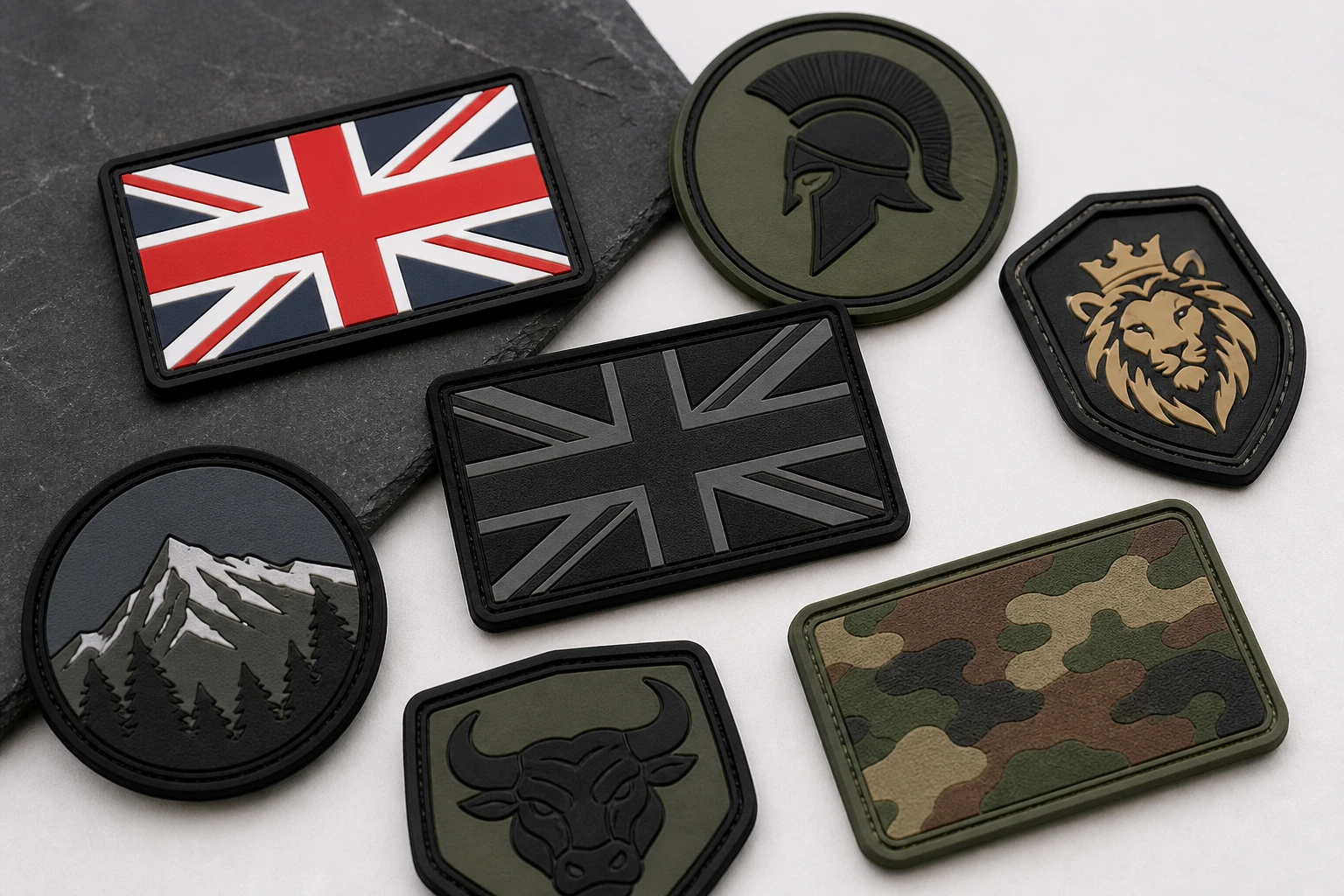
PVC patches are a good choice for outdoor kit, workwear, tactical clothing, bags and brands that need a wipe-clean, weather-resistant badge with raised detail. They are less suitable for traditional blazer crests or soft, textured designs. The Customized Patches makes PVC patches from five pieces per design and provides a free digital mockup, usually within 12 hours, before production.
Key takeaways
- PVC patches are practical for outdoor, tactical and workwear applications because the surface is wipe-clean and does not absorb water like thread.
- Choose PVC for bold shapes, raised lettering and simple logos; choose embroidered or woven patches for a softer, more traditional textile appearance.
- The Customized Patches has a 5-piece minimum per design, provides a free digital mockup usually within 12 hours, and starts production only after approval.
- Backing matters as much as the face: sew-on, iron-on and Velcro each suit different garments, washing routines and replacement needs.
PVC patches are right for a project if you need a hard-wearing, wipe-clean badge with clean outlines, bold colour and raised or recessed detail. They work especially well on outdoor jackets, tactical clothing, workwear, bags, caps and Velcro panels. For a traditional school blazer, wool coach jacket or soft club crest, embroidered or woven patches may look more natural.
The choice is not simply about which patch looks modern. Think about the garment, washing routine, contact with rain or mud, the amount of tiny detail in the artwork, and how the patch will be fitted. The Customized Patches serves customers across the United Kingdom with a 5-piece minimum per design, a free digital mockup usually within 12 hours, and production only after the artwork has been approved.
What are PVC patches made from?
PVC stands for polyvinyl chloride, a flexible synthetic material formed into a patch rather than stitched into fabric. Colour is built into the PVC layers, and the design can include raised borders, recessed areas, domed lettering or a flat printed detail. The result has more physical shape than a standard embroidered badge.
That construction gives PVC patches their familiar rubber-like feel. They are not made from embroidery thread, so they do not fray at the edge in the same way. They are also easy to wipe after a muddy training session or a wet weekend outdoors. They are not indestructible, though. Excessive heat, sharp abrasion, poor attachment and unsuitable washing can still damage the patch or the garment beneath it.
Raised and recessed detail
A raised border can make a simple badge easier to read at a glance. It works well for a club name, a short call sign, a company mark or a straightforward emblem. Recessed sections add contrast without relying on fine thread lines. This is useful on a dark jacket where a flat printed logo might look too quiet.
The limitation is small detail. Very fine lettering, narrow gaps and complicated illustrations may need simplifying so the moulded layers remain clear. A design that looks sharp on a phone screen can lose legibility at 2 inches wide. A production mockup is the sensible check before anyone commits to a run.
When are PVC patches the better choice?
Start with the job the patch has to do rather than the material you first noticed. A football club travelling between muddy pitches may value a wipe-clean badge on training bags. A trades business may want a logo on a waterproof shell. A cadet unit or outdoor group may prefer a Velcro-backed identifier that can be moved between layers.
- Outdoor jackets, softshells and rainwear where the badge may meet rain, mud or frequent cleaning.
- Tactical clothing and equipment with existing Velcro panels.
- Workwear, tool bags and delivery bags that need a clear business mark.
- Caps, rucksacks and accessories where a bold, compact badge reads better than a detailed textile design.
- Biker and motorcycle club garments where a strong edge and weather-resistant surface are useful.
- Limited-run brand merchandise where a small PVC badge adds a distinct physical feature.
They can also suit hospitality and event staff, but check the garment first. On a smooth nylon shell, PVC can look deliberate and professional. On a heavy wool coach jacket, the same badge may feel visually too hard unless the design is kept simple. For motorcycle clothing, compare the badge size with existing panels and seams rather than ordering the largest possible crest. Our guide to biker and motorcycle club patches covers those layout decisions in more detail.
Projects that may suit another material
PVC is not automatically the premium answer. If the brief calls for visible thread, a soft hand and a familiar club-house appearance, embroidered patches are often the stronger fit. An embroidered merrowed crest on a school blazer has a different character from a rubberised badge, and that difference is often the reason the customer is ordering patches in the first place.
For very small lettering or a detailed flat logo, woven patches may hold the design more neatly. For gradients, photographic artwork or a deliberately flat finish, printed patches are worth considering. Printed is flatter; that is the point. It can reproduce a shaded illustration without trying to force every colour and line into a raised mould.
PVC patches compared with embroidered, woven and printed options
The table below is a practical starting point, not a universal ranking. The right option depends on the artwork and garment. Typical enquiries cover all four types for football clubs, cadet units, hospitality polos, biker vests and business clothing, and the best answer has changed from project to project.
| Patch type | Main strengths | Main trade-off | Good UK uses | Typical appearance |
|---|---|---|---|---|
| PVC patches | Wipe-clean surface, weather resistance, raised detail and strong bold shapes | Less suited to fine detail, soft textile texture or traditional crests | Outdoor kit, tactical clothing, workwear, bags and Velcro panels | Rubber-like, dimensional and graphic |
| Embroidered patches | Visible thread texture, traditional appearance and strong fit for uniforms and clubs | Fine detail and gradients can be limited; thread can hold dirt or moisture | Football shirts, school blazers, wool jackets, club clothing and uniforms | Textured, stitched and familiar |
| Woven patches | Neat small lettering, fine lines and a flatter textile face | Less raised texture and a softer visual impact than embroidery | Labels, fashion pieces, workwear and compact logos | Flat, clean and fabric-like |
| Printed patches | Gradients, photographs, shading and detailed artwork | The face is flatter and may need more care against abrasion | Brand artwork, event merchandise, illustrations and detailed logos | Flat, coloured and image-led |
| Leather patches | Natural material appearance and a strong heritage feel | Not ideal for every wash routine or highly detailed multicolour artwork | Denim, caps, outdoor brands and premium casual clothing | Plain, tactile and understated |
There is no problem with mixing materials across a range. A clothing brand might use a PVC badge on a technical outer layer, a woven label on a cap and an embroidered crest on a sweatshirt. The identity stays consistent through colour and layout while each garment gets a suitable finish.
A quick decision test
- Choose PVC if wipe-clean maintenance and raised structure matter more than thread texture.
- Choose embroidered if the patch should look at home on a blazer, football shirt, wool jacket or traditional club garment.
- Choose woven if the design has small text and needs a tidy, flatter textile finish.
- Choose printed if the artwork depends on gradients, shading, a photograph or many small colour changes.
- Choose leather if the material itself is part of the brand look and the design can stay relatively simple.
If the answer is split, ask for two visual routes rather than guessing. The free mockup can show the same mark as PVC and embroidery, which makes the difference easier to judge against the actual garment.
Choose the shape, size and colour before the backing
A patch that works on a sample may not work at the chosen size. Measure the usable area between seams, pockets, zips and existing badges. A chest badge on a polo shirt has different limits from a large back patch on a biker vest. A 3-inch design may be readable on a bag but crowded on a sleeve.
Not sure whether thread, ink or moulded PVC will hold your logo best? Send the artwork and the garment details for a free digital mockup, usually within 12 hours, so you can compare the finish before production.
GET A FREE MOCKUPSimple shield, circle, rectangle and custom-cut shapes are generally straightforward. A complex outline can still be possible, but narrow points and tiny cut-outs need room to remain clean. Consider how the edge will sit on a curved cap or a flexible nylon shell. A neat silhouette is usually more useful than an overworked outline.
Colour matching and contrast
Send the closest available brand colours and say if an exact match matters. Screen colours vary, and the same shade can appear different beside black nylon, royal-blue cotton or fluorescent workwear. Strong contrast is often more valuable than adding extra colours.
PVC uses colour areas and layers, so artwork should be supplied clearly. Vector artwork is helpful, but a clean high-resolution PNG can also be a useful starting point. Avoid relying on hairline outlines or tiny reversed lettering. The production team may recommend a slightly heavier line so the finished badge remains readable.
Backing choices for real garments
Sew-on backing is the dependable choice for garments that will be washed regularly or exposed to pulling. It works well on football kit bags, wool coaches, heavier jackets and motorcycle vests, provided the sewing area is accessible. Sewing takes longer than pressing a badge on, but it gives the customer a more secure attachment.
Iron-on backing is convenient for suitable cotton or cotton-blend surfaces, but it is not a universal solution. Heat-sensitive nylon shells can mark or melt, and a poor press can leave a corner lifting. It is common to see iron-on patches peel after a dryer cycle because the garment, temperature and adhesive were not a good match. Follow the care and application instructions, and sew around the edge if the item will work hard.
Velcro backing is useful for uniforms, tactical kit and removable identifiers. Specify whether the patch needs hook or loop and check the panel size before production. A badge that is 3 inches wide cannot sit properly on a 2-inch panel, however good the artwork looks.
| Backing | Best suited to | Check before ordering |
|---|---|---|
| Sew-on | Frequent washing, heavy garments, wool coaches, biker vests and permanent placement | Access for stitching, edge clearance and whether the garment can be pierced |
| Iron-on | Suitable cotton or cotton-blend garments where fast application is useful | Fabric heat tolerance, press temperature, washing routine and dryer use |
| Velcro | Tactical kit, uniforms and patches that need to move between garments | Hook or loop requirement, panel dimensions and the strength of the existing panel |
Tell us the garment and intended use on the quote. “Jacket” is not enough information if the jacket is a thin nylon shell, a waxed cotton coat or a heavy wool coach. The correct backing is part of the specification, not an afterthought.
How PVC patches behave in rain, washing and daily use
The smooth PVC face is one of the main practical reasons customers choose it. Mud, light grease and surface marks can normally be wiped away more easily than from exposed thread. That makes PVC useful for outdoor groups, delivery teams and equipment that spends time in a van, on a pitch or beside a trail.
The patch is only one part of the system. If it is fitted to a weak fabric panel, the fabric can tear before the PVC fails. If it is ironed onto a water-resistant nylon shell, the adhesive may not bond correctly. If a Velcro patch is pulled off at an angle every day, the attachment can wear. Durability depends on the material, backing, application and care routine together.
Care points worth passing to the end user
- Check the garment label before washing or applying heat.
- Use the recommended press method for iron-on backing and allow the adhesive to cool before testing the bond.
- Avoid high heat and unnecessary tumble drying, particularly with iron-on patches.
- Do not use sharp tools to scrape dirt from the face.
- For sew-on patches, inspect the stitching after heavy use and repair a loose section early.
- For Velcro patches, keep the hook and loop surfaces free from lint so they continue to grip.
No patch material should be described as maintenance-free. A school blazer, hospitality polo and tactical rucksack all receive different treatment. Matching the badge to the use case will prevent most complaints before the order is placed.
Artwork and production details that affect the result
The artwork should show the actual intended wording, not a placeholder that will be changed after approval. Check spelling, punctuation, dates, unit numbers and colour order. If a football club crest has a very small founding date, decide whether it needs to remain or whether removing it will make the badge stronger at the selected size.
Some logos need a production adjustment. A narrow gap may be closed slightly, a tiny letter may be enlarged, or a border may be thickened. That is not a change to your identity; it is a way of making the design survive the manufacturing method. Our guide on how to design artwork for PVC patches explains the checks that matter before approval.
What to include in a quote request
- The artwork file and any brand colour references.
- The finished width and height in inches, or the available garment area.
- The number of pieces required, remembering that the minimum is 5 pieces per design.
- The garment or item the patches will be fitted to.
- The preferred backing: sew-on, iron-on or Velcro.
- The delivery location within the United Kingdom.
- Any required date, event date or stock deadline.
- Whether you need one design or several separate designs.
The 5-piece minimum applies to each design, not simply the total number of patches across a mixed order. Five football badges and five sponsor badges are two designs. State the quantities clearly so the quotation reflects the actual job.
Ordering PVC patches in the United Kingdom
The usual process starts with artwork, quantity, size, backing and garment information. We review the design, raise any practical questions and prepare a digital mockup. The Customized Patches normally sends that free mockup within 12 hours, although the exact timing can depend on the brief and how quickly missing information is supplied.
Name sew-on, iron-on or Velcro on the quote rather than leaving the backing open. We show the correct back on a free digital mockup, usually within 12 hours, and produce only after you approve the design.
GET A FREE MOCKUPProduction begins only after approval. This gives you a clear point to check the badge shape, wording, colour arrangement, size and backing before the run is made. If the mockup is not right, ask for a change. It is better to correct a small detail on screen than to discover it on a box of finished patches.
Lead time and delivery questions
Ask for the current production and delivery estimate when requesting a quote, especially if the patches are for a tournament, launch, exhibition or uniform rollout. Lead time can vary with quantity, design complexity, backing and the production schedule. UK-wide shipping should also be discussed if an order is going to a school, club, business address or rural location.
For a small business testing a new product, a 5-piece minimum can be useful because it limits the first run. For a national team order, it is more important to confirm the full size breakdown, separate designs and delivery arrangement. Keep the approved mockup with the purchase information so the receiving team knows what has been ordered.
If you are comparing suppliers, ask what is included in the quoted price. Check whether artwork preparation, the digital mockup, backing, individual packing, delivery and any changes after approval are covered. Our guide to how much PVC patches cost in the UK covers the factors that move a quote up or down without pretending there is one price for every design.
Name sew-on, iron-on or Velcro on the quote rather than leaving the backing open. We show the correct back on a free digital mockup so production matches the garment and the way the patch will be used.
Common mistakes that make a good patch disappointing
The most common mistake is choosing a material from a screen image without considering the garment. A dimensional PVC badge can look excellent on a technical jacket and out of place on a delicate school blazer. The second is making the badge too small for the text. A club name that is technically present but unreadable has not done its job.
- Ordering a single colour treatment for several garments without checking contrast against each fabric.
- Using an iron-on backing on nylon, coated or heat-sensitive material without testing suitability.
- Specifying Velcro without measuring the existing panel.
- Assuming all dark colours look the same under indoor and outdoor light.
- Approving a mockup without checking spelling, dates, numbers and orientation.
- Adding more detail to solve a design problem when removing detail would make the badge clearer.
- Forgetting that each separate design has its own 5-piece minimum.
- Leaving an event date until the last stage instead of asking for a lead-time estimate.
A useful production conversation is direct. Tell us what has failed before: a patch that peeled, a crest that was too small, a border that disappeared into a dark jacket or a badge that did not fit a Velcro panel. Those details help us quote the next version more accurately.
Final decision: are PVC patches right for your project?
Choose PVC patches when the project needs a wipe-clean face, bold dimensional detail, simple strong shapes and a badge that suits outdoor or hard-working equipment. They are a sensible fit for tactical garments, workwear, waterproof outerwear, bags, caps and removable Velcro identifiers.
Choose another material when the main requirement is thread texture, a soft traditional appearance, very fine woven lettering, photographic artwork or a natural leather finish. There is no prize for forcing every project into PVC. The best patch is the one that matches the garment, artwork, attachment method and daily use.
The Customized Patches can help compare the options before production. Send the artwork, size, quantity, garment and preferred backing. You will receive a free digital mockup usually within 12 hours, and production will start only after approval. For a wider look at the material, see PVC patches: everything UK buyers need to know.
Frequently asked questions
Are PVC patches suitable for rain and outdoor clothing?
PVC patches are generally suitable for rainwear, outdoor clothing, bags and tactical kit because the face is wipe-clean and does not absorb water like exposed thread. The backing and garment still matter. Check whether the jacket is heat-sensitive, whether the patch will be sewn or attached with Velcro, and how the item will be washed.
What is the minimum order for PVC patches?
The Customized Patches has a 5-piece minimum per design. If you order two different logos, each logo is treated as a separate design and must meet the minimum. Confirm the quantity for every design on the quote so the production details are clear.
Are PVC patches better than embroidered patches?
Neither is better for every project. PVC patches suit bold, wipe-clean and dimensional designs on outdoor kit, workwear and Velcro panels. Embroidered patches suit traditional crests, football clothing, school blazers, wool jackets and projects where visible thread texture is part of the look. Compare the garment and artwork before choosing.
Can PVC patches go on nylon jackets?
PVC patches can be used on some nylon jackets, but the backing and application method need checking first. Iron-on adhesive may not bond safely to every coated or heat-sensitive shell. Sew-on or Velcro can be more suitable, depending on the garment construction. Include a photo or garment description with the quote.
How quickly can I see a PVC patch design?
The Customized Patches provides a free digital mockup usually within 12 hours. The timing can depend on the artwork and whether all order details have been supplied. Production starts only after you approve the mockup, so check the size, wording, colours, shape and backing before approval.
Can PVC patches include small text and detailed logos?
PVC patches can include text and detail, but very small lettering, narrow gaps and fine outlines may need simplifying or enlarging. A design that looks clear on a screen may not read well at a small finished size. A production mockup will show whether the detail needs adjustment. For highly detailed or gradient artwork, compare printed patches before deciding.
Ready to produce custom patches for your UK team or brand?
GET A FREE MOCKUP