
A Step-by-Step Guide to Ordering PVC patches
To order PVC patches, send your artwork, state the finished size and quantity, choose the number of PVC layers and backing, then approve a digital mockup before production. The Customized Patches supplies UK customers with a five-piece minimum per design and usually sends a free digital mockup within 12 hours.
Key takeaways
- PVC patches use moulded raised or recessed PVC details, so artwork needs clear shapes, sensible lettering and enough contrast.
- The Customized Patches has a 5-piece minimum per design for UK orders.
- A free digital mockup is usually supplied within 12 hours, and production begins only after the customer approves it.
- Backing choice should match the garment: sew-on is a dependable permanent option, iron-on suits suitable fabrics, and Velcro works for removable panels.
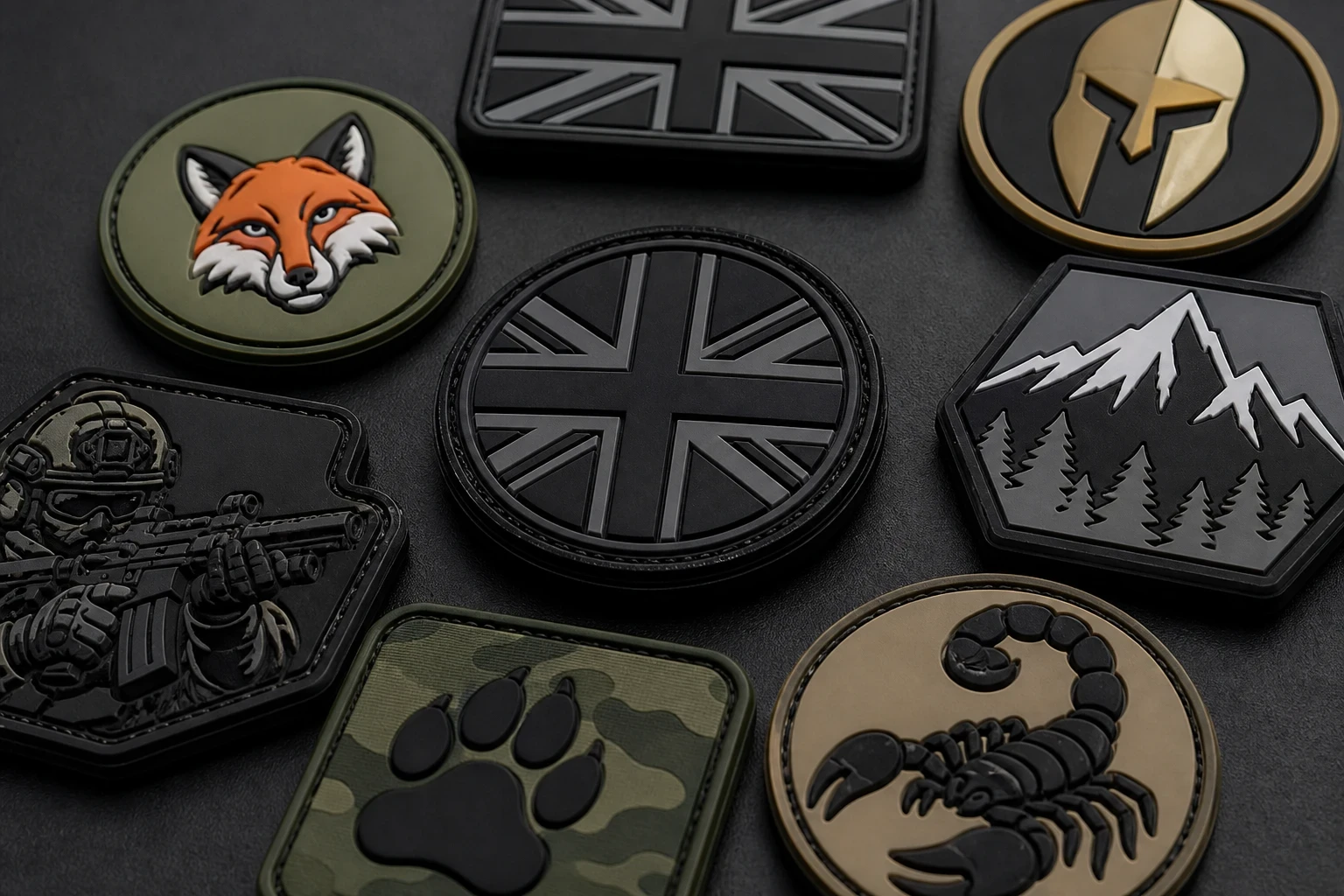
Ordering PVC patches is straightforward: send your artwork, confirm the finished size and quantity, choose the PVC colours and backing, then approve a digital mockup before production. PVC patches suit logos, unit identifiers and outdoor kit because the raised material gives the design a clear, tactile finish.
The Customized Patches supplies customers across the United Kingdom with a 5-piece minimum per design. A free digital mockup is usually sent within 12 hours, and nothing is produced until you approve the details. That approval stage is where size, lettering, colours and backing are checked before the order reaches production.
Step 1: Decide if PVC patches fit the job
PVC is a moulded rubber-like material with a smooth, wipe-clean surface. Designs can have raised lettering, recessed panels, a raised border or several levels of height. That makes PVC patches a sensible choice for football kit bags, outdoor brands, workwear, cadet equipment, motorcycle club garments and Velcro panels on tactical-style products.
They are not the right answer for every logo. A detailed illustration with tiny shading may need printed patches or woven patches, where fine lines and flatter artwork can be reproduced more clearly. A traditional club crest with visible thread texture may be better as embroidered patches. Printed is flatter; that is the point. PVC is chosen for its solid colour blocks, raised surface and easy cleaning.
- Choose PVC for bold logos, simple symbols, lettering, borders and designs that benefit from a three-dimensional surface.
- Consider printed or woven construction for photographs, gradients, very small text and fine illustrated detail.
- Consider embroidered construction for traditional school badges, formal club crests and garments where thread texture is part of the look.
- Choose PVC carefully for very soft or heat-sensitive garments, because the backing and application method still need to suit the fabric.
A nylon shell, a wool coaches jacket and a cotton polo do not behave in the same way. A patch that works well on a Velcro panel may be awkward on a narrow sleeve. Send a photograph of the garment or panel if you are unsure; it gives our team useful context before a specification is agreed.
Step 2: Prepare artwork that can be moulded
Start with the cleanest logo file available. An SVG, AI, EPS or PDF vector file is helpful because the shapes can be inspected without relying on a blurry screenshot. A high-resolution PNG can also work, especially for a straightforward badge, but the production team may need to redraw or simplify parts of it for moulding.
PVC does not reproduce every printed detail as a separate tonal mark. Each colour area needs a practical shape, and very narrow gaps can close when the material is formed. Fine lettering is a common problem. The words may look readable on a large computer screen but become weak at a two-inch finished size.
Artwork checks before quoting
- Keep the main logo or symbol large enough to read at the final patch size, not just at the artwork size.
- Use strong contrast between the background, border and raised detail.
- Check that thin outlines are not being used to separate every small element.
- Avoid relying on subtle gradients, soft shadows or photographic texture.
- Supply the correct wording and spelling, particularly for team names, unit numbers and dates.
- Mention if the design must match an existing brand colour or uniform specification.
- State if the patch needs a shaped outline rather than a simple round, square or rectangle.
Do not tidy the artwork after the quote without telling the maker. A small change to the border, colour count or lettering can affect the mockup and the final mould. If the source file contains a merrowed crest, embroidery guide or an old iron-on badge, send it as a reference but make clear which version is the approved design.
Step 3: Confirm size, quantity and shape
Measure the available area in inches and allow room for stitching or attachment. A 3-inch-wide patch may fit neatly on a jacket chest but look oversized on a polo sleeve. A 2-inch badge may suit a school blazer, while a larger back or shoulder emblem may need a different proportion.
Give the finished width and height if the design is rectangular or unusually shaped. For a round patch, state the diameter. If the artwork is not proportional to the space, say which measurement is fixed. The mockup should show the intended proportions rather than quietly stretching the logo to fill a template.
| Specification | What to provide | Why it matters |
|---|---|---|
| Finished size | Width, height or diameter in inches | Controls readability, garment fit and material use |
| Quantity | Number of pieces per design | The minimum is 5 pieces per design; different artwork counts as a separate design |
| Shape | Round, shield, rectangle, custom outline or other profile | Affects the mould, border and visual balance |
| Colours | Named colours, brand references or artwork colours | Helps keep the approved mockup aligned with the intended identity |
| Backing | Sew-on, iron-on, Velcro or another agreed option | Determines how the patch attaches to the garment or panel |
The 5-piece minimum applies per design. Five identical football club badges meet the minimum; three club badges and two sponsor logos are two designs, so they need to be quoted separately. If you are testing several colourways, list each version clearly rather than combining them under one quantity.
Step 4: Choose the PVC layers and finish
The next choice is how the design should be built. A one-level patch can work for a clean logo with a flat face and raised border. A two-level or multi-level patch can separate the background from the lettering or emblem. More height can make an emblem easier to feel and see, but it also adds specification detail and should be used for a reason.
Ask for the important features to be identified on the proof. Is the outer border raised? Is the lettering recessed or standing proud? Is the centre panel flat? These details matter on a unit badge or brand mark, particularly if the design relies on the contrast between two levels rather than colour alone.
Common PVC specification choices
- Base colour: the main body of the patch, often matched to the artwork or garment.
- Raised detail: useful for lettering, symbols and borders that need a tactile edge.
- Recessed detail: creates a lower panel or engraved-style appearance.
- Raised border: helps define the outside edge and gives the badge a finished frame.
- Custom outline: follows a mascot, shield or logo rather than using a standard shape.
- Matte or gloss appearance: selected to suit the design and the intended garment.
A simple design often looks stronger than a crowded one. If a hospitality polo carries a small company mark, a clean raised border and two solid colours may read better than a miniature version of the full website logo. For a biker vest, a larger back design can carry more lettering, but the text still needs to be checked at the actual finished size.
Not sure whether PVC, thread or ink will hold your logo at the required size? Send the artwork and garment details for a free digital mockup, usually within 12 hours, so you can compare the proposed finish before production.
GET A FREE MOCKUPStep 5: Select the correct backing
Backing is not a minor add-on. It determines how the patch is fitted and how easily it can be removed or replaced. The three options most UK customers ask about are sew-on, iron-on and Velcro.
| Backing | Best suited to | Advantages | Points to check |
|---|---|---|---|
| Sew-on | Workwear, school blazers, jackets, uniforms and long-term use | Dependable attachment and suitable for garments that can be stitched | Allow access for a needle and consider the garment lining |
| Iron-on | Suitable cotton garments and simple one-time applications | Quick to apply without sewing equipment | Heat, pressure and fabric compatibility matter; an iron-on patch can peel after a dryer cycle if applied or washed incorrectly |
| Velcro | Removable panels, outdoor kit, bags and tactical-style garments | Allows the patch to be changed or removed | The garment needs the matching hook or loop panel, and the panel must be positioned correctly |
Sew-on is usually the sensible choice for a wool coaches jacket or a school blazer that will be worn repeatedly. Iron-on may suit a cotton tote or a suitable polo, but it should not be treated as a universal solution for nylon shells, waterproof fabrics or heat-sensitive materials. Velcro works well on a removable team identifier, but it is of little use if the garment has no compatible panel.
If the patch is going onto a biker jacket or vest, check the thickness of the leather or denim and the access available for stitching. Customers ordering biker and motorcycle club patches often need a large back design alongside smaller chest or sleeve patches, so backing and application should be considered across the complete set.
PVC patches compared with other patch types
The right material depends on the job, not on which finish sounds most impressive. PVC gives a moulded, wipe-clean surface and clear colour blocks. Embroidery gives thread texture. Woven construction handles small detail in a flatter format, while printed construction is useful for continuous artwork and photographic effects.
| Patch type | Surface and detail | Good uses | Trade-off |
|---|---|---|---|
| PVC patches | Raised or recessed moulded surface with solid colour areas | Outdoor kit, Velcro panels, bold logos, workwear and club identifiers | Tiny text and subtle shading may need simplifying |
| Embroidered patches | Visible thread texture with a traditional badge appearance | School blazers, football clubs, uniforms, jackets and heritage designs | Fine detail can be limited, and large filled areas may become heavier |
| Woven patches | Flatter woven face with finer small lettering than standard embroidery | Brand marks, labels and detailed flat badges | Less raised texture and a different visual character from PVC |
| Printed patches | Flat printed artwork with broad colour and tonal flexibility | Photographic designs, gradients and illustration-led artwork | Flatter surface and less tactile definition |
For a detailed comparison, see PVC patches vs embroidered patches: Which Is Right for Your Project?. It is also worth comparing a PVC badge with 3D embroidered patches if you want raised detail but prefer thread to moulded material.
Step 6: Request and check the free digital mockup
The mockup is the point where an idea becomes a production instruction. The Customized Patches usually sends a free digital mockup within 12 hours. It should show the shape, approximate proportions, colour arrangement, raised or recessed areas and chosen backing clearly enough for you to check the order.
Look at the proof on a phone as well as a large screen. Check the spelling letter by letter. Confirm that the border is present, that the logo has not been stretched and that the backing matches the garment. If the patch is for a football club, compare the crest against the approved club artwork. If it is for a business, check the logo version and brand colours.
Mockup approval checklist
- Confirm the design name or reference so the correct artwork is being checked.
- Check the finished width, height or diameter in inches.
- Read every word, number and date.
- Check the patch outline, border thickness and corners.
- Compare the proposed colours with the artwork or brand reference.
- Confirm which details are raised, recessed or flat.
- Confirm the backing: sew-on, iron-on or Velcro.
- Check the quantity and delivery details.
- Reply with approval or a clear list of amendments.
Do not approve a mockup with a note such as “looks fine” if one point still needs changing. List the exact amendment, such as “change the outer border to black”, “make the date 1998” or “use Velcro backing”. Production begins only after approval, so a clear reply reduces the risk of a preventable correction later.
Step 7: Place the order and plan the lead time
Once the mockup is approved, the order can move into production. Send the final quantity per design, delivery address, contact details and any date the patches are needed for. A UK-wide order may be for a small club, a national brand or a business with several delivery locations; give the full address information at quote stage.
Lead time depends on the design, quantity, backing, mould requirements and current production schedule. A simple five-piece order is not automatically the same as a larger multi-design order. If the patches are needed for a tournament, school term, product launch or trade event, mention the date before approving the quote so the available delivery window can be assessed.
Price is affected by size, quantity, number of designs, colours, layers, backing and shipping. The five-piece minimum makes small runs possible, but it does not mean every specification costs the same. For more detail on UK pricing factors, read How Much Do PVC patches Cost in the UK?.
Avoid common ordering mistakes
Most avoidable problems happen before production: an unconfirmed size, an unreadable line of text, a backing chosen without checking the garment, or a colour that has only been described as “blue”. A proper proof catches many of these points, but the customer still needs to check it carefully.
- Ordering from a screenshot without supplying the correct wording or clean artwork.
- Assuming a small patch will reproduce every detail from a large logo.
- Using iron-on backing on a nylon shell or another unsuitable material.
- Forgetting that each different colourway or logo is a separate design.
- Approving the shape but not checking the backing shown on the proof.
- Leaving a required delivery date until after production has started.
- Expecting a PVC patch to look like embroidery or printed artwork.
- Changing the artwork after approval without requesting a revised mockup.
Name sew-on, iron-on or Velcro on the quote and include the garment or panel details. We show the correct back on a free digital mockup, usually within 12 hours, and produce only after you approve it.
GET A FREE MOCKUPThe guide Common Mistakes to Avoid When Ordering PVC patches covers these checks in more detail. The short version is simple: measure the garment, simplify where necessary, name the backing and read the mockup before giving approval.
Examples from real UK garment orders
A football club may need a raised crest for kit bags and a separate sponsor mark for training tops. The crest can work well as PVC if the shield and lettering are bold, but a detailed anniversary ribbon may need to be enlarged or simplified. The two designs should be quoted separately because they are not the same artwork.
A cadet unit or outdoor group may choose Velcro so identifiers can be removed from kit before washing or reassigned to another user. In that case, the panel dimensions and hook-and-loop orientation matter as much as the badge itself. A patch intended for a fixed jacket can instead use sew-on backing.
A hospitality business ordering badges for polos may prefer a small, flat-looking PVC face with a raised border. If the logo includes a fine slogan, our team may suggest removing it, increasing the patch size or moving that wording to a separate printed or woven badge. The best result is not always the most detailed version of the original artwork.
A biker club may order a large back patch with strong lettering and smaller front identifiers. Leather and heavy denim need a realistic application plan, particularly if the patch is large or the garment has a lining. A traditional merrowed embroidered crest may be preferred for the main back design, with PVC reserved for smaller removable identifiers.
What to include in your quote request
A complete first message saves time. It does not need to be technical or formal. The useful information is the artwork, quantity, finished size, garment type, backing preference, delivery postcode and deadline.
- Attach the logo or badge in the best available format.
- State the number of pieces required for each design.
- Give the finished size in inches, or provide the available garment space.
- Describe the garment: nylon shell, cotton polo, wool coat, leather vest, school blazer, bag or Velcro panel.
- Choose sew-on, iron-on or Velcro if you already know the application.
- List the preferred PVC colours or attach a brand reference.
- Mention any raised, recessed, border or custom-shape requirements.
- Provide the UK delivery postcode and required date.
- Ask for the free digital mockup and wait for approval before production.
If you are still comparing materials, the PVC patches: Everything UK Buyers Need to Know guide covers construction, uses and backing in more depth. Customers looking for a softer textile finish can also compare chenille patches or leather patches before settling on a material.
Final check before approving PVC patches
A good order is specific without being complicated. The production team needs to know what the patch should look like, how large it should be, how many are required and how it will attach to the garment. The mockup then gives both sides a shared reference.
Before you approve, check the artwork, words, size, colours, layers, border, shape, backing, quantity and delivery details. The Customized Patches has a 5-piece minimum per design, offers a free digital mockup usually within 12 hours and produces only after approval. Those three facts should be part of your ordering plan from the start.
For location-specific delivery questions, see the UK city pages. For a broader comparison of outdoor use and design decisions, the guide to PVC patches Best Practices for outdoor and tactical brands is a useful next read.
Frequently asked questions
What is the minimum order for PVC patches?
The Customized Patches has a 5-piece minimum per design. If you order two different logos or colourways, they are normally treated as two designs, even if the total number of patches is more than five.
How quickly can I receive a PVC patch mockup?
A free digital mockup is usually sent within 12 hours. Timing can depend on the artwork and the information supplied, so include the correct logo, size, quantity and backing request. Production starts only after you approve the mockup.
Can PVC patches go on nylon jackets?
They can, but the backing and application method must suit the nylon shell. Sew-on or Velcro may be more suitable than iron-on for some nylon garments. Send a garment photograph or fabric detail so the backing can be assessed before production.
Are PVC patches better than embroidered patches?
Neither is automatically better. PVC suits raised, wipe-clean designs with solid colour areas, while embroidered patches provide thread texture and a traditional badge appearance. Fine gradients and photographic artwork may be better suited to printed patches. The PVC patches vs embroidered patches: Which Is Right for Your Project? guide compares the main trade-offs.
Can I order PVC patches with Velcro backing?
Yes, Velcro backing can suit removable identifiers, outdoor kit, bags and garments with compatible hook-and-loop panels. Confirm the panel size and position before ordering. A Velcro-backed patch may not be suitable for a garment that has no matching panel.
How much do PVC patches cost in the UK?
Cost depends on finished size, quantity, number of designs, colours, raised or recessed levels, backing and delivery. The 5-piece minimum allows small runs, but a larger multi-design order has different production requirements. Request a quote with the artwork and specifications for an accurate price.
Ready to produce custom patches for your UK team or brand?
GET A FREE MOCKUP