
PVC patches Checklist: What to Confirm Before You Order
Before ordering PVC patches, confirm the finished size, raised or recessed detail, colours, artwork, border, backing, quantity, garment, application method and delivery date. The Customized Patches provides a free digital mockup usually within 12 hours, produces only after approval, and accepts a 5-piece minimum per design.
Key takeaways
- Confirm the finished patch size, not just the size of the artwork file.
- PVC suits bold shapes, raised details and hard-wearing garments, but very fine text may need simplifying.
- The Customized Patches has a 5-piece minimum per design and normally sends a free digital mockup within 12 hours.
- Production starts only after you approve the mockup, so check the spelling, colours, backing and dimensions carefully.
PVC patches are easiest to order when you confirm the practical details before asking for production: finished size, artwork, colours, relief, backing, quantity and garment. For most UK orders, the safest route is to send the logo and the item it will go on, review a digital mockup, then approve the exact version.
The Customized Patches offers a free digital mockup usually within 12 hours. There is a 5-piece minimum per design, and we produce only after approval, so you have a clear chance to correct spelling, sizing or backing before the order moves forward.
Start with the garment and the job the patch must do
A patch for a tactical rucksack has a different brief from one for a hospitality polo. The rucksack may have a loop panel and need a removable hook-and-loop backing. The polo may need a sew-on patch because the fabric is thin, stretchy or regularly washed. Tell us the garment, panel or accessory at the quotation stage rather than choosing a backing in isolation.
Think about movement, washing, rain, abrasion and how often the item will be handled. PVC is a flexible, wipe-clean material with a smooth or textured rubber-like finish. It works well on outdoor kit, workwear, football bags, motorcycle gear, caps and Velcro panels. It is not the natural choice for every wool coat or formal blazer, where a flatter textile patch may sit more comfortably.
- Football clubs: check the kit bag, tracksuit, jacket or coach's coat before selecting the backing.
- Cadet units: check whether the patch must be removed from a loop panel or sewn permanently to uniform.
- Hospitality businesses: test the placement on the actual polo or overshirt, especially if the fabric is piqué knit.
- Biker and motorcycle clubs: confirm whether the patch is for a leather vest, textile jacket, pannier or removable panel.
- Schools: check the blazer cloth and washing instructions before choosing iron-on or adhesive backing.
If you are comparing materials, PVC patches are usually chosen for their defined edges and weather-friendly surface. Embroidered patches bring thread texture and a traditional crest appearance. Neither is automatically better; the right choice depends on the garment, artwork and handling.
Confirm the finished size in inches
Do not judge size from a logo viewed on a laptop. A design that looks clear at 400 percent may be difficult to read at 3 inches wide. Measure the space on the garment and write down the maximum width and height. If the shape is tall or irregular, give both dimensions rather than only saying “small” or “standard”.
For a chest badge, sleeve mark or cap front, the available area can be surprisingly limited. A 3-inch-wide patch may work on a jacket sleeve but feel too large on a cap. A wide club back patch may need a curved shape or separate top and bottom rockers. We can show the proposed dimensions on the digital mockup so the scale is easier to judge.
Size affects detail and price
Larger patches use more material and may need extra handling, while tiny patches place more pressure on the artwork. Fine lettering, narrow gaps and complicated outlines can lose clarity if reduced too far. Ask for a simplification rather than squeezing every part of a full logo into a very small badge.
A useful check is to print the design at its intended size on ordinary paper and hold it against the garment. This will not reproduce the final PVC finish, but it will expose cramped text, an oversized border or a badge that dominates the chest.
Check the PVC construction, colours and surface detail
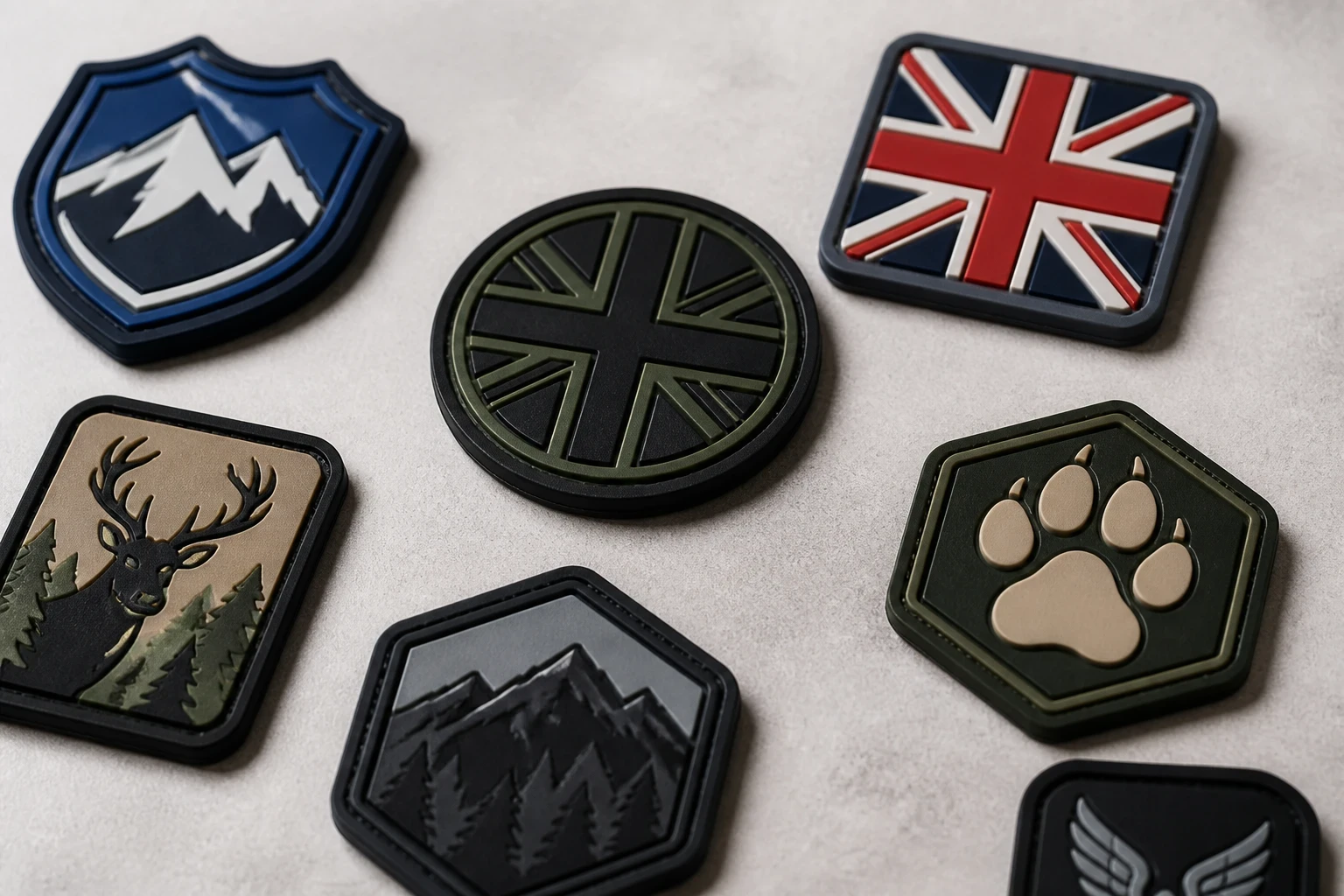
PVC patches can be made with flat areas, raised lines, recessed sections or a combination. Raised detail gives a logo more physical definition. Recessed areas can separate fields of colour and help a badge feel layered. Flat printed or moulded areas keep the design simpler. The choice should support the artwork, not be added simply because it sounds impressive.
Confirm every colour and identify the most important contrast. A dark navy background with black lettering may look acceptable on a bright screen but become difficult to read in ordinary light. White, fluorescent and very light colours can also appear different beside a dark PVC base than they do in a digital file.
| Specification | What to confirm | Why it matters |
|---|---|---|
| Overall shape | Round, shield, rectangle, custom outline or separate components | The shape affects the border, corners, placement and how the patch sits on the garment. |
| Finished size | Width and height in inches | The patch must fit the available area and leave enough room for readable detail. |
| PVC relief | Flat, raised, recessed or mixed detail | Relief changes the appearance, thickness and way the logo is read by touch and sight. |
| Colour count | Base colour, raised elements, lettering and border colours | Clear colour instructions reduce avoidable changes during proofing. |
| Border | Moulded edge, contrasting border or integrated outline | A border protects the edge visually and defines the finished silhouette. |
| Backing | Sew-on, iron-on, adhesive or Velcro | The backing determines how the patch attaches and whether it can be removed. |
If your artwork depends on tiny gradients, photographic shading or very fine lines, compare alternatives before deciding. Printed patches are flatter; that is the point, and they can reproduce detailed artwork in a different way. Woven patches are also worth considering for small lettering and a flatter woven finish. For a traditional raised thread effect, see 3D embroidered patches.
Ask what can be simplified without changing the identity
A production-ready patch is not always an exact miniature of a brand file. Small text may need to be enlarged, close lines may need more space, and a narrow cut-out may need to become a solid section. The aim is to keep the recognisable features while making the patch clear at its real size.
This is where the mockup earns its place. It gives you something concrete to inspect rather than asking you to imagine how a vector file will look as a moulded patch. Read every word. Check the border. Look at the badge beside the garment colour, not only against a white screen.
Not sure whether PVC, thread or ink will hold your logo clearly? Send the artwork and intended garment for a free digital mockup usually within 12 hours, then compare the practical options before production.
GET A FREE MOCKUPChoose the backing for the actual use
Backing is one of the details most likely to be overlooked on an otherwise correct order. Sew-on backing is a dependable choice for permanent placement on jackets, bags and heavier garments. It is often sensible for leather vests, thick nylon shells and items that will be washed or pulled about regularly.
Iron-on backing is convenient for suitable fabrics and a clean, permanent-looking finish, but it still depends on the garment, heat, pressure and aftercare. It is not a universal substitute for sewing. An iron-on patch that looks secure on day one can peel after a dryer cycle if the fabric or application conditions are wrong.
- Sew-on: suitable for permanent attachment and heavier garments, including many jackets, bags and leather items.
- Iron-on: useful where the fabric and heat application are suitable; follow the supplied instructions and consider reinforcing the edge with stitching.
- Velcro: suitable for removable patches on loop panels, tactical kit, rucksacks and some club or event equipment.
- Adhesive: useful for temporary display or certain smooth surfaces, but it should not be treated as the strongest answer for rough, flexible or frequently washed garments.
Tell us if the patch will be applied to a nylon shell, wool coaches jacket, cotton twill, leather vest, school blazer or a Velcro panel. The same PVC face may need a different backing depending on that information. If you need a permanent motorcycle club patch, you can also review our guide to biker and motorcycle club patches.
Prepare artwork that can be checked and approved
Send the cleanest version of the artwork available. A vector file is helpful, but a clear high-resolution PNG or PDF can also give the production team a useful starting point. Include the correct spelling, the current logo and any brand colour references. Do not send several slightly different files without explaining which one is final.
Check names, dates, initials and club mottos character by character. A typo on a team crest or a missing year on a commemorative badge is not a cosmetic issue; it means the approved design is wrong. We produce only after approval, so the proofing stage is your opportunity to catch it.
Artwork checks for small PVC lettering
- Read the smallest line at the finished size, not only at full screen size.
- Check that letters do not touch the border or one another.
- Avoid hairline strokes that could disappear into a background colour.
- Separate similar dark colours if the logo depends on contrast.
- Confirm whether the outer edge is part of the artwork or should be a separate border.
- Tell the production team which elements must remain raised and which can stay flat.
- Remove hidden layers, old versions and unused text from the final file.
For a deeper artwork check, read How to Design Artwork for PVC patches That Production-Ready. It is particularly useful for brands adapting a digital logo that was originally designed for websites, packaging or embroidery rather than moulded PVC.
Confirm quantity, mixed designs and the 5-piece minimum
The minimum order is 5 pieces per design. That means five identical patches meet the minimum, while two different designs with three of each do not normally count as one five-piece order. Tell us the quantity for every design, including any colour or wording variations.
Quantity affects the quotation and helps us understand whether the patches are for a small trial, a team order, a retail run or a wider rollout. A football club may need 18 identical staff badges but 60 player names as separate designs. A brand may want five samples before committing to a larger release. Spell out the split so the quote reflects the actual job.
| Order detail | Example | What to tell us |
|---|---|---|
| One design | 25 identical round badges | Confirm 25 pieces, the finished diameter and the garment or accessory. |
| Several designs | 5 club crests, 10 sponsor badges and 20 event patches | List each design and its quantity; do not combine unlike designs into one total. |
| Colour variation | Same shape with three different team colours | State whether each colour is a separate design and provide the quantities. |
| Sample plus production | 5 approved samples followed by 100 patches | Ask how the sample and main run will be quoted and approved. |
Allow time for the mockup, approval and UK delivery
A sensible order plan has three separate points: artwork review, production and delivery. The free digital mockup is usually sent within 12 hours, but complicated artwork or a busy period can require clarification first. Build in time for your team, committee or client to review it rather than setting the arrival date immediately after the first enquiry.
Once you approve the mockup, the order can move into production. We produce only after approval. Keep the approved image and the written specification, particularly if the patch is part of a uniform order or a branded launch where several people need to sign off the details.
- Send the artwork, quantity, size, backing preference, garment and delivery postcode.
- Review the quotation and ask questions about any unclear specification.
- Receive the free digital mockup, usually within 12 hours.
- Check wording, dimensions, colours, border, relief and backing.
- Request changes if anything is not correct.
- Approve the final mockup in writing.
- Allow the quoted production and UK delivery time before your event, match day, launch or uniform handover.
Do not plan around a generic delivery promise copied from another product. Lead time can depend on design complexity, quantity, backing, approval speed and the delivery destination in the United Kingdom. If the patches are needed for a tournament, trade show, school term or product launch, give that date at the start.
Have a deadline or a garment that needs a particular backing? Include it with the quote request. We can show the correct PVC back on a free digital mockup usually within 12 hours, with production starting only after you approve it.
GET A FREE MOCKUPCompare PVC with other patch materials before committing
PVC is a good fit for strong graphic shapes, tactile raised detail, outdoor use and easy cleaning. It is less suitable if your priority is a soft textile surface, fine thread shading or a traditional merrowed crest. Choosing the material after looking at the artwork and garment usually prevents disappointment.
| Patch type | Strengths | Points to check | Common UK uses |
|---|---|---|---|
| PVC | Defined edges, raised or recessed detail, wipe-clean surface and good visual contrast | Fine lettering, thickness, backing and how the face will sit on soft fabric | Outdoor brands, tactical kit, rucksacks, sports bags and motorcycle gear |
| Embroidered | Thread texture, familiar crest appearance and a traditional textile feel | Small text, thread coverage, garment weight and whether the edge should be merrowed | Football clubs, school blazers, jackets, uniforms and association badges |
| Woven | Flatter surface and clearer small woven lettering than many dense embroidered designs | Less raised texture and the visual effect of a woven rather than moulded badge | Brand labels, apparel, small logos and detailed flat designs |
| Printed | Flat artwork with room for tonal detail, gradients and more illustrative imagery | Surface finish, wash expectations and whether a flat patch suits the garment | Promotional runs, artwork-led brands and photographic or highly detailed designs |
| Chenille | Deep pile, soft texture and a bold varsity appearance | Bulk, handling, fine detail and whether the garment can support the heavier texture | University sports, varsity jackets, school teams and heritage-style clubs |
For a fuller side-by-side discussion, read The Difference Between PVC patches and embroidered patches, Explained. A material comparison is more useful than choosing solely on price because replacement, reapplication and unreadable detail can cost more time than the original saving.
Final PVC patches checklist before you approve
Use this final list in the order email or internal approval sheet. It is deliberately straightforward. If a team captain, designer, procurement contact and garment supplier are all involved, one shared checklist reduces the chance that a change is made verbally and missed by the person approving the artwork.
- The design name or reference is correct.
- The spelling, dates, initials and numbers have been checked.
- The finished width and height are stated in inches.
- The patch shape and outer border are correct.
- The PVC base colour and all detail colours are correct.
- Raised, recessed and flat elements are shown as intended.
- Small lettering remains readable at the finished size.
- The garment, accessory or Velcro panel has been identified.
- The backing is correct for the fabric and intended use.
- The quantity is listed for each design.
- Every design meets the 5-piece minimum.
- The delivery address is in the correct United Kingdom location.
- The required arrival date has been provided.
- The digital mockup has been reviewed by the person responsible.
- Approval has been given only after all changes are complete.
If you are ordering PVC for the first time, our 10 Questions to Ask Before Ordering PVC patches covers the questions that often appear after the first quote. You can also browse the UK city pages if you want to see how we handle enquiries and UK-wide shipping for different areas.
How The Customized Patches handles a checked order
We start with the details that affect the result: artwork, dimensions, quantity, backing, garment and deadline. If something is unclear, it is better to ask before preparing the mockup than to make an assumption about a sleeve, a leather vest or a removable Velcro panel.
The free digital mockup normally arrives within 12 hours. You can check the design against the brief, request reasonable amendments and approve the final version. The 5-piece minimum per design keeps small orders possible for clubs, start-ups, teams and test runs, while larger orders can be quoted from the same approved specification.
Once the mockup is approved, production begins. That approval point matters: it means the final spelling, size, colour arrangement and backing have been reviewed rather than assumed. If you are ready to prepare a quote, use the free mockup quote and include the artwork, quantity, garment and required date.
Frequently asked questions
What should I confirm before ordering PVC patches?
Confirm the finished size in inches, patch shape, artwork, colours, raised or recessed detail, border, backing, garment, quantity and required delivery date. Also check small lettering at the actual size. The Customized Patches sends a free digital mockup usually within 12 hours, and production begins only after approval.
What is the minimum order for PVC patches?
The minimum order is 5 pieces per design. If you have several different designs, list the quantity for each one because unlike designs are not normally combined to meet the minimum. For example, five identical club badges meet the minimum, but two badges in three unrelated designs do not.
Can PVC patches go on nylon shells and Velcro panels?
Yes, PVC patches are commonly used on nylon shells, outdoor equipment, rucksacks and Velcro panels, but the backing must match the application. Choose sew-on for permanent attachment, or Velcro where the patch needs to be removed. Tell us the garment or panel so the mockup and quote show the appropriate back.
Are PVC patches better than embroidered patches?
Neither is always better. PVC is useful for raised detail, defined outlines, outdoor kit and wipe-clean surfaces. Embroidery gives a traditional thread-based crest with visible texture. Fine artwork may suit woven or printed construction instead. Compare the PVC patches vs embroidered patches guide before choosing.
How quickly can I receive a PVC patch mockup in the UK?
The Customized Patches usually provides a free digital mockup within 12 hours. This is a mockup review stage, not the full production and delivery time. Your order is produced only after approval, and the total lead time depends on the design, quantity, backing and UK delivery requirements.
Can I change the PVC patch design after seeing the mockup?
Yes, the mockup is there to check the design before production. Review the spelling, size, colours, border, relief detail and backing, then request any changes before approval. Production starts only after you approve the final mockup, so do not approve while a correction is still needed.
Ready to produce custom patches for your UK team or brand?
GET A FREE MOCKUP