
The Difference Between PVC patches and embroidered patches, Explained
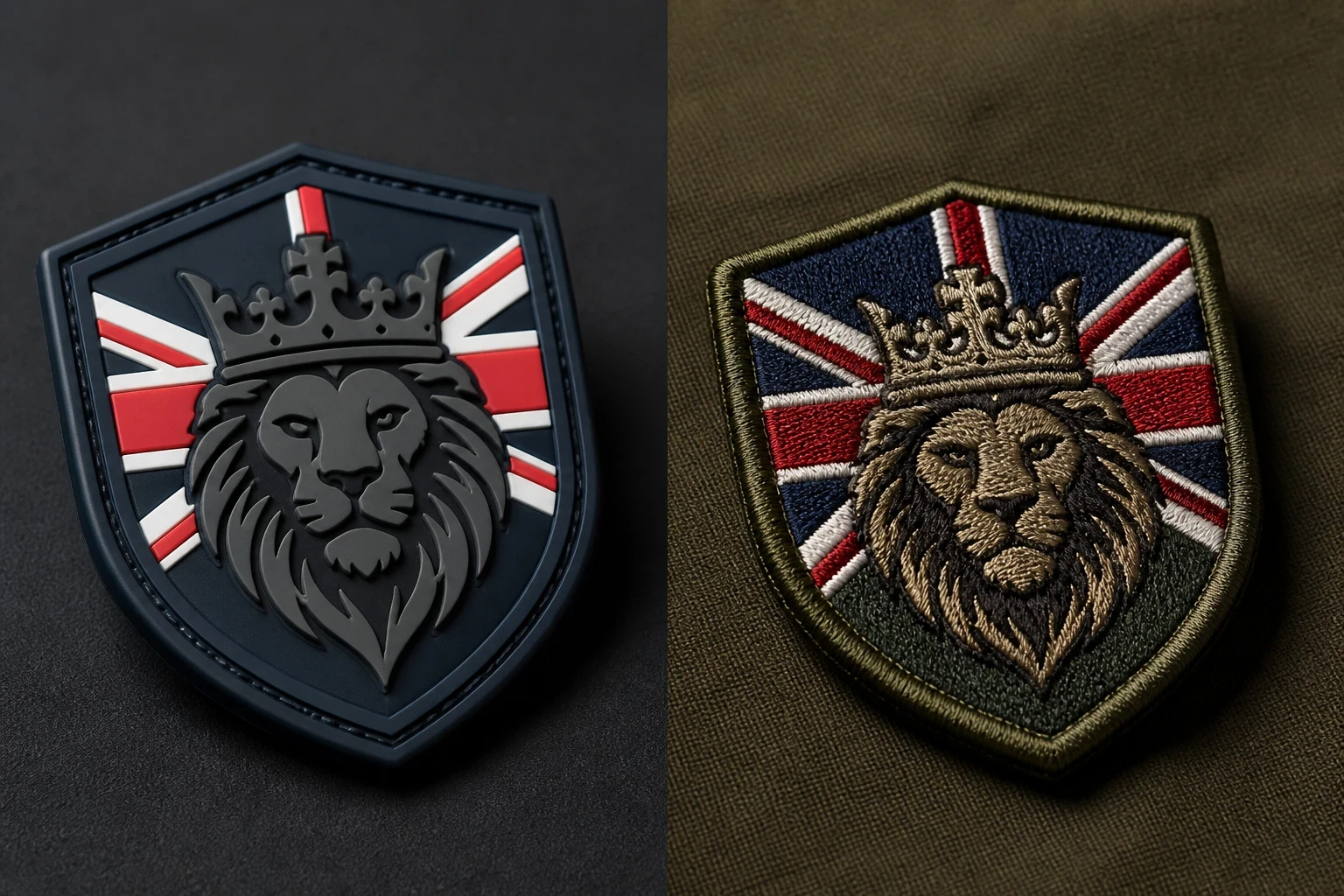
PVC patches are moulded from flexible rubber-like PVC, giving a smooth, raised and weather-resistant finish. Embroidered patches use stitched thread over fabric, creating a traditional textured appearance. PVC suits outdoor kit, Velcro panels and bold simplified artwork; embroidery suits uniforms, clubs, school blazers and garments needing a classic textile crest.
Key takeaways
- PVC patches are smooth, raised and easier to wipe clean, making them useful for outdoor clothing, bags, helmets, cases and Velcro panels.
- Embroidered patches have visible thread texture and a familiar textile appearance that works well on football kits, school blazers, workwear, wool coaches and club garments.
- PVC handles bold shapes and clear lettering well, but very small text and fine illustrated detail may need simplifying before production.
- The Customized Patches has a 5-piece minimum per design, provides a free digital mockup usually within 12 hours, and produces only after approval.
PVC patches are moulded, smooth and slightly raised, while embroidered patches are made from stitched thread on a fabric base. PVC is usually the better fit for outdoor kit, equipment and Velcro panels; embroidery is often the better fit for uniforms, school blazers, football clubs and traditional club crests.
Neither material is automatically better. The right choice depends on the garment, the amount of detail in the artwork, the finish you want people to see, and how the patch will be washed or used. A nylon shell and a wool coaches jacket ask for different answers.
What are the main differences between PVC patches and embroidered patches?
PVC patches are made by filling moulded channels with coloured PVC. The result is a flexible rubber-like badge with a clean surface, raised borders and, if specified, different height levels. The surface can be wiped down, and the edges are normally formed as part of the mould rather than finished with a stitched merrowed border.
Embroidered patches are built from thread stitched into a twill or similar fabric base. The thread gives the patch its recognisable texture and catches the light differently across each direction of stitching. A merrowed crest has a rolled stitched edge, while a laser-cut embroidered patch can follow a more detailed outline without that traditional border.
| Specification | PVC patches | Embroidered patches |
|---|---|---|
| Surface | Smooth, flexible and moulded, with optional raised sections | Textured thread over a fabric base |
| Typical appearance | Modern, graphic and practical | Traditional, tactile and textile |
| Best artwork | Bold shapes, simple lettering and strong colour blocks | Crests, badges, names, stripes and thread-based artwork |
| Fine detail | Good for clear relief and separated shapes; tiny details may merge | Fine detail depends on stitch width, density and minimum lettering size |
| Water and dirt | Easy to wipe clean and suited to damp outdoor use | Can tolerate normal garment use, but thread and fabric can hold dirt or moisture |
| Common garments | Nylon shells, tactical bags, outdoor jackets, caps and equipment | Football shirts, school blazers, polos, work jackets, wool coaches and club clothing |
| Backings | Sew-on, iron-on or hook-and-loop Velcro options | Sew-on, iron-on, adhesive for selected uses, or hook-and-loop Velcro |
| Feel | Flexible, slightly rubbery and often raised | Fabric-like, stitched and slightly thicker over the design |
The visual difference is easy to spot when the two patches sit side by side. PVC has a consistent manufactured surface, rather like a small flexible badge. Embroidery shows individual thread coverage and a softer change in height. That difference matters on a blazer or hospitality polo, where a stitched crest can look part of the garment rather than attached to it.
Choose PVC patches for outdoor kit, equipment and Velcro panels
PVC is a sensible choice for kit that is handled, exposed or wiped down regularly. We quote PVC patches for outdoor brands, cadet units, security equipment, cycling bags, dog-training gear and motorcycle luggage. A smooth surface does not catch on fabric in the same way as raised embroidery can, and a bold moulded border stays visually clear on a dark nylon shell.
They also suit removable identification systems. A hook-and-loop backing allows a unit, team or business to move the badge between a plate carrier, rucksack, jacket or storage case. The backing still needs to be specified correctly: a Velcro panel is not the same as an iron-on patch, and a patch cannot grip properly if the loop section is missing from the garment.
Where PVC works particularly well
- Outdoor and tactical brands that need a badge for jackets, packs, pouches or cases.
- Cadet units and activity groups using removable hook-and-loop name or unit identifiers.
- Motorcycle clubs placing a compact emblem on riding gear, luggage or accessories.
- Businesses using a clean raised logo on work bags, caps or hard-wearing outerwear.
- Sports and leisure brands whose artwork uses a few strong colours and a clear symbol.
PVC is not a magic solution for every outdoor garment. A patch on a rain shell can still fail if it has the wrong backing, poor stitching or an unsuitable application method. For permanent use on a frequently flexed garment, we normally discuss sewn edges as well as the PVC material itself.
Choose embroidered patches for uniforms, clubs and traditional crests
Embroidery remains the natural choice for many garments because people already understand what a stitched badge looks like. A football club crest on a training top, a school emblem on a blazer, or a hospitality logo on a polo usually benefits from visible thread. The finish feels familiar and sits comfortably alongside woven labels, shirt embroidery and other textile branding.
It is common to see this regularly with school blazers and club kit. A wool coaches jacket often looks right with an embroidered crest because the fibres and thread belong together visually. The same artwork placed on PVC may look too industrial for the garment, even if the PVC version is perfectly well made.
Where embroidery is the stronger fit
- School blazers, prefect badges and sixth-form clothing.
- Football, rugby, cricket and grassroots sports club kit.
- Hospitality polos, staff jackets and branded workwear.
- Biker and motorcycle club back panels where a textile patch is part of the established look.
- Traditional associations, uniformed groups and businesses wanting a stitched crest.
The full range of embroidered patches includes different shapes, borders, thread colours and backing choices. If you want more height without moving to PVC, 3D embroidered patches can add raised thread to selected parts of a logo. That can work for a cap or branded jacket, provided the artwork has enough space for the raised area.
There are also cases where embroidery is not the best textile answer. Very fine gradients, photographic artwork and tiny continuous lettering may reproduce more clearly as printed patches. Printed is flatter; that is the point. It can preserve a detailed image that would become a crowded field of thread.
Artwork and detail: what each patch type can reproduce
The artwork decision should happen before a price is treated as final. PVC patches are built from separate moulded areas, so the artwork needs clean shapes, defined borders and enough separation between colours. A small line that looks clear on a monitor may disappear when reduced to a 2-inch badge.
Raised PVC can make a logo look dimensional, but extra height does not create extra resolution. It will not turn a detailed landscape, fine map or long paragraph into a readable patch. For most PVC logos, we recommend short wording, uncomplicated icons and strong contrast between the base and raised details.
Lettering, gradients and small features
Thread has its own limits. Very small lettering may lose counters in letters such as A, R and e, while dense stitching can make a fine line look heavier than expected. PVC has similar size limits, though the issue appears as merged channels or filled gaps rather than individual stitches.
If your logo contains a gradient, photograph or many tiny tonal changes, consider woven patches or printed patches before choosing embroidery or PVC. Woven construction uses finer threads than standard embroidery, while printing keeps the artwork flatter and can carry more continuous colour. The best result is not always the most raised result.
Not sure whether moulded PVC or stitched thread will hold your logo more clearly? Send the artwork and garment details for a free digital mockup usually within 12 hours, then compare both options before production.
GET A FREE MOCKUP| Artwork feature | PVC response | Embroidered response |
|---|---|---|
| Bold logo mark | Usually very clear, especially with raised borders | Usually clear with a suitable stitch direction and border |
| Small text | Needs enough channel width and letter spacing | Needs enough stitch width and open counters |
| Gradient | Usually simplified into separate colours | Usually simplified into thread colours or stitch changes |
| Photographic image | Generally unsuitable without major simplification | Generally unsuitable as standard embroidery |
| Three-dimensional feature | Raised moulded areas | Optional raised thread on selected areas |
| Fine outline | Can work if the line is not too narrow | Can work, but stitch density and direction affect the result |
A production mockup is useful here because it exposes these issues before any mould, stitch file or backing is committed. The Customized Patches provides a free digital mockup usually within 12 hours, and production starts only after you approve it. That approval stage is where size, colours, border shape and small wording should be checked carefully.
Durability, washing and real garment use
Durability is often described too simply. PVC patches are resistant to ordinary splashes and are easy to wipe, so they make sense on kit exposed to mud, rain and handling. Embroidered patches can also last through regular use, but their fabric and threads need the same sensible care as the garment beneath them.
The backing and attachment method can matter more than the face of the patch. An iron-on can peel after a dryer cycle if it was applied to unsuitable fabric, the temperature was wrong, or the garment flexes heavily. It is common to see otherwise good patches lift at the edges because the customer treated iron-on as a permanent substitute for sewing.
Nylon shells, wool coaches and polos
Nylon shells are slippery and heat-sensitive, so a sewn PVC patch or a suitable Velcro arrangement is often safer than relying on heat alone. A wool coaches jacket may accept embroidery naturally, but the backing and stitch placement still need care so the garment does not pucker.
A hospitality polo usually benefits from a neat embroidered badge, particularly if the rest of the uniform is textile-based. For a work bag that is wiped after every shift, PVC may be easier to live with. For a school blazer washed and pressed by families, a sewn embroidered patch is often the more familiar maintenance choice.
- Check the garment care label before selecting an iron-on backing.
- Use sewing for high-flex areas, heavy outerwear and patches expected to stay in place for years.
- Use hook-and-loop when the badge needs to move between compatible panels.
- Avoid assuming that a dryer, industrial wash or hot iron is safe for every backing.
- Ask for the intended garment and application method to be shown on the quote.
Backing choices: sew-on, iron-on or Velcro
A patch material and a patch backing are separate decisions. PVC can be sew-on, iron-on or hook-and-loop, subject to the shape and intended use. Embroidery can use the same broad backing choices, though the finished patch may behave differently because the textile base has more flexibility and surface texture.
Sew-on is the dependable option for permanent placement. It suits club shirts, blazers, jackets and equipment that will be washed or worn heavily. Iron-on is quicker for suitable fabrics, but it should normally be treated as a fixing aid rather than the only answer for a demanding garment. Velcro is useful for removable patches, but the garment must have a matching loop panel.
| Backing | Useful for | Points to check |
|---|---|---|
| Sew-on | Permanent uniforms, jackets, bags and heavy-use kit | Needle access, edge stitching and garment construction |
| Iron-on | Suitable cotton or blended garments and quick application | Heat tolerance, care label, pressure, cooling time and future washing |
| Hook-and-loop Velcro | Removable identifiers, tactical kit, bags and equipment panels | Matching loop panel, correct patch orientation and available panel size |
For a biker back panel, the patch may need to be sewn around its border even if an iron-on layer is included. For a cadet or outdoor unit, Velcro can be the practical answer because the identifier may need changing. For a school blazer, a neatly sewn merrowed embroidered crest will usually look more appropriate than a removable rubber badge.
Price, quantities and the 5-piece minimum
Patch pricing depends on size, quantity, number of colours, artwork complexity, backing, borders and the production method. PVC often involves mould preparation, while embroidery involves digitising and stitch programming. A small run can therefore have a different unit price from a larger club order, even if the face artwork stays the same.
The Customized Patches has a 5-piece minimum per design. This is useful for a small business testing a logo, a five-person team, a club committee or a school department that needs only a modest first batch. If you need two different designs, the minimum applies to each design rather than treating ten mixed patches as one identical run.
Do not compare a PVC quote with an embroidered quote by unit price alone. Check the dimensions in inches, the number of colours, the border, the backing, the artwork preparation and delivery to your UK address. A larger 4-inch back patch can cost more than a compact 2.5-inch chest badge, regardless of material.
A practical budget comparison
For a football club ordering one crest for shirts, embroidery is often the straightforward route. For an outdoor brand ordering a raised logo for rucksacks, PVC may justify its price through wipe-clean handling and a stronger fit with the product. For a detailed illustration, a printed or woven option may reduce the need to simplify the artwork.
The quote should make clear what is included. Ask if the price covers a digital mockup, whether the backing is included, how many pieces are in the batch, and what happens if the artwork changes after approval. These questions prevent a low-looking first figure from becoming a different final cost.
Ordering PVC patches or embroidered patches in the UK
Start with the job rather than the material name. Tell us what the patch is for, where it will sit, the finished size in inches, the garment or equipment, the preferred backing and the number of pieces per design. A photo of the application area is useful, especially for curved caps, narrow straps, Velcro panels and jacket sleeves.
The usual sequence is artwork review, size and backing confirmation, digital mockup, approval and production. The Customized Patches provides a free digital mockup usually within 12 hours. We produce only after approval, so the final approved version should be checked for spelling, colours, orientation, border shape and the position of any hook-and-loop section.
Name sew-on, iron-on or Velcro on the quote and tell us the garment or equipment. We will show the backing and patch style on a free digital mockup usually within 12 hours, with production starting only after your approval.
GET A FREE MOCKUP- Send a clear logo or the best available artwork, plus the intended garment or equipment.
- State the finished width or height in inches and whether the measurement includes the border.
- Choose PVC, embroidery or another method based on appearance, detail and use rather than price alone.
- Select sew-on, iron-on or Velcro backing and explain if the patch must be removable.
- Review the free digital mockup, checking small text, colour separation, shape and backing.
- Approve the artwork in writing before production begins.
- Check the delivered patches against the approved size, design, quantity and backing before applying them.
For more preparation, see the 10 Questions to Ask Before Ordering PVC patches and the A Step-by-Step Guide to Ordering PVC patches. Customers comparing methods may also find the direct comparison in PVC patches vs embroidered patches: Which Is Right for Your Project? useful.
UK-wide shipping can be arranged once the order details are confirmed. Delivery timing depends on the approved design, quantity, backing and production schedule, so it is better to share a required date at quote stage than to assume every patch type follows the same lead time.
Common mistakes that lead to the wrong patch
The most common mistake is choosing from a screen image without considering the garment. A glossy PVC badge can look excellent on a pack but out of place on a formal blazer. A richly stitched crest may suit a rugby shirt but become bulky on a thin nylon sleeve.
- Ordering PVC for artwork that depends on tiny text, thin lines or subtle gradients.
- Choosing embroidery for a logo that needs to be wiped clean after outdoor use.
- Specifying iron-on for a nylon shell without checking heat tolerance.
- Forgetting that the 5-piece minimum applies per design.
- Measuring only the design and not the border or final patch outline.
- Approving a mockup without checking spelling, orientation and the actual backing.
- Assuming Velcro will work without a compatible loop panel on the garment.
- Using a low-resolution screenshot when a vector logo or clearer artwork is available.
Another mistake is treating a digital mockup as decoration rather than a production check. Zoom in on the letters, count the colours and compare the stated dimensions with the garment. If the badge is for a team, show it to the person who will actually wear or apply it before approval.
PVC patches or embroidered patches: a quick decision guide
Choose PVC if the badge needs a smooth raised finish, regular wiping, strong graphic shapes or a removable Velcro arrangement. Choose embroidery if the badge needs visible thread, a traditional crest appearance or a natural place on a polo, blazer, football shirt or wool jacket.
If neither gives the right result, look at woven patches for fine flat lettering, printed patches for continuous artwork, chenille patches for a bold varsity texture, or leather patches for a different material statement. The production method should follow the brief, not the other way around.
| Your priority | Usually the better starting point | Reason |
|---|---|---|
| Raised, wipe-clean and modern | PVC patches | Moulded surface and clear relief suit practical equipment |
| Traditional club or uniform crest | Embroidered patches | Stitch texture fits textile garments and established badges |
| Removable unit identifier | PVC or embroidered with Velcro | The backing allows movement between compatible panels |
| Very flat detailed artwork | Printed or woven | Continuous artwork can be clearer than separated stitches or mould channels |
| Varsity or collegiate letter style | Chenille or embroidery | The thick textile surface supports a bold school or team look |
The Customized Patches can discuss the material, backing and size together rather than quoting the face of the patch in isolation. If you are ordering for a club, brand, business or team in the United Kingdom, include the intended use in your first message. It helps us recommend a patch that looks right and survives the way it will actually be used.
Final answer: which patch should you order?
PVC patches are the practical choice for raised graphic badges, outdoor equipment, wipe-clean surfaces and removable Velcro systems. Embroidered patches are the traditional choice for stitched crests, uniforms, school clothing, sports kit and workwear. The best decision comes from matching the patch face and backing to the garment, artwork and care routine.
Send the artwork, finished size, quantity and garment details before deciding. The minimum order is 5 pieces per design, the free digital mockup is usually supplied within 12 hours, and production begins only after approval. That gives you a chance to compare the finish before committing to the batch.
Frequently asked questions
Are PVC patches better than embroidered patches?
Neither is always better. PVC patches are usually better for smooth raised graphics, outdoor equipment, wipe-clean surfaces and Velcro panels. Embroidered patches are usually better for traditional crests, school blazers, football shirts, polos, workwear and garments where stitched texture is part of the look.
Are PVC patches waterproof?
PVC itself is resistant to water and can be wiped clean, but the complete patch system also includes the backing, stitching and garment. A sewn PVC patch can be suitable for wet outdoor use, while an iron-on application may fail if the garment or heat process is unsuitable. Discuss the intended conditions before ordering.
Can PVC patches have small text and detailed logos?
They can reproduce clear small features when the finished size and channel widths allow it, but tiny lettering, narrow gaps and fine gradients may merge during moulding. Simplifying the artwork often improves the result. A free digital mockup usually within 12 hours provides a useful check before production.
Can I order only five PVC patches or embroidered patches?
Yes. The Customized Patches has a 5-piece minimum per design. If you need two different logos or colourways, each design is treated separately for the minimum. Quantity, size, backing, artwork complexity and production method all affect the quotation.
Which backing should I use for PVC patches?
Use sew-on for a permanent, hard-wearing attachment; iron-on for suitable heat-tolerant garments and lighter applications; and hook-and-loop Velcro when the patch needs to be removed or moved between matching panels. Nylon shells, motorcycle gear and high-flex areas often need more careful backing advice.
How long does it take to receive a patch order in the UK?
Timing depends on the approved artwork, quantity, size, backing and production schedule. The Customized Patches provides a free digital mockup usually within 12 hours, then produces only after approval. Give the required date when requesting a quote so the production and UK-wide shipping plan can be checked.
Ready to produce custom patches for your UK team or brand?
GET A FREE MOCKUP