
The Difference Between custom embroidered patches and printed patches, Explained
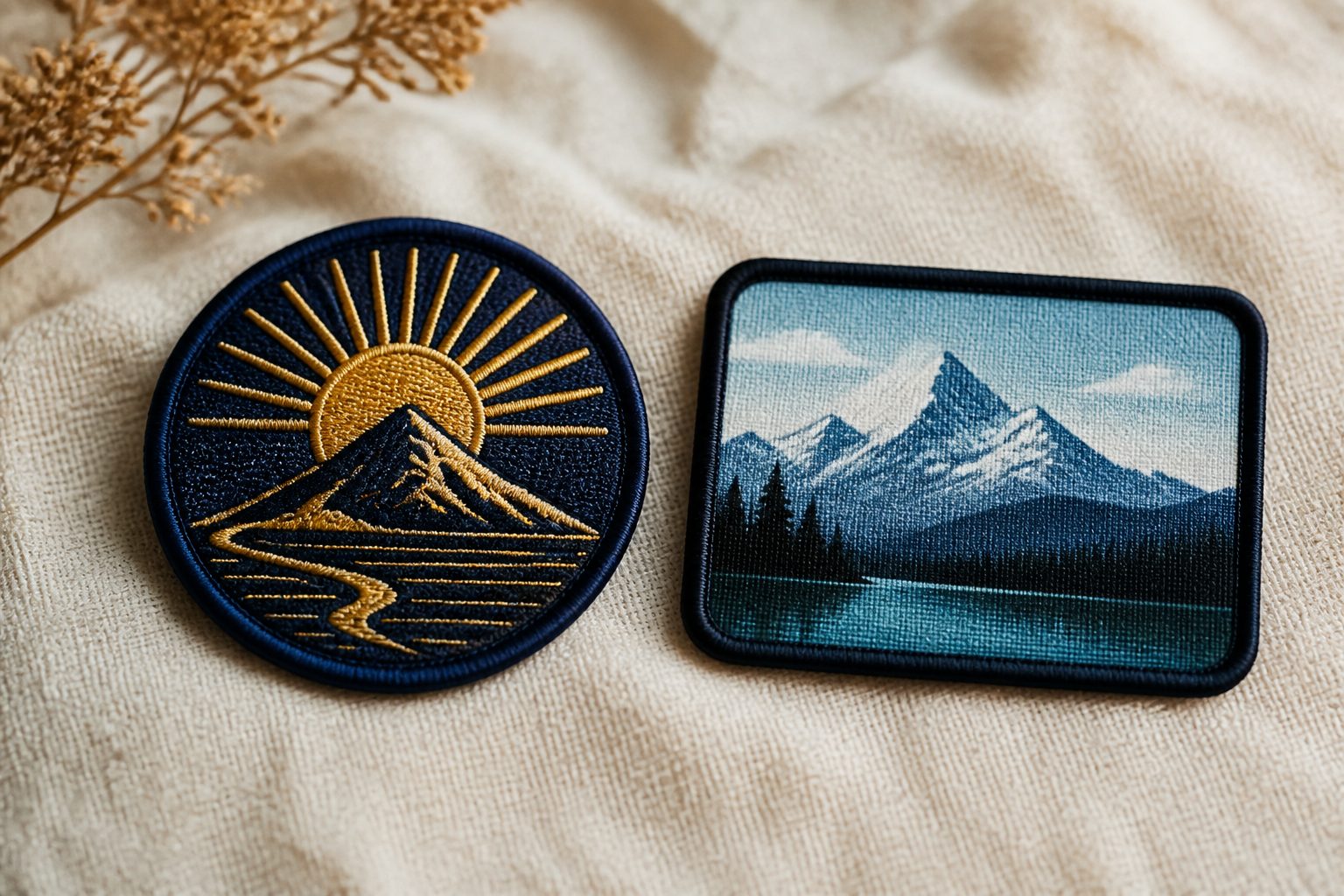
Custom embroidered patches are made with stitched thread, giving a raised, textured finish that suits crests, uniforms and traditional branding. Printed patches place ink onto a fabric base, producing a flatter surface with finer colour detail and gradients. Embroidery is tactile; printing is better for artwork that cannot be simplified.
Key takeaways
- Custom embroidered patches use stitched thread for a raised, traditional finish, while printed patches use ink for a flatter image.
- Printed patches handle gradients, photographs and very small colour changes more easily; embroidery is strongest for bold shapes, lettering and recognisable crests.
- Both types can be supplied with sew-on, iron-on or Velcro backing, but the right backing depends on the garment and how it will be washed or used.
- The Customized Patches has a 5-piece minimum per design, supplies a free digital mockup usually within 12 hours, and produces only after approval.
Custom embroidered patches and printed patches are made in different ways, so they suit different artwork and garments. Embroidery gives you raised thread, visible stitch texture and the familiar look of a club crest; printing gives you a flatter face with more freedom for gradients, photographs and very fine colour changes. The right choice depends on the logo, the clothing and how the patch will be used.
For a football club, cadet unit, biker vest or school blazer, custom embroidered patches are often the natural choice. For a detailed event illustration, sponsor panel or brand mark with shading, printed patches may reproduce the artwork more accurately. The Customized Patches works with customers across the United Kingdom, with a 5-piece minimum per design, a free digital mockup usually within 12 hours, and production only after approval.
What is the actual difference between embroidered and printed patches?
An embroidered patch is built from thread stitched into a fabric base. The thread creates the coloured areas, outlines and lettering, and the completed face has a raised surface that catches light. Depending on the design, the face may be partly embroidered or fully covered with stitching. A merrowed crest normally has a thick, overlocked edge around it, while a heat-cut edge can follow a more detailed outline.
A printed patch starts with a fabric face, then applies the artwork as ink or a printed transfer. The surface is comparatively smooth. That is not a weakness: printed is flatter; that is the point. It works well where a customer needs a drawing, photograph, soft shadow, colour blend or very small detail that thread would have to simplify.
| Specification | Custom embroidered patches | Printed patches |
|---|---|---|
| Surface | Raised, stitched and tactile | Flat or slightly coated, depending on the finish |
| Artwork detail | Best with bold shapes, clear outlines and readable lettering | Best for gradients, photographs, shading and complex illustrations |
| Colour behaviour | Uses selected thread colours, so close shades may need simplifying | Can reproduce more colour changes and tonal transitions |
| Visual character | Traditional, textured and recognisable as a badge | Clean, smooth and closer to the supplied artwork |
| Small text | Needs enough space for stitches to remain legible | Often handles small detail better, subject to size and print quality |
| Typical uses | Football clubs, cadets, school blazers, biker vests and workwear | Events, brand illustrations, sponsor artwork, photographs and detailed logos |
| Backing options | Sew-on, iron-on, adhesive or Velcro can be specified | Sew-on, iron-on, adhesive or Velcro can be specified |
| Main compromise | Fine detail and gradients may need editing | It does not provide the raised stitch texture of embroidery |
When custom embroidered patches are the better choice
Choose custom embroidered patches when the badge itself is meant to look like a badge. A strong outline, two or three thread colours and a clear central symbol can look excellent on a football jacket, a scout shirt or a hospitality polo. The texture is visible from a sensible distance, which helps a crest read on moving clothing rather than looking like a small flat sticker.
Embroidery is also a good fit for designs that need a traditional or hard-wearing appearance. We regularly quote patches for football clubs, cadet units, biker groups, school blazers and workwear. A stitched name, rank panel or club emblem gives the garment a physical identity that a flat print cannot quite imitate.
- Bold initials, numbers and uncomplicated names.
- Football, rugby and other sports crests.
- School, university, scout and cadet badges.
- Biker and motorcycle club back patches with strong lettering.
- Workwear logos intended to match an existing embroidered polo or jacket.
- Brand marks where texture is part of the visual identity.
- Simple icons that must remain clear on a hat, sleeve or chest.
There are limits. A full-colour illustration with a sunset, a face or several smooth fades may lose character when converted into stitches. Tiny text can close up, especially if the patch is only 2 or 2.5 inches wide. This is why an embroidery-ready file is not simply a normal image sent straight to a machine; it needs digitising, stitch planning and an approval check.
Our guide to embroidery digitizing for custom patches explains what to inspect in a stitch file. If the design needs height rather than fine detail, 3D embroidered patches may be worth considering, although raised foam works best for larger, uncomplicated lettering and symbols.
When a printed patch makes more sense
Printed patches are the sensible option when the artwork depends on detail rather than texture. A landscape illustration, a festival poster, a food label with several tones or a sponsor graphic may be easier to recognise when reproduced as ink. The flatter face can also suit a modern clothing brand that does not want a thick, traditional crest.
Printing is useful for photographs and artwork containing smooth gradients. It avoids asking thread to imitate a continuous change from dark blue to pale blue, or to reproduce many tiny marks in a drawing. Fine detail still has a practical limit: a very small patch cannot make microscopic text readable simply because it is printed. Size, contrast and the quality of the source artwork still matter.
- Photographic or illustrated event badges.
- Brand artwork with shadows, fades or many close colour tones.
- Detailed food, drink and hospitality graphics.
- Limited-run merchandise where the supplied artwork should stay close to the original.
- Sponsor patches containing several logos and fine lines.
- Commemorative designs with portraits, scenery or complex linework.
A printed face will not have the same raised feel as embroidery, and ink may show wear differently depending on the fabric, finish and washing routine. If the patch is being fitted to a hard-use outdoor item, ask about the face finish and backing rather than choosing on artwork alone. Printed patches can be compared with woven patches when the design needs a smooth face but should still have a textile structure.
The design details that decide the result
The artwork may look clear on a phone and still need adjustment at patch size. A 4-inch back patch has room for larger lettering and stronger borders; a 2-inch chest patch does not. Ask how the smallest text, narrowest line and tightest gap will be handled. If those features matter, a mockup should show them at the proposed dimensions rather than only as a large screen image.
Text, outlines and negative space
Embroidery needs enough room for a needle and thread to create a stable shape. Very narrow outlines can disappear into neighbouring stitches. Letters with enclosed spaces, such as A, B, R and P, need open counters so they do not fill in. Printed patches can preserve more small marks, but contrast is still required.
A simple edit often improves both types: remove unnecessary tiny wording, thicken a fine border and leave a little more space between letters. For a club with a long name, use a shortened chest mark and keep the full name on a larger back patch. The how to design a custom patch guide covers these decisions in practical terms.
Colour matching
Thread and ink do not behave like pixels on a monitor. Embroidery uses available thread colours, and the apparent shade changes slightly with stitch direction and the surrounding border. Printing allows more tonal variation, but the finished fabric face is still not the same as a glossy screen.
If a team has a fixed blue, red or gold, send the brand reference and explain how strict the match needs to be. A colour reference is more useful than saying “make it brighter”. The approval mockup is the point to check the background, border, text and contrast together.
Shape and edge
A merrowed edge gives a classic rounded border and works particularly well on traditional embroidered crests. Heat-cut and laser-cut edges can follow sharper or more irregular shapes. A printed patch may also use a clean cut edge, but the edge choice remains a separate specification from the face method.
Not sure whether thread or ink will hold your logo best? Send the artwork and the garment details for a free digital mockup usually within 12 hours, then compare the embroidered and printed direction before production.
GET A FREE MOCKUPA motorcycle club may choose a large merrowed back patch with rocker text, while a clothing brand may prefer a small heat-cut patch that follows the outline of its symbol. Read Merrowed vs Heat-Cut vs Laser-Cut Patches: Which Edge Should You Spec? before approving the shape.
Garment and use case: jackets, polos, hats and equipment
The same artwork can need a different patch specification on different garments. A patch on a cotton polo is not facing the same conditions as one on a waterproof nylon shell. A wool coaches jacket can take a sewn badge, but the customer should consider how the needle marks and backing sit on the fabric. A structured cap has a curved front, so an oversized stiff patch may not sit naturally.
For jackets, measure the usable panel rather than the whole garment. Check zips, seams, pockets and lining. Our guide to Custom Patches for Jackets in the UK: Size, Backing, and Stitch covers placement, while the guide to Custom Patches for Hats and Caps: UK Size, Type, and Backing Guide deals with curved and restricted areas.
| Garment or item | Often suitable | Points to check |
|---|---|---|
| Football or rugby jacket | Embroidered crest, sewn or iron-on | Wash frequency, badge size and whether the fabric stretches |
| Nylon shell | Sewn embroidered or printed patch, depending on the face | Heat can damage or mark the shell, so do not assume iron-on is suitable |
| Wool coaches jacket | Sewn embroidered patch | Needle placement, lining and the weight of a large patch |
| Hospitality polo | Small embroidered logo or printed detail patch | Repeated commercial washing and whether the logo must match existing embroidery |
| School blazer | Embroidered crest, usually sewn | Position, edge, washing and a consistent size across pupils |
| Velcro panel on tactical equipment | Hook-backed embroidered, printed or PVC patch | Panel dimensions, hook-and-loop orientation and removal frequency |
| Cap or beanie | Small embroidered or printed patch | Curvature, available height and whether the edge will distort |
For bags and backpacks, thread can give a strong outdoor-brand appearance, while a printed face may preserve a detailed illustration. The attachment point matters just as much as the face: a patch sewn through a padded bag may need a different approach from one applied to a flat canvas pocket. See Custom Patches for Bags, Backpacks, and Luggage in the UK for placement and construction points.
For tactical or removable applications, Velcro is usually more practical than permanent stitching. A user may want one morale patch on a jacket one day and a different one on a bag the next. PVC is another option for wet or outdoor settings, and the comparison of PVC vs Embroidered Patches for Outdoor and Tactical Gear explains why a rubber-like surface can sometimes be a better match.
Backing, washing and common failures
Backing does not turn a patch into a universal garment repair. Sew-on is the dependable choice for a permanent badge, particularly on jackets, heavy cotton, uniforms and items that will be washed frequently. Iron-on is convenient on suitable fabrics, but the adhesive needs correct heat, pressure and cooling time. It is not ideal for every waterproof or heat-sensitive nylon shell.
Velcro is useful for removable badges and equipment panels. Adhesive backing can work for temporary display or smooth surfaces, but it should not be treated as the same as sewing. A common failure is an iron-on patch that peels after a dryer cycle because the garment, temperature or wash routine was not compatible. Another is applying heat over a coated rain jacket and marking the shell.
- Use sew-on for long-term attachment where the garment allows stitching.
- Use iron-on only when the fabric and care instructions are suitable.
- Use Velcro when the badge needs to be removed or exchanged.
- Tell us if the garment is waterproof, coated, stretchy, padded or heat-sensitive.
- Check the care label and wash at the recommended temperature.
- Avoid assuming a domestic dryer is harmless to adhesive-backed patches.
- For a full explanation, read Sew-On vs Iron-On vs Velcro: Which Patch Backing Lasts Longest?.
Printed and embroidered faces can both be supplied with different backings, subject to the construction and intended use. Tell our team where the patch will go before the quote is final. A small change in backing can make the difference between a badge that sits properly and one that lifts at the corners.
Quantity, price and lead time in the UK
The unit price depends on more than embroidered versus printed. Size, shape, number of colours, edge, backing, stitch coverage, artwork preparation and quantity all affect the quote. A large fully embroidered patch uses more thread and production time than a small part-embroidered badge. A detailed printed design may need a particular fabric face or finish.
The Customized Patches accepts a minimum of 5 pieces per design, which suits a small club trial, a new business launch or a team that needs a handful of replacements. Larger quantities can reduce the unit price, but only if the same design, size and specification are being made. Read Bulk Custom Patches in the UK: When 250, 500, or 1,000 Pieces Makes Sense before comparing a bulk quote with a five-piece run.
The normal first step is to send the artwork, dimensions, quantity, preferred face type and garment details. A free digital mockup is usually provided within 12 hours. We produce only after the mockup and specifications have been approved, so the customer can check the spelling, size, colours, backing and placement before manufacture.
Delivery timing depends on the design, quantity and production schedule, followed by UK-wide shipping. A simple repeat design may move differently from a new crest that needs digitising and several revisions. Do not set a launch date from a generic number alone; ask for the expected timing against your actual quantity and required finish. The guide How Long Do Custom Patches Take? UK Turnaround from Mockup to Delivery gives a fuller ordering view.
How to order the right patch without costly changes
Start with the item that will carry the patch. Send a photograph if the garment is unusual, especially for nylon shells, wool coaches, padded bags, caps or Velcro panels. Include the usable area in inches and mention seams, pockets, zips or curved surfaces. This gives the quote more useful information than a logo file on its own.
- Send the best available artwork, preferably a vector file or a high-resolution image.
- State the finished width and height in inches, or give the space available on the garment.
- Confirm the number of pieces; the minimum is 5 pieces per design.
- Choose embroidered or printed, then explain if the choice is provisional.
- Specify sew-on, iron-on, Velcro or another requested backing.
- Mention washing, outdoor exposure, commercial laundering or regular removal.
- Review the free digital mockup usually supplied within 12 hours.
- Check spelling, colours, scale, edge, backing and delivery details.
- Approve the final specification; production starts only after approval.
Do not approve from the artwork alone. Look at the mockup as a physical object: will the text be readable at 2 inches, will the border leave enough space, will a large back patch bend comfortably, and will the backing suit the fabric? For a broader checklist, see How to Order Custom Patches in the UK (From Mockup to Doorstep).
What to put in the quote request
A useful request can be short, but it should be specific. Include “embroidered” or “printed”, finished size, quantity, edge preference, backing, garment type, delivery postcode and the date needed. If you are unsure about the face type, say what the patch must look like and what it will be used for. That gives our team room to recommend a practical alternative.
For example: “We need 25 patches for a UK football club, 3 inches wide, for polyester jackets. The crest has three solid colours and small white lettering. Please quote embroidered and printed, with sew-on backing, and show the lettering at final size.” That is enough to begin a meaningful comparison.
Ready to quote the actual garment rather than compare patch types in the abstract? Name the face, size, quantity and backing on the request, and we will show the proposed result on a free digital mockup usually within 12 hours.
GET A FREE MOCKUPExamples from real UK patch applications
A football club crest with a shield, initials and a ball is usually a straightforward embroidery job if the wording is large enough. The stitched surface fits the garment and matches the way supporters expect a crest to look. If the club badge contains a detailed illustration or several tiny sponsor marks, a printed version may preserve more of the original.
A cadet unit may need a small shoulder or chest badge with clear lettering and a strong border. Embroidery is often selected for its traditional uniform appearance, but the final size matters. A 2-inch badge cannot carry the same amount of text as a 4-inch one. Simplifying the design before production is better than hoping thread will create detail that has no physical room.
A hospitality business putting a logo on polos may choose embroidery for a quiet, professional chest mark. If the logo contains a subtle gradient or a fine illustration, printing can match the brand artwork more closely. Commercial washing should be discussed before selecting the backing and face, rather than treated as an afterthought.
A biker vest often needs a large, readable back patch with a strong border and lettering that can be seen from a distance. Embroidery and a merrowed edge are common choices for that visual language. A small front identifier may use a separate shape and size. The full guide to Custom Biker and Motorcycle Club Patches: A Complete UK Guide covers rocker layouts, placement and specification.
A clothing brand may prefer printed patches for a complex illustration that changes between seasonal collections. The smooth face can keep the artwork close to the original, and the design can be judged as an image rather than as a stitched emblem. If the brand wants a softer textile look with fine detail, woven patches are another comparison worth making.
Are embroidered or printed patches more durable?
Neither face type is automatically right for every form of wear. Durability depends on the base fabric, face finish, thread or ink, edge, backing, attachment and care routine. A well-sewn embroidered patch on a jacket can last for years, but an iron-on attachment may fail before the face does. A printed patch can remain useful for a long time when it is properly made and washed as instructed.
Think about the failure you need to prevent. If the patch will be pulled off equipment repeatedly, use a suitable Velcro construction. If it will be washed weekly, a secure sewn attachment deserves serious consideration. If it will be exposed to rain, ask about the face and backing rather than assuming printed, embroidered or PVC alone answers the question.
For care, follow the garment label and avoid unnecessary heat. Turn washable items inside out where practical, do not iron directly over the patch, and allow adhesive-backed patches to cool and bond correctly after application. Our guide to How to Wash and Care for Custom Patches (UK Jackets, Hats, and Uniforms) explains the everyday steps.
Which patch type should you choose?
Choose custom embroidered patches if the design is a crest, badge, bold logo or club emblem and you want visible stitch texture. They are a strong match for football clubs, cadet units, school blazers, workwear, biker vests and traditional jackets. Keep the lettering and fine lines realistic for the finished size.
Choose printed patches if the artwork relies on gradients, photographs, shading or many fine details and a flat finish suits the garment. Printing is not an inferior version of embroidery; it solves a different artwork problem. If you want a flat textile face with fine detail but not an inked appearance, compare woven construction as well.
- Select embroidery for texture, boldness and a recognisable traditional badge.
- Select printing for gradients, photographs and detailed illustrations.
- Consider woven when the design needs fine detail with a fabric face.
- Consider PVC for some wet, outdoor or tactical applications.
- Choose sew-on for a lasting attachment, iron-on for suitable fabrics and Velcro for removable use.
- Request both options on the mockup if the artwork could reasonably work either way.
- Approve the final design before production, not after the patches have been made.
There is no universal winner. The best patch is the one whose face, size, edge and backing fit the artwork and the garment. If you send the design and intended use to The Customized Patches, we can price the sensible options for delivery across the United Kingdom instead of forcing every logo into one production method.
Frequently asked questions
What is the main difference between custom embroidered patches and printed patches?
Custom embroidered patches use stitched thread and have a raised, textured surface. Printed patches use ink on a fabric face and are flatter. Embroidery suits bold crests, lettering and traditional uniforms, while printing is usually better for gradients, photographs, shading and artwork with many fine colour changes.
Are printed patches cheaper than custom embroidered patches?
Not automatically. Price depends on size, quantity, artwork preparation, colours, backing, edge and production method. Embroidery may cost more for a large, heavily stitched design, while a detailed printed patch may need a particular face or finish. The Customized Patches can quote both options from the same artwork.
Can I order only five custom embroidered patches?
Yes. The Customized Patches has a 5-piece minimum per design. The five pieces must use the same approved design and agreed specification. This suits small clubs, replacement badges, trial merchandise and new businesses that do not yet need a large production run.
How quickly can I see a patch mockup in the UK?
A free digital mockup is usually supplied within 12 hours after the artwork and requirements are received. The mockup should be checked for size, spelling, colours, edge and backing. Production starts only after the customer approves the final mockup and specification.
Do embroidered and printed patches both have iron-on or Velcro backing?
Both types can often be specified with sew-on, iron-on, adhesive or Velcro backing, subject to the construction and intended use. Sew-on is usually the safer permanent choice. Iron-on can peel after a dryer cycle or fail on some nylon and coated fabrics, while Velcro suits removable badges and equipment panels.
Are printed patches better for small text than embroidered patches?
Printed patches can preserve smaller details more easily because they do not need to form each mark with thread. They still need sufficient patch size and contrast, and microscopic wording will not become readable by printing alone. For embroidery, simplify or enlarge small text so the letters have room to stitch clearly.
Ready to produce custom patches for your UK team or brand?
GET A FREE MOCKUP