The Difference Between custom embroidered patches UK and printed patches, Explained
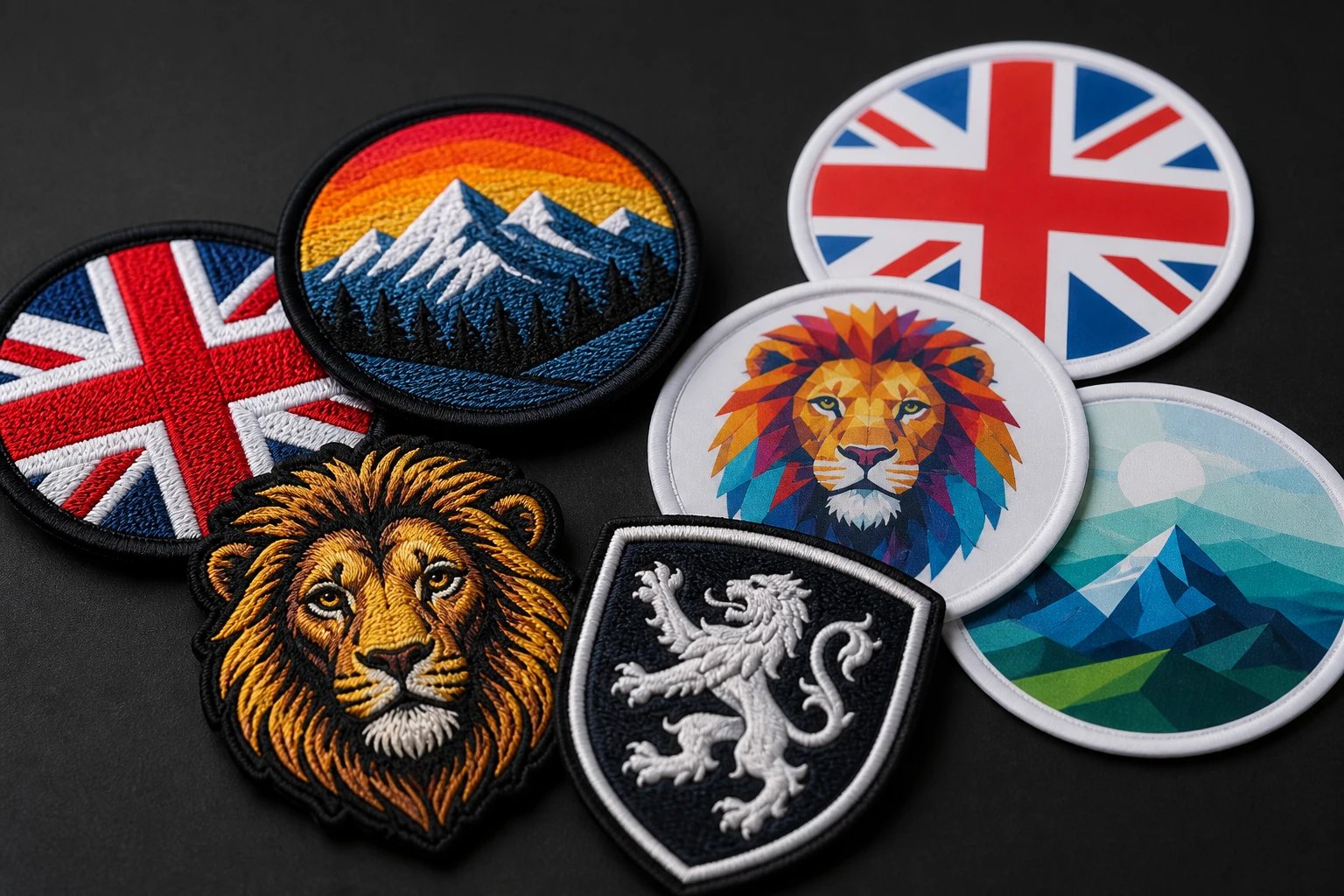
Custom embroidered patches UK are made with stitched thread, giving a raised, textured finish that suits club crests, uniforms, jackets and workwear. Printed patches use ink on a fabric surface, so they stay flatter and reproduce gradients, small details and photographs more easily. The right option depends on artwork, garment, washing, quantity and budget.
Key takeaways
- Embroidered patches use stitched thread and create a raised, tactile finish.
- Printed patches stay flatter and reproduce gradients, photographs and fine artwork more accurately.
- Both options can work on UK teamwear, uniforms, bags and jackets, but the garment and washing routine matter.
- The Customized Patches has a 5-piece minimum per design and normally sends a free digital mockup within 12 hours.
Custom embroidered patches UK use stitched thread to build the design, so they have visible texture, a slight raised surface and the familiar look of a club crest or uniform badge. Printed patches use ink on a fabric face, which keeps the patch flatter and makes gradients, tiny lettering and photographic artwork easier to reproduce.
For a football club badge, cadet shoulder title, hospitality polo or biker back patch, embroidery often gives the right presence. For a detailed illustration, changing event graphic or logo with shading, printed is usually the more practical choice. The difference is not simply which one lasts longer; it is how the artwork, garment and intended use work together.
What is the difference between embroidered and printed patches?
An embroidered patch is produced by stitching coloured thread into a fabric base. The thread forms the outlines, lettering and filled areas, while the edge may be finished with a merrowed border, a heat-cut edge or another specified cut. That construction gives the patch a tactile face. You can feel the lettering when you run a finger across it.
A printed patch starts with a fabric face that receives the artwork as ink. The image sits on the surface rather than being built from individual stitches. Printed is flatter; that is the point. It works well where the wearer wants a lighter, smoother badge or where the design contains colour transitions that thread cannot reproduce cleanly.
| Specification | Embroidered patch | Printed patch |
|---|---|---|
| Surface | Raised thread with a textured finish | Flat printed fabric face |
| Best artwork | Bold shapes, clear lettering, crests and simple symbols | Gradients, shading, illustrations, photographs and fine detail |
| Visual character | Traditional, tactile and highly visible | Smooth, precise and closer to the supplied image |
| Small lettering | Needs enough space for stitches to remain readable | Can usually handle finer detail, subject to size and artwork |
| Colour transitions | Limited by thread colours and stitch structure | More natural for fades, shadows and complex colour changes |
| Typical garments | Football shirts, blazers, jackets, polos, uniforms and bags | Lightweight garments, event clothing, detailed branded apparel and promotional items |
| Common backing | Sew-on, iron-on, hook-and-loop or adhesive options | Sew-on, iron-on, hook-and-loop or adhesive options, depending on construction |
| Minimum order | 5 pieces per design at The Customized Patches | 5 pieces per design at The Customized Patches |
The table gives a useful starting point, but there is no universal winner. A block-colour crest with a strong border may look excellent in embroidery and ordinary in print if the brief calls for a traditional badge. A detailed landscape illustration may look cramped in thread and perfectly natural as a printed patch.
How the artwork changes the decision
The first question on our production desk is not always, “How many patches do you need?” It is often, “What does the artwork contain?” A clean football crest with three or four solid colours is a sensible candidate for embroidery. A brand mark with a fine subheading, soft shadow and several colour fades needs a closer look before anyone promises a thread-based result.
When embroidery suits the design
- Large block lettering such as a club name, unit title or biker back-patch wording.
- Simple mascots, shields, stars, crossed tools and bold symbols.
- Logos that need a raised stitch effect on a polo, jacket or blazer.
- Designs where the border is part of the visual identity, such as a merrowed crest.
- Artwork that will be viewed from several feet away rather than inspected as a tiny detailed image.
Embroidery does need sensible spacing. Tiny letters can close up when converted into stitches, especially on a patch under about 3 inches wide. Very thin lines can also become uneven or disappear into the background. Our digital mockup is the point at which those issues should be shown and corrected, not hidden until the finished batch arrives.
When printed patches suit the design
- Artwork contains gradients, shadows, airbrush effects or many close colour tones.
- The design includes a portrait, detailed illustration or photographic element.
- A smooth, flat finish is preferred on a lightweight shirt or promotional garment.
- The logo includes small information that must remain visually close to the original file.
- The patch is part of a short-run event, campaign or changing seasonal graphic.
Printed does not mean careless or disposable. It means the image is reproduced through ink rather than individual threads. That can be the more accurate manufacturing route for a modern brand mark. If your artwork is supplied as a detailed illustration, forcing it into embroidery may produce a badge that is technically stitched but visually less faithful.
If you want to compare stitch structure, artwork preparation and finished scale, our guide to How to Design Artwork for custom embroidered patches UK That Production-Ready covers the practical checks we use before quoting.
Texture, appearance and brand impression
Embroidery has a physical quality that people recognise immediately. The raised thread catches light differently across the surface, and a dense fill can make a small emblem look substantial. That is why football clubs, cadet units and workwear suppliers often choose embroidered patches for identity pieces. A stitched badge feels like part of the garment rather than a label placed on top.
Printed patches have a cleaner, flatter appearance. This can be useful for a contemporary clothing label, a detailed brewery illustration or a hospitality company that wants its logo to remain close to the supplied brand artwork. Flatness is not a disadvantage if the design is intended to look flat.
We see this in different garment requests. A wool coaches jacket can carry a bold embroidered crest with a defined edge. A lightweight nylon shell may suit a thinner printed badge, particularly if the wearer wants less bulk. A school blazer usually benefits from a readable stitched emblem, while a campaign tote may make better use of detailed print.
Why the border matters
A border frames the artwork and protects the visual edge. Embroidered designs commonly use a merrowed crest-style border, which has a rounded stitched lip, or a heat-cut edge for shapes that need a cleaner outline. Printed designs can also have a border, but its appearance is generally flatter and more graphic.
For unusual outlines, a heat-cut or laser-cut edge may be more suitable than a traditional merrowed finish. The edge choice affects the patch size, the amount of visible border and the way the badge sits against the garment. It is worth specifying this before production rather than treating it as a finishing detail at the end.
Not sure whether thread or ink will hold your logo? Send the artwork and garment details for a free digital mockup, usually within 12 hours, so both approaches can be compared before production.
Which patch lasts longer on UK clothing?
Durability depends on more than the word embroidered or printed. The backing, edge, garment fabric, washing temperature, tumble drying and how often the item is worn all affect the result. A well-made embroidered patch sewn securely to a jacket can remain in use for years, but an iron-on patch applied to a garment that goes through a hot dryer may peel even if the face of the patch still looks fine.
Printed patches can perform well when applied and washed according to their construction. The printed face should be assessed for the intended use rather than judged only by a close-up image. Repeated abrasion, harsh detergents and high heat are more demanding than occasional wear on a display jacket or event bag.
If you are still choosing type, size, or backing, send the artwork and the garment. Free digital mockup in 12 hours — 5-piece minimum per design. We do not produce until you approve.
GET A FREE MOCKUP| Use case | Usually practical choice | Reason |
|---|---|---|
| Weekly football or rugby kit | Embroidered or carefully specified printed | Choose based on kit fabric, wash routine and whether a raised crest is wanted. |
| Nylon shell or rain jacket | Printed or lightweight embroidered | The smooth shell and lower garment weight can make a flatter patch easier to wear. |
| Wool coaches jacket | Embroidered | The textured fabric and substantial jacket suit a tactile stitched badge. |
| School blazer | Embroidered | A clear stitched crest is familiar, readable and suitable for regular uniform wear. |
| Detailed brand illustration | Printed | Ink can reproduce shading and fine image detail without compressing it into stitches. |
| Biker vest or back panel | Embroidered | Bold lettering, strong borders and high visibility are usually central to the design. |
| Velcro panel on operational clothing | Embroidered or printed with hook backing | The backing and panel dimensions matter as much as the face finish. |
For hard-use workwear, sew-on is often the safest attachment because it does not rely on adhesive alone. Iron-on can be useful for some garments, but it is not a substitute for checking the fabric and care label. We have seen iron-on patches lift after a dryer cycle, particularly where the garment surface was treated, stretchy or repeatedly heated.
If you are ordering for a removable uniform system, say so at quotation stage. A hook-and-loop backing needs the correct hook or loop side for the garment panel. A patch intended for a fixed position on a blazer or jacket may be better supplied as sew-on, even if an iron-on option appears quicker.
Custom embroidered patches UK for teams, clubs and businesses
The best finish often becomes clear once the wearer and garment are named. A football club may need a durable crest for shirts, kit bags and coaches' jackets. A cadet unit may need clear rank or unit identification on uniform. A hospitality group may want a small logo on polos where a tidy, flat mark is more comfortable and easier to match across several garment types.
Biker and motorcycle club patches usually need strong lettering, a visible outline and enough scale to be read on a back panel. That points towards embroidery for many designs, although a detailed side-patch illustration can still be better printed. Our guide to biker and motorcycle club patches covers the sizing and construction questions that commonly arise.
For teams, quantity can also change the sensible choice. The Customized Patches accepts a 5-piece minimum per design, so a small school group, pilot club or new business does not need to commit to hundreds before seeing the result. Larger orders may make the unit cost more attractive, but the correct artwork and backing should be settled first.
Examples from the production desk
- A football club crest with a shield, initials and two bold colours is normally a strong embroidered candidate.
- A cadet shoulder title with clear block lettering benefits from a stitched border and readable thread spacing.
- A hospitality polo with a small one-colour logo can use embroidery if the lettering is large enough, but a detailed logo may need print.
- A biker vest with a large arched name and bottom rocker usually suits embroidery because the wording needs visual weight.
- A school blazer badge should be checked at its actual finished size so the crest remains legible from normal standing distance.
- A brand selling illustrated tote bags may prefer printed patches because the artwork contains gradients and fine drawn lines.
The garment is part of the brief. A patch can look excellent on a sample swatch and still feel too heavy on a thin nylon shell. Conversely, a very light printed badge may look lost on a thick wool jacket. Tell us the garment, the placement and the care routine rather than sending artwork alone.
Backing and attachment: sew-on, iron-on or Velcro
The face of the patch gets most of the attention, but the backing decides how it attaches. Sew-on is the dependable choice for many jackets, uniforms, bags and club garments. It is particularly sensible where the item is washed frequently, where the fabric is textured or where the patch will be pulled and rubbed during normal use.
Iron-on uses heat-activated adhesive. It can be convenient for a flat, stable garment, but the application temperature and pressure must suit the fabric. Nylon shells, coated rainwear, stretchy sports fabrics and heat-sensitive materials need care. A patch that bonds well to cotton may not bond properly to a technical jacket.
Velcro, also called hook-and-loop, is useful where the wearer needs to change names, roles or identifiers. Confirm the panel size and which side is already fitted to the garment. The wrong side will not attach as intended, and a patch that overhangs the panel can catch on equipment or clothing.
| Backing | Good for | Check before ordering |
|---|---|---|
| Sew-on | Jackets, blazers, bags, uniforms and frequent washing | Allow a suitable edge for stitching and check the garment can be sewn. |
| Iron-on | Stable cotton or compatible fabric where quick application matters | Read the care label, test heat and do not assume it suits nylon or coated fabric. |
| Hook-and-loop | Removable badges, team identifiers and operational clothing | Confirm panel dimensions and whether the garment requires hook or loop. |
| Adhesive | Temporary display, samples or limited-use items | Treat as less suitable for repeated washing, abrasion or heavy garments. |
We explain the available choices in Custom embroidered patches Sizing and Backing Options Explained. The useful detail to provide is not just “iron-on please”; it is the garment fabric, placement, washing routine and whether the badge must be removable.
Size, colour and small lettering
A patch should be judged at its finished size, not only on a large computer screen. A 4-inch crest may look spacious in an artwork file but have crowded text once reduced to a 2.5-inch blazer badge. Printed artwork can retain more fine detail, but even print needs enough physical area for the eye to read it from normal viewing distance.
Thread colours are selected to create the closest practical match within the available palette. Printed artwork can represent more subtle colour shifts, but the final result still depends on the fabric face and production method. If an exact corporate colour matters, include the colour reference and approve the digital mockup before production.
White lettering on a dark background is often clear in embroidery when the letters have enough height and spacing. A thin script font can be a problem. The same script may remain more faithful in print, although it can still become difficult to read if the patch is too small.
Pricing, minimum quantities and UK ordering details
The price of either patch depends on the finished size, number of colours or artwork complexity, backing, edge, quantity and production requirements. Embroidery can involve digitising the artwork into stitch instructions, while printed patches involve preparing the image for the chosen print process. It is not accurate to judge the final quote from face finish alone.
The Customized Patches has a 5-piece minimum per design. Different designs are normally counted separately, so five football crests and five sponsor badges are not automatically treated as ten pieces of one design. Tell us the quantities for each artwork when requesting a quote.
A free digital mockup is usually supplied within 12 hours. Production starts only after you approve the mockup. That approval stage gives you a chance to check the wording, dimensions, border, colours, backing and the way a detailed logo has been interpreted.
- Send the artwork, approximate size in inches, quantity and the garment or item where the patch will be used.
- Tell us if you prefer embroidery, print or need both options compared.
- Confirm the backing, edge style, placement and any colour references.
- Review the free digital mockup, normally sent within 12 hours.
- Approve the mockup or request changes before production begins.
- Receive the completed patches with UK-wide delivery arranged for the order.
If you are unsure what information to include, our 10 Questions to Ask Before Ordering custom embroidered patches UK covers the practical points that affect a quote. It is better to clarify the fabric and backing at the start than to discover after delivery that an iron-on finish is unsuitable for a coated jacket.
Ready to spec the run? Open the quote form for a free 12-hour mockup and UK-wide shipping after approval.
GET A FREE MOCKUPName sew-on, iron-on or Velcro on the quote and tell us where the patch will be fitted. We show the appropriate backing on a free digital mockup, usually within 12 hours, and produce only after your approval.
Care advice for embroidered and printed patches
Follow the garment care label first. For most patched clothing, washing inside out on a moderate cycle and avoiding unnecessary high heat is sensible. Allow the item to dry naturally where possible, particularly if the patch uses an iron-on backing.
Do not pull at loose threads or scrape the patch against rough surfaces. If a sewn edge becomes loose, repair it promptly rather than allowing the patch to lift further. For printed patches, avoid aggressive rubbing over the image and do not assume a hot tumble dryer is harmless because the patch looks flat.
A jacket used for occasional events has a different care burden from a football kit washed every week. Tell us the likely use when ordering. That information helps us discuss the face finish and attachment method together instead of treating them as unrelated choices.
Alternatives if neither standard option feels right
Embroidery and print are not the only patch constructions. A woven patches design uses a flatter woven face that can suit fine lettering and clean lines while retaining a textile appearance. 3D embroidered patches add raised foam under selected areas, which can work for bold logos but needs enough space and a suitable garment.
Chenille patches have a soft, looped texture and are often associated with varsity-style lettering and teamwear. PVC patches are moulded and wipe-clean, so they may suit outdoor, tactical or hard-wearing applications where fabric texture is not required. Leather patches give a different material character for caps, bags and selected clothing.
These alternatives should still be judged by the same questions: what does the artwork contain, what will the patch touch, how will it be washed and does the wearer want a flat, stitched, raised, moulded or natural material finish? A short description of the item is often more useful than simply asking for the “best” patch.
Which should you choose?
Choose embroidered patches when you want texture, a traditional crest appearance, bold lettering or a badge that feels substantial on a jacket, blazer, polo, uniform or club garment. They are especially suitable for simple logos with clear shapes and enough space between details.
Choose printed patches when the artwork depends on gradients, fine illustration, photographs, small tonal changes or a smooth surface. Printed is often the honest choice for a detailed modern brand graphic. It does not need to imitate embroidery to be effective.
If both could work, compare them at the actual finished size on the intended garment. The free mockup is useful here because it exposes crowded text, weak borders and unsuitable proportions before the order is made. The Customized Patches can discuss the trade-off and supply from a 5-piece minimum per design across the United Kingdom.
Related guides and product options
For a second comparison focused on project type, read Custom embroidered patches UK vs printed patches: Which Is Right for Your Project?. If you are ready to specify a stitched badge, embroidered patches covers the main product route, while printed patches is the relevant product hub for a flatter ink-based finish.
Teams and clubs can also review Custom embroidered patches UK Best Practices for sports teams. Buyers covering several UK regions can view our UK city pages for local delivery information and ordering context. The same production process applies: artwork is checked, a digital mockup is supplied, and manufacture begins only after approval.
Frequently asked questions
Are custom embroidered patches UK better than printed patches?
Neither is automatically better. Custom embroidered patches UK are usually better for bold crests, raised texture, uniforms, jackets and club lettering. Printed patches are usually better for gradients, photographs, fine illustrations and a flat finish. The garment, artwork, washing routine and desired appearance should decide the choice.
Do printed patches last as long as embroidered patches?
Both can last well when correctly made, applied and cared for. Durability depends on the fabric, backing, washing, heat, abrasion and frequency of use. Sew-on attachment is often sensible for demanding garments. An iron-on patch can peel after a hot dryer cycle even when the patch face itself remains in good condition.
Can small lettering be used on an embroidered patch?
Small lettering can be embroidered if the finished patch is large enough and the font has suitable stroke width and spacing. Very small or thin text may close up in stitches. A printed patch can reproduce finer detail, but it still needs enough physical size to remain readable. The digital mockup should show the lettering at its intended dimensions.
What is the minimum order for patches from The Customized Patches?
The minimum is 5 pieces per design. Separate artwork is normally treated as a separate design, even if the size and backing are similar. Send the quantity for each design with the artwork so the quotation reflects the actual order.
How quickly can I see a patch mockup in the UK?
The Customized Patches usually sends a free digital mockup within 12 hours after receiving the necessary artwork and specifications. Production begins only after the mockup has been approved. The mockup can show the proposed size, colours, edge and backing so changes are made before manufacture.
Which patch backing should I use for a nylon jacket or Velcro panel?
A nylon jacket needs its fabric and care label checked before choosing iron-on. Sew-on may be more dependable for frequent use, while hook-and-loop is suitable for a correctly sized Velcro panel. State the jacket material, panel dimensions and whether the patch must be removable when requesting a quote.
Ready to produce custom patches for your UK team or brand?
GET A FREE MOCKUP