
Custom embroidered patches vs printed patches: Which Is Right for Your Project?
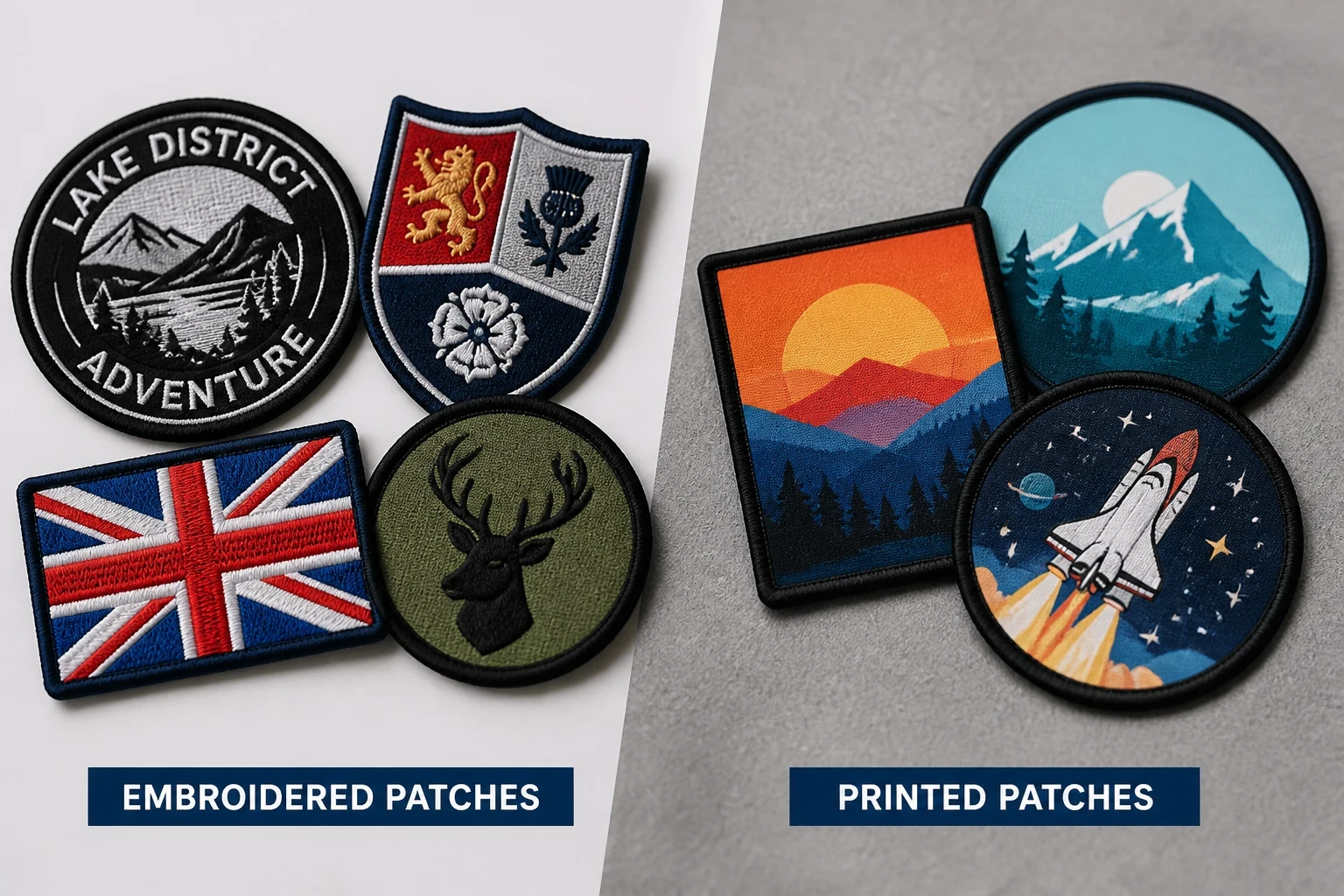
Custom embroidered patches suit logos, crests and workwear designs that need visible texture and a traditional stitched finish. Printed patches are better for gradients, photographs, tiny detail and a flat surface. The right choice depends on artwork, garment, washing, quantity and budget. The Customized Patches supplies both in the UK, from five pieces per design.
Key takeaways
- Choose custom embroidered patches for raised thread texture, bold lettering, crests and a traditional club or uniform appearance.
- Choose printed patches for photographs, gradients, fine illustrations and artwork that needs to remain flat.
- Both patch types can work on jackets, bags, uniforms and teamwear, but the backing must suit the garment and washing routine.
- The Customized Patches has a five-piece minimum per design and usually sends a free digital mockup within 12 hours before production.
Custom embroidered patches are usually the better choice for bold logos, club crests, uniform badges and designs where visible thread texture matters. Printed patches are usually better for gradients, photographs, tiny details and a flat graphic finish. The right answer depends on the artwork, garment, washing routine and how the patch should look after months of use.
At The Customized Patches, we quote both options for UK teams, brands, clubs and businesses. The minimum is five pieces per design. You can request a free digital mockup, usually within 12 hours, and we produce only after you approve the design, size, colours and backing.
The short answer: embroidered or printed?
An embroidered patch is built with thread stitched into a fabric base. That creates raised lines, visible fill and the familiar badge texture found on football club kit, cadet uniforms, biker vests and school blazers. It is a strong fit for simple logos, initials, shields, mascots and lettering that needs to read from a few feet away.
A printed patch has artwork applied to the face of the patch rather than recreated through individual stitches. Printed is flatter; that is the point. It can carry smooth colour changes, shading, fine line work and photographic imagery that would be difficult or unsuitable for thread.
| Project requirement | Usually the better option | Reason |
|---|---|---|
| Bold crest with clear shapes | Embroidered | Thread gives the badge texture and a traditional finish. |
| Photograph or detailed illustration | Printed | Ink can reproduce continuous detail without forcing it into stitch areas. |
| Large text or initials | Embroidered | Dense thread makes simple lettering easy to see. |
| Smooth gradients and shadows | Printed | Colour can transition across the artwork instead of changing in stitch steps. |
| Removable unit or tactical panel | Either, usually with Velcro | The backing and hook-and-loop placement matter more than the face type. |
| Small run for a club or business | Either | The five-piece minimum allows both options to be considered. |
How the two patch faces are made
What happens with embroidery
For embroidery, artwork is prepared for stitching, a process often called digitising. The file tells the machine where to place the thread, which direction each section should run and how dense the fill should be. A good file is not simply a picture converted into stitches. Small text may need simplifying, thin lines may need thickening and colour areas may need sensible boundaries.
The result has a tactile face. A merrowed crest has a stitched border that can make the edge look deliberately finished, while a heat-cut edge can suit detailed shapes and sharp corners. You can read more about embroidery digitising before approving artwork.
What happens with printing
Printed patches retain more of the original artwork because the face is not limited to a grid of thread paths. A sunset gradient, small illustrated map, product image or shaded animal can be reproduced with a flatter visual result. Fine detail still needs a sensible patch size; printing does not make unreadable artwork readable.
This is where some buyers make the wrong comparison. A printed patch is not a failed embroidered patch. It is a different product for a different visual brief. If the design is meant to look like a clean label on a work jacket or a detailed graphic on a festival bag, the flat face may be exactly what you want.
Custom embroidered patches: strengths and limitations
The main strength of custom embroidered patches is their physical presence. Thread catches the light differently from the base fabric, so a simple badge can look more substantial than the same artwork printed flat. This is why football clubs, cadet units, motorcycle groups and hospitality teams often choose embroidery for names, crests and rank-style identifiers.
- Good for bold logos, shield shapes, initials, mascots and clear lettering.
- Creates a raised, tactile surface that looks like a traditional sewn badge.
- Works particularly well on jackets, polos, uniforms, bags and sturdy teamwear.
- Can use a merrowed border for a classic finished edge.
- Pairs naturally with sew-on, iron-on or Velcro backing.
- Often remains visually strong when the artwork is viewed from normal standing distance.
There are limits. A large block of very small wording can become crowded. A detailed skyline with dozens of narrow windows may need simplifying. Thread also adds texture and a little thickness, which may not suit a lightweight nylon shell or a design intended to feel like a smooth printed label.
The garment matters too. A stitched badge on a wool coach jacket can look excellent, while a heavy embroidered patch on a thin running top may feel out of proportion. For a raised alternative, see 3D embroidered patches or compare the texture of chenille patches for varsity-style work.
Printed patches: strengths and limitations
Printed patches are the practical option when the artwork depends on detail rather than texture. A food brand may need a shaded illustration, a festival organiser may want a full-colour event graphic, and a small business may have a logo with a fine line that would need adjustment for embroidery.
- Handles gradients, shading, photographs and detailed illustrations more naturally.
- Provides a flat face that suits modern labels and clean graphic designs.
- Can preserve more small artwork detail at a suitable finished size.
- Works well on bags, event merchandise, promotional clothing and brand labels.
- Can be combined with a sew-on, iron-on or Velcro backing.
- May be preferable where a thick stitched surface would catch or add unwanted weight.
Printed does not mean indestructible, and embroidered does not mean indestructible either. Both need the correct base, edge and backing for the intended use. A printed badge on a frequently washed work jacket needs sensible care, just as an embroidered badge can suffer if it is rubbed against a rough surface or attached with an unsuitable iron-on application.
For a flat woven construction rather than a printed face, consider woven patches. Woven badges use a fine weave to form detail and can sit between the smooth appearance of printing and the texture of embroidery.
Detail, colour and small lettering
Artwork is often the deciding factor. Ask what a person needs to recognise first: the overall silhouette, the brand name, a small contact detail, a character illustration or a photographic scene. If the main message is a simple crest with three strong colours, embroidery is likely to give the right result. If the design depends on a soft gradient or many tiny colour changes, printing is usually more practical.
Not sure whether thread or ink will hold your logo? Send the artwork and intended garment to The Customized Patches for a free digital mockup, usually within 12 hours, so you can compare both finishes before production.
GET A FREE MOCKUP| Artwork feature | Embroidered face | Printed face |
|---|---|---|
| Solid blocks of colour | Very suitable, especially with clear outlines. | Suitable, with a smoother flat appearance. |
| Fine outlines | May need thickening or simplifying. | Can retain more fine detail at the right size. |
| Small text | Needs adequate letter height and spacing. | Can reproduce more detail, but tiny text can still be hard to read. |
| Photographs | Usually unsuitable unless simplified heavily. | Usually the more suitable choice. |
| Gradients | Converted into stitch colour steps. | Usually reproduced more continuously. |
| Metallic or tactile effect | Thread texture can help create visual depth. | Flat unless a special construction or finish is specified. |
Do not judge a design only on a large computer screen. A logo that looks clear at 12 inches wide may lose its small wording at 3 inches wide. We check the intended dimensions during the mockup stage, and changes can be made before production. The guide on how to design a custom patch covers spacing, outlines and artwork preparation in more detail.
Durability, washing and real garment use
Durability is affected by more than the patch face. Base fabric, border, backing, attachment method, abrasion and washing all have a part to play. A sew-on patch is mechanically held to the garment and is often the sensible choice for a wool coach jacket, heavy workwear or a biker vest. An iron-on patch can be convenient, but it is not the right answer for every fabric.
It is common to see iron-on badges peel after a dryer cycle, particularly where the heat, fabric or application pressure was not suitable. Nylon shells can be damaged by excessive heat, and some coated fabrics do not accept hot-melt adhesive reliably. A Velcro panel is more useful for removable unit identifiers, but it needs a properly sized hook-and-loop area and a firm attachment to the garment.
- For regular washing, follow the garment and patch care instructions rather than treating every fabric the same.
- Turn patched garments inside out where practical and avoid unnecessary high heat.
- Do not assume iron-on is suitable for nylon, waterproof coatings, elastic fabrics or heat-sensitive garments.
- Choose sew-on for a long-term attachment where the garment can accept stitching.
- Use Velcro for badges that need to be removed, swapped or stored separately.
- Inspect the edge after washing; early lifting is easier to repair than a fully detached badge.
Our wash and care guide explains sensible care for UK jackets, hats and uniforms. If you are still deciding between attachment methods, compare sew-on, iron-on and Velcro backing before placing the order.
Choosing the patch for specific UK projects
Football clubs and sports teams
A club crest with bold lettering normally suits embroidery. It gives players, coaches and supporters a recognisable badge that works on jackets, kit bags and fan merchandise. Printed patches can make sense for a detailed mascot, sponsor artwork or a limited event graphic, particularly if the design includes shading.
Cadets, scouts and youth groups
Unit names, activity badges and simple emblems are common embroidered applications. Clear lettering and a strong border help badges remain readable on shirts, fleeces and bags. If the design contains a highly detailed scene, printed or woven construction may preserve the important elements more clearly. See the guide to custom patches for scouts, cadets and youth groups.
Hospitality and workwear
For polos, aprons and jackets, embroidery gives a familiar branded uniform finish. A small business logo with a strong wordmark is a good candidate. Printed patches can suit a campaign mark, illustrated food label or a design that needs fine detail, but confirm the washing conditions and attachment method before selecting them.
Biker clubs and motorcycle clothing
Large back patches and rocker panels often use embroidery because the stitched texture suits leather and heavy denim. Merrowed crests and bold borders are common choices. A printed face may be useful for artwork with photographic shading, but the patch still needs to be sized and attached for a thick vest. See biker and motorcycle club patches for more project detail.
Brands, festivals and small businesses
A brand with a simple icon may benefit from embroidered texture on caps, jackets and bags. A festival graphic with a date, illustrated scene and several colour transitions may be better printed. For a small run, the five-piece minimum makes it possible to test a design without committing to hundreds of pieces.
Size, edge and backing are part of the decision
A face type cannot be chosen in isolation. The finished size controls how much detail is possible, the edge changes the outline and the backing affects how the patch behaves on the garment. A 2-inch chest badge has different requirements from a 10-inch back patch, even if the artwork is identical.
| Specification | Questions to answer | Common practical choice |
|---|---|---|
| Finished size | What is the available space in inches? Does the wording remain readable? | Measure the garment and show the requested size on the mockup. |
| Edge | Should the outline look traditional, sharp or closely cut to the artwork? | Merrowed for a classic border; heat-cut or laser-cut for detailed shapes. |
| Backing | Will it stay on permanently, be removed or be applied without sewing? | Sew-on for long-term use; Velcro for removable badges; iron-on only where suitable. |
| Base garment | Is it cotton, polyester, nylon, wool, leather, denim or coated fabric? | Match the attachment method to the material and expected heat or abrasion. |
| Quantity | How many designs and pieces are needed now? | Minimum five pieces per design, with pricing reviewed for larger runs. |
For jackets, look at the available panel and seam lines before choosing the shape. Our guide to custom patches for jackets covers placement, size, backing and stitch. For backpacks and luggage, check the panel construction and whether the inside can be reached for sewing; the advice in custom patches for bags and backpacks is useful here.
Cost, quantity and the five-piece minimum
Patch pricing is shaped by size, face type, number of colours, edge, backing, artwork preparation and quantity. Embroidery can involve more digitising and stitch work, while printing can be more efficient for detailed artwork. Neither is automatically the least expensive option for every specification.
Name the face type, size and backing on your quote, or ask us to compare them. We show the proposed embroidered or printed finish on a free digital mockup, usually within 12 hours, and production starts only after approval.
GET A FREE MOCKUPThe Customized Patches accepts a minimum of five pieces per design. That suits a small business testing branded workwear, a club ordering a handful of committee badges, a school society producing a first run or a team that needs a limited number of jackets. Larger quantities can change the unit price, so include your likely repeat order when asking for a quote.
- State the number of pieces for each separate design.
- Give the finished width or height in inches, rather than only saying small or large.
- Send the best available artwork and identify any text that must remain unchanged.
- Tell us the garment and whether the patch will be washed frequently.
- Specify sew-on, iron-on or Velcro if you already know the requirement.
- Ask for both embroidered and printed options if the visual choice is not settled.
Ordering from the UK: mockup, approval and lead time
A useful quote starts with more than a logo attachment. Send the artwork, desired size, quantity, garment type, preferred face, backing and delivery postcode. If you are comparing materials, say so; it is easier to price a realistic embroidered and printed version than to compare two vague estimates.
The free digital mockup is usually sent within 12 hours. Check the spelling, dimensions, thread or print colours, border, shape and backing before approval. We produce only after approval, so this is the point to request a revised size, a cleaner outline or a different face type.
- Send artwork and explain where the patch will be used.
- Confirm the number of pieces per design, with five pieces as the minimum.
- Review the quoted embroidered and printed specifications.
- Check the digital mockup, including wording, scale, border and backing.
- Approve the final version in writing.
- Production begins after approval, followed by UK delivery to the supplied address.
Lead time depends on the design, quantity, backing and current production schedule. A five-piece sample run and a 500-piece team order are not the same job. For a fuller explanation of the stages, see how to order custom patches in the UK and how long custom patches take.
A practical decision checklist
Start with the garment, not the patch catalogue. A badge for a wool coaches jacket, a nylon shell, a school blazer and a Velcro tactical panel may use the same logo but need different construction choices. Think about where the patch will sit, how it will be washed and whether the wearer needs to remove it.
- Choose embroidered if the design has bold shapes, a clear crest, large lettering or a traditional club and uniform feel.
- Choose printed if the design includes photographs, smooth gradients, fine illustration or a deliberately flat label appearance.
- Ask about woven if you want fine detail with a textile face but less raised texture than embroidery.
- Measure the patch area in inches and check that text will remain readable at the finished size.
- Select sew-on for a firm long-term attachment where stitching is possible.
- Select Velcro for removable identifiers or badges that will be swapped between garments and equipment.
- Treat iron-on as a garment-specific choice, not a universal shortcut.
- Order from five pieces per design upwards and provide the final quantity for an accurate quote.
- Approve the mockup before production, checking every word and colour.
If neither face is quite right, there are other routes. PVC patches suit some outdoor and tactical uses, leather patches can give caps and heritage garments a stamped finish, and woven patches can preserve fine lettering with a flatter textile surface. The correct choice is the one that fits the artwork and the garment, not the one with the longest feature list.
Final recommendation for UK buyers
For most team crests, workwear logos, school badges and club emblems, custom embroidered patches remain the dependable starting point. They give the design texture, a visible border and the established look people expect from a sewn badge. Keep the artwork bold and give small lettering enough room.
For detailed artwork, gradients, photographs and modern flat branding, printed patches are often the more honest choice. Printed is flatter; that is the point. If you are undecided, ask for both versions on the same mockup and judge them against the actual garment rather than choosing from a screen image alone.
The Customized Patches supplies UK-wide orders from five pieces per design. Send the artwork, use case, size and quantity for a free digital mockup, usually within 12 hours. Nothing is produced until the design has been approved.
Frequently asked questions
Are custom embroidered patches better than printed patches?
Neither is always better. Custom embroidered patches are usually better for bold logos, crests, initials and a raised traditional finish. Printed patches are usually better for photographs, gradients, shading and fine illustrations. The garment, washing routine, size and backing should decide the final choice.
Can printed patches last as long as embroidered patches?
Both can provide useful service when made with a suitable base, edge and backing and cared for correctly. Durability also depends on abrasion, washing, heat and how the patch is attached. A sew-on patch may outlast an unsuitable iron-on application, regardless of whether the face is printed or embroidered.
Which patch type is best for small lettering?
Printed patches can preserve more fine detail, but tiny lettering can still become unreadable if the patch is too small. Embroidered lettering needs sufficient height, spacing and stitch density. The safest approach is to show the exact wording at the intended size on the mockup before approving production.
What is the minimum order for embroidered or printed patches in the UK?
The Customized Patches has a five-piece minimum per design for UK orders. If you need five embroidered patches and five printed patches with different artwork, treat them as separate designs when requesting the quote. Larger quantities may affect the unit price.
How quickly can I receive a patch mockup?
The Customized Patches usually supplies a free digital mockup within 12 hours. Send the artwork, size, quantity, garment and preferred backing so the mockup reflects the real specification. Production starts only after you approve the design.
Can I use iron-on backing on a nylon jacket?
Do not assume iron-on backing is suitable for nylon. Heat can damage or mark some nylon shells and coated fabrics, and the adhesive may not bond reliably. Sew-on or another suitable attachment can be safer, depending on the jacket. Provide the garment details before the backing is finalised.
Ready to produce custom patches for your UK team or brand?
GET A FREE MOCKUP