Embroidered vs Printed Patches: Which Is Better for UK Brands?
Key takeaways
- Embroidered patches win for texture, heritage uniforms, and long wear on jackets and hats.
- Printed patches win for photos, gradients, and logos with many colors.
- Durability, backing, and size matter as much as the look of the sample photo.
- A free digital mockup is the safest way to compare both before you produce 5+ pieces.
If you are ordering custom embroidered patches or printed patches in the UK, the first fork is usually embroidered vs printed. Both can look premium. They solve different jobs: raised thread and a classic uniform feel on one side, photo-real colour and tiny detail on the other. Choosing wrong is expensive—not because one type is “bad,” but because the patch has to survive how your team actually wears it.
This guide walks through materials, durability, design limits, cost drivers, and real use cases for UK brands, sports teams, clubs, and merch drops. If your motto is too small for thread, compare woven vs embroidered patches next. If the art is a photo versus a fine weave, see printed vs woven patches. If you are choosing a badge versus ink on the garment itself, see patches vs screen print vs heat transfer. Jacket chests: custom patches for jackets. If the patch lives on a pack in rain, start with PVC vs embroidered instead of ink or stitch.
What embroidered patches actually are
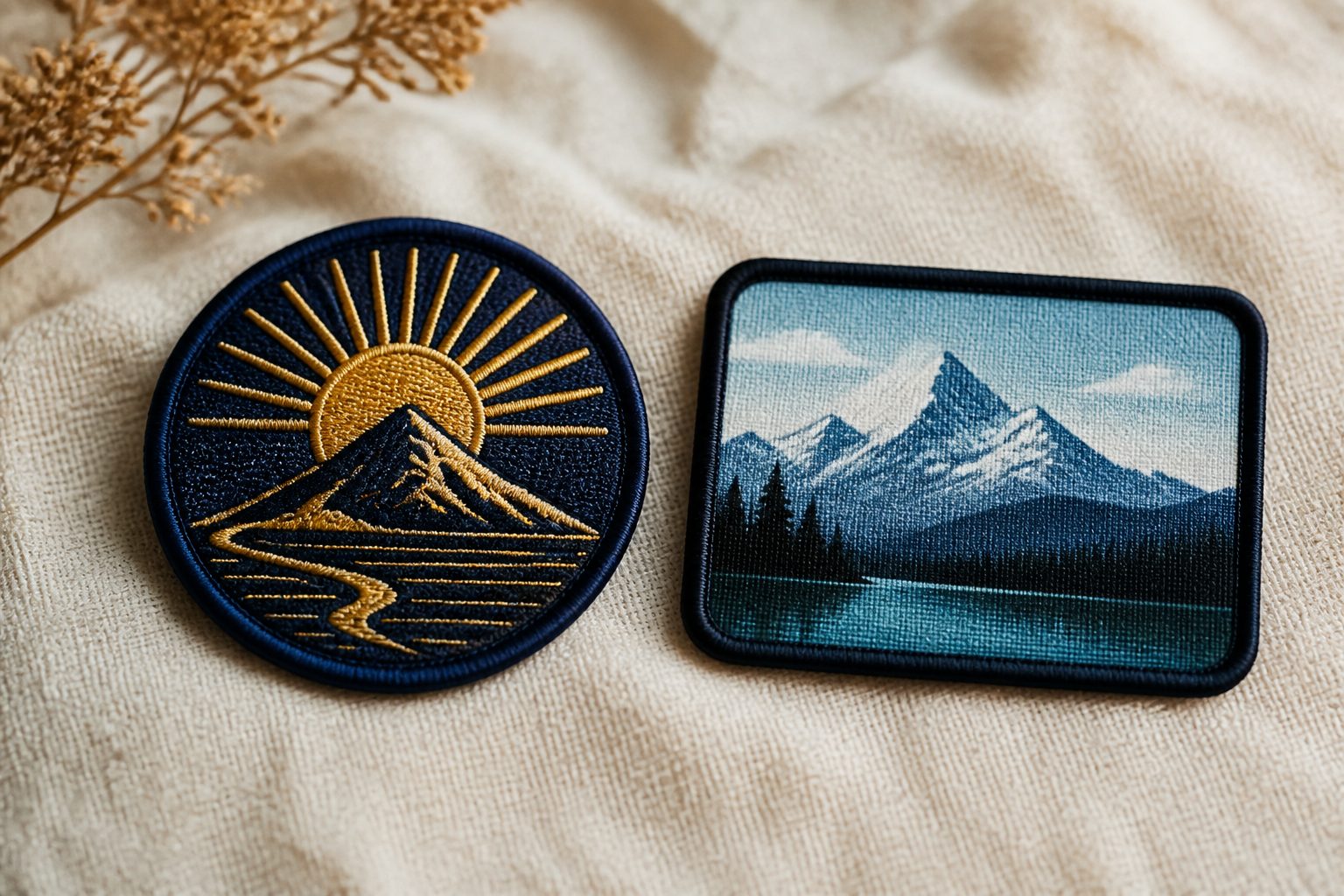
Embroidered patches are stitched with thread on twill or similar fabric. A digitizer converts your logo into a stitch file. Density, underlay, and pull compensation decide whether a 3-inch crest looks crisp or muddy. Edges are typically merrowed (a raised overlock) or hot-cut / laser-cut for shaped logos.
UK customers expect that look on workwear, biker vests, grassroots sports caps, and military-style jackets. Thread has thickness. That is a feature when you want a patch you can feel. It is a limit when the art is a photograph or a 12-color gradient.
What printed and sublimated patches are
Printed patches put ink or dye onto fabric—often twill, polyester, or a coated base. Dye-sublimation (common at 300 DPI) infuses color into polyester so gradients, skin tones, and fine type stay readable. Edges can be merrowed, heat-cut, or laser-cut like embroidery. The surface is flatter than thread, which is why printed patches photograph closer to the original artwork.
Printed is not automatically “cheap.” A well-made sublimated patch with a merrowed border and sew-on or Velcro back is a professional product. It is simply a better match when the logo looks like a photo, a watercolor, or a seal packed with micro type.
Side-by-side comparison
| Factor | Embroidered | Printed / sublimated |
|---|---|---|
| Best art | Bold shapes, 4–8 solid colors | Photos, gradients, tiny detail |
| Feel | Raised thread, classic texture | Flatter, closer to the original file |
| Typical edge | Merrow or hot-cut | Merrow, heat-cut, or laser-cut |
| Wash / sun | Excellent on apparel | Good; follow care for the fabric |
| Hats & jackets | Excellent | Good; sew-on preferred on hats |
| Outdoor gear | OK on clothing; PVC may be better on packs | OK indoors; PVC often better in rain |
| MOQ at our shop | 5 pieces per design | 5 pieces per design |
Not sure whether thread or ink will hold your logo? Get a free digital mockup in 12 hours and compare both before you produce.
GET A FREE MOCKUPDurability in real UK use
A varsity jacket that is worn for four seasons is a different environment than a weekend event lanyard. Embroidered thread handles washing, sun, and abrasion on cotton and wool well. Printed patches also last when the base fabric and backing match the garment. Problems show up when someone irons a printed patch onto nylon, or sews a dense embroidered disc onto a stretchy performance tee without testing.
If the patch lives on a backpack in rain, start with custom PVC patches instead of either fabric option. If it lives on a polo or cap, start with embroidery. If it is a full-color mascot for a one-season fan pack, printed is often the cleanest look. Raised hat wordmarks are a third process — 3D embroidered (puff) patches.
Design limits you should know before you draw
Embroidery limits
- Hairline outlines and 4-point type often merge
- Too many color changes raise stitch count and cost
- Tiny inner counters in letters like e, a, and 8 can fill in
- Photorealistic shading does not stitch the way it prints
Print limits
- Very low-resolution logos look soft at 4 inches
- Some fabrics hold dye better than others—polyester loves sublimation
- A merrowed border still needs a little margin so art is not clipped
- Iron-on on slick shells can fail even if the print looks perfect
Cost: what actually moves the quote
In the UK, patch price is mostly size in inches, quantity, stitch or print coverage, and backing. Embroidery costs more when the fill is dense or the run is small. Printed costs more when you need special fabrics, unique shapes, or extra finishing. Our 5-piece minimum exists because setup and mockup time are similar whether we run 5 or 500. Larger runs (250, 500, 1,000+) drop the unit price on both types.
Ready to spec the run? Open the quote form for a free 12-hour mockup and UK-wide shipping after approval.
GET A FREE MOCKUPDo not pick printed only to “save money” if the brand needs a raised, merrowed look. A cheap-looking patch on a £80 jacket costs more in reputation than it saves on the PO.
How to choose in five minutes
- If the logo is a photo or has more than about eight colors, lean printed.
- If you want texture on a hat, jacket, or uniform, lean embroidered.
- If the patch lives outdoors on a pack or vest, consider PVC instead.
- Pick backing for the garment: sew-on for uniforms, Velcro for gear, iron-on only on compatible fabrics.
- Request a free mockup. We can show embroidered, printed, or both before you commit.
Ordering embroidered or printed patches with us
Upload your file, choose a type, size, quantity, and backing, and we send a free digital mockup—usually within 12 hours. We do not produce until you approve. Standard manufacturing plus UK-wide shipping is typically 7–12 business days after approval. That workflow is the same whether you pick thread or ink. File checklist: how to design a custom patch and how to order custom patches in the UK. Teams in London, Manchester, and beyond use the same process — see UK city pages.
Frequently asked questions
Is embroidered always better quality than printed?
No. Quality is match-to-use. Embroidered is higher texture and classic for uniforms. Printed is higher fidelity for photos and complex color. A well-made printed patch can outlast a poorly digitized embroidered one.
Can I mix embroidered and printed in one order?
Yes. Many UK teams order embroidered cap patches and printed fan packs from the same art. Each design has a 5-piece minimum. Tell us both uses on the quote so we mock them correctly.
Which lasts longer in the wash?
On cotton jackets and twill hats, high-density embroidery is extremely durable. Sublimated patches also wash well on compatible fabric if you follow care instructions. Avoid high heat on iron-on backs.
What size should I order?
Caps often work at 2–2.5 inches. Jackets and bags usually look right at 3–3.5 inches. Larger backs and chenille letters run 4–5 inches. We price custom shapes on the longest side.
Do you offer a free mockup for both types?
Yes. Every UK quote includes a free digital mockup, usually within 12 hours, so you can compare stitch fill versus print before production.
What is the minimum order?
5 patches per design. That covers a typical roster or small merch drop without leftover pallets.
Ready to produce custom patches for your UK team or brand?
GET A FREE MOCKUP