
The Complete Guide to Custom embroidered patches in 2026
Custom embroidered patches are fabric badges built with stitched thread on a twill base, then finished with an edge and backing suited to the garment. They work well for UK sports teams, clubs, uniforms, jackets and brand clothing. The Customized Patches accepts a 5-piece minimum per design and provides a free digital mockup, usually within 12 hours, before production.
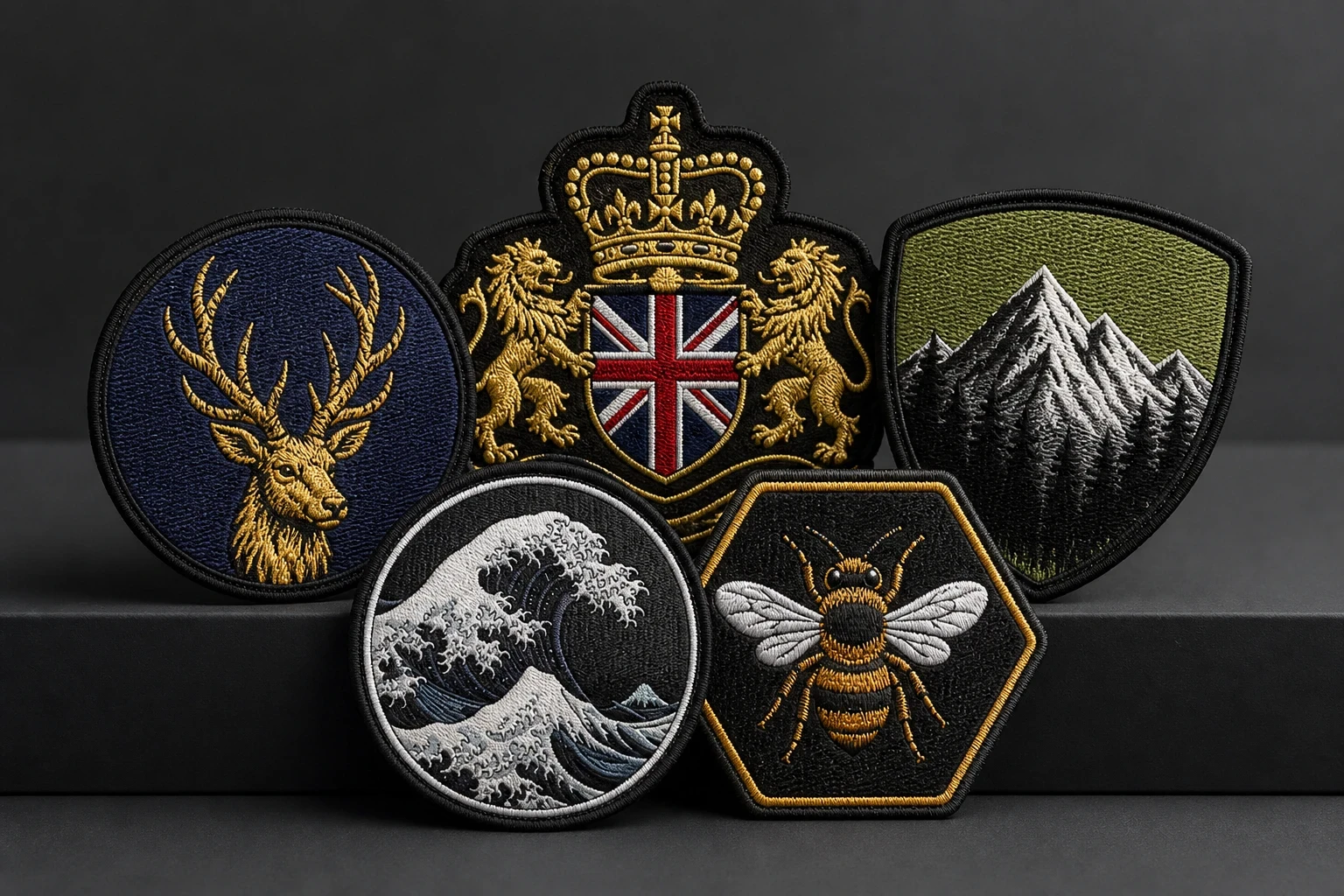
Key takeaways
- Custom embroidered patches suit logos, crests, initials and bold lettering that need a raised stitched finish.
- The correct patch size depends on the garment area, viewing distance, lettering and the amount of detail in the artwork.
- A 5-piece minimum applies per design, and a free digital mockup is usually supplied within 12 hours before production.
- Sew-on, iron-on and Velcro backings solve different garment problems; the backing should be specified before the order is approved.
Custom embroidered patches are fabric badges made by stitching coloured thread into a twill base, then cutting and finishing the shape for a garment or accessory. They are a strong fit for UK football clubs, cadet units, school blazers, hospitality polos, workwear, biker jackets and branded clothing because the stitching gives a visible, tactile finish. The short version is simple: send the artwork, choose the size and backing, approve the mockup, and the patches are then produced.
The Customized Patches supplies custom embroidered patches across the United Kingdom with a 5-piece minimum per design. A free digital mockup is usually sent within 12 hours, and production only starts after you approve the design and specifications. That approval step matters: it is where small lettering, edge shape, thread colours and the way the patch will sit on a real garment are checked rather than guessed.
What custom embroidered patches are made from
The usual construction is a woven twill fabric base covered with stitched thread. The base gives the patch a stable surface, while the embroidery creates the coloured areas, outlines and lettering. A finished patch may have a merrowed edge, a heat-cut edge or a laser-cut edge, depending on the shape and the look required.
Most people recognise the traditional embroidered look immediately: a firm fabric background, visible thread direction and a little height above the garment. That texture is useful on a club crest or a workwear badge because it remains legible from a short distance. It is not a photograph, though. Tiny gradients, very fine lines and small paragraphs of text need simplifying before they can stitch cleanly.
Thread coverage and the base fabric
A patch can use partial or fuller thread coverage. Partial coverage lets some of the twill show through and can keep the cost and weight down. Fuller coverage gives a more solid colour field, but it may make the patch heavier and can expose problems in artwork if large areas are specified with too many close colours.
Colour matching is practical rather than identical to a screen display. A red on a phone may look different from thread under workshop lighting. If a football club or business has a brand colour reference, include it with the artwork. The approved digital mockup is a visual guide, but thread has its own surface and sheen.
Choosing the right size, shape and edge
Start with the place where the patch will be worn, not with a standard size chart. Measure the usable area in inches and allow room for seams, pockets, zips and movement. A 3-inch crest may suit the chest of a polo, while a larger back patch may need 8 to 12 inches depending on the jacket and the artwork.
- Chest and polo badges commonly need a compact width that leaves room for the garment's placket, embroidery or existing logo.
- Sleeve patches need enough contrast to be read from the side, but excessive height can make the patch catch on doorways and equipment.
- Football and rugby club crests often need their shield proportions kept intact rather than stretched to fit a square area.
- Hat and cap patches need a size that follows the front panel without forcing the fabric into folds.
- Back patches can carry more detail because they are larger, but small sponsor names still need sensible lettering height.
- Bags and backpacks may have seams and curves that favour a smaller sew-on patch or a Velcro panel.
The outside edge changes the character of the badge. A merrowed edge gives a rounded rope-like finish and suits classic crests, biker club pieces and traditional uniform badges. A heat-cut or laser-cut edge can follow sharper points and unusual outlines more accurately. See the guide to Merrowed vs Heat-Cut vs Laser-Cut Patches: Which Edge Should You Spec? if the border is a major part of the design.
How artwork changes the finished patch
A clean vector logo is helpful, but a high-resolution raster file can still be used as a starting point. The production artwork may need lettering enlarged, a thin outline thickened or a small gap opened between two colours. These changes are not a replacement for your design; they are adjustments that stop thread from closing up the detail.
A common failure is sending a full-colour logo intended for a website and expecting every fine detail to appear as raised thread. A second is using narrow type under a quarter of an inch high. If a school name or sponsor line must remain, ask for a mockup at the actual size. The correct question is not whether the logo looks clear on a monitor, but whether it can be read on the garment.
When embroidered is the right choice
Embroidery is usually chosen for a textured, traditional finish. It works particularly well for team crests, initials, bold brand marks, club badges, uniform identifiers and designs with clear blocks of colour. A merrowed crest on a wool coaches jacket has a different feel from a flat transfer, and that difference is often the reason the patch is being ordered.
Printed is flatter; that is the point. A printed patch can carry photographic shading, tiny text and smooth colour changes that thread cannot reproduce in the same way. Woven patches can show finer small lettering with a flatter woven surface, while PVC is useful for waterproof, moulded relief on tactical or outdoor gear. Compare the options in The Difference Between custom embroidered patches and printed patches, Explained.
| Patch type | Best suited to | Main strength | Trade-off |
|---|---|---|---|
| Embroidered | Crests, bold logos, uniforms, jackets and teamwear | Raised thread texture and a familiar badge finish | Very fine detail and photographic shading need simplifying |
| Woven | Small lettering, detailed flat logos and labels | Fine detail in a smoother surface | Less raised texture than embroidery |
| Printed | Gradients, photographs, illustrations and small complex artwork | Broad colour range and very fine visual detail | Flatter appearance and possible surface wear depending on use |
| PVC | Outdoor equipment, airsoft, tactical clothing and wet conditions | Moulded, wipe-clean surface with strong relief | Less traditional fabric appearance |
| Chenille | Varsity jackets, large letters and bold collegiate graphics | Deep, soft pile with strong three-dimensional texture | Large pile does not suit tiny detail |
| Leather | Caps, heritage clothing, premium casualwear and simple marks | Natural material and stamped or engraved appearance | Not suitable for every wash routine or detailed multicolour artwork |
The choice should follow the garment and the message. A hospitality company may want embroidered initials on a polo because they look part of the uniform. An event organiser may choose printed patches for an illustration that changes colour across the design. A mountain club may prefer PVC for wet kit, while a university society may choose embroidery for a traditional crest. The embroidered patches hub shows the standard embroidered route, with other materials available if the artwork calls for them.
Not sure whether thread or ink will hold your logo? Get a free digital mockup in 12 hours and compare both before you produce.
Selecting sew-on, iron-on or Velcro backing
Backing is not a minor finishing detail. It decides how the patch is attached, how easily it can be removed and how it behaves after washing. Sew-on is the dependable option for heavy jackets, school blazers, wool coaches jackets and workwear that will be worn repeatedly. It takes more time to apply, but the attachment is not relying on adhesive alone.
Not sure whether thread or ink will hold your logo? Get a free digital mockup in 12 hours and compare both before you produce.
GET A FREE MOCKUP- Sew-on backing is suitable for nylon shells, denim, wool, cotton twill, uniforms and most stable fabrics. A matching or contrasting thread can be used around the edge.
- Iron-on backing is convenient for a quick application to suitable cotton or blended fabric. It can struggle on coated nylon, waterproof shells, textured knitwear and garments exposed to frequent heat.
- Velcro backing is useful for removable identifiers, tactical equipment, event staff panels and units that need to change a name or role badge. The hook side and loop side must be specified correctly.
- Adhesive backing can work for temporary display or low-use applications, but it should not be treated as the strongest answer for regular washing or outdoor wear.
Iron-on that peels after a dryer cycle is a familiar complaint. Often the issue is not the embroidered face but the combination of heat, moisture, a coated garment and insufficient pressure during application. A nylon shell can also scorch or distort before the adhesive has bonded properly. If there is any doubt, choose sew-on or ask for a removable Velcro panel. The guide to Sew-On vs Iron-On vs Velcro: Which Patch Backing Lasts Longest? covers the practical differences.
Garments that need extra thought
Nylon shells are slippery and may be water-resistant, which makes adhesive bonding less predictable. Wool coaches jackets can accept a well-placed sew-on patch, but thick seams and lining need to be considered. A Velcro panel on a tactical vest needs the patch dimensions to match the loop field, not simply the overall chest area.
For school blazers, check the school position and the fabric before ordering several designs. For hospitality polos, check that the patch will not interfere with a button line or another embroidered logo. For biker vests, allow room for a large back piece, rocker text or smaller front identifiers. The Custom Patches for Jackets in the UK: Size, Backing, and Stitch guide has more garment-specific examples.
How much custom embroidered patches cost in the UK
There is no useful single price without the size, quantity, shape, thread coverage, edge and backing. A small simple badge ordered in a larger batch is priced differently from a large, heavily stitched back patch ordered in five pieces. Setup and digitising may also affect the quotation, particularly where artwork needs careful conversion for stitching.
Quantity normally affects the unit cost because the work involved in preparing a design is spread across more pieces. The Customized Patches accepts a minimum of 5 pieces per design, so a club can test a small run without committing to hundreds. If a school, brand or sports league needs a larger batch, compare the quantities rather than assuming that the smallest order has the lowest total cost. The Bulk Custom Patches in the UK: When 250, 500, or 1,000 Pieces Makes Sense guide explains the planning side.
- Ask whether the quotation is per design or per size. A second size of the same logo may need a separate setup.
- State the finished dimensions in inches, not just 'small', 'medium' or 'jacket size'.
- List the backing and edge, because sew-on, iron-on and Velcro involve different finishing work.
- Confirm the quantity for each design. The 5-piece minimum applies per design, not to a mixed basket of unrelated artwork.
- Send the delivery postcode and required date so the quotation can reflect UK delivery needs.
- Check whether the price includes a digital proof and whether production waits for written approval.
Ordering custom embroidered patches from artwork to delivery
A good order starts with a clear brief. Include the artwork, finished size, quantity, garment type, backing, edge preference, thread colours and delivery address. If you do not know the correct size or backing, say what the garment is and how it will be used. A production desk can then identify the decisions that matter rather than treating a vague specification as final.
- Send the best artwork available, preferably a vector file or a high-resolution image.
- Explain the application: football kit, cadet uniform, school blazer, cap, bag, biker vest, polo, jacket or Velcro panel.
- Confirm the finished width or height in inches and flag any lettering that must remain readable.
- Choose sew-on, iron-on, Velcro or another backing and specify whether the patch will be washed often.
- Review the digital mockup for spelling, shape, colours, size, edge and backing.
- Approve the final mockup and quotation in writing.
- Wait for production and check the finished pieces against the approved design on arrival.
The free digital mockup is usually supplied within 12 hours. It is not the finished physical patch, so it cannot show every thread crossing or the exact hand feel, but it is a useful approval document. It should make the main questions visible: Is the wording correct? Is the badge too small for the lettering? Does the edge follow the artwork? Is the backing right for the garment?
Production only begins after approval. This is especially important for team orders, where a single spelling error can affect an entire batch. Keep the approved mockup and quotation with the order records so the club secretary, kit manager or business owner knows what was signed off.
Name sew-on, iron-on or Velcro on the quote. We show the correct back on a free 12-hour mockup so production matches the garment.
Lead times, approval and UK delivery
Turnaround depends on artwork complexity, quantity, backing, approval time and the delivery service selected. The fastest part of the process is often the first proof: a free digital mockup is usually sent within 12 hours. Production time starts after approval, not when an initial enquiry is received.
Allow extra time before a football season, freshers' week, a festival, a wedding, a trade show or a uniform changeover. A five-piece test order and a 500-piece club order do not carry the same production planning. If your date is fixed, state it at the start rather than asking after the artwork has been approved. Read How Long Do Custom Patches Take? UK Turnaround from Mockup to Delivery for a fuller planning guide.
UK-wide delivery should be planned around the address, not only the county or city. The Customized Patches serves customers across the United Kingdom, including teams and businesses ordering from England, Scotland, Wales and Northern Ireland. A clear delivery address helps avoid delays when the patches are needed for a match, event or uniform handover.
Where teams, clubs and businesses use embroidered badges
Sports teams use embroidered crests on jackets, bags, caps and supporter clothing. A junior football club may order five pieces for committee members, then return for a larger run after checking the size on the kit bag. Rugby, hockey and rowing clubs often need several related designs, so each design should be counted separately against the 5-piece minimum.
Cadet units, scouts and youth groups often need clear identification without a delicate finish. A sew-on badge may be sensible for hard-used uniform, while Velcro allows role or name patches to be changed. Emergency service and rescue clothing may require specific positioning, visibility and garment compatibility, so the application should be described before a backing is selected. See Custom Patches for Emergency Services in the UK: Fire, Ambulance, and Rescue.
Businesses use patches to add a logo to workwear, hospitality uniforms, delivery jackets, caps and staff bags. Embroidery gives a company mark a physical presence that can look more integrated than a loose printed sticker. It is still worth checking the garment supplier's wash instructions, particularly for waterproof outerwear and high-heat laundry.
Name sew-on, iron-on or Velcro on the quote. We show the correct back on a free 12-hour mockup so production matches the garment.
GET A FREE MOCKUPBiker and motorcycle club patches commonly use larger back designs, rocker shapes and separate front badges. These need careful spacing because the vest may already contain stitching, zips and seams. A traditional merrowed edge can suit the look, while sew-on backing is usually considered for a patch that will be worn outdoors and handled regularly. The Custom Biker and Motorcycle Club Patches: A Complete UK Guide covers those layouts in more detail.
Washing, application and everyday care
Follow the garment care label first. Turn the garment inside out where possible, use a suitable wash temperature and avoid treating the patch as a separate piece of fabric. High heat can affect adhesive backing, while aggressive tumble drying can lift an edge that would have stayed secure with air drying.
- Sew loose edges promptly rather than allowing a thread to catch on equipment or door handles.
- Do not iron directly over the embroidered face unless the garment and patch instructions allow it; use a cloth or press from the reverse where appropriate.
- Avoid bleach and harsh chemical treatments unless the garment manufacturer confirms they are suitable.
- For Velcro patches, close the hook-and-loop before washing so the hook does not catch on the garment.
- Check iron-on patches after the first wash, especially if the garment has been tumble dried.
- Store spare patches flat and dry, away from direct heat and damp.
Application also affects life. A patch sewn through a stable jacket panel is less likely to lift than one attached across a stretchy seam. On a backpack, stitch around the edge and check the lining before sewing. On a hat, use a patch that follows the front panel without creating hard folds. The guide to Custom Patches for Bags, Backpacks, and Luggage in the UK deals with those awkward surfaces.
Common mistakes to avoid in 2026
The most expensive mistake is often approving a design without checking it at finished size. A logo that looks excellent at 10 inches can lose a small line of text at 2.5 inches. The second is ordering the wrong backing for the garment, particularly iron-on for coated nylon or Velcro without a matching loop panel.
- Do not rely on a screenshot alone for thread colours; provide brand references and review the mockup.
- Do not send a complex image without saying which details matter most.
- Do not count five mixed designs as five pieces of one design; confirm the quantity per artwork.
- Do not place a badge over a jacket zip, pocket opening or curved seam without checking the movement.
- Do not approve the quote before confirming the final dimensions in inches.
- Do not leave a fixed event date until the end of the conversation.
- Do not assume an embroidered patch is automatically the best material; printed, woven, PVC, chenille or leather may suit the job better.
A useful production brief is short but specific: '2.75 inches wide, shield shape, merrowed edge, sew-on backing, 20 pieces, navy twill, white and gold thread, for wool coaches jackets, required in the UK by a stated date.' That gives enough information to quote, mock up and question the weak points before production.
The practical answer for UK buyers
Choose custom embroidered patches if you want a stitched, recognisable badge finish for a logo, crest, initials or bold lettering. Measure the application area, keep small text realistic, choose the backing for the garment and compare alternatives if the design has gradients or very fine detail.
For The Customized Patches, the order starts at 5 pieces per design. You receive a free digital mockup usually within 12 hours, and nothing is produced until the design and specifications are approved. That gives a UK team, club, brand or business a clear checkpoint before money and materials are committed.
If you already know the size, quantity and backing, go to embroidered patches for the product route. If the decision is still open, include the garment photo and artwork with your free mockup quote so the patch can be judged in context.
Frequently asked questions
What are custom embroidered patches?
Custom embroidered patches are fabric badges made with stitched thread on a twill base. They can include logos, crests, lettering, borders and shaped edges, then be finished with sew-on, iron-on or Velcro backing. They are commonly used on UK teamwear, uniforms, jackets, bags, caps and club clothing.
What is the minimum order for custom embroidered patches?
The minimum is 5 pieces per design. If you need five different logos, each logo is treated as its own design, so the quantity should be confirmed separately for each one. This allows small UK clubs, teams and businesses to order a short run without committing to a large batch.
How quickly can I see a mockup?
The Customized Patches usually provides a free digital mockup within 12 hours. The mockup should be checked for wording, proportions, colours, size, edge and backing. Production only starts after the final design and specifications have been approved.
Are embroidered patches better than printed patches?
Neither is best for every design. Embroidery gives raised thread texture and suits bold logos, crests and traditional badges. Printed patches are flatter and can reproduce gradients, illustrations, photographs and very fine detail more easily. The garment, viewing distance and required finish should guide the choice.
Which backing is best for a jacket or uniform?
Sew-on backing is generally the dependable choice for jackets, school blazers, workwear and garments that are washed regularly. Iron-on is convenient on suitable stable fabric but can fail on coated nylon, textured material or after repeated high heat. Velcro is useful when the patch needs to be removed or changed.
Can I order custom embroidered patches for a nylon shell or backpack?
Yes, but the backing and application need care. Nylon shells can be slippery or coated, making iron-on adhesion less predictable, so sew-on or a correctly fitted Velcro panel may be more suitable. Backpacks also have seams, pockets and linings to consider, and the finished dimensions should be checked before production.
Ready to produce custom patches for your UK team or brand?
GET A FREE MOCKUP