
Varsity chenille patches UK: Everything UK Buyers Need to Know
Varsity chenille patches UK buyers order are raised, soft-textured patches made with chenille yarn, usually finished with a felt base and a stitched border. They suit varsity jackets, school blazers, club clothing and branded outerwear. The Customized Patches offers a 5-piece minimum, a free digital mockup usually within 12 hours, and produces only after approval.
Key takeaways
- Varsity chenille patches use raised chenille yarn for a soft, letterman-style surface, so they are best for bold shapes and readable lettering rather than tiny detail.
- The right backing depends on the garment: sew-on is the safest general choice, iron-on is convenient on suitable fabrics, and Velcro works well for removable badges.
- The Customized Patches has a 5-piece minimum per design and sends a free digital mockup usually within 12 hours.
- Production starts only after you approve the mockup, including the patch size, colours, border, backing and placement.
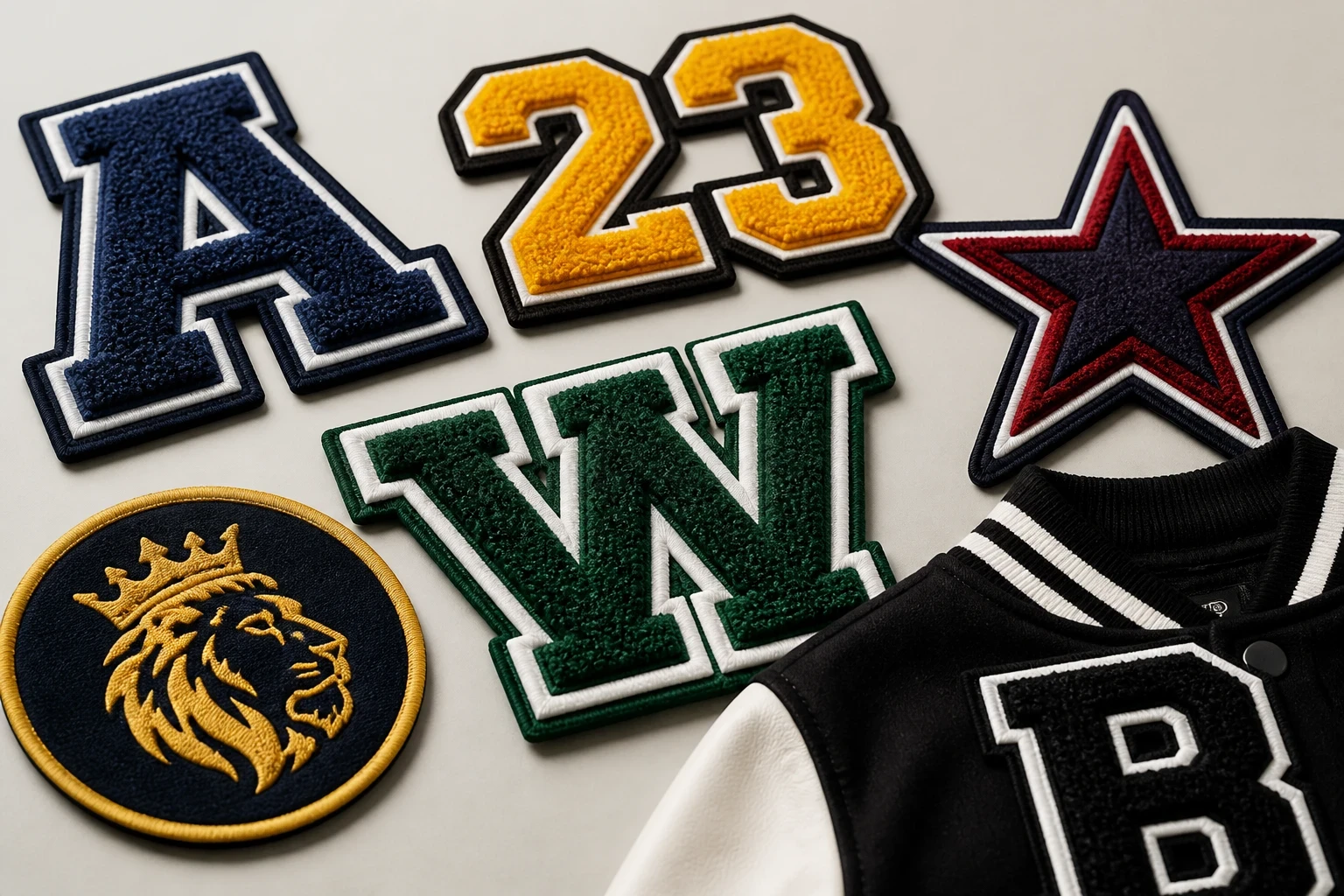
Varsity chenille patches UK buyers usually want are raised, soft-textured patches for varsity jackets, school blazers, club kit and branded outerwear. They are made with chenille yarn on a felt-style base, then finished with a stitched border. The result is a bold badge that can be felt as well as seen.
The Customized Patches supplies these patches across the United Kingdom, with a 5-piece minimum per design. You receive a free digital mockup usually within 12 hours, and we produce only after you approve the artwork and specifications.
What makes varsity chenille patches different?
Chenille is the fuzzy, looped yarn used to create the raised surface associated with American letterman jackets. A typical patch has a felt or fabric base, chenille-filled letters or shapes, and a contrasting stitched border. That construction gives the patch depth and a deliberately collegiate appearance.
This texture is also the main design limitation. Chenille works best with large initials, numbers, mascots, simple shields and clear block lettering. Fine script, tiny dates and intricate line drawings can lose definition because the yarn occupies more space than a flat embroidery stitch.
The parts of a chenille patch
- Chenille yarn creates the raised, tactile area of the design.
- The base fabric gives the patch shape and supports the yarn.
- A stitched or merrowed edge protects the perimeter and creates a finished outline.
- The backing controls how the patch attaches to the garment.
- The colour combination controls contrast, especially on dark wool or nylon.
A merrowed crest edge can look particularly traditional on school and club badges, but it adds visual weight around the design. That is useful for a large shield on a wool coaches jacket. It may be less suitable for a small badge where every millimetre is needed for lettering.
Where UK teams and businesses use them
The obvious home is a varsity jacket, but the same format works across British teamwear. Typical enquiries cover football clubs, cadet units, hospitality polos, biker vests and school blazers where the customer wanted a badge with physical presence rather than a flat printed mark.
- Schools and colleges use chenille initials, year badges, house symbols and achievement patches on wool blazers or sports jackets.
- Football, rugby, hockey and athletics teams use large mascots, player numbers and championship-style badges on warm-up jackets.
- Cadet units and youth organisations use clear unit letters and emblems on suitable uniform panels.
- Hospitality businesses can add a large crest to wool coaches jackets, staff overshirts or event uniforms.
- Independent clothing brands use chenille lettering on varsity jackets, fleece, denim and heavyweight cotton.
- Motorcycle and social clubs can use bold back patches, provided the garment and application method can support the weight.
For a biker vest, check the leather or denim surface before choosing adhesive. A sew-on finish is usually the sensible route for a large back badge. For a removable role or unit badge, a Velcro panel may be more practical than permanently attaching the patch.
A school blazer needs a slightly different approach. The patch must not cover the lapel edge, pocket opening or a seam, and the backing should suit the blazer fabric. A small chenille badge can look excellent, but an oversized design may make a formal blazer feel more like sportswear.
Choosing the right size, shape and artwork
Start with the garment, not the artwork file. Measure the area where the patch will sit and note nearby seams, pockets, buttons and zips. A patch that looks balanced on a screen can feel cramped on a sleeve or overlap a pocket once it is physically applied.
Common sizes in inches
| Use | Typical size | What to check |
|---|---|---|
| Small chest or sleeve badge | 2.5–3.5 inches wide | Keep lettering short and avoid narrow strokes. |
| School or club crest | 3.5–5 inches wide | Leave room around the blazer pocket, seam or panel. |
| Large varsity letter | 6–10 inches high | Check jacket width and allow for the border. |
| Back jacket design | 8–12 inches wide | Measure between seams and consider the weight of the finished patch. |
| Name or role badge | 3–4.5 inches wide | Use high contrast and a simple typeface. |
These are planning ranges rather than fixed product sizes. The correct dimension depends on the number of letters, the shape and the fabric. A wide wordmark may need a shorter height, while a tall initial can use more vertical space without becoming too heavy.
Artwork rules that prevent disappointment
- Use a short word or large initial for the clearest chenille result.
- Choose colours with enough contrast against both the base and the garment.
- Avoid very thin outlines that will be swallowed by a raised yarn surface.
- Check every spelling, year and number before approval.
- Keep the border visibly separate from the chenille fill.
- Send a vector file if available, but do not delay a quote if you only have a clear PNG or photograph.
If your logo has a fine line drawing, several small words or a detailed crest, compare chenille with embroidered patches or woven patches. Flat embroidery gives more control over small lines. Woven construction can reproduce compact text more cleanly. Printed is flatter; that is the point, and it may be the right answer for a detailed photographic or gradient design.
Backing options for varsity chenille patches UK buyers need to understand
Backing is not a minor finishing choice. It decides how the patch behaves on the garment, how easy it is to remove, and how much confidence you can have after washing. The best option depends on the fabric, the patch size and whether the badge is permanent.
| Backing | Best suited to | Advantages | Points to check |
|---|---|---|---|
| Sew-on | Wool jackets, denim, leather, heavy cotton and uniforms | Strong, reliable and suitable for larger patches | Needs stitching around the edge and access to the garment. |
| Iron-on | Suitable cotton, polyester and smooth fabric surfaces | Quick application with no visible hand stitching | Heat, washing and fabric finishes can affect adhesion; test first. |
| Velcro | Removable unit, team or role badges | Allows the patch to be changed or removed | The garment needs a matching loop panel and the patch gains extra thickness. |
| Adhesive | Temporary display or light-use applications | Simple for short-term use | Not normally the first choice for repeated washing or heavy outerwear. |
Not sure whether chenille, flat embroidery or print will hold your logo clearly? Send the artwork and garment details for a free digital mockup usually within 12 hours, then compare the options before you produce.
GET A FREE MOCKUPSew-on is usually the safest recommendation for a wool varsity jacket, a leather vest or a large back patch. Iron-on can be convenient on the right fabric, but an iron-on patch that peels after a dryer cycle is a common avoidable failure. Adhesive is not a substitute for stitching on a garment that will be worn hard.
For more detail on dimensions and application, see Chenille patches Sizing and Backing Options Explained. If you are deciding between a permanent crest and an interchangeable badge, tell us how the garment will be worn rather than choosing from a generic backing list.
Chenille compared with other patch types
There is no single best patch for every UK project. Chenille is chosen for texture and a collegiate look. Embroidery is chosen for stitch detail and broad versatility. Woven and printed patches are often better for small wording, gradients or artwork that needs to remain flat.
| Patch type | Surface and appearance | Strong choice for | Main trade-off |
|---|---|---|---|
| Chenille | Raised, soft and tactile | Varsity letters, mascots, bold crests and school or team jackets | Small detail and fine text are limited. |
| Embroidered | Thread-filled with a traditional stitched finish | Uniform badges, logos, clubs and general garment branding | Very detailed artwork may still need simplification. |
| Woven | Flat and finely woven | Small lettering, compact logos and detailed linework | It does not have chenille's raised texture. |
| Printed | Flat ink or printed surface | Gradients, illustrations, photographs and fine colour changes | It lacks the tactile finish and may need careful washing. |
| PVC | Raised rubber-like surface | Outdoor, sports, workwear and modern utility designs | Less traditional for a letterman-style jacket. |
| Leather | Natural or synthetic leather face | Premium-looking brand marks and biker clothing | Artwork and colour options differ from textile patches. |
You can compare the wider range through 3D embroidered patches, printed patches, PVC patches and leather patches. For a direct material comparison, our guide to The Difference Between chenille patches and embroidered patches, Explained covers where each method makes sense.
How much do varsity chenille patches cost in the UK?
A useful quote needs more than a patch width and a quantity. Cost is affected by the design area, number of colours, chenille coverage, border, backing, shape, order quantity and any changes required during artwork preparation. A large back patch with several layers will not be priced like a small single-letter chest badge.
The Customized Patches has a 5-piece minimum per design. Ordering more pieces can reduce the unit cost because the initial setup is shared across the run, but it is still worth ordering only the quantity you can use. Ask for a quote in pounds sterling and include the delivery postcode if you need a UK delivery estimate.
- State the finished width and height in inches, or provide the measured garment area.
- Mention the number of pieces per design; different names or numbers may count as separate designs.
- List the chenille, base and border colours, using reference images or colour details where possible.
- Specify sew-on, iron-on or Velcro backing.
- Tell us the garment type, such as wool varsity jacket, nylon shell, blazer, polo, denim or leather.
- Explain the intended use, including regular washing, outdoor wear or occasional display.
Do not compare two quotations by unit price alone. Check if artwork preparation, backing, mockup revisions and delivery are treated in the same way. A lower starting figure may not include the finish your garment actually needs.
Ordering and lead-time details for UK customers
The simplest order starts with a clear enquiry: artwork, quantity, size, garment, backing and required date. If the artwork is still being developed, send the current version and explain what may change. That lets our team identify problems before the design is treated as final.
- Send the logo, lettering or crest and state the intended garment.
- Confirm the quantity, remembering the 5-piece minimum per design.
- Agree the size in inches, patch shape, colours, border and backing.
- Review the free digital mockup, usually supplied within 12 hours.
- Request any changes while the design is still at mockup stage.
- Approve the final mockup in writing.
- Production begins only after approval, followed by manufacture and UK-wide shipping.
Lead time depends on the specification, order quantity and production workload, so a fixed promise without seeing the design would be misleading. School terms, team launches, club events and clothing drops should be planned with time for approval, production, delivery and application to the garment.
For a fuller preparation list, use Chenille patches Checklist: What to Confirm Before You Order. Our UK city pages can also help if you are arranging a project from London, Manchester, Birmingham, Glasgow, Cardiff, Belfast or another UK location.
Application and care: avoiding common failures
A well-made patch can still fail if it is applied to the wrong surface or washed aggressively. Before attaching it, place the patch on the garment and check the position from a normal standing distance. Look for seams, lining, pockets and areas that bend constantly.
- Sew large or heavy patches through the base and garment where the fabric allows it.
- Use a matching or deliberately contrasting thread around the edge rather than stitching through the chenille face.
- For iron-on backing, follow the agreed temperature and pressing method and protect the patch with a pressing cloth.
- Test heat on a hidden part of nylon, coated fabric or synthetic material before application.
- Do not assume an iron-on finish will survive every tumble dryer cycle.
- For Velcro, make sure the loop panel is securely fixed to the garment before attaching the patch.
- Wash according to the garment label and avoid harsh treatment of the raised yarn.
Nylon shells deserve extra caution because heat can mark, shrink or distort the fabric. Wool coaches jackets may need hand stitching because adhesive does not always bond well to a textured weave. A school blazer may have a lining that makes stitching slower but still gives the most dependable result.
If an iron-on badge starts lifting at one corner, do not keep reheating it indefinitely. The adhesive may not suit the fabric or the garment may have been exposed to moisture and heat. Stitching around the edge is often the practical repair, provided the base and garment can be safely pierced.
Design examples for UK teams, schools and brands
Football and sports clubs
A large club initial, animal mascot or year badge works well in chenille because spectators can recognise it at a distance. Keep the lettering broad and use a strong contrast, such as white chenille on navy felt with a gold border. Small sponsor wording is usually better as a separate flat embroidered or printed element.
Name sew-on, iron-on or Velcro on the quote and show us the garment. We will include the correct back in a free digital mockup usually within 12 hours, and production starts only after you approve it.
GET A FREE MOCKUPSchools and colleges
House letters, leavers' years and achievement badges can be made as a consistent family of designs. Set a standard width and border treatment before ordering so every pupil's blazer or sports jacket looks part of the same system. Chenille patches Best Practices for schools and colleges covers sizing, placement and practical school considerations.
Independent clothing brands
Chenille can give a heavyweight garment a strong focal point, particularly on a wool varsity jacket or brushed cotton overshirt. Consider the finished thickness, edge colour and how the patch will sit after repeated wear. A complex brand mark may work better as chenille lettering with a separate 3D embroidered patches detail rather than forcing every part into one badge.
Clubs, cadet units and businesses
For badges that identify a role or unit, clarity matters more than decoration. Use a short abbreviation, a large symbol and a backing that matches the uniform. A Velcro panel is useful for changing roles, while a sewn badge is better for a permanent club or business identity.
A final specification checklist before approval
Before approving the digital mockup, read the design as if you have never seen the original logo. Check the spelling, the direction of any symbol, the order of colours and the position on the garment. This is the point where a small change is straightforward; after production, a correction means a new run.
- Is the patch the correct width and height in inches?
- Does the artwork remain readable at its finished size?
- Are the chenille, base and border colours correct?
- Is the edge suitable for the shape and size?
- Does the backing match the garment and expected use?
- Have separate names, numbers or colourways been counted as separate designs?
- Is the quantity at least 5 pieces for each design?
- Has the required date allowed time for approval, production and UK delivery?
- Has somebody checked the final spelling and measurements?
The most useful order information is specific and visual. A photograph of the jacket, a measurement of the available area and a clear note about washing will usually answer more questions than a short message saying “make it varsity”.
Frequently asked questions about varsity chenille patches UK orders
The answers below cover the questions that most often affect a quote. If your garment is unusual, include a close photograph and tell us how it will be worn; a nylon shell, wool jacket and leather vest should not be treated as the same application.
For a broader ordering walkthrough, read A Step-by-Step Guide to Ordering chenille patches.
Frequently asked questions
What are varsity chenille patches UK buyers usually use?
They are raised patches made with chenille yarn, commonly placed on varsity jackets, school blazers, sportswear, club clothing and branded outerwear. Bold initials, numbers, mascots and simple crests are usually clearer than fine detailed artwork.
What is the minimum order for varsity chenille patches?
The Customized Patches has a 5-piece minimum per design. If names, numbers or colourways are materially different, ask whether they need to be treated as separate designs before confirming the quantity.
How quickly can I see a mockup?
A free digital mockup is usually provided within 12 hours. The timing can depend on receiving usable artwork and clear specifications. Production begins only after you approve the mockup.
Are chenille patches better than embroidered patches?
Neither is always better. Chenille gives a raised, soft varsity appearance and suits bold lettering. Embroidery is usually more flexible for fine lines, smaller wording and detailed logos. The garment, artwork and intended look should decide the material.
Which backing should I choose for a wool varsity jacket?
Sew-on backing is usually the dependable choice for a wool varsity jacket, particularly for a large or heavy patch. Iron-on backing may be suitable for some fabrics, while Velcro is useful if the badge needs to be removed or changed.
Can varsity chenille patches go on nylon jackets?
They can, but nylon needs care because heat may mark or distort the fabric and adhesive may not bond consistently. Check the shell, test a hidden area and consider sew-on attachment if the garment construction permits it.
Ready to produce custom patches for your UK team or brand?
GET A FREE MOCKUP