
10 Questions to Ask Before Ordering chenille patches
Before ordering chenille patches, confirm the finished size, lettering detail, colours, border, backing, garment, quantity, price, delivery date and artwork approval process. The Customized Patches has a 5-piece minimum per design and normally supplies a free digital mockup within 12 hours. Production starts only after you approve the mockup.
Key takeaways
- Chenille patches work best with bold shapes, clear lettering and enough space between design elements.
- A 5-piece minimum applies per design, so confirm whether all garments use the same artwork before requesting a quote.
- The backing must suit the garment: sew-on is dependable, iron-on is convenient, and Velcro is useful for removable patches.
- The Customized Patches usually sends a free digital mockup within 12 hours and produces only after the customer approves it.
The ten checks that matter most before ordering chenille patches are size, artwork, lettering, colours, border, backing, garment, quantity, price and delivery. Chenille suits bold team crests and varsity-style lettering, but very fine detail can become unclear on its raised yarn surface. The right design decision is made before production, not after the patches arrive.
The Customized Patches supplies UK customers with a free digital mockup, usually within 12 hours, and produces only after approval. There is a 5-piece minimum per design, so a football club, cadet unit, school, hospitality team or clothing brand can order a small run without committing to hundreds of identical pieces.
1. Is chenille the right material for the design?
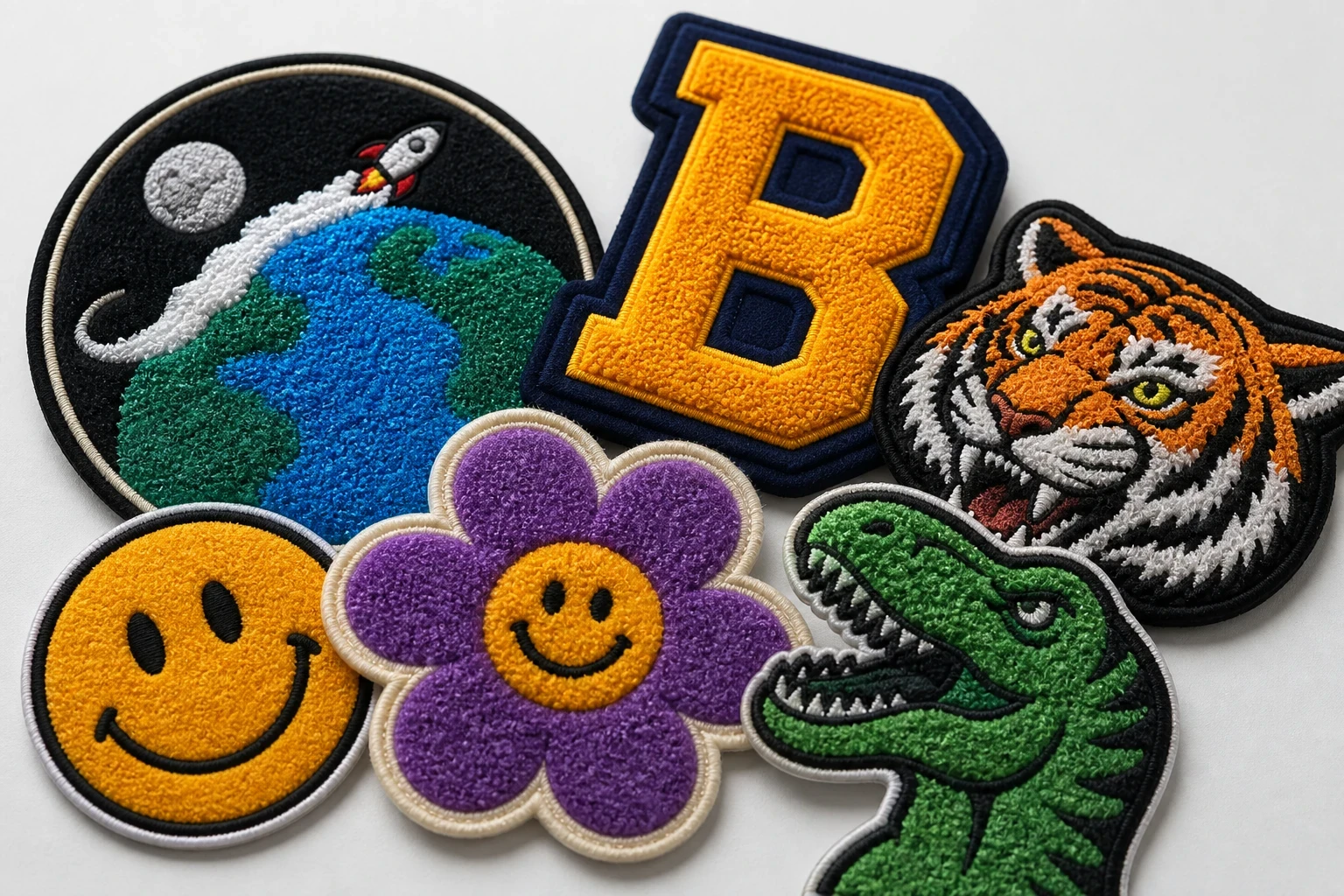
Chenille is recognised by its soft, tufted surface and raised pile. It gives a patch a substantial feel that works particularly well for varsity initials, club names, bold mascots, numbers and simple shield shapes. A large letter on a wool coaches jacket can look exactly right in chenille because the texture is part of the design rather than a problem to hide.
It is not the best answer for every logo. A detailed sponsor mark, fine map outline or small line of text may need embroidered patches or woven patches instead. Woven patches are flatter and can hold finer small detail; printed is flatter again, and that is the point when a photographic image or smooth tonal artwork matters. The useful question is not which finish sounds most impressive, but which surface keeps the artwork readable.
What chenille does particularly well
- Large initials on varsity jackets, wool coaches jackets and team outerwear.
- Bold football, rugby, hockey and American football club badges.
- School, college and university lettering with a traditional sports look.
- Simple brand marks on heavyweight sweatshirts, overshirts and work jackets.
- Large numbers or names where the letter shape is more important than fine detail.
2. What finished size will make the patch readable?
Do not choose a size from the artwork file alone. Measure the real garment. A chest patch on a polo shirt has a different working area from a back patch on a biker vest, and a badge intended for a school blazer must avoid the lapel, pocket and seam. Give the measurement in inches and tell the maker whether it is a width, height or maximum dimension.
A patch that looks generous on a screen can feel cramped at 2 inches wide. That is especially true if it includes a border, a mascot and two lines of wording. On a small patch, one strong word may work better than a club name, founding year, slogan and crest all packed together. If the design needs to be wider than it is tall, say so rather than allowing it to be forced into a square.
| Application | Common starting point | What to check |
|---|---|---|
| Left chest on a polo or shirt | Around 2.5–3.5 inches wide | Keep lettering short and check the patch against buttons, seams and the logo area. |
| School blazer badge | Around 2.5–3.5 inches high | Leave space around the pocket and confirm the badge will sit flat on the blazer. |
| Varsity or wool coaches jacket | Around 4–10 inches wide | Large initials and mascots usually suit the available back or chest area. |
| Football or rugby kit bag | Around 3–5 inches wide | Check the bag fabric, zip positions and whether the item will be washed regularly. |
| Biker vest or back panel | Often 8–12 inches wide for a large back design | Measure the actual panel and account for existing club patches, seams and curved areas. |
These are starting points, not fixed rules. The correct size depends on the wording, shape and garment. A narrow name strip might be 1.5 inches high but several inches wide, while a round crest may need a more balanced height and width. A mockup at the requested dimensions gives a better decision than guessing from a thumbnail.
3. Does the artwork suit chenille production?
Ask for a production check before finalising the design. Chenille normally favours clear blocks of colour, broad outlines and lettering with enough room for the yarn texture. Hairline outlines, tiny gaps, very small punctuation and delicate illustrations can merge when translated into a tufted surface.
A clean vector file is useful, but a vector file does not automatically make every detail manufacturable. A designer may create an impressive logo at 10 inches wide that becomes unreadable at 3 inches. Send the original artwork if you have it, along with the intended size and the garment photograph. The production team can then flag changes rather than simply shrinking the artwork.
Common artwork checks
- Are all words spelled correctly, including dates, initials and club abbreviations?
- Is there enough contrast between the chenille fill, border and background?
- Will narrow counters inside letters such as A, B, R and P remain open?
- Do the shapes still look clear without tiny decorative marks?
- Does the artwork show the correct aspect ratio rather than a stretched logo?
- Are any gradients, photographic effects or hairline outlines better suited to a printed finish?
The How to Design Artwork for chenille patches That Production-Ready guide covers these decisions in more detail. The wording is awkward in the guide title, but the practical point is simple: design for the finished patch, not for the high-resolution screen preview.
4. How many colours and how much contrast does it need?
Colour choice affects recognition, not just appearance. A navy yarn on a black garment may look stylish in a mockup but disappear in poor light. A white border around a dark crest can make the edge clearer, while a gold or cream fill may give a traditional school or club badge a warmer feel.
Ask how close colours can be matched and identify any colours that must remain distinct. If your brand uses a particular blue, provide a reference such as a Pantone value or a clear brand guide, while understanding that thread and yarn do not behave like ink on a screen. A free digital mockup is a visual production check, not a guarantee that a monitor will display physical yarn perfectly.
Contrast examples from real garments
- On a black nylon shell, a bright border and solid fill usually read more clearly than dark-on-dark colours.
- On a cream wool coaches jacket, navy, forest green, burgundy or black can create a clear traditional contrast.
- On a red hoodie, a white or cream border may separate the crest from the garment better than a similar red yarn.
- On a school blazer, check the school colours against the blazer fabric rather than against a white artwork background.
- On a Velcro panel, confirm the hook-and-loop area will not visually compete with the patch border.
If you are comparing surfaces, chenille patches vs embroidered patches: Which Is Right for Your Project? explains the practical differences. A flat embroidered badge may carry more small detail; chenille offers a more tactile, varsity-style result.
5. Which border finish should the patch have?
The border frames the design and protects the edge, so it deserves its own check. A merrowed crest has a raised, wrapped edge that gives a traditional badge appearance. Other edge treatments may suit a cleaner or more modern outline, depending on the patch shape and the intended garment.
Ask to see how the border will meet corners, points and curves. A round badge is forgiving, while a sharp shield or irregular mascot outline needs careful handling. If you are matching existing club patches, photograph them beside a ruler and mention the finish you want to resemble. The aim is a consistent set, not a new badge that looks unrelated to the others.
Not sure whether the design needs chenille, flat embroidery or a printed finish? Send the artwork and the garment details. We can show the options on a free digital mockup, usually within 12 hours.
GET A FREE MOCKUP6. Which backing suits the garment and washing routine?
Backing is not a minor add-on. It determines how the patch is fitted and how it behaves after use. Sew-on backing is usually the dependable choice for heavy jackets, school blazers, biker vests and garments that will be washed often. It takes more fitting time, but the attachment is easier to inspect and repair.
Iron-on backing is convenient for many cotton and cotton-blend garments, but it needs the right heat, pressure and surface. It is not suitable for every nylon shell, waterproof fabric or heat-sensitive finish. An iron-on patch can peel after a dryer cycle if the adhesive, temperature or garment is wrong. Velcro is useful for removable identifiers on kit, tactical-style clothing and event uniforms, but the panel must be positioned correctly and the hook side can catch on other fabric.
| Backing | Best suited to | Main trade-off |
|---|---|---|
| Sew-on | Blazers, wool jackets, biker vests, heavy workwear and frequently washed items | More fitting work, but generally a dependable long-term attachment. |
| Iron-on | Suitable cotton and cotton-blend garments where a quick application is wanted | Heat and fabric compatibility matter; poor application can lead to lifting or peeling. |
| Velcro | Removable team identifiers, kit bags, tactical-style garments and interchangeable badges | Needs a correctly positioned loop panel and may feel bulkier than sew-on. |
Tell the quote team what the patch will be attached to. “Jacket” is not enough information if the jacket could be a cotton varsity jacket, a coated nylon shell or a wool coaches jacket. Include the fabric, whether it is waterproof or heat-sensitive, and how it is normally cleaned.
7. Does the garment need special handling?
Garments are often the part of the order that gets overlooked. A patch can be made correctly and still be unsuitable for a thin nylon shell, stretchy sportswear or a curved cap. Nylon shells may need sewing rather than heat application, while a blazer may need careful positioning so the badge does not distort the front panel.
For football clubs, ask where the badge will sit in relation to sponsor marks, numbers and manufacturer logos. For hospitality polos, check that the patch does not interfere with a chest pocket or create an uncomfortable raised edge. For cadet units or work teams, consider whether the garment will be exposed to rain, abrasion, repeated washing or equipment straps.
Questions to answer about the garment
- What is the fabric: cotton, polyester, nylon, wool, denim, fleece or a blend?
- Is the surface coated, waterproof, stretchy, ribbed or quilted?
- Will the patch sit over a seam, zip, pocket or curved panel?
- Will the garment be tumble-dried or commercially laundered?
- Does the wearer need to remove or replace the patch?
- Is there already a backing panel or existing badge that must be matched?
A photograph is often more useful than a long description. Place a ruler or tape measure on the garment, show the intended area and include the inside if there is a lining or backing panel. This gives a clearer starting point for the size and attachment advice.
8. What quantity should you order?
The Customized Patches has a 5-piece minimum per design. That means five identical patches can be ordered for a small club, pilot clothing run or sample batch, but five different names or five separate logos are normally five designs rather than one design quantity.
Make a garment list before requesting the quote. Count players, staff, substitutes, spare jackets and future replacements, then decide whether one design will cover all items. A football club may need one crest for shirts and another larger version for a supporters’ jacket. A school may need the same badge in one size for blazers and another for bags. Those are useful details to share early.
Quantity can affect the unit price because setup, materials and finishing are spread across the run. Do not order a large number simply to chase a lower per-piece figure if the artwork or backing is still uncertain. A small approved batch can be sensible for a new brand; a larger run may suit a club with a stable badge and known garment requirements.
9. What should the quote include?
A useful quote should describe more than a patch size and a total. Check that it reflects the design count, finished dimensions, colours, border, backing, quantity and delivery destination in the United Kingdom. If you need several sizes or versions, ask for each one to be listed separately so the comparison is clear.
Ask whether the quoted amount includes artwork preparation, mockup work, backing and any finishing details discussed. Prices can vary with patch size, number of colours, shape, border, backing and order quantity. A small, simple chenille letter patch and a large multi-colour crest are not equivalent jobs even if both are described as one patch.
| Quote detail | Why it matters | What to provide |
|---|---|---|
| Number of designs | The 5-piece minimum applies per design. | State how many distinct logos, names or versions are required. |
| Finished size | Material use and readability change with size. | Give width and height in inches, plus a garment photograph. |
| Backing | Sew-on, iron-on and Velcro have different uses and costs. | Name the preferred backing and the fabric it will attach to. |
| Colour and border | The surface finish affects the visual result. | Send brand references and identify colours that must remain separate. |
| Delivery requirement | A production schedule needs a clear destination and date. | Give the UK postcode and the date the patches are needed. |
For a wider comparison of UK pricing factors, see How Much Do chenille patches Cost in the UK?. The sensible way to compare suppliers is to compare like with like, including size, quantity, backing, border and what happens after artwork changes.
10. What is the approval and delivery process?
Ask what happens between sending the artwork and receiving the finished patches. At The Customized Patches, a free digital mockup is usually supplied within 12 hours. Check the spelling, size, proportions, colours, border, backing and placement on the mockup before approving it.
Production starts only after approval. That protects both sides from an avoidable mistake, particularly with club initials, dates and sponsor wording. If you request a change after the mockup, ask for the revised version to be checked again rather than assuming the first approval covers the new artwork.
Lead time can depend on the design, quantity, backing and current production schedule, followed by UK-wide shipping. Give a required-in-hand date, not only an event date. A school may need badges before a new term; a club may need them before a tournament; a brand may have a clothing launch or photoshoot. The earlier the artwork and garment information are complete, the easier it is to discuss a realistic schedule.
If you want a checklist before sending the quote, use A Step-by-Step Guide to Ordering chenille patches. It follows the same practical sequence: choose the design, specify the garment and backing, review the mockup, approve it and then arrange production.
How chenille compares with other patch finishes
A short comparison can prevent a long correction later. Chenille has the raised yarn texture many teams want, but it is not automatically the best material for small text or image-heavy artwork. The garment, viewing distance and washing routine should guide the choice.
Name sew-on, iron-on or Velcro on the quote and include the garment fabric and required-in-hand date. We show the proposed design and backing on a free digital mockup, usually within 12 hours, and production begins only after approval.
GET A FREE MOCKUP| Patch type | Surface and strengths | Good fit for | Watch for |
|---|---|---|---|
| Chenille | Raised, tufted and tactile | Varsity lettering, bold crests, school and sports designs | Very fine detail and tiny text may lose clarity. |
| Flat embroidered | Thread-based with a more detailed stitched surface | Club badges, uniforms and logos with moderate detail | Dense detail can still need simplifying at small sizes. |
| Woven | Flat and closely woven | Small lettering, clean logos and flatter garment applications | Less of the raised varsity texture associated with chenille. |
| Printed | Flat ink or printed colour | Photographic images, gradients and highly detailed artwork | The finish is flatter; that is the intended result. |
| PVC | Rubbery, moulded and weather-tolerant in suitable uses | Outdoor, utility and modern graphic badges | May not suit a traditional wool, school or varsity appearance. |
| Leather | Natural or leather-look surface | Biker, heritage and premium casual clothing | Fine graphic detail and washing requirements need checking. |
You can compare printed patches, PVC patches and leather patches with chenille before settling on the finish. For biker clothing, see biker and motorcycle club patches and measure the full back panel before ordering a large design.
Examples of orders that need different decisions
A football club ordering 24 chest badges may prioritise a clear crest, sew-on backing and a size that does not interfere with the shirt sponsor. If the badges are for match shirts that are washed repeatedly, the club should discuss attachment and care rather than choosing iron-on simply because it sounds faster.
A cadet unit may need removable identifiers on a Velcro panel, with lettering visible at a practical distance. It should confirm the panel size and whether the patch needs to be removed for washing. A hospitality business putting badges on polos may prefer a smaller, simpler mark, while a large chenille crest could feel bulky or cover a pocket.
A school ordering blazer badges may need the same design across several year groups. It should approve the badge against the blazer colour, check the position on the pocket and allow time for fitting before the start of term. A biker club ordering a large back patch should map the available panel around existing badges and decide whether a separate rocker or border is required.
These are not just design preferences. They affect dimensions, backing, production suitability and the final appearance on the garment. A useful quote includes the context, not only the logo file.
A final pre-order checklist
Before approving the order, read the mockup as if you had never seen the original artwork. This catches the mistakes that are easy to miss because the designer already knows what the logo is supposed to say.
- Confirm the patch name or design reference.
- Check every word, initial, number and date.
- Confirm the finished width and height in inches.
- Check the fill colours, border colour and contrast with the garment.
- Confirm that the shape and aspect ratio are correct.
- Check the backing: sew-on, iron-on or Velcro.
- Confirm the target garment and its fabric.
- Check the quantity and remember the 5-piece minimum per design.
- Confirm the UK delivery postcode and required-in-hand date.
- Approve the final mockup in writing before production.
Keep the approved mockup with the quote and garment list. If you place a repeat order later, that record helps establish which size, colours and backing were previously accepted. If the garment changes, review the backing again rather than assuming the old choice will suit the new fabric.
Where to go next
If the main question is material, start with the chenille patches product page and compare it with the embroidered patches hub. If the main question is location, The Customized Patches supports customers across the United Kingdom, including teams and businesses ordering from different UK cities through the UK city pages.
For design-led planning, read Chenille patches Best Practices for schools and colleges or Chenille patches: Everything UK Buyers Need to Know. For another raised finish, 3D embroidered patches may be worth comparing, although the surface and production approach are different from chenille.
The simplest next step is to send the artwork, intended dimensions, quantity and garment details through the free mockup quote. The quote team can identify missing information before a design is put into production.
Frequently asked questions
What are the main questions to ask before ordering chenille patches?
Check the finished size, artwork detail, lettering, colours, border, backing, garment fabric, quantity, price and delivery date. Also ask how the mockup is approved. The Customized Patches has a 5-piece minimum per design and produces only after approval.
What is the minimum order for chenille patches?
The minimum is 5 pieces per design. If you need several different names, logos or sizes, ask for them to be listed as separate designs because the minimum applies to each design rather than to the whole basket.
How quickly can I see a chenille patch mockup in the UK?
The Customized Patches usually provides a free digital mockup within 12 hours. Review the wording, size, colours, border, backing and proportions carefully. Production starts only after the customer approves the mockup.
Should chenille patches be sewn on or ironed on?
Sew-on backing is generally the dependable choice for heavy jackets, wool coaches jackets, school blazers and garments washed often. Iron-on can suit compatible cotton or cotton-blend fabrics, but heat, pressure and cleaning conditions matter. Nylon shells and heat-sensitive garments should be checked before choosing iron-on.
Can chenille patches include small lettering?
They can include lettering, but small text may become unclear because chenille has a raised, textured surface. Bold, short wording with adequate spacing normally works better. If the artwork depends on fine detail, compare woven or flat embroidered patches before approving the design.
How do I order chenille patches for delivery anywhere in the UK?
Send the artwork, intended size in inches, quantity, garment type, preferred backing, colour references and required-in-hand date. The Customized Patches can prepare a free digital mockup, usually within 12 hours, then produce only after approval and arrange UK-wide shipping.
Ready to produce custom patches for your UK team or brand?
GET A FREE MOCKUP