
The Difference Between chenille patches and embroidered patches, Explained
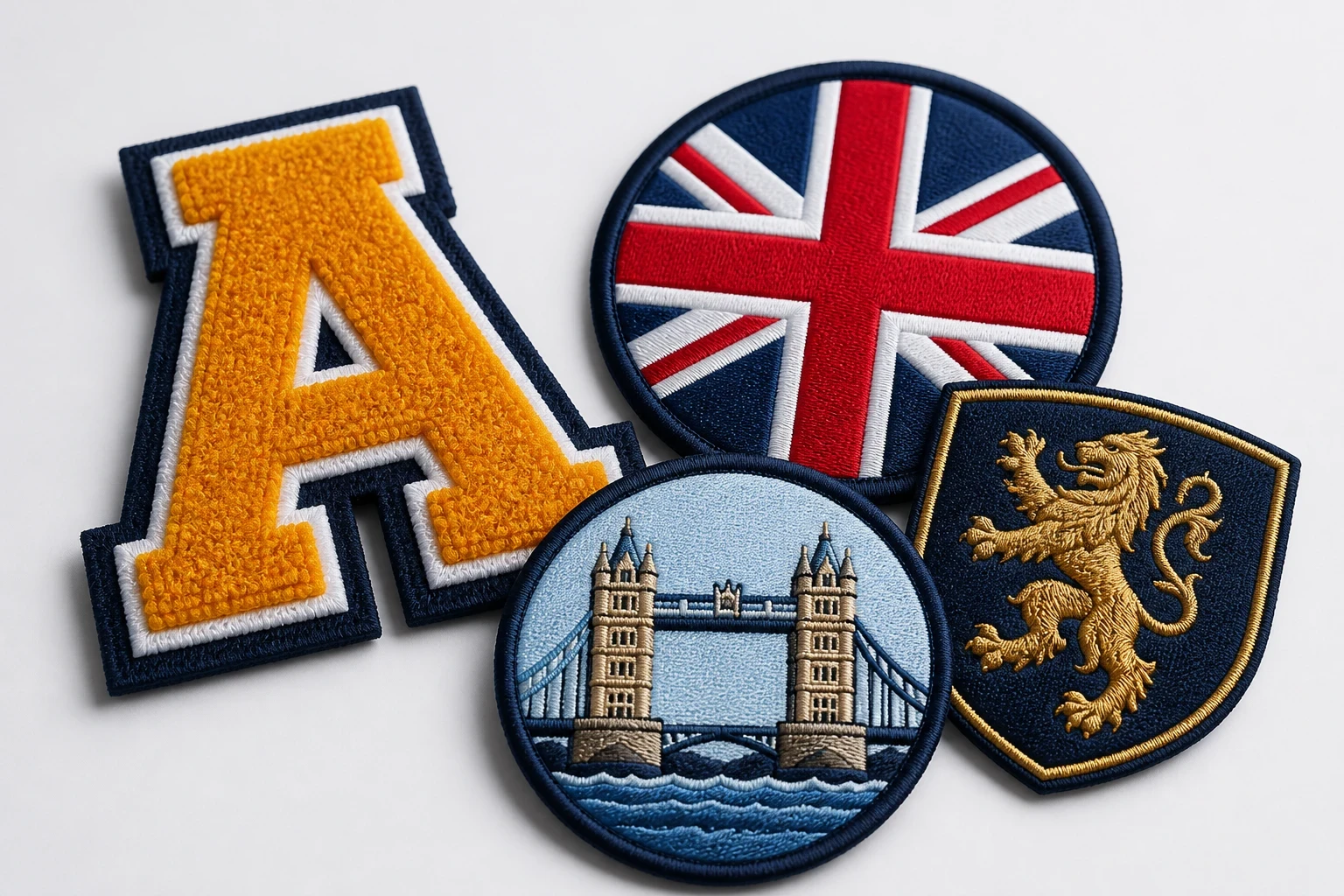
Chenille patches use raised, soft yarn to create a bold, textured finish, while embroidered patches use stitched thread on a fabric base for sharper detail and finer lettering. Chenille suits varsity crests, school badges and statement logos. Embroidery is usually better for detailed club, workwear and brand designs.
Key takeaways
- Chenille patches are raised, soft and bold; embroidered patches are flatter and usually better for fine detail.
- Chenille works particularly well for varsity lettering, school crests, sports clubs and large simple logos.
- Embroidered patches suit workwear, football kits, biker garments, hospitality polos and designs containing small text.
- The Customized Patches has a 5-piece minimum per design, offers a free digital mockup usually within 12 hours, and produces only after approval.
Chenille patches are raised and soft, with a fuzzy yarn surface that gives a badge a strong varsity or collegiate appearance. Embroidered patches use stitched thread on a fabric base, so they are flatter, generally sharper and better suited to fine lettering or detailed artwork. The right choice depends on the garment, the viewing distance and how much texture your design needs.
For a school blazer, football club crest or large team name, chenille can provide the bold presence people expect. For a company logo on a work jacket, a detailed motorcycle club emblem or a hospitality polo, embroidery is often more practical. The Customized Patches supplies both options across the United Kingdom, with a 5-piece minimum per design and a free digital mockup usually within 12 hours.
What is the main difference between chenille patches and embroidered patches?
The simplest distinction is the surface. Chenille is made with looped or cut yarn that sits above the backing, creating a soft, tactile pile. Embroidery is formed from tightly stitched thread on a twill or similar fabric base. You can feel the raised yarn on chenille immediately; an embroidered patch feels more like a firm piece of cloth with stitched coverage.
That construction affects the visual result. Chenille gives large shapes and letters a strong block appearance, but it is not intended to reproduce tiny details like a printed image. Embroidery can follow outlines, borders and lettering more precisely, although very small details still need enough room to stitch cleanly.
| Specification | Chenille patches | Embroidered patches |
|---|---|---|
| Surface | Raised, soft yarn with a textured pile | Stitched thread on a fabric base |
| Best visual effect | Bold, tactile, varsity or collegiate | Defined, traditional, detailed and versatile |
| Fine lettering | Best with larger, simple letters | Usually better for smaller text and outlines |
| Typical applications | School crests, sports teams, varsity jackets and statement logos | Workwear, football kits, clubs, brands, polos and jackets |
| Small design elements | Can become unclear if crowded or too small | Can handle more line work, subject to size and stitch limits |
| Backing choices | Sew-on, iron-on or Velcro can be specified | Sew-on, iron-on or Velcro can be specified |
| Feel on the garment | Soft, raised and more noticeable | Flatter and usually lighter in visual impact |
There is no universal winner. A large, uncomplicated letter on a wool coaches jacket may look better in chenille because the raised yarn is part of the design. The same letter beside a small slogan, fine border and several colour changes may be easier to produce as embroidery.
How chenille patches look and feel on real garments
Chenille is associated with varsity jackets for a reason. The pile catches light differently from a flat woven fabric, and large letters remain visible across a sports hall or pitch. It also sits naturally on wool coaches jackets, heavyweight sweatshirts and thicker school or college garments.
A football club might use a chenille shield with a large initial, season year or simple mascot. A school may choose a raised house letter for a blazer. A hospitality group could use a smaller chenille emblem on a thick overshirt, but we would first check the artwork and garment because the yarn needs enough space to show its shape.
Texture is also a trade-off. Chenille can attract lint, and the raised surface needs more care than a flat stitched badge. It is not the natural choice for a very detailed crest containing tiny text, narrow lines or a photographic effect. If the appeal is the raised, tactile finish, that limitation is usually acceptable.
Where chenille can go wrong
- Tiny lettering can close up visually because the yarn has a thicker, softer profile than standard embroidery thread.
- Very narrow gaps between shapes may disappear once the design is converted for production.
- A busy logo can lose its hierarchy when every part is raised to a similar level.
- Iron-on chenille on a nylon shell can peel or lift if the fabric, heat and care instructions are not suitable.
- A large badge may need sewing as well as adhesive support on workwear or outerwear that is regularly washed.
Those are design and application issues, not reasons to reject chenille. A clean mockup normally shows whether the lettering needs enlarging, whether a border should be simplified or whether sew-on backing is safer than iron-on. Our chenille patches team can review the garment before production.
Why embroidered patches remain the safer all-round option
Embroidery is familiar because it fits a wide range of garments and artwork. It works on football jackets, club fleeces, work shirts, branded hoodies, biker vests and hospitality polos. The stitched surface is flatter than chenille, but printed is flatter still; that is the point when a business needs a clean, low-profile logo.
A standard embroidered patch can include a border, several thread colours, initials, a simple illustration and small supporting text. There are still limits. Text that is too small may stitch poorly, and a complicated crest may need a larger finished size. The advantage is that embroidery gives the designer more control over outlines and internal detail than traditional chenille.
For a football club, embroidery may be the better choice when the badge contains a motto around a shield. For a business, it can keep a company name readable on a 3-inch jacket patch. For a biker or motorcycle club, a large back panel may combine an embroidered central design with other materials and a merrowed crest edge.
- Choose embroidered patches when the logo contains small but important lettering.
- Consider 3D embroidered patches when one section needs controlled height rather than an all-over chenille pile.
- Use woven patches when a smooth, tightly detailed surface is more suitable than visible thread texture.
- Ask about printed patches when the artwork depends on gradients, fine shading or a flat image effect.
The choice does not have to be driven by fashion. Think about how the patch will be read at six feet, how the garment will be washed and whether the wearer needs a soft statement piece or a more discreet company mark.
Choosing between chenille and embroidery by design detail
Start with the largest and smallest elements in the artwork. If the design is one bold word, a broad border and two or three strong colours, chenille is worth considering. If it has a fine shield outline, small dates, narrow lettering and separate internal symbols, embroidery will usually preserve more of the intended structure.
Finished size matters as much as decoration. A 4-inch school crest has more room for lettering than a 2-inch chest badge. A design that looks clear on a phone screen can become crowded when reduced to the size required for a polo or blazer. We check the artwork at its proposed finished dimensions rather than judging only from the original PDF.
| Your design or requirement | Likely starting point | Reason |
|---|---|---|
| Large single initial for a varsity jacket | Chenille | Raised yarn gives the letter visual weight |
| School house crest with a short name | Chenille or embroidery | Either can work if the lettering is large enough |
| Company logo with small wording | Embroidery or woven | Flatter construction helps preserve detail |
| Football badge with several outlines | Embroidery | Stitching offers more control over borders and symbols |
| Photographic artwork or smooth gradients | Printed | Ink reproduces tonal changes more naturally than thread |
| Raised single element on a flat badge | 3D embroidery | Height can be used selectively instead of across the whole design |
| Large biker back patch | Embroidery, chenille or a combination | The garment, panel size and club style should guide the finish |
Colour matching deserves a practical note. Thread and chenille yarn do not behave like screen colour, and a digital file is not a promise that every shade will appear identically on fabric. Send the closest brand references you have, then review the mockup for contrast, border thickness and the relationship between colours.
Not sure whether thread or raised yarn will hold your logo? Send the artwork and garment details for a free digital mockup usually within 12 hours, so you can compare the finish before production.
Backing, garment choice and wash performance
Backing is part of the specification, not an afterthought. Sew-on is the dependable option for many jackets, wool garments and items that will be washed often. Iron-on is convenient on suitable cotton or blended fabrics, but the adhesive is only as reliable as the heat, pressure and garment surface allow.
Not sure whether thread or raised yarn will hold your logo? Send the artwork and garment details for a free digital mockup usually within 12 hours, so you can compare the finish before production.
GET A FREE MOCKUPVelcro is useful for removable identifiers, tactical clothing, event teams and garments with a dedicated Velcro panel. The hook side and loop side need to be specified correctly. A patch intended for a panel is not the same as a badge that will be bonded permanently to a garment.
- Nylon shells can be sensitive to heat, so do not assume an iron-on backing is suitable.
- Wool coaches jackets may need sew-on application to avoid adhesive problems and distortion.
- Velcro panels are practical for changing names, roles or event identifiers.
- School blazers often benefit from sewing because repeated cleaning can challenge adhesive.
- Football training tops and polyester kit require the correct temperature and care approach.
- A dryer cycle can make a poorly chosen iron-on patch peel, curl or lose its edge.
It is common to see iron-on badges lift after a dryer cycle, particularly where the garment was not suitable or the patch had not been pressed correctly. That does not mean iron-on is always wrong. It means the back, fabric and care instructions should be considered together.
Sew-on, iron-on or Velcro?
If the garment is expensive, heavily used or difficult to heat safely, sew-on is usually the sensible starting point. Iron-on can save application time for suitable garments and small batches. Velcro makes more sense where the wearer needs to remove or replace the patch.
Tell us the actual garment rather than only saying jacket. A nylon shell, wool coaches jacket, cotton hoodie, football shirt and leather biker vest each present different application questions. The same chenille design may need a different backing from an embroidered version.
Which option suits teams, schools, clubs and businesses?
Schools and colleges often choose chenille for house letters, leavers' badges and prominent sports awards. The raised finish feels traditional and works well when the design is deliberately simple. For a school blazer with a detailed crest and small motto, embroidery may be the more readable route. Our guide to chenille patches best practices for schools and colleges covers sizing and application decisions in more detail.
Football clubs usually need a badge that can be recognised quickly and repeated consistently across jackets, kit bags and staff clothing. Embroidery is often the practical default for a multi-part crest, while chenille can make a large club initial or special tournament badge stand out. A team ordering several sizes should check that each version has enough room for its own lettering.
Biker and motorcycle club patches tend to be larger and more layered than a normal chest badge. A back panel may use a central embroidered design, a rocker shape and a separate merrowed crest. You can review the biker and motorcycle club patches range when the garment and club layout require a larger format.
Businesses often prioritise repeatability and clear branding. A hospitality company may need a low-profile badge on polos that move through commercial laundry. A trades team may prefer embroidered patches on jackets because staff names and company wording need to remain legible. A fashion or streetwear brand may select chenille for a limited collection because the raised texture is part of the product design.
| Buyer | Good reason to choose chenille | Good reason to choose embroidery |
|---|---|---|
| School or college | A bold house letter, sports award or traditional varsity look | A detailed crest, small motto or everyday blazer badge |
| Football club | A large simple initial or special event badge | A detailed club crest for jackets and kit bags |
| Biker club | A large statement area with broad lettering | A detailed back panel, rocker or merrowed crest |
| Hospitality business | A textured overshirt or premium staff garment | A flat logo that suits polos and regular laundry |
| Fashion brand | A tactile, collectible or varsity-inspired finish | A controlled logo with finer artwork and repeat production |
There is also nothing wrong with using different patch methods within one range. A brand might use embroidery for its staff uniform and chenille for a capsule jacket. A college may use embroidered academic crests but chenille sports letters. The visual system can stay consistent through shape, border and colour even when the surface changes.
Cost, minimum quantities and what affects the quote
Patch pricing depends on more than the number of pieces. Finished size, stitch or yarn coverage, number of colours, shape, backing, border, artwork preparation and delivery all affect the quote. Chenille can require different production work from embroidery because the yarn surface and lettering need to be planned around the raised construction.
The Customized Patches accepts a 5-piece minimum per design. If you need five school letters, each letter may be treated as its own design depending on the artwork. If you need two versions of a crest, confirm whether they are separate sizes or separate designs before approving the quote.
A lower piece count does not automatically make one method cheaper. A simple embroidered badge may be efficient to produce, while a small chenille badge with complex lettering may need more design adjustment. Equally, a large embroidered patch with heavy coverage can take more production time than a clean chenille letter. The useful comparison is based on the exact finished badge, not a general price claim.
What to include in a quote request
- Upload the clearest artwork available, preferably a vector file or a high-resolution image.
- State the finished width and height in inches, or tell us the garment position and intended viewing distance.
- Name the garment: nylon shell, wool coaches jacket, blazer, hoodie, polo, football shirt, leather vest or another item.
- Choose a likely backing, or ask for advice between sew-on, iron-on and Velcro.
- List the quantity for each design and identify any different sizes or colour versions.
- Mention small lettering, gradients, fine lines and any part of the artwork that must remain exact.
- Say how the patch will be used and washed so the application advice fits the job.
A clear quote request reduces revisions. It also lets our team flag a problem before money is spent on a design that will not read at the intended size. Our guide, 10 Questions to Ask Before Ordering chenille patches, is useful if several people in a club or business need to agree the specification.
Ordering times, mockups and approval
The first useful step is to send the artwork, quantity, finished size and garment information. The Customized Patches usually provides a free digital mockup within 12 hours. That mockup lets you review the shape, border, colours, lettering and general surface treatment before the order moves forward.
Production starts only after approval. This matters because the mockup is the point to correct a misspelt club name, enlarge a school letter, change the backing or simplify a narrow line. Once production has begun, a change is no longer just an artwork revision; it may affect the manufacturing work already planned.
Lead time varies with design complexity, quantity, backing and the production schedule. Ask for the current estimate when requesting a quote, especially if the patches are needed for a new football season, school presentation, trade event or clothing launch. UK-wide shipping is available, but delivery time should be considered separately from production time.
Name sew-on, iron-on or Velcro on the quote. We show the proposed back on the free 12-hour mockup so the finished specification matches the garment and the way the patch will be used.
Name sew-on, iron-on or Velcro on the quote. We show the proposed back on the free 12-hour mockup so the finished specification matches the garment and the way the patch will be used.
GET A FREE MOCKUPCommon mistakes when comparing the two methods
The first mistake is choosing from a thumbnail. A patch can look excellent on a screen and lose its small lettering when made at 2 inches wide. Always judge the proposed finished size, not just the original artwork.
The second is assuming texture equals quality. Chenille is not a higher-quality version of embroidery, and embroidery is not an inferior flat version of chenille. They are different constructions. A clean embroidered patch will usually beat a crowded chenille patch, while a bold chenille letter can look more convincing than a flat stitched one.
- Do not use chenille for detail that depends on hairline strokes or tiny text.
- Do not force an embroidered design to imitate a raised varsity badge if texture is the main reason people will notice it.
- Do not select iron-on solely because it is convenient without checking the garment fabric and care routine.
- Do not leave the backing decision until after production artwork has been approved.
- Do not compare prices without matching size, quantity, colours, backing and artwork complexity.
- Do not assume every variation counts as one design; confirm this when ordering several names, letters or sizes.
- Do not approve a mockup without checking spelling, dimensions, border shape and garment placement.
For more artwork guidance, see How to Design Artwork for chenille patches That Production-Ready. It is especially useful for cleaning up shapes before a school, club or brand order is quoted.
A practical decision guide
Choose chenille patches when the raised surface is central to the look, the letters or shapes are reasonably large, and the garment can support a more tactile badge. School sportswear, varsity jackets, college clothing and statement fashion pieces are common examples.
Choose embroidery when the patch must carry a detailed crest, small wording or a business logo that needs to sit neatly on a polo, jacket or kit bag. It is the sensible starting point for many clubs and businesses because it balances recognition, flexibility and a familiar finish.
Choose another method if neither surface fits the artwork. Woven patches can suit fine, flat detail; printed patches can reproduce gradients; PVC can provide a moulded, wipe-clean surface; and leather can support a more material-led brand identity. The aim is not to make every design embroidered. The aim is to make the finished badge work on the garment.
- Pick chenille for raised yarn, strong block lettering and a varsity-led appearance.
- Pick embroidery for detailed logos, club crests, workwear and flatter application.
- Pick woven for compact detail where a smooth fabric surface matters.
- Pick printed for gradients, illustrations and image-like artwork.
- Pick PVC for a moulded badge with a different feel from thread.
- Pick leather for a material-specific look suited to selected garments and brands.
If you are between two options, request mockups of both at the same finished size. Comparing chenille and embroidery side by side is more useful than debating the names of the techniques. It shows how the border, text and colour balance behave on the actual garment.
Final checks before you approve a patch order
Check the spelling, finished dimensions, orientation and border. Look at small text at the size it will be produced. Confirm the backing, garment fabric, quantity per design and delivery address in the United Kingdom.
The Customized Patches keeps the process straightforward: send the artwork, receive a free digital mockup usually within 12 hours, make any agreed changes, then approve the production version. We produce only after approval. The 5-piece minimum applies per design, so list each variation clearly when requesting a quote.
Chenille and embroidery are both useful when matched to the right brief. Chenille makes texture visible and gives bold letters presence. Embroidery handles a broader range of detailed logos and everyday garments. The best choice is the one that remains readable, wearable and suitable for the way your team, club, brand or business will use it.
Frequently asked questions
Are chenille patches better than embroidered patches?
Neither is automatically better. Chenille patches are better for raised, soft texture, large letters and varsity-style designs. Embroidered patches are usually better for detailed logos, small lettering, football crests, workwear and business branding. The garment, finished size and artwork should decide the method.
Can chenille patches include small lettering?
They can include lettering, but the letters need enough height and spacing to remain clear in raised yarn. Very small words, narrow strokes and crowded text may lose definition. If a motto or company name must be readable at a small size, embroidery or woven construction may be more suitable.
Are embroidered patches flatter than chenille patches?
Yes. Embroidered patches use stitched thread on a fabric base and normally have a flatter profile. Chenille patches use raised yarn, so they feel softer and stand above the backing. The flatter embroidered surface can be easier to place on polos, jackets, football kit bags and garments that need a less noticeable badge.
What backing should I choose for chenille patches?
Sew-on, iron-on and Velcro are common options. Sew-on is often the safest choice for wool, nylon shells, heavy outerwear and garments that receive frequent washing. Iron-on can suit compatible fabrics, while Velcro is useful when the patch needs to be removed or changed. The garment should be named before the backing is confirmed.
What is the minimum order for chenille patches from The Customized Patches?
The minimum is 5 pieces per design. If you are ordering different letters, sizes, names or artwork versions, ask us to confirm how each variation is counted. The Customized Patches provides a free digital mockup usually within 12 hours and produces only after the mockup and specification have been approved.
How quickly can I see a patch mockup in the UK?
The Customized Patches usually sends a free digital mockup within 12 hours of receiving usable artwork and the key order details. Include the design, finished size, quantity, garment and preferred backing. Production does not begin until you approve the final version, and the manufacturing lead time is confirmed separately in the quote.
Ready to produce custom patches for your UK team or brand?
GET A FREE MOCKUP