
Chenille patches Checklist: What to Confirm Before You Order
Before ordering chenille patches, confirm the finished size, wording, colours, border, backing, garment, quantity and delivery date. Check that small details will work with chenille’s raised yarn texture, approve a digital mockup, and order at least 5 pieces per design. The Customized Patches provides a free digital mockup, usually within 12 hours, before production begins.
Key takeaways
- Chenille patches need clear, simplified artwork because raised yarn can soften small lettering and fine lines.
- The Customized Patches has a 5-piece minimum per design for chenille patches.
- A free digital mockup is usually supplied within 12 hours, and production starts only after approval.
- Backing, garment fabric, finished size and delivery date should be confirmed before a quote becomes an order.
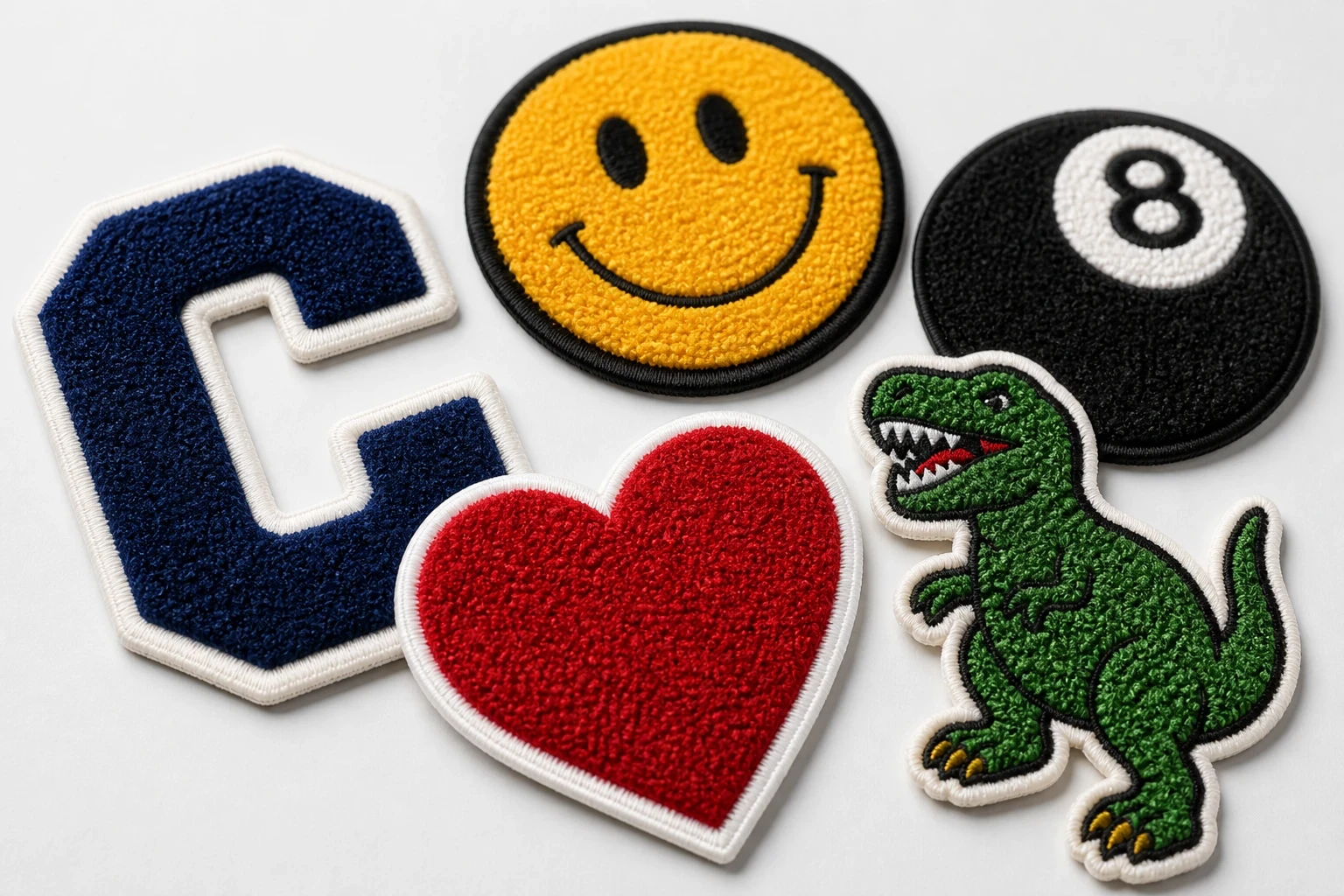
The safest way to order chenille patches is to confirm seven things before production: artwork, finished size, colours, border, backing, garment and delivery date. Chenille has a raised yarn surface, so tiny lettering and very fine lines need checking rather than assuming they will reproduce like a flat print.
The Customized Patches supplies a free digital mockup, usually within 12 hours, so you can check the proposed design before committing. There is a 5-piece minimum per design, and we produce only after you approve the mockup.
1. Start with the job, not just the logo
A logo on a screen does not tell us enough to quote a useful patch. We need to know what the patch will be doing. A football club may want a large crest for a wool coach jacket, a cadet unit may need a durable identifier for a uniform, and a hospitality company may want a small emblem on polos that go through regular washing.
The same artwork can need different treatment in each case. A patch for a Velcro panel needs a hook-compatible backing. A patch being sewn to a nylon shell may need a clean edge and careful stitch placement. A school blazer usually benefits from a neat sew-on finish, while a promotional garment may call for a flatter and lighter option.
Write down these basic details
- The garment or item receiving the patch, such as a football jacket, wool coach jacket, nylon shell, school blazer, polo shirt, bag or vest.
- The number of separate designs and the quantity required for each design.
- The target finished width and height in inches.
- The required attachment method: sew-on, iron-on or Velcro.
- The date the patches need to arrive in the United Kingdom.
- Any club, school, company or brand colour references that need close attention.
- Whether the patch will be washed often, exposed to rain, or removed and reapplied.
This short brief prevents a common problem: choosing a patch from a product image without considering the garment underneath. A thick chenille crest may look right on a varsity-style jacket but feel bulky on a lightweight polo. If the patch is going on a particular garment, send a photograph or tell us the fabric. That information affects the recommendation.
2. Check whether your artwork suits chenille patches
Chenille is recognised for its soft, tufted yarn and bold, tactile finish. It works particularly well for initials, block lettering, mascots, numbers, simple crests and strong geometric shapes. It is less suited to artwork packed with tiny text, narrow gaps, hairline outlines or detailed photographic shading.
That is not a quality judgement. It is a material trade-off. Raised yarn gives the patch its character, but it does not behave like ink on a smooth sheet. A small word may need larger lettering, heavier strokes or a simpler typeface. If the design depends on fine detail, compare it with embroidered patches, woven patches or printed patches before deciding.
Artwork checks to make before sending a file
- Check every word, initial and number. A spelling correction after approval can mean a new mockup and a delayed order.
- Decide which parts are essential. A mascot’s silhouette may matter more than tiny facial features.
- Look at the artwork at the intended physical size, not only at full screen size.
- Avoid placing narrow lettering too close to a border, where the edge can make it harder to read.
- Keep separate colour areas clear enough for the yarn construction.
- Tell us if a particular typeface must be retained, and understand that it may need simplifying at small sizes.
- Supply the cleanest file available, but do not redraw the design yourself if you are unsure. A clear PNG, PDF, SVG or similar artwork can be reviewed.
For a football club, bold initials and a simple year can make a stronger chenille design than a full shield packed with small text. For a biker vest, a large back crest can support more detail than a small front identifier. For school blazers, readability at arm’s length usually matters more than reproducing every line in an old badge. Our guide to artwork for chenille patches covers this decision in more detail.
3. Confirm the size in inches
Patch size should be agreed as a finished measurement. Saying “medium” is not enough for production. Tell us the maximum width, maximum height or both, and mention whether the shape must remain proportional. A circular crest, a long name strip and a tall mascot will each sit differently on the garment.
Use a ruler or make a paper cut-out and place it on the garment. This simple test often catches mistakes before production. A 3-inch chest patch may look large on a polo but modest on a jacket back. A 5-inch chenille letter may be right for a varsity jacket and too large for a school blazer pocket.
| Project example | Size question to confirm | Practical point |
|---|---|---|
| Football club chest crest | Will the crest fit beside the zip, sponsor mark or pocket? | Check the available flat area and allow room for the border. |
| School blazer badge | Will the badge sit neatly on the upper chest? | Compare the paper template with the blazer pocket and seam. |
| Biker back patch | Is the full back panel available, including space for rockers? | Measure the vest rather than copying a size from another jacket. |
| Hospitality polo emblem | Will the patch feel too heavy or wide on the chest? | A smaller design may be more comfortable and easier to wash. |
| Velcro panel identifier | Does the patch match the panel dimensions? | Allow for the backing and avoid a patch that overhangs the hook area. |
Size also affects legibility, cost and the balance of the artwork. Making a patch larger can help lettering, but it may not solve a design that has too many competing details. Sometimes simplifying the crest is the better answer. A free mockup gives you a visual check before you have a batch of patches on the production schedule.
4. Agree colours, yarn texture and the border
Colour choices should be written down rather than described only as “dark blue” or “bright red”. If the patch represents a club, school or brand, send the preferred colour reference and identify the most important colours. Screen displays vary, and yarn has its own surface texture, so a digital mockup is a planning representation rather than a guarantee that every screen pixel will match a thread sample.
Ask which areas will be raised and which will form the background. A chenille letter can stand out against a contrasting field, while similar shades may merge at a distance. Gold against yellow, navy against black and pale grey against white all deserve a careful look before approval.
The border is part of the design
A merrowed crest gives a traditional finished edge and can suit team jackets, school clothing and biker garments. The border needs enough visual weight to frame the design without swallowing small details near the outside. Ask whether the shape should be round, shield-shaped, rectangular, arched or cut to the artwork.
- Name the border colour separately from the background colour.
- Check that the outer edge does not cover an important letter or thin shape.
- Use a bold contrast when the patch must be read from several feet away.
- Consider a simpler outline when the artwork already contains many colour changes.
- Confirm whether a traditional merrowed edge suits the garment or whether a cleaner cut edge is preferable.
5. Choose the backing for the garment
Backing is not a minor add-on. It determines how the patch is attached and how easily it can be moved later. The usual choices are sew-on, iron-on and Velcro, but the right option depends on fabric, laundering, patch weight and intended use.
Not sure whether your lettering, colours and border will hold up in chenille? Send the artwork and garment details to The Customized Patches for a free digital mockup, usually within 12 hours. We produce only after you approve it.
GET A FREE MOCKUP| Backing | Usually suitable for | Points to check |
|---|---|---|
| Sew-on | Wool jackets, school blazers, denim, biker vests, bags and garments needing a dependable attachment | Allow access for stitching and consider the garment’s lining or waterproof construction. |
| Iron-on | Some cotton or suitable blended garments with a firm, heat-tolerant surface | Heat, pressure and fabric suitability matter. An iron-on patch that peels after a dryer cycle is not a successful fit. |
| Velcro | Removable identifiers, tactical-style panels, clubs changing names or roles, and compatible bags or jackets | The garment needs the matching hook or loop panel, and the patch should not exceed the usable panel. |
Sew-on is often the most adaptable choice for wool coaches, denim and school clothing. It is also sensible for a biker vest that will be worn outdoors. Iron-on can be convenient, but nylon shells and heat-sensitive fabrics need care; heat can mark or distort the material. Velcro is useful when a team changes its identifier, but it can add bulk and requires the receiving panel to be installed correctly.
Do not assume an iron-on backing removes the need for stitching in every situation. Frequent washing, heavy use, curved panels and rough handling can put stress on the adhesive bond. If the garment will go through a commercial laundry or a dryer, tell us before choosing the attachment method.
6. Compare chenille with other patch materials
Chenille is chosen for its texture and bold collegiate feel, not because it is the answer to every patch brief. Printed is flatter; that is the point. Woven can hold small lettering more neatly than a high-pile surface. Standard embroidery gives a familiar stitched appearance, while PVC gives a moulded, wipe-clean finish.
| Patch type | Surface and detail | Good fit | Trade-off |
|---|---|---|---|
| Chenille | Raised, soft yarn with bold shapes | Varsity jackets, team crests, school groups, initials and large numbers | Small text and fine detail may need simplifying. |
| Embroidered | Stitched thread with flexible detail | Uniforms, branded workwear, clubs and general-purpose badges | Less plush than chenille and can look busier when heavily detailed. |
| Woven | Flatter, tighter surface | Small lettering, labels and designs needing a clean line | Does not provide the same raised chenille texture. |
| Printed | Flat ink or printed surface | Gradients, photographs and highly detailed artwork | Flatter appearance and different wear considerations. |
| PVC | Raised moulded rubber-like surface | Outdoor, utility and wipe-clean applications | Different visual character from a traditional textile crest. |
| Leather | Natural or leather-look material surface | Biker garments, premium labels and understated branding | Limited suitability for detailed multicolour artwork. |
If your logo has a photograph, a fine illustration or a colour gradient, ask for a comparison rather than forcing it into chenille. You can review 3D embroidered patches for a raised thread effect, printed patches for flat detail, PVC patches for a moulded surface or leather patches for a different garment style. The best choice is the one that suits the artwork and the way the garment will be used.
7. Confirm quantity, minimum order and price
The minimum order is 5 pieces per design. That means one design can be ordered as five patches, while a second design also needs to meet its own 5-piece minimum. It is worth counting sizes and versions carefully if you have a first team, reserve team, staff version or different club wording.
A quote normally depends on the finished size, quantity, artwork complexity, backing and delivery requirements. Larger patches use more material and may need more production time. Multiple colour areas, shaped borders and detailed lettering can also affect the work involved. For a useful quote, send the final quantity rather than a broad estimate such as “some for the team”.
Questions to ask about the quotation
- Is the price for one design or several different designs?
- Does the quote include the selected backing?
- Is the finished size measured by width, height or the maximum dimension?
- Is delivery to one UK address included or calculated separately?
- Does the price change if the quantity rises from 5 to 20 or 50 pieces?
- Are there any artwork amendments needed before the mockup can be prepared?
- What happens if the garment or backing changes after approval?
If you are comparing prices, compare like for like. A quote for a 3-inch sew-on patch cannot be fairly compared with a 5-inch Velcro version. Check the design count, backing, dimensions, quantity and delivery line before selecting an option. Our guide to how much chenille patches cost in the UK explains the main pricing factors.
8. Plan the production and delivery date
Give us the date the patches need to arrive, not only the date you expect to place the order. A football club may need badges before a presentation evening. A hospitality business may need branded polos before an opening weekend. A school or college may be working towards a graduation event, sports tour or new academic term.
The free digital mockup is usually sent within 12 hours, but that is the artwork-check stage rather than the full production time. Production begins only after approval. If you request a size change, new wording, different colours or a new backing after the first mockup, allow time for that revision before production.
A sensible ordering sequence
- Send the artwork, quantity, intended size and garment details.
- Confirm the design, colour preferences, border and backing.
- Receive and inspect the free digital mockup, usually within 12 hours.
- Check spelling, dimensions, proportions, colour layout and attachment method.
- Approve the final mockup in writing.
- Production starts after approval, followed by delivery to the confirmed UK address.
Leave a little room around a hard event date. Transport delays, a late garment delivery or an internal approval delay can affect the overall project even when the patch production itself runs as planned. If you are ordering for a club committee, appoint one person to give final approval so that conflicting changes do not arrive from several people.
9. Approve the mockup like a production proof
A mockup is your chance to catch practical errors while changes are still straightforward. Do not only ask whether it looks attractive. Check whether it says the right thing, fits the intended area and uses the correct backing. A design can look excellent on a white screen and still be wrong for a black wool jacket or a narrow Velcro panel.
- Spelling, initials, dates and numbers.
- Width and height, including whether the shape remains proportional.
- Border style and border colour.
- Background, lettering and motif colours.
- The position of every major element.
- The selected attachment method.
- The garment or item the patch is intended for.
- The quantity for each separate design.
- The delivery address and required arrival date.
Share the mockup with the person who knows the club badge, school crest or company identity. A production desk can check construction, but a committee member or brand owner may spot a wording or colour issue that is not obvious from the artwork file. Once approval is given, production follows the approved specification.
10. Avoid the most common failures
Most patch problems begin before production. The design is supplied at the wrong size, a backing is chosen without checking the fabric, or the customer assumes a small word will read clearly because it looks fine on a monitor. These are specification issues, not reasons to blame the material after the order has been made.
Name sew-on, iron-on or Velcro on the quote and tell us the date the garments are needed. We will show the proposed backing and layout on a free digital mockup, usually within 12 hours, before production starts.
GET A FREE MOCKUP- Ordering fewer than 5 pieces for a design and discovering the minimum applies separately to each version.
- Using the same small patch for a chest and a jacket back without checking scale.
- Choosing iron-on for a nylon shell or another fabric that cannot safely take the required heat.
- Forgetting that a dryer cycle can weaken an adhesive bond when the garment is not cared for as specified.
- Approving a proof without checking the exact wording and numbers.
- Sending a low-resolution screenshot and expecting fine detail to be reconstructed without clarification.
- Changing the backing after approval and assuming the garment fit will remain identical.
- Leaving no time between mockup approval and a club event, match day or launch.
- Placing a heavy patch across a seam, zip or pocket where it cannot sit flat.
- Copying a badge from an old garment without checking whether the new garment has a different usable area.
The practical fix is simple: measure the garment, state the use, review the mockup and approve one agreed specification. Our guide to common mistakes when ordering chenille patches is useful if this is your first order.
11. Examples from real UK garment briefs
A football club ordering chenille patches for a wool coaches’ jacket often wants a traditional, high-impact crest. We would check that the patch does not sit over the zip, ask whether the jacket will be washed frequently and confirm whether the club wants sew-on backing. Large initials, a ball motif and a clear year can work well; a tiny sponsor line may need a different treatment.
A cadet unit may be thinking about a removable identifier on a compatible Velcro panel. In that case, the panel dimensions, hook-and-loop arrangement and patch weight matter more than a decorative border. The artwork may need to be simplified so the identifier can be recognised quickly rather than read as a detailed crest.
A hospitality team using polos has a different brief again. The patch may need to be smaller, lighter and comfortable against the chest area. Printed or woven could be better if the mark includes small text. If chenille is preferred for a premium or collegiate feel, check the size against the polo and choose a backing that suits repeated laundering.
Biker and motorcycle club patches often involve several pieces working together: a back crest, upper and lower rockers, a front identifier and sometimes a smaller sleeve mark. Each piece should be measured on the actual vest, not guessed from a photograph. See the biker and motorcycle club patches range if the wider layout is part of your order.
12. Final chenille patches ordering checklist
Before you approve the quote, run through this list from top to bottom. It is deliberately simple because the useful checks are the ones a team manager, buyer or business owner can complete without specialist production knowledge.
- I have named the garment or item receiving the patch.
- I have measured the available area in inches.
- I have checked the design at the intended finished size.
- I have confirmed the wording, initials, dates and numbers.
- I have identified the main colours and border colour.
- I have decided whether the edge should be merrowed or another shape.
- I have selected sew-on, iron-on or Velcro backing.
- I have considered washing, dryers, rain, heat and regular handling.
- I have counted each design separately and met the 5-piece minimum per design.
- I have supplied the delivery address in the United Kingdom.
- I have stated the date the patches need to arrive.
- I have reviewed the free digital mockup, usually within 12 hours.
- I understand that production starts only after approval.
- I have one person responsible for final approval.
If those points are clear, you are ready to request a quote. The free mockup quote is a sensible first step when you are unsure about size, detail, colours or backing. You can also compare the wider range through embroidered patches before deciding whether chenille is the right surface for the job.
Related guides and product options
For a second look at the ordering process, read 10 Questions to Ask Before Ordering chenille patches and A Step-by-Step Guide to Ordering chenille patches. If you are checking an existing specification for weak points, Common Mistakes to Avoid When Ordering chenille patches provides a useful final review.
The Customized Patches serves teams, brands, clubs and businesses across the United Kingdom. We will help you compare the surface, size and backing honestly, prepare the digital mockup and wait for your approval before production.
Frequently asked questions
What is the minimum order for chenille patches?
The minimum order is 5 pieces per design. If you order two different designs, each design must meet the 5-piece minimum. Different sizes, wording or colour versions may count as separate designs, so list each version clearly when requesting a quote.
How quickly can I receive a chenille patches mockup?
The Customized Patches usually provides a free digital mockup within 12 hours. The mockup stage is separate from production and delivery. Production starts only after you have checked and approved the proposed artwork, size, colours, border and backing.
Are chenille patches suitable for small lettering?
They can be suitable for larger, bold lettering, but very small type may lose clarity because chenille uses raised yarn. Increase the lettering size, simplify the wording or compare a flatter option such as woven or printed patches. The mockup should be checked at the intended finished size.
Which backing is best for chenille patches on a school blazer?
Sew-on backing is commonly the practical choice for a school blazer because it does not depend on heat or adhesive. The exact choice depends on the blazer fabric, laundering and whether the badge needs to be removed. Confirm the garment details before the backing is selected.
Will iron-on chenille patches work on a nylon jacket?
Nylon and other heat-sensitive shells need checking before choosing iron-on backing. Heat can mark, distort or damage some fabrics, and heavy use or dryer cycles can weaken adhesive. Sew-on or a compatible Velcro arrangement may be more suitable, depending on the garment.
Can I order chenille patches for a UK club or business in several designs?
Yes. Each design should be listed separately with its own quantity, dimensions, artwork and backing. The 5-piece minimum applies per design. A football club, school, hospitality team or business can request several designs in one enquiry, provided the specifications are clear.
Ready to produce custom patches for your UK team or brand?
GET A FREE MOCKUP