
Are sublimation printed patches UK Right for Your Project? A Decision Guide
Sublimation printed patches UK are a good choice for artwork with gradients, photographs, small lettering or many colours. The image is printed onto patch material rather than built with thread, so the surface stays flat and detailed. Choose embroidery for raised texture, and confirm garment, backing and wash requirements before ordering.
Key takeaways
- Sublimation printed patches UK suit photographs, gradients, fine lines and multi-colour artwork that thread cannot reproduce easily.
- Printed patches have a flatter face than embroidered patches; that is useful on lightweight clothing and modern brand graphics, but it does not provide raised texture.
- The Customized Patches has a 5-piece minimum per design, supplies UK-wide, and normally sends a free digital mockup within 12 hours.
- Production begins only after you approve the mockup, backing, size, quantity and artwork details.
Sublimation printed patches UK are usually right for projects that need a flat, detailed image rather than raised thread. They work particularly well for photographs, gradients, fine line drawings and logos with several colour changes. If your priority is a traditional crest with visible stitching, embroidered patches may be the better fit.
The choice depends on the artwork, garment, backing and expected use. A football club badge on a tracksuit, a hospitality logo on a polo and a full-colour design for a nylon shell may need different specifications. The Customized Patches supplies customers across the United Kingdom, with a 5-piece minimum per design, a free digital mockup usually within 12 hours, and production only after approval.
What are sublimation printed patches UK?
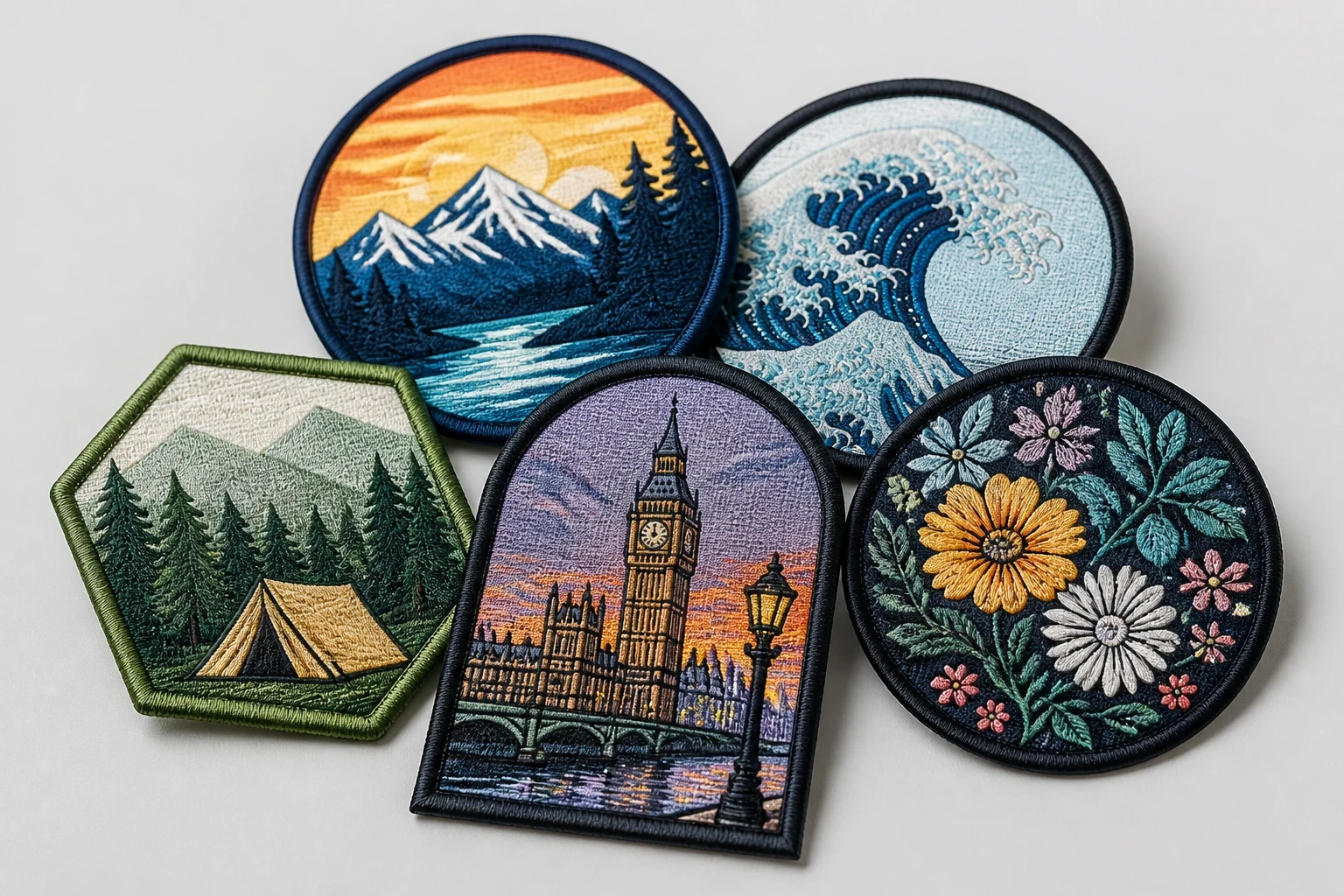
A sublimation printed patch uses heat to transfer an image into a suitable patch surface. Instead of building the design from separate stitches, the artwork is reproduced as colour on the face of the patch. That makes the finished patch flatter and allows the artwork to retain shading, tonal changes and photographic detail.
Printed is flatter; that is the point. A flat face can sit neatly on a football shirt, branded polo or lightweight jacket without the raised bulk of a dense embroidered fill. It also gives a designer more freedom with artwork that contains a sunset, a painted illustration, a map, a face or a complex background.
This does not mean every file should be sent straight to production. Small text, very fine lines and low-contrast details still need checking at the final patch size. A design that looks clear on a laptop at 100 per cent may lose definition when reduced to a 2.5-inch badge.
The main advantages
- Photographs and realistic illustrations can be reproduced more naturally than with standard thread fills.
- Gradients and smooth colour transitions are practical, whereas embroidery normally converts them into stepped thread colours.
- A flat surface is comfortable on shirts, polos and lighter garments.
- Fine artwork can remain visually close to the supplied design, subject to the final size and file quality.
- A single patch can contain many colours without needing a separate thread choice for every shade.
There are trade-offs. A printed face does not have the tactile relief of a merrowed crest or a raised satin stitch. Very hard-wearing applications may need a different construction, a protective finish or a sturdier base. The correct decision is not based on the word printed alone; it is based on how the patch will be used.
When should you choose a printed patch instead of embroidery?
Start with the artwork. If the design contains a photograph of a mountain, a realistic animal, a painterly illustration or a gradient behind a logo, printing is normally the more direct route. Embroidery can reproduce the idea, but the artwork may need simplification, larger shapes and fewer colour changes.
Printed patches are also useful for event designs that change regularly. A UK club may need a tournament badge, a school may want a leavers design, and a small business may run a seasonal campaign. A flat full-colour patch can carry more visual information without turning the design into a heavy mass of thread.
- Choose sublimation printing for photographs, gradients, detailed illustrations and artwork with many colours.
- Choose embroidery for a raised, traditional appearance on a blazer, wool jacket, uniform or club crest.
- Choose woven patches when fine lettering matters but you still want a fabric face with a woven appearance.
- Choose PVC when the project needs a rubberised, waterproof-feeling surface for outdoor or tactical use.
- Choose chenille when the main requirement is a thick, tactile varsity or college-style finish.
For a balanced comparison, see the guide to the difference between sublimation printed patches UK and embroidered patches, explained. You can also compare the wider range of embroidered patches before settling on a construction.
Examples from real garment types
A football club might use a printed patch for a sponsor-led anniversary graphic, but use an embroidered badge for the permanent first-team crest. A cadet unit may prefer embroidery for a formal insignia, while a training event patch with a detailed landscape or aircraft image may suit printing.
Hospitality teams often place patches on polos, aprons or lightweight overshirts. A flat patch can be more comfortable than a heavily stitched emblem. On a biker vest, the decision can go the other way: members often want a raised, traditional club identity, so an embroidered back patch or biker and motorcycle club patch may carry the right visual weight.
Printed, embroidered, woven, chenille or PVC: a practical comparison
No single patch method wins every project. The comparison below is a starting point for choosing the face construction. Backing, border, size and garment still affect the final result.
| Patch type | Surface and appearance | Best for | Main limitation | Typical garment or use |
|---|---|---|---|---|
| Sublimation printed | Flat fabric face with printed colour | Photographs, gradients, detailed artwork and many colours | Less raised or tactile than thread-based methods | Sportswear, polos, event jackets and detailed brand patches |
| Embroidered | Raised thread with visible stitch texture | Traditional crests, uniforms, club badges and bold logos | Very fine detail and gradients may need simplifying | Blazers, wool jackets, workwear and teamwear |
| Woven | Flat woven face with fine thread detail | Small lettering, clean icons and compact logos | Less depth than embroidery and not ideal for photographic shading | Caps, shirts, bags and small brand badges |
| Chenille | Thick, soft, looped yarn with a varsity feel | College lettering, sports awards and large bold initials | Small detail is not its strength and the surface is bulky | Varsity jackets, hoodies and sports clothing |
| PVC | Rubberised, moulded and often slightly raised | Outdoor graphics, tactical clothing and waterproof-feeling patches | Photographic artwork and soft shading are restricted | Outdoor jackets, bags, workwear and equipment |
A woven patch can be a sensible middle ground for a compact logo with small lettering. See fine-detail woven patches UK sizing and backing options if your artwork depends on narrow characters. For a rubberised finish, review PVC patches; for a thick sports look, consider chenille patches.
The most common mistake is choosing from a product name rather than the intended result. A customer may ask for embroidery because the word feels more premium, then discover that their supplied photograph must be reduced to a few broad thread areas. Printed is not a lesser version of embroidery. It is a different production method with a different visual purpose.
Artwork requirements for a clear finished patch
Good artwork gives the production team room to work. A high-resolution PNG, PDF, SVG or AI file is useful, although the best format depends on how the artwork was created. If you only have a screenshot, send it anyway and explain the intended size; the important point is to discuss the limitation before approval.
Check detail at the finished size
Ask yourself what must be read from a normal viewing distance. A 3-inch patch can carry a short club name, but a long sentence in a narrow font may become difficult to read. Thin outlines can disappear into a dark background, while pale artwork may lose contrast on a pale garment.
- Use strong contrast between the artwork and the patch background.
- Avoid relying on hairline strokes that are only one or two pixels wide in the source file.
- Check whether small text is essential or could be removed without weakening the design.
- Keep important faces, symbols and lettering away from the edge and border.
- Tell the maker the finished width or height in inches, not only the artwork pixel dimensions.
- Mention if the patch needs to match an existing garment, printed logo or Pantone reference.
Not sure whether thread or ink will hold your logo best? Send the artwork and garment details for a free digital mockup usually within 12 hours, so you can compare the finish before production.
GET A FREE MOCKUPA digital mockup is valuable because it shows the design at an intended proportion, not just as a large screen graphic. The mockup is not a guarantee that every screen colour will match the finished material, but it gives you a clear chance to spot spelling, placement, size and contrast issues before production.
For a file checklist, read how to design artwork for sublimation printed patches UK that is production-ready. If the project involves photographs, the guide to best practices for sublimation printed patches UK with photorealistic designs covers the practical limits in more detail.
Size, shape, border and backing decisions
The correct size is tied to the garment and viewing distance. A small badge on a polo may sit comfortably at around 2 to 3 inches wide, while a back patch on a biker vest or a large team jacket can need considerably more area. These are examples, not fixed rules; the proportions of the design matter just as much as the measurement.
Shape also affects the result. A simple circle, shield or rectangle is straightforward to position. A custom silhouette can follow an animal, vehicle or object, but the border needs enough width to finish the edge cleanly. Ask for the outer dimensions and confirm whether the measurement includes the border.
Backing options
Sew-on backing is the dependable choice for garments that will be washed frequently or used hard. It is suitable for wool coaches' jackets, workwear and many club garments, provided the person sewing it on uses thread appropriate for the fabric.
Iron-on backing is convenient for straightforward applications, but it needs the right heat, pressure and fabric. Nylon shells can react badly to high heat, and a patch that looks secure after application may peel after a dryer cycle if the surface was not prepared correctly. We often advise sewing around an iron-on patch when the garment will see repeated washing, pulling or outdoor use.
Hook-and-loop backing is useful for removable patches on Velcro panels. It is common on tactical bags, uniforms, event equipment and some outdoor garments. Make sure the garment already has the matching loop panel, or include the panel in the specification. A hook-backed patch placed directly on a nylon shell is not a substitute for a proper loop field.
| Backing | Good choice for | Points to confirm |
|---|---|---|
| Sew-on | Frequent washing, workwear, wool jackets and long-term use | Sewing access, edge clearance and garment construction |
| Iron-on | Quick application to suitable cotton or blended fabrics | Fabric heat tolerance, pressing instructions and whether extra stitching is needed |
| Hook-and-loop | Removable patches and existing Velcro panels | Matching loop panel, patch orientation and how often it will be removed |
| Adhesive | Temporary display or clean indoor applications | Surface cleanliness, expected duration and heat or wash exposure |
For a broader look at dimensions and backs, read printed patches sizing and backing options explained. Tell us if the patch is for a nylon shell, wool coaches jacket, school blazer, football tracksuit or Velcro panel; the same backing recommendation does not suit all five.
Durability, washing and garment use
Durability is a use question, not simply a material label. A patch on a display jacket worn twice a year has a different workload from one on a school blazer worn every weekday. A football tracksuit may be washed often, while a branded event jacket may spend most of its life hanging in a wardrobe.
Follow the garment's care instructions and avoid assuming that every patch should go through a hot tumble dryer. Repeated high heat, harsh detergents, abrasion and incorrect pressing can affect both the patch and the fabric beneath it. Washing the garment inside out and allowing it to dry naturally is generally kinder to applied patches than a hot dryer cycle.
Printed patches are a sensible choice for detail, but they are not a reason to ignore construction. A good face can still fail as a project if the backing does not suit the garment. It is common to see iron-on patches peel after a dryer cycle, edges lift on unsuitable nylon and Velcro patches ordered without the matching loop panel.
Use cases and sensible choices
- Football clubs: use printing for a commemorative or sponsor graphic, and embroidery for the main crest where a traditional raised finish matters.
- Cadet units: use embroidery for formal insignia, subject to the unit's own uniform requirements; use printing for event or activity designs with detailed imagery.
- Hospitality businesses: use flat printed patches for colourful brand artwork on polos or overshirts, after checking the fabric and cleaning routine.
- Schools: use embroidery for a formal blazer crest and printing for a leavers badge, house event or detailed celebration design.
- Biker clubs: consider embroidery for a classic club identity, especially on a vest, and printing for a one-off rally or anniversary graphic.
- Small businesses: printing can carry a product illustration or photographic campaign image that would need heavy simplification in thread.
If your design is being used as part of a broader brand system, consistency matters. Keep the same logo proportions, border treatment and colour references across patches, clothing and packaging. The guide on how sublimation printed patches UK can strengthen your brand identity is useful for planning a repeatable visual system.
Quantity, pricing and the 5-piece minimum
The Customized Patches accepts a minimum of 5 pieces per design. That makes the service workable for a small club trial, a staff group, a product launch or a limited event run without forcing a large first order. If you need three different designs, the minimum applies to each design rather than being treated as one mixed batch.
Pricing depends on the finished size, quantity, shape, border, backing, artwork and construction. A 2-inch simple patch and a 5-inch detailed patch do not use the same amount of material or handling time. A custom shape may also require more preparation than a standard rectangle or circle.
- The number of pieces required for each individual design.
- The finished width and height in inches.
- The patch method and whether a border is required.
- The backing: sew-on, iron-on, hook-and-loop or another requested option.
- Whether the artwork contains photographs, fine text or complex colour matching.
- The delivery postcode and the date the patches are needed.
A quote is more useful when it contains those details from the start. If you are comparing methods, request the same size, quantity and backing for each option. Comparing a small printed patch with a larger embroidered one will produce a misleading result.
For more detail on cost factors, read how much sublimation printed patches UK cost in the UK. A quote is prepared around the actual specification rather than a headline price that leaves out the backing or finishing requirements.
How the approval and ordering process works
Send the artwork, quantity, finished size, garment type and preferred backing. If you are undecided between printing and embroidery, say so rather than choosing one before the artwork has been checked. We can explain the visual trade-off and show an appropriate mockup.
Name sew-on, iron-on or Velcro on the quote, and include the garment so the backing matches the job. We provide a free digital mockup usually within 12 hours and produce only after you approve it.
GET A FREE MOCKUP- Share the artwork or the clearest version available, along with the intended patch width or height in inches.
- Confirm the quantity for each design, remembering the 5-piece minimum per design.
- Tell us about the garment: nylon shell, polo, football jacket, wool coaches jacket, school blazer, bag or Velcro panel.
- Choose or discuss the patch construction, border and backing.
- Review the free digital mockup, usually sent within 12 hours.
- Check spelling, colour direction, size, border, backing and placement on the garment.
- Approve the mockup. Production begins only after approval.
- Allow for production and UK-wide shipping according to the quoted schedule.
The mockup stage is where avoidable errors should be caught. Check that a sponsor name is spelt correctly, that a date is right, that the border has not swallowed small lettering and that the patch is not too large for the chest or sleeve. If the design is going on a Velcro panel, check the orientation and the visible side of the hook-and-loop system.
Lead time depends on the specification, quantity and current production schedule. A small repeat order with approved artwork may be simpler than a first order with multiple designs and several backing types. UK-wide shipping is arranged after the production details and address are confirmed, so provide a real deadline rather than only saying the order is urgent.
For a fuller ordering walkthrough, read a step-by-step guide to ordering sublimation printed patches UK. You can also use the sublimation printed patches UK checklist before sending the quote request.
Common mistakes that cause disappointing results
Most problems begin before production. The artwork is supplied at the wrong proportion, the final size is never stated, or the customer assumes a backing will work on a garment without checking the fabric. These issues are easier to fix at quotation stage than after patches have been made.
- Ordering from a low-resolution screenshot and expecting fine facial detail or small lettering to remain sharp.
- Choosing iron-on for a nylon shell without checking the fabric's heat tolerance.
- Specifying a Velcro-backed patch without confirming that the garment has a matching loop panel.
- Approving a large on-screen design without viewing it at the actual patch dimensions.
- Using pale artwork on a pale garment and expecting the edge or details to remain prominent.
- Counting mixed artwork as one design when each version needs its own 5-piece minimum.
- Assuming printed and embroidered patches will have the same colour appearance or surface texture.
- Sending a deadline without confirming quantity, delivery postcode and approval time.
A particularly common failure involves the border. Customers sometimes ask for a tight custom outline around an irregular illustration, but leave no margin for the edge finish. The result can feel cramped. A slightly wider border often gives the artwork a cleaner perimeter and makes placement easier.
Another issue is using a patch to solve a garment problem. A patch can cover a logo, reinforce identity or add decoration, but it cannot always hide a stretched seam, a damaged zip or a fabric that will not accept heat. Send a photograph of the garment if the application is unusual.
The guide to common mistakes when ordering sublimation printed patches UK covers a longer checking list. For a small business with limited stock, sublimation printed patches UK for small businesses explains how to test a design without committing to an oversized run.
So, are sublimation printed patches UK right for your project?
Choose sublimation printed patches UK if the design depends on photographic detail, gradients, smooth shading, fine artwork or a large colour range, and if a flat face suits the garment. They are particularly practical for promotional clothing, event patches, sports graphics, detailed illustrations and small-batch brand work.
Choose embroidery if texture, raised stitching and a formal club or uniform appearance matter more than photographic detail. Choose woven for compact fine lettering, chenille for a bold varsity surface, and PVC for a moulded outdoor-style finish. The best patch is the one that matches the artwork and the way the garment will be worn.
The Customized Patches can quote from 5 pieces per design and normally sends a free digital mockup within 12 hours. You review the construction and artwork before anything is produced. That approval step gives a football club, cadet unit, hospitality team, school or business a practical chance to make the right choice rather than relying on a product name.
If you are still comparing finishes, see printed patches alongside the embroidered range. A clear brief with the design, size, quantity, garment and deadline will produce a more useful recommendation than simply asking which patch is best.
Frequently asked questions
Are sublimation printed patches UK suitable for photographs?
Yes. Sublimation printed patches UK are well suited to photographs, realistic illustrations, gradients and artwork with many colours because the image is printed rather than recreated with separate thread areas. Final clarity still depends on the source file, finished patch size and contrast.
What is the minimum order for sublimation printed patches?
The Customized Patches has a 5-piece minimum per design. If you order three different designs, each design needs at least 5 pieces. The minimum applies to the design being produced, not simply to the total number of patches in the parcel.
How quickly can I see a patch mockup in the UK?
The Customized Patches normally provides a free digital mockup within 12 hours. The mockup should be checked for spelling, size, border, backing, colours and placement. Production begins only after the customer approves the mockup.
Are printed patches more durable than embroidered patches?
Neither method is automatically more durable for every application. Durability depends on the patch construction, backing, garment, washing routine and level of abrasion. Sew-on backing is often suitable for hard use, while iron-on patches may need extra stitching on frequently washed garments.
Can I put a printed patch on a nylon jacket or a Velcro panel?
You can, but the backing must match the garment. Nylon may not tolerate the heat needed for some iron-on applications, so sew-on or hook-and-loop may be more suitable. A Velcro-backed patch also needs a matching loop panel on the jacket, bag or equipment.
Should I choose sublimation printing or embroidery for a club crest?
Choose printing if the crest contains photographs, gradients or detailed shading and a flat face is acceptable. Choose embroidery if the club wants raised stitching, a traditional merrowed edge or a formal blazer and teamwear appearance. A free mockup can help you compare the two before production.
Ready to produce custom patches for your UK team or brand?
GET A FREE MOCKUP