
The Difference Between sublimation printed patches UK and embroidered patches, Explained
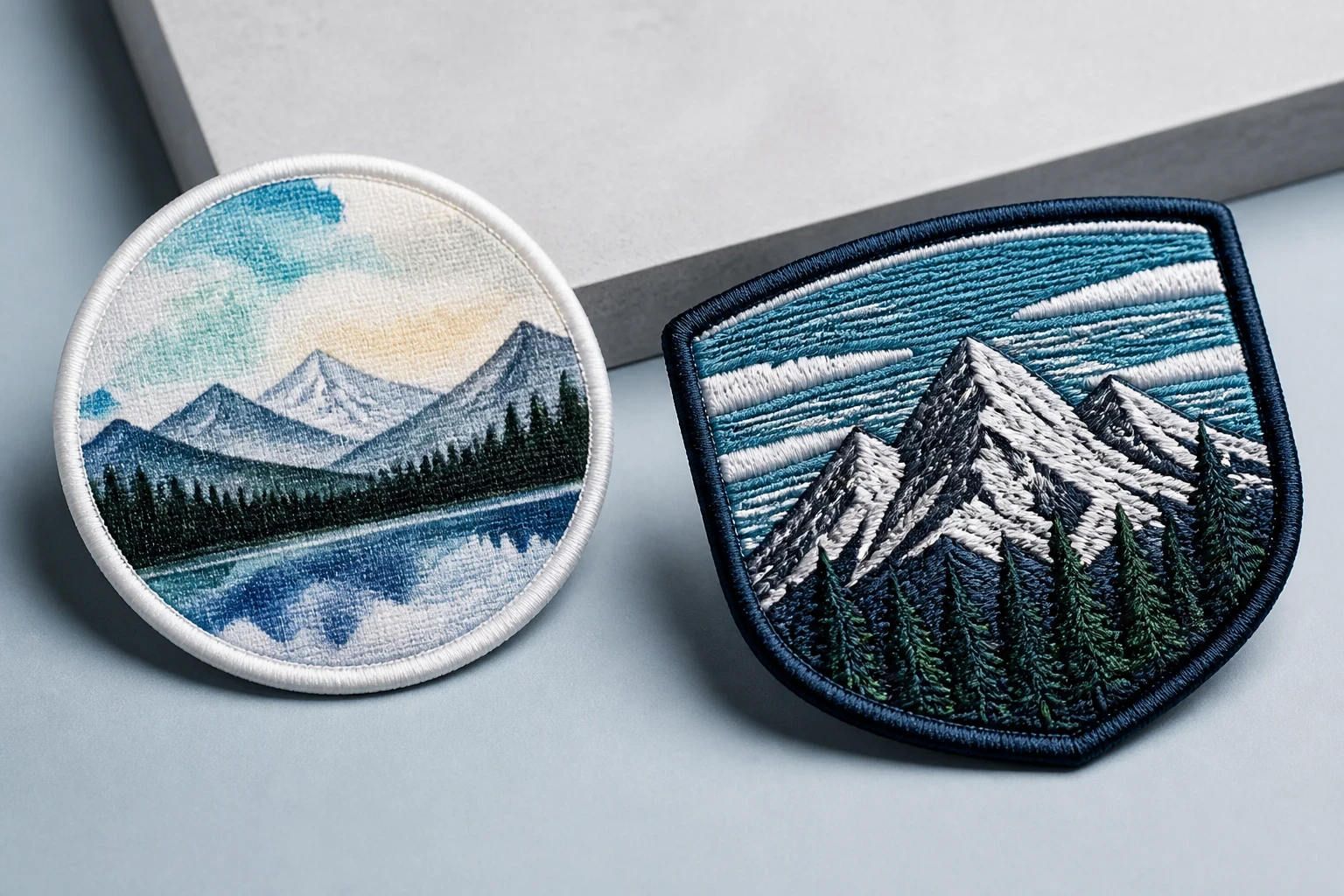
Sublimation printed patches UK use ink transferred onto a patch face, giving a flat finish and fine colour detail, including gradients and photographs. Embroidered patches use stitched thread, creating visible texture and a raised appearance. Choose printed patches for detailed artwork and embroidered patches for a traditional crest, bold lettering or textured uniform branding.
Key takeaways
- Sublimation printed patches UK are flat and suited to photographs, gradients, small details and artwork with many colours.
- Embroidered patches use thread and provide raised texture, strong visual weight and a familiar club or uniform appearance.
- Both styles need the correct backing and garment placement; iron-on is not automatically suitable for nylon shells, wool coaches or frequent washing.
- The Customized Patches has a 5-piece minimum per design, supplies a free digital mockup usually within 12 hours, and produces only after approval.
Sublimation printed patches UK are flat, ink-based patches made for detailed artwork, photographs, gradients and colour-heavy logos. Embroidered patches are built with thread, so they have visible stitch texture and a raised finish. The right choice depends mainly on the artwork, the garment and the look you want after repeated wear.
Printed is flatter; that is the point. Embroidery is more tactile and traditional, but very small text and photographic detail can become difficult to reproduce cleanly. The Customized Patches supplies both options across the United Kingdom, with a 5-piece minimum per design, a free digital mockup usually within 12 hours, and production only after you approve the artwork.
What makes sublimation printed patches UK different?
A sublimation printed patch starts with a suitable patch base and a printed design. Heat transfers the ink into the material rather than building the image from hundreds of separate thread stitches. This gives the artwork a smooth face, clean colour changes and room for detail that would be difficult to sew.
That method works well for a landscape illustration, a sponsor panel, a full-colour mascot, a map, a product image or a logo with a soft shadow. It also handles gradients far more naturally than standard embroidery. A football club can use a detailed stadium illustration; a drinks brand can reproduce a bottle label; a school can include a painted-style house crest without simplifying every shade.
The printed face is usually thinner and flatter than a dense embroidered face. Some buyers see that as less substantial, especially on a heavy biker jacket. Others specifically want a patch that sits neatly on a polo, cap, lightweight overshirt or Velcro panel without adding much bulk.
What sublimation does well
- Photographic and illustrated artwork with several colours.
- Smooth gradients, shadows, highlights and fine line detail.
- Small graphics that need a clean printed appearance rather than visible stitches.
- Designs that should remain relatively flat on hospitality polos, event clothing or bags.
- Artwork that changes colour across the face instead of using a small set of thread shades.
Printed patches still need sensible artwork. A tiny line that is only a fraction of an inch wide may disappear at production size, even if it looks clear on a large monitor. A mockup at the intended size is the practical test, not the original artwork viewed at 400%.
How embroidered patches are made and why they look different
An embroidered patch uses thread stitched into a twill or similar base. The stitches create the design and give the surface its familiar textured appearance. A dense fill can make a club crest feel weighty, while satin stitches can give lettering and borders a sharper, slightly raised edge.
This is the style many people expect on a football shirt, school blazer, cadet uniform, work jacket or club gilet. It has visual depth under ordinary indoor and outdoor light. A merrowed crest, with a stitched overlocked edge, also gives the outside of the patch a distinct border that reads clearly from a short distance.
Embroidery is not a better version of printing in every situation. It is excellent for bold shapes, limited colours, initials and recognisable badges. It is less suitable for a detailed photograph, a fine tonal gradient or a long sentence set very small. Thread needs space to turn, overlap and hold its shape.
Where embroidery earns its place
- Traditional team crests and club badges.
- Large initials, short names and bold block lettering.
- Workwear where a raised logo helps the branding feel substantial.
- Biker and motorcycle club back panels with a strong border and clear lettering.
- School blazers, scout clothing, cadet kit and formal uniform pieces.
- Simple designs where thread texture is part of the intended appearance.
For a three-colour football badge with a clear shield, embroidery is often the natural starting point. For a full-colour sponsor logo with tiny gradients, a printed face may be the more honest recommendation. The design, not the name of the garment, should make the decision.
Sublimation printed patches UK versus embroidered patches: side-by-side comparison
The table below gives a production-led comparison. It is a guide rather than a promise that one method suits every order. Final results depend on finished size, artwork, base material, edge, backing and how the garment is washed and worn.
| Specification | Sublimation printed patches UK | Embroidered patches |
|---|---|---|
| Surface | Flat, smooth printed face | Raised stitched surface with visible thread texture |
| Best artwork | Photographs, gradients, illustrations, complex logos and many colours | Bold crests, simple graphics, initials and limited-colour artwork |
| Colour changes | Smooth tonal changes and detailed colour work | Defined thread colours with a more textured transition |
| Fine detail | Usually better for printed detail, subject to finished size | Small detail may need simplifying so stitches do not merge |
| Visual character | Clean, modern and relatively low-profile | Traditional, tactile and visibly raised |
| Typical garments | Polos, lightweight jackets, caps, bags, event clothing and Velcro panels | Football tops, blazers, work jackets, gilets, wool coaches and biker jackets |
| Edge options | Printed or finished border options should be confirmed on the quote | Merrowed or overlocked edges are common for a classic badge appearance |
| Backing | Sew-on, iron-on, hook-and-loop or other suitable options by garment | Sew-on, iron-on, hook-and-loop or other suitable options by garment |
| Main limitation | The flat face may not provide the heavy texture some uniform buyers want | Photographic detail, gradients and very small text may not reproduce cleanly |
| Minimum order | 5 pieces per design | 5 pieces per design |
Price is affected by size, quantity, backing, edge and artwork as well as the production method. A small order of five patches may not follow the same unit price as a larger run for a national club. The useful comparison is the quoted price for the finished specification, not a headline figure for an unspecified patch.
Choose by artwork first, then by garment
Start with the artwork at its real patch size. If the design contains a face, a painted scene, a gradual sunset, a detailed animal or a logo made from many shades, look first at printed patches. If the artwork is a shield, crossed tools, a short word or a bold emblem, embroidery may give it the stronger result.
A football club crest often needs a balance of small lettering, stars and internal borders. If those elements are bold enough, embroidery gives the badge a proper match-day feel. If the crest includes a highly detailed illustration or a photographic sponsor panel, a printed section can preserve the information without forcing thread into spaces that are too small.
For a cadet unit, the answer may be embroidery for the main shoulder badge because the raised border suits the uniform. A printed name tab can work on a Velcro panel where a flat face is easier to read and remove. For a hospitality team, printed patches can sit neatly on a polo without the heavy raised effect of a dense embroidered badge.
Examples from real garment choices
- Nylon shell: confirm heat and attachment suitability before choosing iron-on. Sew-on or hook-and-loop may be safer for a technical outer layer.
- Wool coach jacket: embroidery can complement the heavier fabric, but the backing and stitching need to be considered so the patch does not pull the material.
- Velcro panel: a hook-and-loop-backed printed patch is useful for names, teams or changing event roles.
- School blazer: an embroidered crest usually matches the formal fabric and expected appearance better than a flat print.
- Biker vest: a large embroidered back patch or a set of embroidered rocker panels normally gives the visual weight associated with club clothing.
- Hospitality polo: a flatter printed logo can be comfortable, tidy and suitable for a detailed brand mark.
- Sports bag: either option can work, but the placement, abrasion and chosen backing should be confirmed before production.
Not sure whether thread or ink will hold your logo on the intended garment? Send the artwork and garment details for a free digital mockup usually within 12 hours, so you can compare the look before production.
GET A FREE MOCKUPDo not assume an iron-on backing will survive every wash. An iron-on patch that looks secure on day one can peel after a dryer cycle if the heat, pressure, fabric or washing routine is unsuitable. Sewing around the edge is often the sensible reinforcement for workwear, bags and frequently washed kit.
If you want a thread-led alternative with a softer, raised surface, 3D embroidered patches may suit a short logo or cap design. For a very soft pile, chenille patches are another direction, while woven patches can help with fine text and a flatter thread-based appearance.
Backing, edges and attachment are part of the specification
The face is only one part of a patch. A sew-on backing is a dependable choice for many jackets, uniforms and bags, provided the garment can be stitched. Iron-on backing is convenient on suitable fabrics, but it relies on the correct application temperature, pressure and cooling time. It should not be treated as a universal answer.
Hook-and-loop is useful for removable identifiers, tactical-style panels, event roles and club kit that needs different names or badges. It adds thickness and needs a compatible loop panel on the garment. If a patch will be removed regularly, say so at quote stage rather than selecting a fixed backing by habit.
The edge affects the finished character. A merrowed edge gives many embroidered crests a rounded, stitched outline. A clean cut or another finished edge may suit a printed design, especially if the artwork runs close to the border. The correct edge depends on the shape, material and intended look.
Questions to settle before a quote
- What is the finished width and height in inches?
- Which garment or item will carry the patch?
- Will it be washed frequently, tumble dried or exposed to rain and abrasion?
- Does it need to be removable?
- Is the artwork a photograph, gradient, fine illustration or bold crest?
- Do you want the border to be part of the printed image or visibly raised in thread?
- Should the patches be sewn, ironed on or attached with hook-and-loop?
- How many pieces are required per design?
The minimum is 5 pieces per design. If a club needs five different names, each name may count as a separate design because each artwork file is produced individually. Send a clear list of versions so the quote reflects the real order rather than an assumed single design.
Artwork preparation for both methods
A vector logo is helpful, but it does not remove the need for a size check. A patch viewed on a desktop screen can look generous, then become too small for its text once reduced to a 2-inch-wide badge. Keep important letters, gaps and borders large enough to remain readable.
For sublimation printed patches UK, supply the cleanest high-resolution artwork available and identify colour references if the brand has them. Photographic images should have enough resolution for the finished size. Avoid placing essential information over a busy background unless the design includes a clear border or contrast panel.
For embroidery, simplify before production rather than waiting for a stitch file to expose the problem. Tiny gaps can close, thin outlines can lose definition and closely packed letters can become a single textured band. A good production mockup should show the artwork at the intended patch size, not only as a large digital logo.
Our guide on How to Design Artwork for sublimation printed patches UK That Production-Ready covers the practical preparation points. You can also compare printed patch sizing and backing options before sending a quote request.
Why the mockup matters
A mockup lets you judge the actual decision: flat ink or raised thread, readable text or crowded text, suitable border or overworked edge. It also gives a team committee, club secretary or brand manager something specific to approve instead of relying on a description.
The Customized Patches provides a free digital mockup usually within 12 hours. We produce only after approval, so the approved size, colours, edge and backing are the version used for manufacture. If a change is needed, make it before approval rather than trying to correct a finished batch.
Ordering, quantity, price and UK lead times
A useful quote includes the design, finished size, quantity per design, backing, edge, garment type and delivery destination. UK-wide shipping can then be considered alongside the production specification. A request that only says “50 logo patches” leaves important variables open and can lead to an unsuitable recommendation.
The 5-piece minimum applies per design. That works for a small business testing a new logo, a school ordering a few replacement badges or a club ordering a small first run. Larger quantities normally give more room to compare unit pricing, but the quote still depends on the finished specification.
Lead time starts after the artwork, size, backing and mockup are agreed, not simply when an initial enquiry arrives. Artwork changes, multiple versions and late approval can move the schedule. If a football tournament, product launch, school term or trade event has a fixed date, include it in the first message.
For a straightforward order, our team can usually identify the next steps quickly once the details are clear. We do not treat the free mockup as permission to manufacture. Approval comes first, then production, followed by UK delivery according to the agreed order.
If you are comparing costs, review the guide on How Much Do sublimation printed patches UK Cost in the UK?. It is also worth reading 10 Questions to Ask Before Ordering sublimation printed patches UK if several people are involved in signing off the design.
Have the quantity, garment and artwork ready? Name sew-on, iron-on or Velcro on the quote and we will show the proposed backing on a free digital mockup usually within 12 hours. Production begins only after you approve the final version.
GET A FREE MOCKUPCommon mistakes UK buyers can avoid
The first mistake is choosing embroidery because it sounds more durable without checking the design. A detailed photographic logo may become muddy when converted to thread. The second is choosing printing for a formal blazer crest simply because it holds more colours, then finding that the flat appearance does not match the uniform.
Another common problem is ordering the wrong backing for the fabric. Nylon shells can react badly to excess heat, wool coaches need care around pressing, and a patch intended for a Velcro panel needs the matching attachment system. A backing that works on a cotton jacket is not automatically correct for every garment.
- Ordering before checking the design at finished size.
- Using a long slogan that cannot be read on a small patch.
- Assuming the same backing suits a polo, nylon shell and wool jacket.
- Forgetting to state that one order contains multiple versions.
- Approving a screen image without checking the edge and attachment method.
- Expecting iron-on to withstand a dryer cycle without checking the fabric and care routine.
- Sending a low-resolution screenshot when the logo file is available.
- Treating the 5-piece minimum as a total across unrelated designs.
A short production conversation prevents most of these issues. Tell us what the patch is for, where it will sit, how it will be washed and which details cannot change. The recommendation can then be based on the actual use rather than a generic preference for printed or embroidered.
Which patch should you order?
Choose sublimation printed patches UK when the artwork depends on photographs, gradients, fine illustrations, subtle shading or a wide range of colours. Choose embroidery when the design is a bold crest, a short name, a simple emblem or a traditional uniform badge where texture is part of the appeal.
If you are still undecided, compare both versions at the same finished size. A printed mockup may show that the logo is clearer and more comfortable on a polo. An embroidered mockup may show that the crest has the visual weight needed on a football jacket, biker vest or school blazer.
There are other materials too. PVC patches can suit outdoor, utility and raised rubber-style branding. Leather patches may fit a heritage garment or premium accessory. For club back pieces, see biker and motorcycle club patches. These are different finishes, not automatic substitutes, so the garment and artwork still decide the result.
The embroidered patches hub covers the embroidered route and related specifications. If the design is primarily photographic or needs a smooth face, the printed patches hub is the more relevant starting point. The Customized Patches can quote either route for UK delivery and explain the trade-offs before manufacture.
Related guides and product choices
For the full ordering sequence, read A Step-by-Step Guide to Ordering sublimation printed patches UK. It covers the information to send, the mockup stage and the checks to make before approval.
If you are considering a more detailed comparison, Sublimation printed patches UK vs embroidered patches: Which Is Right for Your Project? looks at the same decision from a project-planning angle. For a wider printed patch reference, see Sublimation printed patches UK: Everything UK Buyers Need to Know.
Send the logo, approximate width in inches, number of pieces per design, garment type and preferred backing through the free mockup quote. A clear brief gives our team something useful to check and gives you a more accurate comparison between ink and thread.
Frequently asked questions
What are sublimation printed patches UK?
Sublimation printed patches UK are patches with artwork transferred onto the face using ink and heat. They have a smooth, relatively flat finish and can reproduce photographs, gradients, illustrations and detailed multi-colour logos. The finished result still depends on artwork quality, patch size, edge and backing.
Are sublimation printed patches better than embroidered patches?
Neither is better for every job. Printed patches are usually better for photographs, gradients, fine illustrations and many colours. Embroidered patches are usually better for bold crests, short lettering, uniforms and buyers who want a raised, traditional texture. The garment and artwork should decide.
Are sublimation printed patches durable on UK workwear?
They can be suitable for workwear when the patch material, attachment method and care routine match the garment. Frequent washing, tumble drying, abrasion and outdoor exposure should be discussed before ordering. Sewing may be more suitable than relying only on iron-on backing for demanding garments.
What is the minimum order for printed or embroidered patches?
The minimum is 5 pieces per design. Five different names or versions may count as five designs if each requires separate artwork. State the number of versions clearly in your enquiry so the quote reflects the actual production requirement.
How quickly can I see a patch mockup?
The Customized Patches provides a free digital mockup usually within 12 hours. The mockup is for checking the design, size, edge and backing. Production starts only after approval, so changes can be made before the batch is manufactured.
Can I use an iron-on patch on a nylon jacket or wool coach jacket?
Not automatically. Nylon can be affected by heat, while wool requires care during pressing. The correct backing depends on the fabric, lining, care label and intended use. Sew-on or hook-and-loop may be more suitable in some cases. Include the garment details in the quote request before choosing.
Ready to produce custom patches for your UK team or brand?
GET A FREE MOCKUP