Are custom embroidered patches UK Right for Your Project? A Decision Guide
Custom embroidered patches UK are a strong choice for teams, clubs, uniforms, jackets and brands that want visible thread texture and a traditional finish. They are less suitable for tiny lettering, photographic artwork or very fine colour detail, where printed or woven patches may work better. The Customized Patches offers a free digital mockup, usually within 12 hours, with a 5-piece minimum per design.
Key takeaways
- Choose embroidered patches for visible thread texture, strong outlines and a traditional badge finish.
- Printed or woven patches may be better for tiny lettering, gradients, photographs and very fine artwork.
- The Customized Patches has a 5-piece minimum per design and usually sends a free digital mockup within 12 hours.
- Approve the mockup before production so the size, colours, border and backing match the garment you plan to use.
Custom embroidered patches UK are right for many football clubs, cadet units, schools, hospitality teams, workwear brands and motorcycle groups, but they are not the best answer for every logo. Choose them when you want raised thread, a tactile surface and a familiar badge appearance. Choose another patch type if your artwork depends on photographic detail, tiny text or smooth colour gradients.
The practical test is simple: look at the artwork, the garment, the expected wear and the way the patch will be attached. The Customized Patches supplies a free digital mockup, usually within 12 hours, and produces only after approval. The minimum order is 5 pieces per design, so small clubs and trial runs can order without committing to a large batch.
What embroidered patches do particularly well
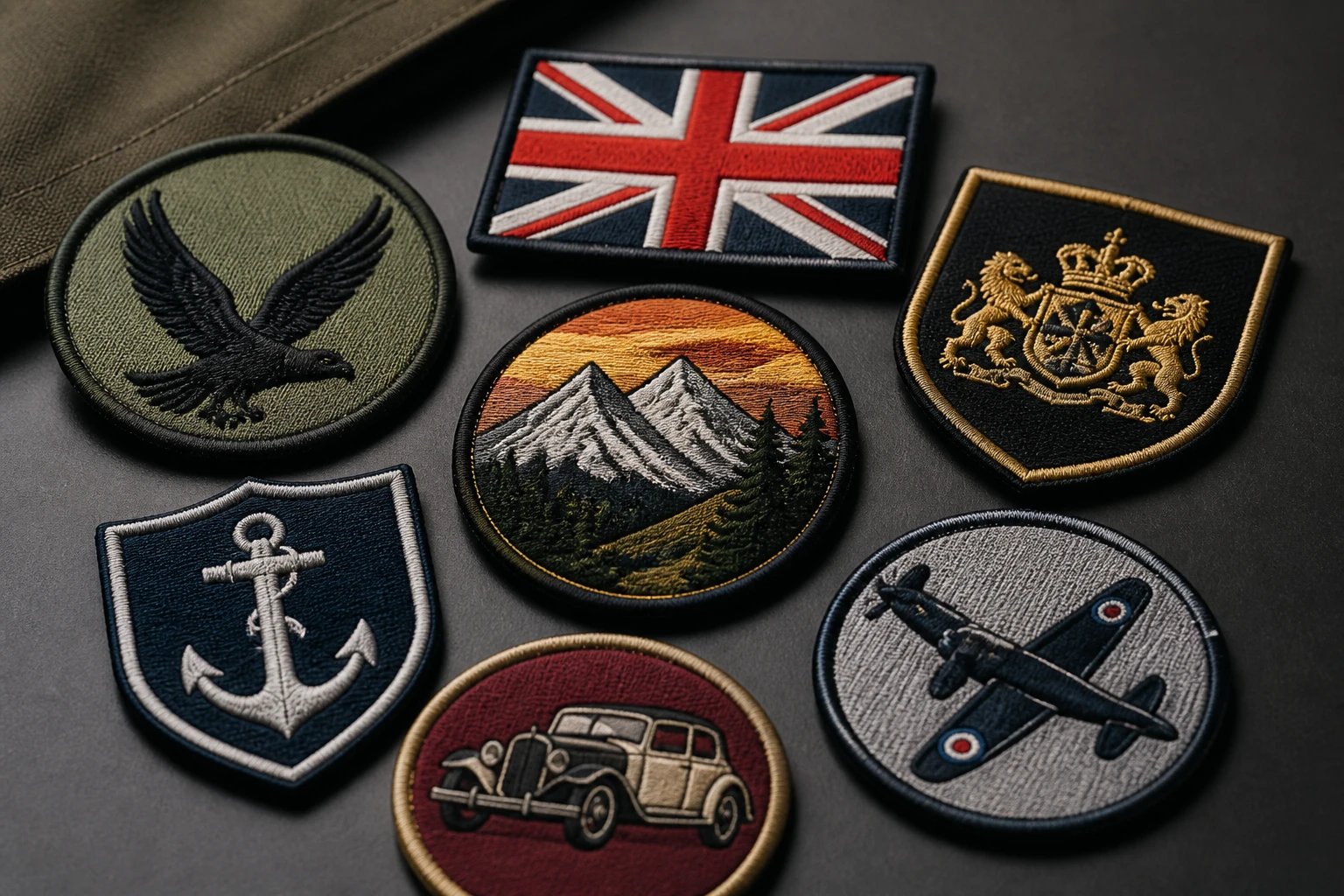
Embroidery gives a patch a stitched surface that people can see and feel. A merrowed crest around a football badge, a bold name on a work jacket or a simple club emblem on a school blazer can look convincing because the thread itself becomes part of the design. It has more visual depth than a flat transfer without needing a complicated construction.
That makes embroidered patches a sensible fit for garments that need identity rather than a full front-to-back graphic. We regularly quote for football clubs, cadet units, biker vests, hospitality polos and school blazers. A well-sized crest can make a plain navy polo look like team kit, while a stitched unit badge gives a nylon shell or wool coaches jacket a recognisable purpose.
- Sports teams needing a crest, sponsor mark, player role or event badge.
- Schools and colleges adding house, year or activity badges to blazers and jumpers.
- Cadet units, scouts and uniformed groups requiring clear identification.
- Hospitality, trades and service businesses branding polos, fleeces and jackets.
- Clubs and brands using patches as merchandise, membership markers or limited event pieces.
- Motorcycle groups wanting a traditional back patch, chest badge or rocker design.
The finish is also forgiving of small imperfections in a bold logo. Strong outlines, solid blocks of colour and simple lettering usually translate well. If your concept relies on those features, the embroidered patches product hub is the sensible place to start.
When custom embroidered patches UK may not be the best option
Embroidery has limits. Thread needs room to form a clean line, so tiny text can close up or become difficult to read. Fine facial details, small web addresses, subtle shadows and photographic artwork can lose their character once converted into stitch. This is not a fault in the patch; it is a consequence of using thread as the image-making material.
Printed is flatter; that is the point. A printed patch can hold a photograph, a soft gradient or a detailed illustration more directly. Woven construction may suit small lettering and fine linework because its surface is flatter and more tightly detailed. PVC patches can be a better match for outdoor, technical or wipe-clean equipment, while chenille patches are chosen for a soft, varsity-style pile rather than crisp micro-detail.
| Project requirement | Usually suitable | Reason to consider an alternative |
|---|---|---|
| Bold club crest or team badge | Embroidered | A large number of colours or tiny internal detail may need simplification. |
| Small name or fine lettering | Woven or printed | Thread may make very small characters less clear. |
| Photograph or realistic illustration | Printed | Printed colour can reproduce continuous shading more directly. |
| Raised varsity-style letter | Chenille or 3D embroidered | Standard embroidery may not give enough pile or height. |
| Water-resistant technical kit | PVC or printed | A fabric patch may absorb water and need more careful washing. |
| Traditional biker vest badge | Embroidered or leather | Leather gives a different material and heritage appearance. |
| Smooth brand mark on a performance polo | Printed or woven | A flat finish may suit lightweight sports fabric better. |
The right decision often involves simplifying the artwork rather than abandoning embroidery. Remove a tiny strapline, widen a narrow gap, strengthen the outline and use fewer, clearer thread areas. If the artwork must remain unchanged, compare it against the Difference Between custom embroidered patches UK and printed patches, Explained guide before requesting a quote.
A quick artwork test
View the logo at the intended patch size, not as a large screen image. Print it at roughly the width you expect in inches, then check the smallest letters and gaps from normal viewing distance. If the mark already looks crowded on paper, it will need adjustment before digitising. A clear border and a sensible outer shape usually help more than adding extra colours.
Do not approve a design only because it looks good as a 2,000-pixel PNG. The stitch file controls how lines turn, where thread overlaps and how much open fabric remains. Our How to Design Artwork for custom embroidered patches UK That Production-Ready guide covers the files and design decisions that make approval easier.
Match the patch to the garment and working conditions
Garment choice affects both appearance and attachment. A cotton hoodie, heavy denim jacket and school blazer normally give a patch a stable surface. A thin nylon shell, stretchy running top or lightweight polo can move underneath it, so a large heavy badge may pucker the fabric or feel out of proportion.
Think about the garment as it is actually used. A hospitality polo may be washed every few days. A cadet jacket may see rain and hard wear. A biker vest may be thick leather or denim and may need a perimeter stitch for confidence. A wool coaches jacket can look excellent with a simple chest emblem, but a dense oversized design may dominate the fabric and sit awkwardly over seams.
- Nylon shells: keep the badge reasonably light and check that the backing and attachment method suit the slippery fabric.
- Wool coaches jackets: use a balanced size and avoid placing the patch across a bulky seam or pocket edge.
- Velcro panels: specify the loop-compatible backing rather than assuming a standard sew-on or iron-on back will work.
- School blazers: keep lettering readable at chest distance and confirm the patch will not cover the blazer pocket or badge position.
- Football and training kit: consider stretch, repeated washing and whether a flat printed mark would sit more comfortably.
- Biker vests: confirm whether you need a chest patch, a large back piece, rockers or separate name bars.
Backing is not a minor detail. Sew-on is dependable for long-term use and works across many fabrics, but it takes more time to attach. Iron-on is convenient on suitable fabrics, yet heat, washing and flexing can test the adhesive; an iron-on patch that peels after a dryer cycle is an avoidable disappointment. Velcro is useful for changeable identification, but only where the garment has a compatible loop panel.
For a deeper look at dimensions, border choices and attachment, read Custom embroidered patches Sizing and Backing Options Explained. For jackets specifically, Custom Patches for Jackets in the UK: Size, Backing, and Stitch covers the practical decisions we see on production quotes.
Size, shape and thread detail: the choices that change the result
Size should follow the placement, not a standard catalogue measurement. A chest crest on a polo may be around 2 to 4 inches wide, while a large jacket back design may need considerably more room. There is no useful single size for every project. Measure the panel, pocket, sleeve or back area and leave space for seams, zips and existing badges.
Shape affects the perceived finish. A clean merrowed border works well around circles, shields and simple custom outlines. A cut-to-shape edge can follow a more complicated silhouette, but very narrow points and internal cut-outs need checking. A border also gives the eye somewhere to stop, which can make a busy crest easier to read.
Not sure whether thread, ink or PVC will suit your logo and garment? Send the artwork and the intended use for a free digital mockup, usually within 12 hours, so you can compare the result before production.
GET A FREE MOCKUPColour matching and contrast
Thread colours are not the same as screen colours. A bright digital blue may appear different once represented by thread, particularly beside navy fabric. Strong contrast between the fill, outline and garment matters more than chasing a perfect screen match. For a local football club, it is often better to choose a clearly visible royal blue and white combination than a subtle shade that disappears against a dark shirt.
The mockup is the point at which these choices become visible. It should show the proposed size, shape, border, colours and backing rather than simply repeat the original artwork. Production begins only after approval, so use that stage to ask about unreadable text, crowded detail, placement and garment compatibility.
Raised options and alternative surfaces
Standard embroidery gives a stitched face. 3D embroidered patches add height to selected areas, which can help a bold initial or emblem stand out, but they are not designed for tiny detail. Woven patches offer a flatter surface for fine lines, while leather patches provide a material-led look that may suit a heritage brand, outdoor label or motorcycle garment.
Do not select 3D embroidery just because raised texture sounds impressive. It needs a design with broad, uncomplicated shapes and enough scale to show the height. The same judgement applies to chenille. A large varsity letter can work beautifully, but a detailed club crest may be clearer in standard embroidery or print.
Cost, quantity and the five-piece minimum
Patch pricing depends on more than the number of patches. Size, stitch density, backing, border, number of designs and the complexity of the artwork all influence the quote. A small single-colour badge is not comparable with a dense 5-inch back patch containing several fills, lettering and a special attachment method.
The Customized Patches accepts a minimum of 5 pieces per design. That suits a five-person club committee, a small business testing branded workwear or a family ordering matching event patches. If you need several different badges, each design is assessed separately rather than treating unrelated artwork as one identical run.
| Ordering point | What to confirm | Why it matters |
|---|---|---|
| Quantity | At least 5 pieces per design | The minimum applies to each separate artwork design. |
| Patch dimensions | Width and height in inches | Size affects detail, stitch area, price and garment balance. |
| Backing | Sew-on, iron-on, Velcro or another agreed option | The wrong back can make attachment difficult or unreliable. |
| Artwork | Logo file, colours and any text | Production artwork may need simplification for clean stitching. |
| Approval | Written confirmation of the digital mockup | Production should follow the approved version, not an earlier draft. |
| Delivery | UK delivery address and required date | Lead time and dispatch planning depend on the final specification. |
The cheapest-looking quote is not always the most useful comparison. Ask if it includes the selected backing, border and artwork preparation. Ask how a supplier will deal with small type. Ask whether a proof is supplied before production. Our guide to How Much Do custom embroidered patches UK Cost in the UK? explains the main pricing variables without pretending that one flat price suits every patch.
For larger orders, scale can improve the unit cost, but only if you genuinely need the quantity. A school may need one badge for each pupil, whereas a new clothing label may prefer a smaller first batch while checking customer demand. It is usually better to order a sensible quantity with approved artwork than to hold hundreds of patches that do not fit the garment or brand direction.
Ordering custom embroidered patches UK: from quote to delivery
Start with the information that affects the quote: artwork, approximate size, quantity per design, garment type, attachment method and required date. A phone photo of the garment can help if you are unsure about placement. Tell us if the patch will be sewn to leather, attached to a Velcro panel or used on a stretchy sports top; the same artwork can need a different recommendation depending on the surface.
- Send the artwork and explain the garment, placement and intended use.
- Confirm the quantity, remembering that the minimum is 5 pieces per design.
- Review the quote and ask about size, border, thread colours and backing.
- Receive the free digital mockup, usually within 12 hours.
- Check text, colours, proportions, placement and attachment details at the proposed size.
- Approve the mockup in writing or request changes before production.
- Receive the finished patches through UK-wide shipping according to the agreed production and delivery plan.
A mockup is not a formality. It is where a football secretary may spot that the club name is too small, a business owner may see that the border blends into a black fleece, or a cadet leader may realise the patch is too large for the uniform sleeve. The approval version should be the version everyone in the project is working from.
Lead time depends on the design, quantity, backing and current production schedule. Give a real deadline rather than simply saying the order is urgent. If the patches are for a tournament, launch, school presentation or club anniversary, mention the event date at quotation stage so the production plan can be discussed before approval.
Care, attachment and common failure points
A well-made patch can still fail if it is attached or washed poorly. Follow the care guidance for the garment and backing. Avoid treating an iron-on patch as permanent on every fabric; heat, repeated tumble drying, fabric softener and flexing can weaken the adhesive. For hard-working uniforms, sew-on attachment is often the safer long-term choice.
Sew around the border rather than catching only a few loose points. Use thread that suits the patch and garment, and do not place the patch over a zip, folded hem or high-friction edge unless the design accounts for it. On a nylon shell, test the attachment area where possible because very thin fabric may need support. On a leather biker vest, a strong perimeter stitch and suitable needle are more appropriate than relying on heat.
- Check the patch after the first wash rather than assuming every backing behaves the same.
- Turn decorated garments inside out where the garment care instructions allow it.
- Use a low or moderate wash setting suited to the base garment and avoid unnecessary tumble drying.
- Do not iron directly over raised embroidery, adhesive backing or a PVC surface.
- Repair a loose stitch early before washing or wear pulls more of the border away.
- Keep spare patches from the same approved batch if a team or workwear programme may need replacements.
For practical washing advice across jackets, hats and uniforms, see How to Wash and Care for Custom Patches (UK Jackets, Hats, and Uniforms). Care does not turn an unsuitable patch into a suitable one, but it can prevent an appropriate design from being damaged by the wrong cleaning routine.
Examples from UK projects
A grassroots football club often needs a crest that reads clearly from the touchline and survives frequent washing. Embroidered thread suits a bold shield with a short club name, especially on a jacket, kit bag or heavy hoodie. If the same crest includes a long sponsor line in very small type, we may recommend separating the sponsor mark or using print for that part.
Name sew-on, iron-on or Velcro on the quote and tell us what garment the patch will use. We will show the proposed backing and layout on a free digital mockup, usually within 12 hours; production starts only after you approve it.
GET A FREE MOCKUPA cadet unit may need a sleeve identifier with strict placement and clear lettering. The important questions are not only colour and size, but also whether the patch is removable, whether the uniform already has a Velcro panel and whether the badge will rub against equipment. A sew-on badge and a removable Velcro badge solve different problems.
For hospitality polos, an embroidered chest logo can give a team a consistent appearance without making the garment feel like advertising. Keep the patch modest in size and watch the weight on lightweight fabric. For a brand selling technical cycling tops, the flatter surface and flexibility of a printed solution may be more comfortable than a dense embroidered badge.
A biker club may want a large back emblem, smaller front badge and name rocker. Embroidery provides the traditional look many riders expect, but the size, border, leather or denim base and attachment method need agreeing before production. A biker and motorcycle club patches collection can help you compare the types of badge commonly used for those garments.
Small businesses often start with a short run for staff jackets, packaging or merchandise. Five pieces per design makes a controlled test possible, especially if the owner wants to check the badge on more than one garment colour. The Custom embroidered patches UK for Small Businesses: A Practical Guide guide covers that use case in more detail.
The decision: should you choose embroidery?
Choose embroidered patches if the design is bold enough for thread, the garment can support the patch and the tactile badge finish is part of the appeal. They work particularly well for crests, initials, simple logos, team identity and traditional club clothing. They are also a practical choice when people need to recognise the mark quickly rather than study fine illustration.
Choose printed or woven construction if the artwork depends on tiny details, photographs, gradients or a very flat feel. Consider PVC for technical or wipe-clean equipment, chenille for a soft varsity effect, and leather when the material itself is central to the look. A good supplier should explain those trade-offs rather than force every design into one production method.
- Select embroidery when texture, strong outlines and a traditional badge finish matter most.
- Select woven or printed when small text and fine line detail must remain legible.
- Select PVC when the patch will face wet, technical or wipe-clean conditions.
- Select chenille or 3D embroidery when controlled raised texture is the main design feature.
- Select leather when you want a material-led appearance for jackets, bags or heritage branding.
- Request a mockup before committing so the proposed result can be judged at real size.
If you are still weighing the options, compare the woven patches and leather patches hubs with the embroidered range. You can also read Custom Patches vs Screen Print vs Heat Transfer: Which Lasts on UK Apparel? for a wider garment-decoration comparison. The best choice is the one that fits the artwork, surface, use and maintenance routine—not simply the one that sounds most traditional.
Questions to ask before approving your patch
Before approval, ask for the final width and height in inches, the border style, the backing, the number of pieces per design and the expected delivery plan. Confirm that all text is correct and that the supplied artwork is the version you want digitised. These checks are quick, but they prevent the most expensive kind of mistake: producing the wrong item accurately.
Ask how the patch will sit on the garment, especially if the fabric is stretchy, thin, waterproof or already lined. If you are ordering for a group, show the mockup to the person responsible for kit, uniform or brand approval. A second pair of eyes often notices a spelling issue, reversed colour or awkward proportion before it reaches production.
The 10 Questions to Ask Before Ordering custom embroidered patches UK guide is useful if several people are involved in the decision. For a final pre-order check, use the Custom embroidered patches UK Checklist: What to Confirm Before You Order.
Frequently asked questions
Are custom embroidered patches UK suitable for football clubs and sports teams?
Yes. Custom embroidered patches UK are suitable for football clubs, rugby teams, school teams and other sports groups when the crest has clear shapes, readable lettering and enough space for thread. Check the fabric weight and stretch first. For lightweight performance kit, a printed or woven patch may sit flatter and feel more comfortable.
What is the minimum order for an embroidered patch?
The minimum order is 5 pieces per design. If you have two different logos, each logo is treated as a separate design. This allows a small club, business or project team to order a short run without committing to hundreds of identical patches.
How quickly can I see a mockup for custom embroidered patches UK?
The Customized Patches usually provides a free digital mockup within 12 hours. The mockup should be checked for size, colours, border, lettering, placement and backing. Production begins only after you approve the mockup, so changes can be made before the patches are manufactured.
Are sew-on or iron-on embroidered patches better for jackets?
Sew-on is generally the safer long-term option for hard-wearing jackets, nylon shells, leather and garments that are washed often. Iron-on can be convenient on suitable fabrics, but heat and repeated dryer cycles may weaken the adhesive. Velcro is useful when the badge needs to be removed or changed and the garment has a compatible panel.
Can embroidery reproduce small text and detailed logos?
Embroidery can reproduce clear small-to-medium lettering, but very tiny text, narrow gaps, photographs and gradients may need simplification. Woven or printed patches are often better for fine detail because their surfaces can hold smaller visual elements more clearly. A digital mockup helps show what is practical at the proposed size.
Do you ship custom embroidered patches across the United Kingdom?
Yes. The Customized Patches serves customers across the United Kingdom with UK-wide shipping. Share the delivery address and required date when requesting a quote, especially if the patches are for a tournament, launch, school event, club anniversary or uniform issue.
Ready to produce custom patches for your UK team or brand?
GET A FREE MOCKUP