
Varsity chenille patches UK Checklist: What to Confirm Before You Order
Before ordering varsity chenille patches UK, confirm the finished size, chenille and border colours, lettering height, backing, garment, quantity, delivery date and artwork approval process. The Customized Patches supplies a free digital mockup usually within 12 hours, produces only after approval, and accepts a minimum order of 5 pieces per design.
Key takeaways
- Varsity chenille patches UK orders need a confirmed size, colour plan, backing and garment before production.
- A 5-piece minimum applies to each design, so different names, numbers or crests may need to be counted separately.
- The Customized Patches normally sends a free digital mockup within 12 hours and produces only after approval.
- Sew-on, iron-on and Velcro backings suit different garments, washing routines and future use.
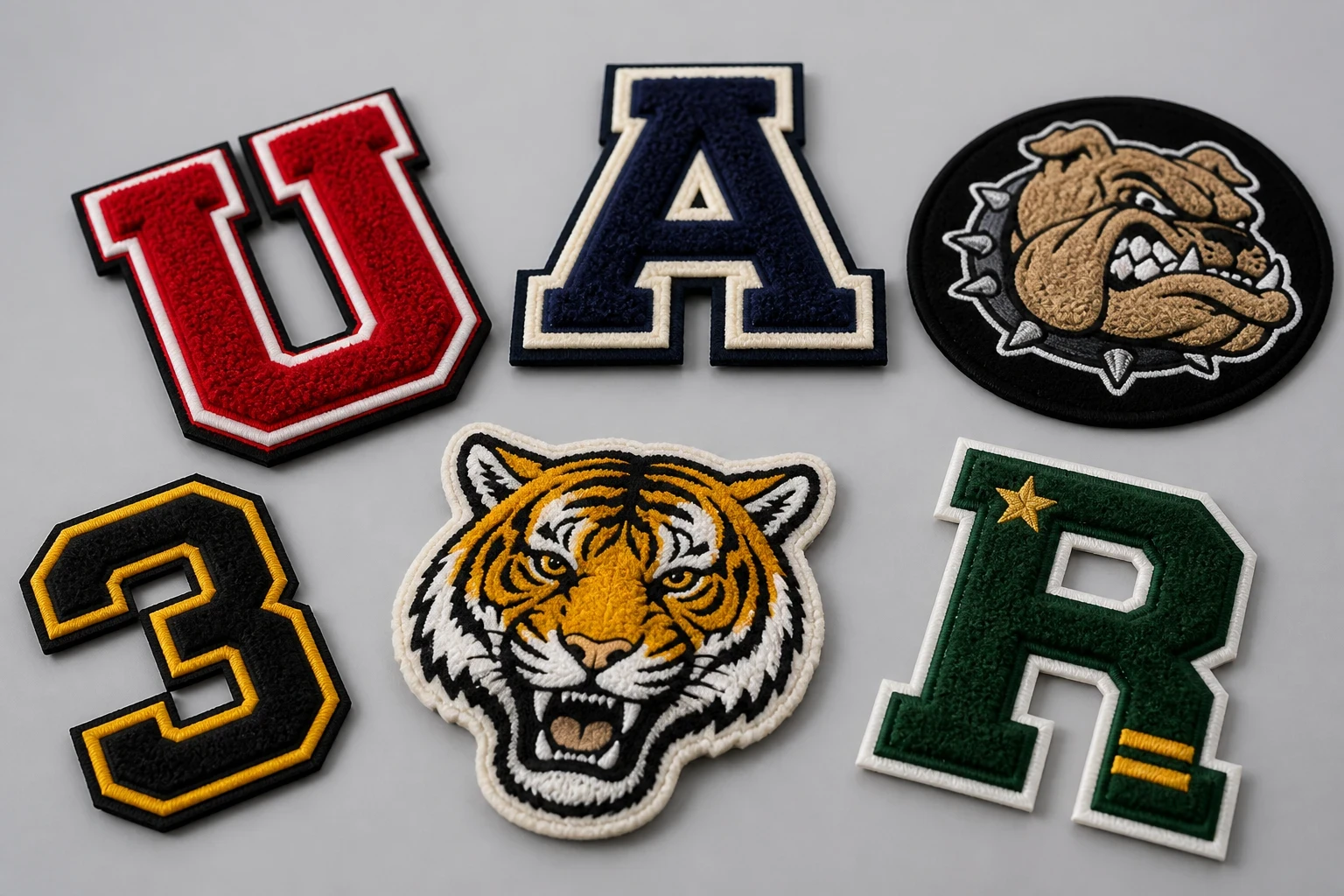
The main things to confirm before ordering varsity chenille patches UK are the finished size, lettering, colours, backing, garment, quantity and required date. Chenille has a raised, tufted surface, so it suits bold initials, mascots and large crests better than tiny detailed artwork. The Customized Patches sends a free digital mockup usually within 12 hours, and production starts only after you approve it.
This checklist is for a football club ordering a run of jackets, a school fitting blazers, a brand decorating wool coaches, or a business adding a tactile badge to uniforms. The minimum order is 5 pieces per design. That point matters if you have several different names, numbers or badge layouts, because each distinct design may need its own quantity.
1. Confirm what the patch is meant to do
Start with the garment and the job of the patch. A large chenille letter on the chest of a wool varsity jacket has different requirements from a small club crest on a nylon shell. A hospitality group may want a neat badge on a polo, while a cadet unit may need a removable identifier on a Velcro panel.
Chenille is chosen for its texture and presence. The yarn catches light differently from flat embroidery, which helps a large initial or mascot stand out from a distance. It is not the right answer for every logo. Fine website addresses, very small sponsor names and detailed photographic artwork usually need a flatter construction such as embroidered patches or woven patches.
- Use chenille for bold letters, school initials, sports mascots, club symbols and simple crests.
- Consider embroidery for compact detail, small text and sharp linework.
- Consider printed patches when a flat image, gradient or highly detailed artwork is the priority.
- Consider PVC patches for a rubber-like surface on outdoor, workwear or tactical garments.
- Use a mixed order only when the different patch types genuinely suit different parts of the range.
Printed is flatter; that is the point. Chenille is more tactile and traditional, but its pile can soften fine edges. A good quote begins with an honest description of the garment, use and artwork rather than simply asking for the largest possible badge.
2. Check the size against the real garment
Do not estimate size from a screen. Measure the usable area on the actual jacket, blazer, shirt or bag. Width and height should be recorded in inches, including the border if the border forms part of the finished outline. A patch that looks balanced on a digital logo can appear crowded beside a zip, pocket or shoulder seam.
Lay a paper version on the garment and stand back. This simple test catches many problems. A 4-inch-wide crest may be comfortable on the back of a wool coach jacket but too large for the left chest of a polo. A tall letter may need more height than width, while a shield may need room below the main symbol for a year or location.
| Use | Typical planning point | What to check before approval |
|---|---|---|
| Large varsity back letter | Often needs a generous area on the back of a jacket | Check shoulder seams, hood clearance and how the letter sits when worn |
| Left-chest club crest | Usually needs a compact proportion | Check pocket position, zip line and the distance from the collar |
| School blazer badge | Needs to sit neatly on a structured front panel | Check blazer fabric, lining, pocket flap and the preferred attachment method |
| Sleeve or arm badge | The available width is often restricted | Check sleeve seams and whether the patch will catch on desks or equipment |
| Velcro identifier | Must fit the existing loop panel | Measure the panel exactly and confirm hook-side or loop-side requirements |
If the garment is already in production, ask the clothing supplier for the panel dimensions. Nylon shells can have curved seams and coatings that make attachment less straightforward. Wool coaches and varsity jackets usually give a more forgiving surface, but the ribbed cuff, lining and heavy seam allowances still affect placement.
3. Make the artwork suitable for varsity chenille patches UK
Lettering, spacing and border weight
Bold lettering is the safest route. Ask yourself whether the smallest word can be read at the size you have selected. Thin script, tight letter spacing and narrow counters can lose definition once the yarn is tufted. Short words, initials and block capitals generally translate well.
A border does more than finish the edge. It separates the chenille shape from the garment and gives the artwork a controlled outline. If the border is too narrow, it may not frame the design clearly. If it is too wide, it can reduce the usable area for lettering. Send the original artwork where possible, not a screenshot copied from a social media page.
Colours and contrast
List the colours in plain language: navy chenille, white lettering, gold border, black felt background, for example. If a club has an approved colour system, provide the reference and a visual sample. Digital screens vary, so the mockup is a placement and appearance guide rather than a promise that a monitor can show physical yarn exactly.
High contrast is usually easier to read. White on navy, cream on burgundy and gold on black are familiar combinations, but the correct choice depends on the garment. A navy patch on a navy shell may disappear at the edge even if the lettering is clear. The border may need to do more work than the central fill.
Shapes, cut lines and merrowed edges
Decide if the patch should be a clean cut shape, a shield, a circle, a rectangle or an irregular mascot outline. A merrowed crest gives a traditional overlocked edge and works well for many club and school badges. Very sharp internal corners can require a simpler treatment than the artwork suggests.
Use the artwork approval stage to check the whole outline, not just the logo inside it. Ask to see the patch at its intended finished size. This is where you can spot a border that has become too heavy, a letter that needs more space, or a small detail that should be removed instead of produced indistinctly.
If you are still choosing type, size, or backing, send the artwork and the garment. Free digital mockup in 12 hours and compare the proposed chenille treatment with a flatter option before you produce.
4. Choose the backing for the garment and washing routine
Backing is a practical decision, not a finishing detail to leave until the end. Sew-on is usually the dependable choice for wool coaches, school blazers, heavy jackets and garments that will be washed repeatedly. It takes more fitting time, but a stitched patch is not relying on adhesive alone.
If you are still choosing type, size, or backing, send the artwork and the garment. Free digital mockup in 12 hours — 5-piece minimum per design. We do not produce until you approve.
GET A FREE MOCKUPIron-on can be convenient on a suitable heat-safe fabric with a smooth surface. It is less suitable for some nylon shells, coated outerwear, waterproof materials, stretchy fabrics and garments with a lining that can be damaged by heat. An iron-on patch that appears secure can peel after a dryer cycle if the temperature, pressure or fabric is wrong.
Velcro is useful when an identifier must be removed or changed. It works well with kit bags, tactical-style panels, event clothing and some team systems. It adds thickness and requires an accurately sized loop panel. Confirm which side is already on the garment before the patch is made.
| Backing | Good fit | Main caution |
|---|---|---|
| Sew-on | Wool jackets, blazers, heavy outerwear and long-term use | Allow time for stitching and check that the garment can be sewn without damaging lining or seams |
| Iron-on | Suitable cotton or heat-safe smooth fabrics where quick fitting matters | Heat can damage nylon, coatings, synthetics and some structured garments; follow fitting instructions |
| Velcro | Removable club identifiers, bags, kit and existing Velcro panels | Measure the loop panel and account for extra thickness and repeated removal |
| Adhesive-only use | Temporary display or very light-duty applications | Not the first choice for regular washing, outdoor wear or heavy chenille patches |
Tell the maker about washing. A football club kit manager may wash jackets weekly, while a brand may use the patch on occasional event clothing. The right backing depends on that routine. If you are comparing chenille with other constructions, the guide to the difference between varsity chenille patches UK and embroidered patches explains the practical trade-offs.
5. Confirm the quantity and what counts as one design
The Customized Patches has a minimum order of 5 pieces per design. Five identical football crests count as one design. Five crests with different player names, years or numbers may be treated as separate artwork versions, so list them clearly when requesting a quote.
Make a quantity sheet before sending artwork. Include the design name, size, backing, garment location and number of pieces. This avoids a common problem where a customer asks for 30 patches but later reveals that the order contains three sizes, two colourways and a set of individual names.
- Design A: school crest, 3.5 inches wide, sew-on, 24 pieces.
- Design B: house letter, 4 inches high, sew-on, 8 pieces.
- Design C: staff identifier, 3 inches wide, Velcro, 6 pieces.
- Design D: individual surname patches, 12 different layouts, quantity to be confirmed separately.
Small runs can make sense for a trial with a new garment or a limited club intake. Larger runs may reduce the per-piece cost, but only order a larger quantity if the design, size and garment are settled. A box of unusable patches is not a saving.
6. Review the mockup before production
A digital mockup should answer practical questions: how large is the patch against the garment, where does the border sit, which colours are being used, and how will the backing be supplied? It is also the final spelling check. Club names, school mottos and place names deserve a slow read before approval.
The Customized Patches usually provides the free digital mockup within 12 hours. Production takes place only after approval, so do not approve while a quantity, colour or placement question is still open. If the artwork changes after approval, the order may need to be reviewed again before manufacture.
Mockup approval checklist
- Is every word, number and initial spelled correctly?
- Does the finished width and height match the garment?
- Are the chenille, border and background colours identified clearly?
- Is the patch outline the requested shield, circle, rectangle or custom shape?
- Are any fine details too small for a raised chenille surface?
- Does the backing shown or described match the garment?
- Does the quantity list separate each distinct design?
- Is the delivery address and required date recorded?
Keep the approved mockup with the order paperwork. It gives the team, school office or brand manager a shared reference. For a larger clothing project, send the same approved version to the garment fitter so nobody works from an older logo file.
7. Plan production and UK delivery around the real deadline
Give the date the patches must be in hand, not only the date you hope to place the order. A school may need badges before the first autumn fitting. A club may need jackets before a tournament. A brand may have a launch, trade event or staff induction already booked.
The order normally moves through artwork review, customer approval, production, checking and UK-wide shipping. The free mockup usually arrives within 12 hours, but approval time still depends on how quickly the customer confirms the details. If there are several colourways or personalised versions, allow time for each one to be checked.
Put the deadline, delivery postcode and any event date in the first message. Mention if the patches are going to a school office, a clothing decorator, a football club secretary or a business premises with restricted delivery hours. Clear information reduces avoidable email exchanges.
Name sew-on, iron-on or Velcro on the quote. We show the correct back on a free 12-hour mockup so production matches the garment.
8. Know when a different patch type is the better choice
A practical checklist should include permission to change direction. Chenille is a strong choice for tactile, bold artwork, but it is not automatically best for every UK order. A small detailed brand mark on a polo may be clearer as embroidery. A full-colour illustration may be better as a printed patch. A weather-exposed workwear badge may suit PVC.
For a biker vest, a large back panel may call for a construction that holds the club name and rocker text clearly. See the range of biker and motorcycle club patches if the project has several large panels. For a premium clothing label, leather patches may suit a denim or waxed cotton product better than a raised varsity finish.
Ready to spec the run? Open the quote form for a free 12-hour mockup and UK-wide shipping after approval.
GET A FREE MOCKUP| Patch type | Surface and detail | Useful for | Trade-off |
|---|---|---|---|
| Chenille | Raised, soft and visibly textured | Varsity letters, school badges, mascots and bold crests | Fine text and tiny details may need simplifying |
| Embroidered | Thread-based with a flatter detailed surface | Club crests, uniforms, logos and compact lettering | Less plush than chenille and can become thread-heavy at very high coverage |
| Woven | Flat, tightly woven detail | Small lettering, clean linework and detailed symbols | Does not provide the raised varsity texture |
| Printed | Flat ink or printed image | Gradients, photographs and highly detailed artwork | Flatter appearance and may need different care from a stitched patch |
| PVC | Raised rubber-like moulded surface | Outdoor badges, workwear and modern utility designs | Different visual character from traditional yarn chenille |
| Leather | Natural or synthetic leather face | Denim, bags, premium labels and heritage-style products | Colour and detail options differ from thread-based patches |
The choice should follow the artwork, garment and use. If the key requirement is texture and a strong varsity look, chenille remains a sensible option. If the key requirement is small detail, a flatter construction may save redesign work and produce a clearer result.
9. A final quote checklist for UK teams, clubs and businesses
Before you request the final quote, gather the information in one message. This is particularly helpful when the person ordering is not the person holding the garment. A complete brief gives our team enough context to flag a backing or sizing issue before the mockup is prepared.
- Name the design and explain where it will be worn.
- Attach the cleanest available logo, crest or lettering artwork.
- State the finished width and height in inches, or provide the measured garment area.
- List each chenille, border and background colour.
- Confirm the patch shape and edge treatment.
- Choose sew-on, iron-on or Velcro backing.
- State the garment fabric, including nylon, wool, cotton, polyester, denim or a coated material.
- Separate quantities by design, size, colourway and personalisation.
- Remember the 5-piece minimum per design.
- Give the required in-hand date, delivery postcode and any access instructions.
- Wait for the free digital mockup, normally within 12 hours.
- Check and approve the mockup before production begins.
For more detail on the questions to ask, see 10 Questions to Ask Before Ordering varsity chenille patches UK. If you are starting with artwork rather than an existing logo, the artwork preparation guide can help you remove avoidable problems before quoting.
10. What a good order brief looks like
Here is a realistic example: “We need 18 navy and gold chenille school crests for wool blazers. Finished size should be 3.5 inches wide. Use a gold merrowed border, sew-on backing and the supplied crest artwork. The badges must arrive at a Birmingham school office before the blazer fitting on 15 August.”
That brief gives our team the design, quantity, fabric, colours, size, edge, backing, destination and deadline. If the school also needs eight house letters, list those as another design with their own size and quantity. The clearer the split, the easier it is to confirm the 5-piece minimum and prepare the right mockup.
A less useful brief would say only “Please quote varsity patches” and attach a small image from a social profile. It leaves the important decisions open. The result may be a longer quotation process, an unsuitable backing or a patch that has to be redesigned after the garment order has already been placed.
Final checklist: approve only when every box is clear
Varsity chenille patches UK orders are straightforward when the physical details are settled early. Confirm the garment, measure the area, simplify the artwork where necessary, choose the backing, separate the quantities and give the real delivery date. Then read the mockup as if you were the person fitting the patch, not only the person who designed the logo.
The Customized Patches supports UK-wide orders for teams, brands, clubs, schools and businesses. Every design has a 5-piece minimum. You receive a free digital mockup usually within 12 hours, and production takes place only after approval, giving you a clear point to correct spelling, size, colour or backing before manufacture.
If you already have the artwork, send it with a photograph or description of the garment and the quantity by design. If you are still deciding between chenille and another construction, ask for the comparison at the mockup stage rather than after production.
Frequently asked questions
What should I confirm before ordering varsity chenille patches UK?
Confirm the finished size, patch shape, lettering, colours, border, garment fabric, backing, quantity per design and required delivery date. Also check the free digital mockup carefully before approval. The Customized Patches has a 5-piece minimum per design and starts production only after approval.
What is the minimum order for chenille patches?
The minimum order is 5 pieces per design. If you order a crest, a house letter and personalised name patches, these may be separate designs because the artwork differs. List each version and its quantity when requesting a quote.
How quickly can I receive a varsity chenille patch mockup in the UK?
The Customized Patches usually provides a free digital mockup within 12 hours. The customer must review and approve the mockup before production begins. Production and UK-wide shipping time depend on the design, quantity, backing and delivery requirements.
Which backing is best for a wool varsity jacket or school blazer?
Sew-on backing is generally the dependable option for wool varsity jackets and school blazers because it does not rely on heat-activated adhesive alone. Iron-on may suit a compatible heat-safe garment, while Velcro is useful when the patch needs to be removed or replaced.
Can small lettering be used on varsity chenille patches UK?
Small lettering may need to be enlarged, spaced out or simplified because chenille has a raised yarn surface. Short block lettering usually reads more clearly than thin script or tightly packed text. Review the artwork at its intended finished size on the digital mockup.
Is chenille better than embroidery for a club or business logo?
Neither is always better. Chenille provides a raised, traditional varsity texture and suits bold initials, mascots and large crests. Embroidery is often clearer for compact detail, small lettering and intricate logos. The difference between chenille patches and embroidered patches explains the main trade-offs.
Ready to produce custom patches for your UK team or brand?
GET A FREE MOCKUP