
A Step-by-Step Guide to Ordering varsity chenille patches UK
Ordering varsity chenille patches UK involves choosing the lettering, size, colours, border and backing, then checking a digital mockup before production. The Customized Patches supplies a free digital mockup usually within 12 hours, has a 5-piece minimum per design, and produces the patches only after approval.
Key takeaways
- Varsity chenille patches use raised yarn lettering and bold shapes, so simple artwork usually gives the clearest result.
- The Customized Patches has a 5-piece minimum per design and sends a free digital mockup usually within 12 hours.
- Choose the backing according to the garment: sew-on is dependable, iron-on is convenient, and Velcro is useful for removable patches.
- Production begins only after you approve the mockup, including the wording, colours, dimensions and backing.
To order varsity chenille patches UK, send your artwork, state the patch size and quantity, choose the colours and backing, then approve the digital mockup before production. The key decision is keeping the design bold enough for raised chenille yarn to show clearly on the garment.
The Customized Patches supplies a free digital mockup usually within 12 hours. There is a 5-piece minimum per design, and patches are produced only after you approve the mockup, so spelling, dimensions, colours and backing can be checked before work starts.
1. Decide whether chenille suits the garment and job
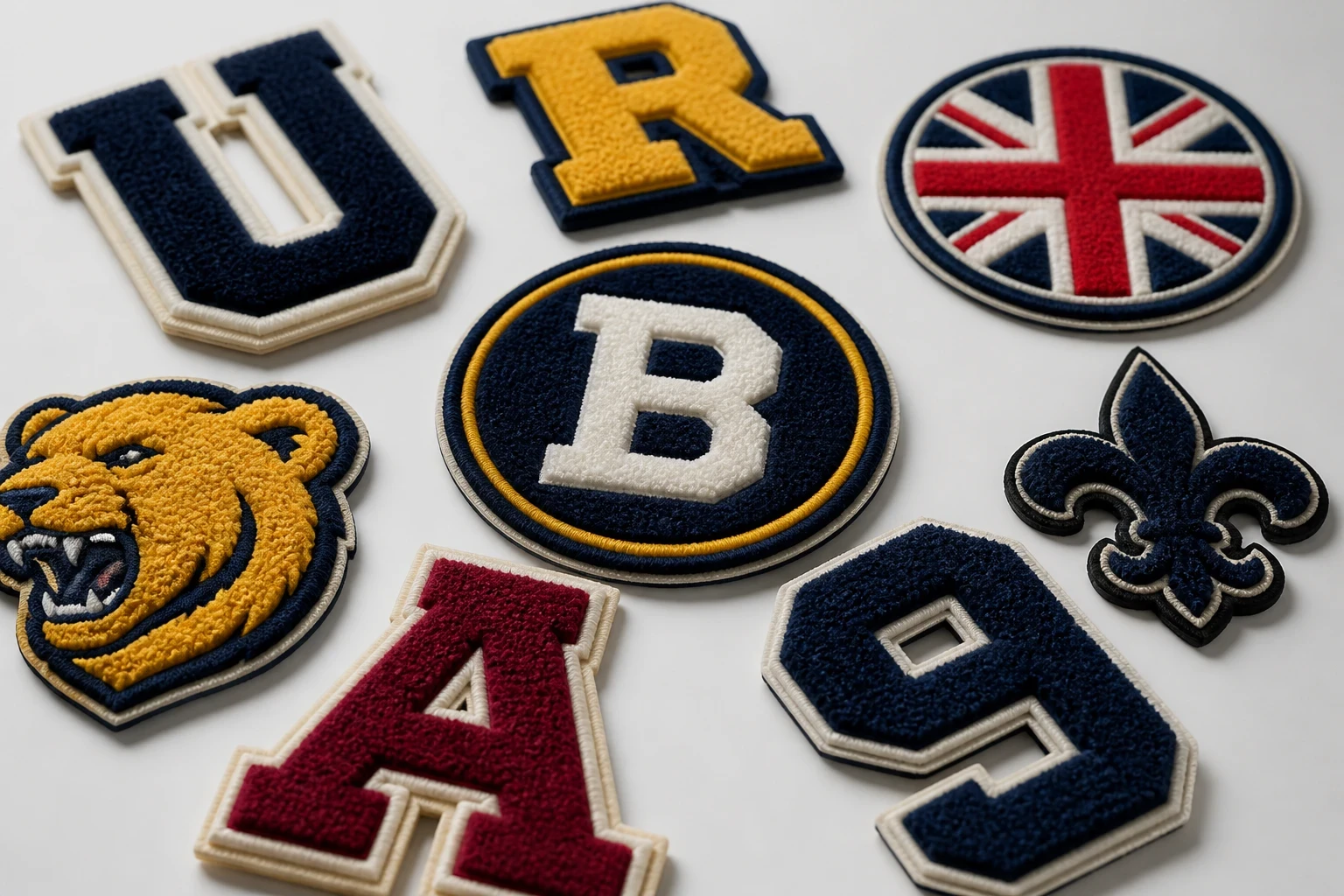
Varsity chenille works best when the patch needs texture and presence rather than fine photographic detail. The familiar look is a felt base with raised yarn forming a large letter, number, mascot or simple crest. That is why it suits wool coaches jackets, school blazers, rugby tops, American football jackets and heavyweight teamwear.
It can also work on a branded overshirt or a hospitality jacket, provided the fabric can carry the weight and the attachment method is suitable. Typical enquiries cover football clubs, cadet units, hospitality polos and biker vests, and the garment changes the recommendation every time. A nylon shell needs a different fixing conversation from a wool jacket. A Velcro panel needs a loop-compatible back rather than an iron-on finish.
Chenille is not the answer for every logo. Tiny wording, narrow outlines and detailed gradients can lose definition because the yarn has a visible pile. If the design contains small sponsor names or a fine web address, consider embroidered patches or woven patches for those elements. Printed is flatter; that is the point, and it can preserve a detailed image that chenille cannot.
- Choose chenille for bold initials, school letters, numbers, mascots and simple club crests.
- Choose flat embroidery for stitched outlines, compact lettering and mixed-detail logos.
- Choose woven for small text and a flatter, tidy surface.
- Choose printed when gradients, photographs or very fine artwork matter more than texture.
- Consider a mixed order when a large chenille chest emblem and smaller embroidered sleeve badges serve different purposes.
2. Prepare artwork that can become a chenille patch
Start with the cleanest file available. A vector PDF, SVG, AI or high-resolution PNG is helpful, but a clear photograph of an existing badge can also start the process. Include the exact wording in a message rather than relying on a low-resolution image, especially for initials, squad names and dates.
Do not expect every line in a digital logo to survive unchanged. Chenille needs practical shapes: letters with enough room for the yarn, borders that do not collapse into the background, and gaps that remain visible after the patch is made. A designer may combine two close colours or remove a hairline detail so the badge reads properly from normal standing distance.
Artwork details to state clearly
- Exact text, including capital letters, punctuation and any year or team number.
- The preferred base colour, yarn colour and border colour.
- The intended garment and the position, such as left chest, back panel, sleeve or blazer pocket.
- The finished patch width and height in inches, or the maximum area available.
- Any details that cannot be changed, such as a school colour, club crest proportion or brand colour.
- A reference photograph if the patch needs to match an existing badge.
It is better to ask one extra question than to make a confident guess. Tell us if the patch is being placed on a wool coaches jacket, a nylon shell or a school blazer. The same 4-inch design can look proportionate on one garment and crowded on another.
3. Choose the size, shape and visual hierarchy
Measure the flat area where the patch will sit. Use a ruler or tape measure and allow for seams, pockets, buttons, zips and curved panels. A large back patch might be around 10 to 12 inches wide on some jackets, while a chest letter may be closer to 3 to 5 inches, but the correct measurement belongs to the garment rather than to a generic size chart.
Think about reading distance. A badge viewed across a football pitch needs larger forms than one viewed on a school blazer at arm's length. If the name is long, stacking it over two lines may produce a clearer result than squeezing it into one narrow strip. A strong border also helps the patch separate from a patterned or dark jacket.
| Patch element | What to decide | Practical UK ordering note |
|---|---|---|
| Overall size | Width and height in inches | Measure the usable garment area, not just the front panel. |
| Shape | Letter, shield, circle, rectangle, mascot or custom outline | Simple outlines tend to keep the cleanest chenille edge. |
| Lettering | One line, stacked lines, initials or number | Allow enough space for raised yarn and avoid very narrow characters. |
| Base | Felt colour and material appearance | Use a contrasting base if the jacket colour is close to the yarn colour. |
| Border | Merrowed, stitched or defined outer edge | A visible border helps separate a crest from wool, fleece or dark nylon. |
| Application | Sew-on, iron-on, Velcro or another finish | The garment and cleaning routine should guide this choice. |
The raised surface is part of the appeal, but it also takes space. Avoid cramming a long sentence into a small badge. For a club motto or sponsor line, a separate embroidered patch may be more readable beside the main chenille crest. Our Chenille patches Sizing and Backing Options Explained guide covers the measurements and attachment choices in more detail.
Not sure whether chenille, flat thread or ink will hold your logo? Get a free digital mockup usually within 12 hours and compare the options before you produce. The 5-piece minimum applies per design, so you can plan a small test run without committing to a large batch.
4. Select colours that remain distinct on the garment
Colour selection is more than matching a screen image. The felt base, raised yarn, border and garment all sit together, so a colour that looks separate on a white design board may merge on a navy wool jacket. Ask for the colours to be shown in the mockup against the intended garment shade where possible.
High contrast is usually the safer route for initials and numbers. White yarn on burgundy, cream on forest green or gold on navy can read strongly, although the final result depends on the exact materials and surrounding border. Similar shades can still work for a subtle fashion badge, but they should be chosen knowingly rather than because a display monitor made them look different.
Colour checks before approval
- Check the lettering against the felt base.
- Check the outer border against the garment.
- Confirm whether school, club or brand colours need a close visual match rather than a named colour alone.
- Ask how a dark garment will affect a dark base.
- Review the mockup on a phone and a larger screen, since small previews can hide narrow gaps.
For an established brand, send a colour reference or approved artwork file, but remember that thread and felt are physical surfaces rather than screen pixels. The mockup is a visual approval stage, not a promise that a monitor can reproduce a textile colour exactly.
5. Pick the backing for the actual garment
Sew-on is the dependable choice for many jackets, blazers, bags and long-term clubwear. It suits wool coaches jackets and heavier fabrics because stitching gives the patch a mechanical attachment. A merrowed crest can be sewn around the edge, through a suitable border, without asking adhesive to carry the whole load.
Not sure whether thread or ink will hold your logo? Send the artwork and garment details for a free digital mockup usually within 12 hours, then compare the look before production.
GET A FREE MOCKUPIron-on is convenient for suitable cotton or compatible teamwear, but it is not universal. Heat-sensitive nylon shells can mark, shrink or reject the adhesive. A patch that appears fine on day one may peel after a dryer cycle if the garment, temperature or application method is wrong. We always want to know the fabric before recommending iron-on.
Velcro makes sense for removable unit badges, kit systems and garments that need different identifiers. The patch needs the correct hook or loop arrangement, and the garment needs a secure matching panel. It may add thickness and cost, but that trade-off is worthwhile for a cadet unit or team that changes names and roles.
| Backing | Good fit | Watch for |
|---|---|---|
| Sew-on | Wool jackets, blazers, bags, heavyweight teamwear and long-term use | Needs stitching time and access to the garment edge or patch area. |
| Iron-on | Suitable cotton and compatible garments where quick application matters | Heat, washing and dryer conditions can affect adhesion; not ideal for every nylon shell. |
| Velcro | Removable unit, club or team identifiers | Requires matching garment panels and can feel thicker. |
| Plain or unbacked | Projects where the buyer will apply a separate fixing method | The application method must be planned before the patch is made. |
If you are ordering for school blazers, ask how the patches will be attached and washed before choosing the finish. If the same badge is moving between garments, sew-on may be inconvenient and Velcro may be more practical. For a one-off fashion jacket, iron-on can be attractive, but only after checking the garment label and heat tolerance.
6. Send the quote information in one clear message
A usable quote request does not need to be complicated. It needs the information that changes the price or construction. Include one design per line if you are ordering several team names, years or colourways, because a 5-piece minimum is counted per design rather than across unrelated artwork.
- State the design name and attach the artwork or a clear reference image.
- Give the quantity for each design, with the minimum of 5 pieces per design in mind.
- Provide the finished width and height in inches, or the available garment space.
- List the felt, yarn and border colours.
- Name the garment, such as wool coaches jacket, school blazer, football jacket, nylon shell or Velcro panel.
- Choose sew-on, iron-on, Velcro or ask for a recommendation.
- Give the UK delivery postcode and any date by which the patches are needed.
- Mention if there are separate versions for age groups, squads, branches or brand colourways.
The phrase “same as last time” is useful only if the previous specification is available and still correct. Garment stock, colour choices and application plans change. Attach the old photograph or order reference, then confirm the current size and quantity rather than assuming the old patch will fit the new jacket.
7. Review the free mockup before production
The mockup is the point where an idea becomes a checkable specification. The Customized Patches usually sends a free digital mockup within 12 hours. Look at it as a production drawing: confirm the wording, letter order, badge shape, dimensions, colour relationships, border and backing.
Zoom in on the parts most likely to cause trouble. Is a number accidentally close to the edge? Has a long club name become too small? Does the outer border disappear against the jacket? Is the Velcro shown on the correct side? These questions are quick to answer before manufacture and awkward to answer after an unapproved assumption has become a finished batch.
What approval should cover
- Exact spelling and punctuation.
- Patch width and height in inches.
- The number of colour areas and their intended contrast.
- Lettering layout, including stacked lines and spacing.
- Backing type and whether any matching garment panel is required.
- Quantity per design and the delivery address.
- Any special application note, such as a nylon shell or school laundering routine.
Production begins only after approval. If a coach, committee member or brand manager needs to sign off, include that person early. A short written approval such as “approved for production, 50 pieces, sew-on backing” gives everyone a clear record.
8. Understand price, lead time and UK delivery
The price of varsity chenille patches depends on more than the number of pieces. Size, number of colours, lettering complexity, shape, backing and quantity all affect the quotation. A 12-inch back patch with several elements requires a different amount of material and handling from a 3-inch single initial.
Quantity can affect the unit cost because setup and production work are spread across the batch. That does not mean every club needs to order hundreds. The 5-piece minimum per design is useful for a small school group, pilot merchandise run, staff uniform test or club committee sample, while larger team orders can be quoted from the full size list.
Lead time should be discussed before approval, especially for a presentation, tournament, graduation, launch or school term. The free mockup is usually sent within 12 hours, but that is the artwork approval stage rather than a promise that finished patches will arrive the next day. Production and delivery depend on the confirmed specification, quantity and current schedule.
For UK-wide shipping, provide the correct postcode and a realistic required date. If the order is going to several clubs or branches, confirm whether it should ship together or to separate addresses. Our How Much Do varsity chenille patches UK Cost in the UK? guide explains the main cost factors without pretending there is one price for every design.
Name sew-on, iron-on or Velcro on the quote. We show the correct back on a free digital mockup usually within 12 hours so production matches the garment, and we only produce after approval. That small check can prevent a box of otherwise attractive patches arriving with the wrong application method.
9. Apply and care for the finished patch
Application should follow the selected backing and the garment manufacturer's care instructions. Sew-on patches need even stitches around the secure border, with thread that suits the patch and garment. On a lined jacket, take care not to catch the lining or create a visible ridge inside.
Iron-on patches need a stable, heat-safe surface, a pressing cloth and the correct temperature and pressure. Do not assume a household iron will bond safely to every material. Nylon shells, coated fabrics and heat-sensitive finishes need particular care, and a sewn attachment may be the better route.
Wash and dry according to the garment and backing instructions. Avoid treating a chenille badge like a printed transfer. Raised yarn can collect lint, and aggressive brushing or high heat can affect the surface. If the jacket is valuable, use a professional cleaner familiar with trims and applied badges.
Common ordering mistakes to avoid
The most frequent problem is not a dramatic artwork error. It is a missing practical detail: no measurement, no garment information, an assumed backing or a quantity split across several designs. Those gaps create avoidable questions and can delay a team order.
Name sew-on, iron-on or Velcro on the quote, and include the garment photograph if you have one. We show the backing on a free digital mockup usually within 12 hours, then produce only after your approval.
GET A FREE MOCKUP- Sending a screenshot without stating the exact wording.
- Choosing a size that ignores a pocket, seam, zip or curved panel.
- Using similar yarn and base colours on a dark jacket without checking contrast.
- Ordering iron-on for a nylon shell without checking heat compatibility.
- Counting 20 mixed designs as one 20-piece order when each design has its own minimum.
- Approving a mockup without checking the back, spelling or final dimensions.
- Leaving a tournament, launch or school event date until after production has started.
- Assuming an old patch specification will fit a new garment.
For a second checklist, read Common Mistakes to Avoid When Ordering varsity chenille patches UK. If you are comparing finishes, Varsity chenille patches UK vs embroidered patches: Which Is Right for Your Project? sets out the texture, detail and application trade-offs.
Alternatives to varsity chenille patches UK
A good quote sometimes ends with a different patch type. That is not a failed enquiry; it is the right result if the artwork or garment needs another construction. A detailed hospitality logo may work better as printed patches, while a raised but more detailed emblem may suit 3D embroidered patches.
| Patch type | Best suited to | Main trade-off |
|---|---|---|
| Varsity chenille | Bold initials, numbers, mascots and traditional team or school jackets | Strong texture, but fine detail and tiny wording are limited. |
| Embroidered | Crests, outlines, compact lettering and familiar branded uniforms | More detail than chenille, with a flatter stitched surface. |
| Woven | Small text, neat linework and a flatter badge profile | Less raised texture than chenille. |
| Printed | Gradients, photographs and artwork with very fine tonal changes | Flatter appearance and a different tactile finish. |
| PVC | Outdoor, hard-wearing or modern utility-style applications | Rubbery look and feel rather than yarn or thread. |
| Leather | Premium casualwear, biker garments and simple debossed marks | Best with restrained detail and a different visual character. |
For motorcycle clothing, compare the garment, abrasion, attachment area and desired style before deciding. Our guide to biker and motorcycle club patches covers that use case separately. The useful question is not which material is universally best; it is which surface, backing and detail level match the job.
A simple order checklist for UK teams and businesses
Before sending the final message, read the specification aloud. This catches missing words, swapped colours and an unrealistic size more often than staring at a crowded design file. Keep the approved mockup with the order record so the person applying the patch knows what was agreed.
- Design name and exact wording confirmed.
- Artwork attached in the clearest available format.
- Quantity confirmed for each design, with at least 5 pieces per design.
- Finished width and height measured in inches.
- Felt, yarn and border colours listed.
- Garment type and application position stated.
- Backing selected or recommendation requested.
- Required date and UK postcode supplied.
- Free mockup checked for spelling, size, colour and backing.
- Written approval given before production.
If you are ordering for a school, college or club committee, nominate one person to approve the artwork. If you are ordering for a brand or business, include the person responsible for garment procurement as well as the person responsible for the logo. It keeps the practical and visual decisions together.
Where to go next
Start with the chenille patches product hub if you already know that raised yarn is right for the project. If the design still needs comparison, review embroidered patches, woven patches and printed patches before requesting the mockup.
For local project context, the UK city pages can help you find the relevant delivery and ordering information for your area. The core process stays the same across England, Scotland, Wales and Northern Ireland: send the details, review the free mockup, approve the specification and then allow production and UK delivery time.
The safest order is a clear one. State the garment, size, colour, quantity and backing, then check the mockup with the person who will wear or apply the patch. The Customized Patches has a 5-piece minimum per design, provides a free digital mockup usually within 12 hours, and produces only after approval.
Frequently asked questions
What is the minimum order for varsity chenille patches UK?
The minimum is 5 pieces per design. If you order three different team names or colourways, each design should be counted separately. Send the quantity for every design so the quote reflects the actual order.
How quickly can I receive a mockup for varsity chenille patches UK?
The Customized Patches usually provides a free digital mockup within 12 hours. This is the artwork approval stage, not a promise of finished delivery within 12 hours. Check the design, dimensions, colours and backing before approving production.
Can varsity chenille patches be put on a nylon jacket?
They can be used on some nylon garments, but the backing and application method need checking first. Iron-on adhesive may not suit a heat-sensitive or coated nylon shell. Sew-on or a suitable Velcro arrangement may be safer, depending on the garment.
Are varsity chenille patches suitable for small lettering?
Chenille is strongest for bold lettering, initials and numbers. Very small wording or narrow lines may lose clarity because the raised yarn needs practical space. For compact text, compare embroidered patches or woven patches before approving the design.
When does production start for varsity chenille patches UK?
Production starts only after you approve the digital mockup and confirmed specification. Approval should cover spelling, size in inches, colours, backing, quantity and any garment-specific instructions.
How should I choose between sew-on, iron-on and Velcro backing?
Choose sew-on for many wool jackets, blazers and long-term applications; iron-on for suitable heat-safe garments where convenient application matters; and Velcro where the badge must be removed or changed. The garment fabric, washing routine and intended use should guide the decision.
Ready to produce custom patches for your UK team or brand?
GET A FREE MOCKUP