
The Difference Between varsity chenille patches UK and embroidered patches, Explained
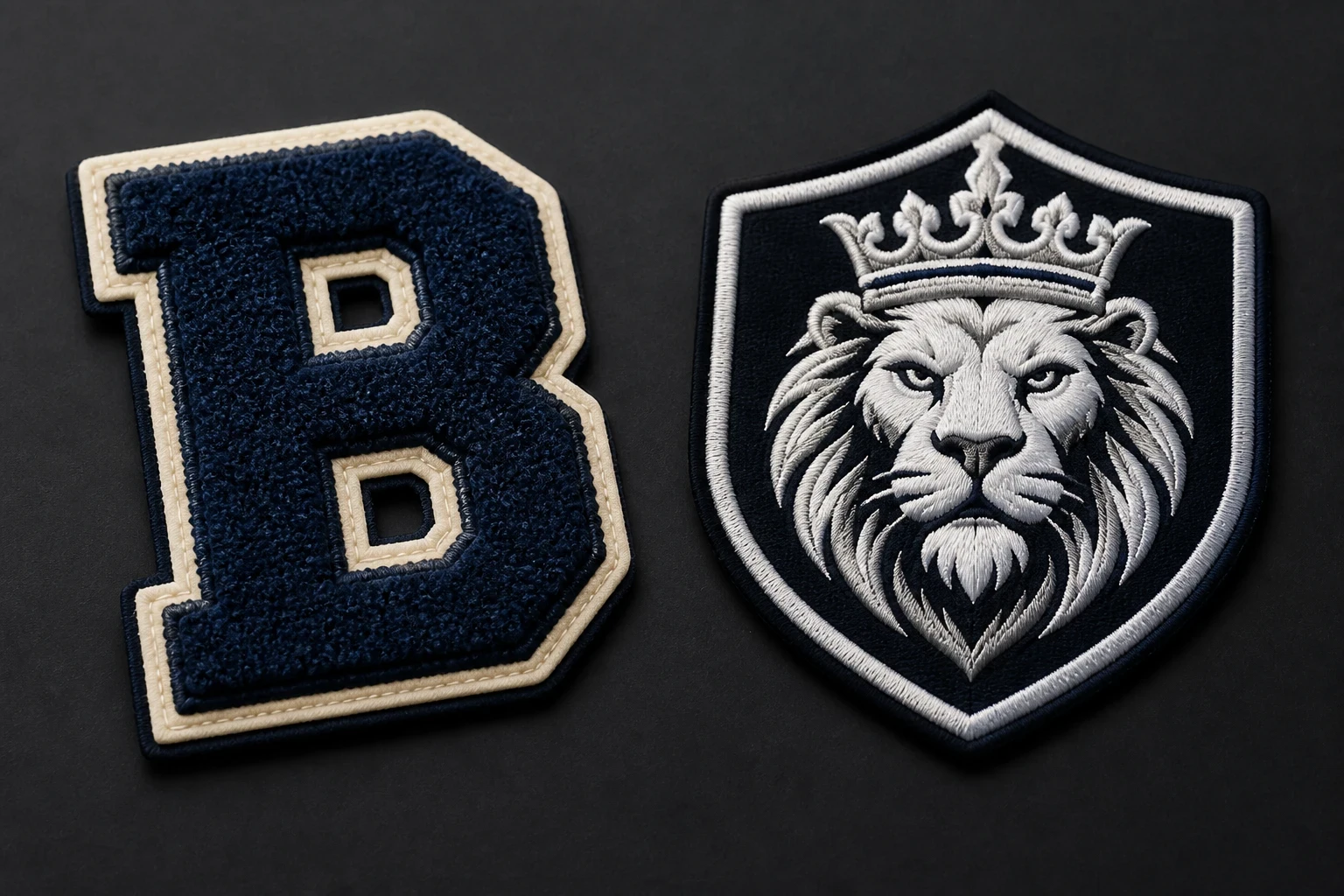
Varsity chenille patches UK are soft, raised badges made with tufted yarn, giving bold lettering and a traditional athletic look. Embroidered patches use stitched thread on a fabric base, so they suit finer detail, smaller text and more flexible branding. The right choice depends on artwork, garment, use and backing.
Key takeaways
- Chenille is raised, soft and tactile; embroidery is flatter, sharper and better for fine detail.
- Chenille normally suits large letters, simple crests and traditional school, sports or club garments.
- Embroidered patches handle smaller text, detailed logos and broad business branding more reliably.
- The Customized Patches requires a 5-piece minimum per design and produces only after artwork approval.
Varsity chenille patches UK are the better choice for a thick, soft badge with large lettering and a traditional American-style sports look. Embroidered patches are flatter and usually better for fine lines, smaller text, detailed crests and logos that need to sit neatly on a wider range of garments.
The difference is mainly in the surface and the way the artwork is made. Chenille uses looped, tufted yarn to create a raised pile; embroidery uses stitched thread on a fabric base. At The Customized Patches, both options are made for UK teams, brands, clubs and businesses, with a 5-piece minimum per design and UK-wide shipping.
What are varsity chenille patches UK?
Chenille is the fuzzy material often associated with school letter jackets, college sportswear and old-school team badges. The yarn is worked into a soft pile, so a block letter or simple emblem stands proud from the background. Run your hand across one and you feel the difference straight away. It is not a flat print pretending to be textured.
That texture makes chenille particularly effective on wool coaches jackets, varsity jackets, heavy sweatshirts and school or college clothing. A large initial, year, mascot or simple shield has visual weight without needing lots of tiny stitches. It also photographs well on teamwear because the raised yarn catches light differently from the base fabric.
There is a limit to that character. Very small wording, fine outlines and detailed illustrations do not translate as cleanly into tufted yarn as they do into embroidery. A football club crest with several small words may need simplifying, especially if the finished badge is only 3 or 4 inches wide. The useful question is not simply whether chenille looks impressive; it is whether the artwork has room to breathe.
How embroidered patches differ
An embroidered patch is built from thread stitched into a twill or similar fabric base. The result is flatter than chenille, though it can still have a strong stitched edge and a substantial feel. It is the familiar choice for football clubs, cadet units, workwear, hospitality polos, school blazers and branded outerwear because it accommodates a wide range of logos.
Embroidery is normally the safer option for a logo with narrow lettering, several colour changes, fine borders or a recognisable line drawing. A hotel group may need its name legible on a polo sleeve. A cadet unit may need a crest with small internal features. A biker club may need a detailed back patch with curved wording. Flat embroidery will not make every small detail perfect, but it gives the production file more ways to represent it than chenille.
That does not make embroidery automatically superior. Printed is flatter; that is the point. If the design is a full-colour illustration or a photographic-style mark, printed patches may be more suitable. If you want a rubbery outdoor badge, PVC patches may make more sense. Material choice should follow the logo and garment, rather than a general preference for one patch type.
Chenille versus embroidery: the practical differences
The table below is a starting point for the decision. Exact results depend on size, artwork, colours, border, backing and the garment itself. A simple 8-inch school letter and a dense 3-inch company logo should not be judged by the same rule.
| Specification | Varsity chenille | Embroidered patch |
|---|---|---|
| Surface | Raised, soft and looped or tufted | Flatter stitched thread on a fabric base |
| Best visual style | Bold varsity lettering, mascots, initials and simple crests | Logos, lettering, unit badges, club crests and detailed symbols |
| Small text | Usually needs to be larger and simpler | Generally handles smaller text more effectively, subject to size |
| Texture | Highly tactile and visibly three-dimensional | Stitched texture, but less bulky and less fuzzy |
| Typical garments | Wool coaches, varsity jackets, heavy sweatshirts and college clothing | Polos, football shirts, nylon jackets, school blazers, workwear and vests |
| Colour and shading | Strongest with bold colour blocks and limited detail | More flexible for outlines, colour changes and stitched detail |
| Backing | Can be supplied for sew-on, iron-on or Velcro applications, subject to design and garment | Commonly available as sew-on, iron-on or Velcro, subject to the garment |
| Main trade-off | Distinctive texture but less suited to intricate artwork | More adaptable and detailed, but without the thick chenille pile |
Texture, thickness and the way the badge sits
Chenille has a taller profile. That is useful on a jacket front where the badge is meant to be noticed, but it can feel too bulky on a lightweight nylon shell or a fitted polo. Embroidery sits closer to the garment and is often easier to position on a sleeve, chest or narrow Velcro panel.
A raised badge also changes how it wears. It can catch against a bag strap or rub under a seat belt. That does not make it unsuitable for active clothing, but the placement deserves thought. For a large back panel on a heavy jacket, the texture is part of the appeal. For a small workwear chest badge, a flatter embroidered finish may be more comfortable.
Artwork detail and readability
Chenille is strongest with clear shapes. Think one or two large letters, a block number, a broad border or a mascot reduced to its main silhouette. Thin strokes can disappear into the pile, and tiny gaps may close when viewed at the finished size. A good production file does not merely copy a screen logo; it adapts the design to the chosen material.
Embroidery gives more control over outlines and small features, although there is still a practical minimum for thread and lettering. A logo that looks clear on a monitor may be too fine at 2 inches wide. We check this during artwork preparation and can show the proposed result before anything is made. Our 3D embroidered patches can also add raised thread detail if you want extra depth without a full chenille surface.
Durability and care
Both types can work well on garments when the backing and attachment method match the job. Sew-on patches are dependable for jackets, blazers and thick clothing. Iron-on is convenient, but it is not a magic solution for every fabric. It is common to see iron-on patches peel after a dryer cycle, particularly when the garment was not prepared correctly or was exposed to repeated high heat.
Nylon shells need particular care because heat can affect the fabric and some adhesives. A Velcro panel needs the hook-and-loop section placed accurately, with enough area to support the badge. A merrowed crest can look tidy on a blazer or team jacket, but the border must not crowd the lettering. Follow the garment care label, avoid unnecessary tumble drying and tell us how the patch will be used before choosing the back.
Not sure whether the logo needs raised yarn or flatter thread? Send the artwork and the intended garment. We can compare the options on a free digital mockup, usually within 12 hours, before production.
GET A FREE MOCKUPWhich patch suits your garment?
Start with the garment, not the badge catalogue. A wool coaches jacket can carry a substantial chenille letter without looking overloaded. A nylon shell usually benefits from a lighter, flatter patch and a carefully selected backing. A school blazer may suit a traditional embroidered crest, while a college society sweatshirt can take a large chenille initial on the front.
- Choose chenille for varsity jackets, letterman-style clothing, heavy wool jackets, large sweatshirt initials and simple sports emblems.
- Choose embroidery for football shirts, cadet uniforms, workwear polos, school blazers, club vests and logos containing smaller wording.
- Use Velcro when the badge must be removed or exchanged, such as on club kit, tactical clothing or reusable uniform panels.
- Use sew-on for a long-term attachment on a thick jacket, blazer or biker vest where the garment can take a needle and thread.
- Treat iron-on as a convenient option rather than a universal one, especially on nylon, waterproof shells and garments that go through frequent hot washes.
Biker and motorcycle club garments bring another consideration: size and placement. A large back badge may suit biker and motorcycle club patches with a strong border and readable lettering, while a small front chest mark may be better embroidered. For a business uniform, the logo usually needs to be clear at a conversation distance, not simply impressive close up.
If the main attraction is the material, chenille earns its place. If the main requirement is a faithful, readable version of a complicated logo, embroidery is usually the sensible starting point. Woven patches are another option for very fine, flat detail where a smooth surface matters more than stitched depth.
Choosing size, shape and backing
Size changes the result more than many first-time buyers expect. A 4-inch round patch may be right for a chest or sleeve, but it will not give a long team name much room. A 10-inch back patch can carry large lettering, yet it may be too much for a fitted polo. Measure the usable panel on the actual garment and allow space for seams, pockets, zips and existing badges.
The border also affects readability. A merrowed edge gives a traditional finished outline, while a clean cut edge can suit a more modern shape. With chenille, a broad border helps contain the pile and frame the design. With embroidery, a border can separate the logo from a patterned or dark garment. Do not judge the edge in isolation; it must work with the colour of the jacket, shirt or vest.
Backing choices in real use
Sew-on is the dependable choice for garments that will be worn and washed regularly. It takes more time to attach, but it avoids relying on adhesive alone. Iron-on can be practical for a stable cotton or cotton-blend item when the garment and care instructions allow it. Velcro is useful for removable identity panels, but it adds thickness and needs a matching loop surface.
For a cadet unit, the right backing may depend on whether the badge is changed between activities. For a football club, a sew-on or suitable iron-on option may be preferred for a fixed crest. For a promotional nylon jacket, adhesive performance and heat tolerance need checking first. Give us the garment details rather than selecting a backing from a generic list.
Cost, minimum quantities and lead times in the UK
The final price is shaped by size, number of pieces, artwork complexity, colours, border, backing and production method. A large chenille badge uses more material and handling than a small embroidered chest logo, but a detailed embroidered design may require more digitising work. The cheapest-looking option on a screen is not always the lowest-cost option once the right size and attachment method are included.
The Customized Patches has a 5-piece minimum per design. That suits a small team, a new clothing label testing a first run or a club ordering a handful of committee badges, while larger orders can be quoted from the same approved artwork. Different designs are treated separately, so five pieces of one crest and five pieces of another are not normally one five-piece design.
A free digital mockup is usually supplied within 12 hours. We produce only after approval, so the customer can check the wording, size, colours, border and backing before the order moves into production. That approval stage is especially useful when comparing varsity chenille patches UK with embroidery, because a visual proof shows the difference more clearly than a paragraph of description.
Lead time depends on the product, quantity, backing and current production schedule. A small straightforward run may move differently from a large multi-design team order. If a club has a match date, a school has a presentation evening or a brand has a launch deadline, state it at quote stage. We can then discuss the realistic route instead of making a promise without checking the job.
For more ordering detail, see How Much Do varsity chenille patches UK Cost in the UK? and the Chenille patches Sizing and Backing Options Explained. You can also compare the full range through our embroidered patches product hub.
How to prepare artwork for a reliable result
Send the best version of the logo available, preferably a vector file such as AI, EPS or SVG, although a clear PNG can be a useful starting point. Include the intended finished size in inches, the garment colour, the number of pieces and the preferred attachment method. If the artwork contains wording, tell us which parts must remain exactly as supplied.
Do not add tiny detail simply because there is empty space on the computer screen. A 6-inch patch viewed on a monitor can make ¼-inch lettering look generous, but the finished thread or yarn has physical limits. Ask whether the wording needs to be readable from several feet away, or whether it is a small decorative detail that can be simplified.
- Remove unnecessary shadows, hairline outlines and texture that cannot be reproduced in the selected material.
- Keep a clear contrast between the patch background, border and garment.
- Check spelling, dates, initials and club names before approving the mockup.
- State the finished width or height in inches rather than saying only 'large' or 'small'.
- Show a photo of the garment if the patch must fit beside a pocket, zip, seam or existing badge.
- Ask for a revised mockup if the first material does not give the right balance of detail and texture.
Name sew-on, iron-on or Velcro on the quote and tell us what the patch will be attached to. We show the proposed backing and artwork on a free digital mockup, usually within 12 hours, and production starts only after approval.
GET A FREE MOCKUPOur guide to How to Design Artwork for varsity chenille patches UK That Production-Ready covers the preparation stage in more detail. The wording is awkward in the guide title, but the practical point is simple: design for the finished badge, not just the original screen artwork.
Examples from UK orders and common mistakes
A school may choose a chenille letter for a senior sports jacket because the large initial is the feature. The same school may choose embroidered house crests for blazers because the crest needs to remain compact and legible. A football club could use embroidery for player or staff tops, then use a larger chenille anniversary badge for a special jacket.
A hospitality business often needs a small chest logo on polos and overshirts. Embroidery generally sits neatly there, provided the lettering is sized sensibly. A fashion label might use chenille on a heavyweight overshirt as a deliberate tactile feature, while using a small embroidered mark on caps or lighter garments. One brand can reasonably use both methods.
The recurring failures are predictable. Customers sometimes choose chenille for a detailed circular logo, specify a patch that is too small for the wording, or select iron-on for a nylon shell without checking heat and washing conditions. Another common problem is assuming a Velcro patch will work without a loop panel already fitted to the garment.
A further mistake is approving a proof without checking the actual dimensions. Place a ruler on the table and imagine the patch on the garment. A 3-inch badge can look substantial on a digital mockup but appear modest on a large back panel. Conversely, a 10-inch patch can overwhelm a child’s blazer or a narrow jacket front.
For more checks before placing an order, read Common Mistakes to Avoid When Ordering varsity chenille patches UK. If your project is for a school or college, the Varsity chenille patches UK Best Practices for schools and colleges guide covers uniform and teamwear considerations.
A straightforward decision guide
Choose varsity chenille patches UK when the badge should feel like part of the garment rather than simply a label attached to it. Large letters, simple symbols and strong colour blocks benefit from the raised yarn. Chenille is especially convincing on varsity jackets, wool coaches and heavy sweatshirts where the material has enough structure to support it.
Choose embroidery when the logo has smaller text, several outlines, a detailed crest or a practical uniform purpose. It is usually easier to place on a polo, nylon jacket, school blazer, football top or Velcro panel. It is also the more flexible starting point if the same design will be used at different sizes.
If neither is quite right, ask about alternatives rather than forcing the artwork into the wrong process. Leather patches can suit premium workwear or caps. A smooth woven patch may preserve fine flat lines. The aim is a patch that works on the garment, survives its use and represents the design honestly.
The Customized Patches ships across the United Kingdom, including orders for teams, businesses, clubs, schools and independent clothing brands. Send the design, quantity, intended size and garment details for a practical recommendation. A free digital mockup is usually ready within 12 hours, and no production begins until the artwork has been approved.
Frequently asked questions
Frequently asked questions
Are varsity chenille patches UK better than embroidered patches?
Neither is always better. Varsity chenille patches UK are better for raised texture, large letters and simple athletic designs. Embroidered patches are usually better for fine detail, smaller wording, workwear logos and compact crests. The garment, finished size and artwork should decide the material.
Can chenille patches be used on a nylon jacket?
They can be used on some nylon jackets, but the garment and backing need checking first. Nylon can be affected by heat, so iron-on should not be selected casually. Sew-on may be more suitable, depending on the shell, lining and intended use. Send a garment photo with the quote.
What is the minimum order for a patch design?
The Customized Patches has a 5-piece minimum per design. Each design is counted separately, so five pieces of one logo and five pieces of a different logo are normally quoted as two designs. The minimum applies to both the chenille and embroidered options.
How quickly can I see a patch mockup?
A free digital mockup is usually supplied within 12 hours. It can show the proposed size, colours, border and backing so you can compare chenille with embroidery before committing. The Customized Patches produces only after the customer has approved the artwork.
Do embroidered patches last longer than chenille patches?
Both can last well when attached and cared for correctly. Embroidery has a flatter surface and may be easier to maintain on everyday uniforms. Chenille has a raised pile that can catch on rough use or straps, but it is well suited to heavy jackets and team clothing. Washing, drying and attachment method affect service life.
Can I order both chenille and embroidered patches for one club?
Yes. A club might use embroidered crests on football shirts and chenille anniversary letters on heavy jackets. Each design and product type should be specified on the quote. A free digital mockup lets you review the difference before production, with the 5-piece minimum applying per design.
Ready to produce custom patches for your UK team or brand?
GET A FREE MOCKUP