
Top 10 Uses for custom embroidered patches in 2026
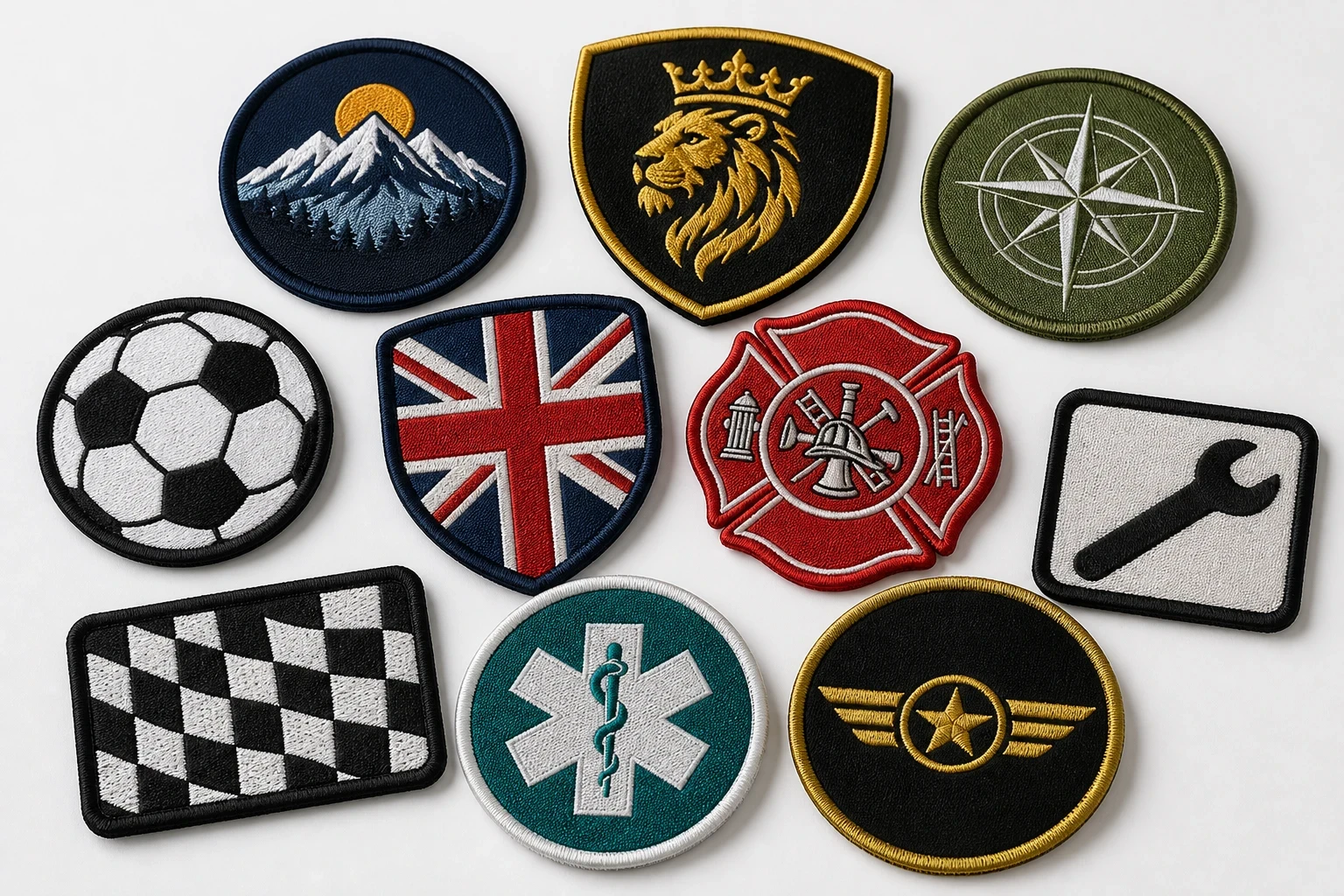
Custom embroidered patches are used for team kits, workwear, school uniforms, club clothing, jackets, bags, events, uniforms, branded merchandise and collectables. They add a tactile stitched design to garments or equipment. The Customized Patches offers a 5-piece minimum per design and produces only after approval of a free digital mockup, usually sent within 12 hours.
Key takeaways
- Custom embroidered patches work best for logos, crests, names and bold lettering that can be represented clearly in thread.
- A 5-piece minimum per design makes small club, team and business runs practical without committing to hundreds of units.
- Backing should match the garment: sew-on suits permanent placement, iron-on suits simple application, and Velcro suits removable identification.
- The Customized Patches usually sends a free digital mockup within 12 hours and produces only after you approve the design.
The top uses for custom embroidered patches in 2026 are team kits, workwear, school clothing, club garments, jackets, bags, events, uniforms, merchandise and collectables. They give a logo or crest a stitched surface that people can see and feel, rather than printing the design directly onto fabric.
For UK buyers, the sensible choice depends on the garment, the amount of detail in the artwork and how the patch will be washed or handled. The Customized Patches accepts a 5-piece minimum per design, normally sends a free digital mockup within 12 hours, and produces only after approval.
Why custom embroidered patches still work in 2026
A good patch gives a plain garment a clear point of identity. On a football jacket, it can carry the club crest. On a work fleece, it can identify the company. On a denim vest, it can be part of the garment rather than an afterthought. The raised thread catches light differently from the surrounding fabric, which is why an embroidered badge often feels more substantial than a flat transfer.
There are limits. Small lettering can close up, gradients need simplifying, and a detailed photograph is usually better suited to a printed patch. Printed is flatter; that is the point. If the artwork contains tiny text, fine facial detail or a large number of colour changes, compare printed patches and woven patches before choosing an embroidered finish.
The 10 most useful applications
1. Football, rugby and other sports teams
Sports clubs use patches on tracksuit tops, coaches' jackets, kit bags, caps and supporter clothing. A stitched crest gives players, coaches and volunteers a shared visual mark without requiring a fully bespoke garment for every person. It also works well for tournament squads, anniversary seasons and cup-run merchandise.
Football club artwork often contains a shield, a ball, a year and small lettering. At patch size, the outer shape and main colours matter more than squeezing in every detail from the original badge. For a practical comparison of positions and garments, see the guide to custom patches for sports teams.
2. Company workwear and uniforms
Embroidered patches are useful for trades, facilities teams, security contractors, delivery companies, cafés and independent shops. A badge can go on a softshell jacket, polo shirt, fleece, gilet or high-visibility outer layer, subject to the garment and the chosen attachment method.
A patch is especially handy when staff wear different garment brands or replace clothing at different times. Instead of embroidering a logo directly into each item, the business can order a consistent badge and apply it to approved garments. The workwear and uniform guide covers sizing, placement and laundering concerns.
3. School blazers, colleges and societies
Schools, universities and student societies use patches for house crests, clubs, trips, leavers' clothing and society merchandise. A badge on a blazer sleeve or school jacket can be more flexible than a permanently embroidered garment, particularly for temporary teams and annual events.
For a school crest, keep the text large enough to stitch cleanly and check the contrast against navy, black or burgundy fabric. Iron-on backing may seem convenient, but an iron-on patch can peel after a dryer cycle or repeated hot washing. A sewn edge is normally the safer specification for blazers that will be worn for a full term. See custom patches for schools, universities and societies for more examples.
4. Hospitality, cafés and food businesses
A stitched name badge or logo patch can give hospitality polos, aprons, overshirts and chef jackets a consistent appearance. It suits independent cafés, breweries, restaurants, bakeries, street-food traders and event caterers that need branded clothing without ordering an entire uniform range.
Hospitality garments are washed often, so the backing and attachment need thought. A sew-on patch is more dependable for a polo or jacket that goes through frequent laundering. If the garment is a thin nylon shell, test the location first; heavy stitching may affect the drape, and heat from an iron can mark or distort nylon.
5. Jackets, coats and outdoor clothing
Jackets are one of the most recognisable homes for a patch. Denim, canvas, cotton twill, fleece and wool coaches' jackets all provide a useful surface for a crest, band logo, expedition badge or brand mark. Back panels can carry a larger design, while chest and sleeve positions suit smaller identifiers.
Outerwear is not one material. A denim jacket behaves differently from a quilted coat, and a nylon shell can be damaged by excess heat. Sew-on is usually the dependable option for thick jackets. Velcro is useful for tactical or club garments that need patches changed, while iron-on is best treated as a convenience option rather than a universal answer. Read the advice on custom patches for jackets before approving the size.
6. Bags, backpacks and luggage
A patch can turn a plain backpack, kit bag, tote or travel case into something identifiable and personal. Scouts use them for camps, sports groups use them for team bags, and businesses use them on conference bags or staff rucksacks. A simple design with a strong outline is easier to recognise from a distance.
Bags receive rubbing, bending and contact with floors, seats and luggage belts. Sew-on patches are normally the strongest permanent choice, although Velcro is useful for bags used by tactical, airsoft or outdoor groups. Avoid placing a large badge over a fold or zip line. Our guide to custom patches for bags and backpacks covers practical placement points.
7. Biker, motorcycle and riding clubs
Motorcycle clubs often use a back design, a top rocker, a bottom rocker and smaller chest or sleeve patches. The format carries group identity, location, chapter information and founding dates. It is a design system, not just a single logo, so the relationship between each piece matters.
Leather and denim riding garments can take a sewn patch well, but thick leather needs a suitable needle and careful positioning. Merrowed crests provide a traditional raised border, while a heat-cut edge can suit a more modern shape. Do not assume a standard iron-on will bond reliably to a heavy leather vest. The biker and motorcycle club patches guide explains the usual parts of a club layout.
8. Scouts, cadets, youth groups and community organisations
Badges mark camps, achievements, patrols, local events and group membership. Scouts, cadets, guides, sea cadets, youth charities and community projects can order a small first run, then reorder the same design when the next group joins.
Not sure whether thread or ink will hold your logo? Get a free digital mockup in 12 hours and compare both before you produce.
GET A FREE MOCKUPThe 5-piece minimum per design is useful here because a local group does not need to buy hundreds before testing interest. For children’s clothing, check the application method, washing instructions and the position of the patch so it does not interfere with straps, seams or name labels. The guide to patches for scouts, cadets and youth groups gives more detail.
9. Festivals, events and promotional merchandise
Event organisers use patches as admission keepsakes, volunteer identifiers, artist merchandise and sponsor gifts. A festival patch can outlive a paper wristband and be added to a jacket or bag after the event. Small runs suit local events, while larger orders may make sense for recurring festivals or touring merchandise.
The artwork needs to work at a glance. Event names, dates and location details should not be reduced to unreadable thread. Consider a bold central symbol, a short date and a clear edge. For a softer, varsity-style finish, compare chenille patches with standard embroidery; chenille has more pile and texture, but it is less suited to very fine lettering.
10. Brands, creators and collectable merchandise
Independent clothing labels, musicians, online creators and small businesses use patches as low-volume merchandise. They can be sold on their own, included with an order or attached to a cap, overshirt or tote. This makes them useful for testing a design before committing to a full garment run.
Brand patches need consistency. Use the same thread colours, border treatment and proportions across every reorder. If a logo has a tiny slogan, prepare a simplified patch version rather than shrinking the whole logo until the letters close together. For a flatter surface and more detailed artwork, compare custom embroidered patches with printed patches.
Choosing the right patch specification
The best result comes from choosing the specification alongside the garment, not after it. A crest on a thick football jacket can use a different edge and backing from a small logo on a polo. Tell our team the garment type, approximate patch size, preferred position and how often the item will be washed.
The edge is part of the look. A merrowed edge gives a rounded stitched border and suits traditional badges. A heat-cut edge follows sharper or more irregular outlines. Laser-cut finishing can help with detailed contours, but the artwork still needs to be prepared for thread. The guide to merrowed, heat-cut and laser-cut edges shows the practical differences.
| Specification | Best suited to | Main advantage | Trade-off to consider |
|---|---|---|---|
| Sew-on backing | Denim, canvas, wool, leather and frequently washed clothing | Strong permanent attachment when stitched around the edge | Application takes longer and needs access to the garment |
| Iron-on backing | Simple application to suitable cotton or twill garments | Quick to apply without sewing equipment | Heat and washing can cause lifting; unsuitable for some nylon shells |
| Velcro backing | Tactical clothing, airsoft kit, bags and changeable identifiers | Patch can be removed or replaced | Needs a matching loop panel and can add thickness |
| Embroidered finish | Crests, logos, names and bold lettering | Raised thread texture and a traditional badge appearance | Very fine detail and gradients may need simplification |
| Woven finish | Small lettering, fine lines and flatter branded artwork | Sharper detail at a smaller size | Less raised texture than embroidery |
| Printed finish | Photographic artwork, gradients and very fine colour detail | Flat surface with broad artwork freedom | Does not have the tactile stitched texture of embroidery |
Thread count and coverage also affect the result. Dense stitching gives a fuller surface but can make a patch heavier and less flexible. A good digitised file decides which areas need solid coverage and which can use the base fabric. Approval should include the actual mockup, not only the original logo file.
Not sure whether thread or ink will hold your logo? Get a free digital mockup in 12 hours and compare both before you produce.
Artwork details that prevent avoidable failures
Most patch problems begin before the machine starts. A logo may look clear on a monitor at 8 inches wide but lose its small wording at 3 inches. Fine gaps can close when stitched, thin outlines can disappear, and similar thread colours can merge under indoor light.
- Send the cleanest artwork available, preferably a vector file, but include the original image if that is all you have.
- State the finished patch width and height in inches rather than saying small, medium or large.
- Identify the wording that must remain readable and allow the production team to suggest simplification.
- Confirm the base fabric colour, border colour and any thread colour references.
- Tell the team if the badge will sit on a curved cap, a thin polo, a padded jacket or a stiff bag.
- Check the spelling of names, dates, club titles and locations before approval.
- Ask for the edge and backing to be shown on the mockup.
A cap deserves particular care because its front panel is curved and has limited height. A patch designed for a flat jacket may wrinkle on a six-panel cap. Likewise, a large back design can work on a denim jacket but look crowded on a small backpack pocket. The custom patch design guide explains how to prepare artwork that stitches cleanly.
Backing, application and garment compatibility
Backing is not a minor finishing choice. It determines how the patch is applied and how easily it can be changed later. Sew-on backing is the usual choice for long-term use. Iron-on backing is convenient on compatible fabric, but it needs an even, protected heat application and may not survive repeated tumble drying. Velcro is practical where the badge must be removed.
Nylon shells deserve a warning. Direct heat can mark, shrink or distort the fabric, so do not press an iron-on patch onto a rain jacket without checking the garment instructions. Wool coaches' jackets and leather biker vests are also better handled with sewing. For a fuller comparison, see sew-on vs iron-on vs Velcro and patch backing types.
| Garment or item | Usually suitable | Extra check |
|---|---|---|
| Denim jacket | Sew-on, iron-on or sew-on with adhesive positioning | Check seams and allow room around the patch |
| Football tracksuit | Sew-on or suitable iron-on | Avoid blocking zips, club labels or stretchy panels |
| Nylon shell | Sew-on or suitable Velcro panel | Avoid untested heat; fabric may mark or distort |
| Wool coaches' jacket | Sew-on | Use careful stitching to avoid pulling the wool |
| Leather biker vest | Sew-on | Plan needle access and avoid placing over heavy seams |
| Backpack | Sew-on or Velcro | Keep clear of folds, zips and padded sections |
| Cotton cap | Sew-on or approved heat application | Confirm the curve, crown height and patch flexibility |
Ordering custom embroidered patches in the UK
A straightforward quote should cover the finished size, quantity, artwork, backing, edge, thread colours and delivery address. If you are ordering for a club or business, gather one approved logo file and one clear description of the garments before requesting the quote. This reduces the chance of approving a badge that later proves too large for the sleeve or too detailed for the chosen stitch.
The Customized Patches works with UK teams, brands, clubs and businesses, including small first runs. The minimum is 5 pieces per design, not 5 pieces spread across several unrelated designs. A football crest, staff logo and event badge count as separate designs unless the artwork is genuinely the same.
A free digital mockup is usually sent within 12 hours. It should show the proposed proportions and help settle questions about colours, border, backing and placement. Production starts only after approval, so check every word and number before giving the go-ahead. You can send the artwork through the free mockup quote.
What to include in the quote request
- The artwork file and the name of the organisation or brand.
- The quantity for each design, remembering the 5-piece minimum per design.
- The finished width and height in inches, or a photograph showing the intended position.
- The garment or item: polo, blazer, tracksuit, jacket, bag, cap, vest or another product.
- The preferred backing: sew-on, iron-on or Velcro.
- The preferred edge, such as merrowed or heat-cut, if you have one.
- The UK delivery postcode and the date the patches are needed.
- Any must-keep text, colours or layout requirements.
Name sew-on, iron-on, or Velcro on the quote. We show the correct back on a free 12-hour mockup so production matches the garment.
GET A FREE MOCKUPLead time depends on artwork approval, quantity, construction and delivery. A small simple badge is not planned in the same way as 1,000 detailed event patches. Do not schedule application for the day before a tournament, launch or school trip. Ask for the expected production and delivery timing in the quote, then leave room for garment preparation and sewing.
Name sew-on, iron-on, or Velcro on the quote. We show the correct back on a free 12-hour mockup so production matches the garment.
Cost, quantities and reordering
Patch pricing is shaped by size, stitch coverage, number of colours, backing, edge, quantity and artwork complexity. A small simple logo and a large dense back patch are not equivalent jobs. The unit price may reduce at higher quantities, but ordering more than you can use is not automatically good value.
For a new club or small business, 5 to 25 pieces can be a sensible test run. A school house, event or established uniform programme may need 50 to 250. Larger campaigns can justify 500 or 1,000 pieces, especially if the artwork will remain unchanged for future orders. Keep the approved mockup and quote reference so a reorder does not quietly change the proportions.
If you expect a second order, say so before production. A standardised finished size and thread palette make later batches easier to match. The UK bulk patch guide explains when larger quantities start to make practical sense.
How embroidered patches compare with other patch types
There is no single best patch for every application. Embroidery is chosen for tactile thread, clear shapes and a traditional badge appearance. Woven patches handle fine lettering better at smaller sizes. Printed patches suit gradients and photographic detail. PVC handles rain and hard use differently, while leather gives a stamped heritage finish.
| Patch type | Good choice for | Less suitable for |
|---|---|---|
| Embroidered | Sports crests, workwear logos, school badges, jackets and club identity | Very small text, photographs and smooth gradients |
| Woven | Fine lines, smaller logos and flatter branded merchandise | Customers wanting a deep raised thread texture |
| Printed | Photographs, gradients, illustrations and detailed artwork | A traditional stitched or tactile badge appearance |
| PVC | Outdoor, airsoft, tactical and wet-weather equipment | Soft heritage styling or detailed thread texture |
| Leather | Caps, premium bags, workwear and heritage branding | Multi-colour artwork with lots of small text |
| Chenille | Varsity jackets, large letters and bold collegiate graphics | Fine detail and compact technical logos |
The correct choice should follow the artwork and the item. A rain-exposed airsoft bag may be better served by PVC patches, while a school blazer may need the familiar surface of embroidery. A cap brand may prefer leather patches for a stamped look. The material comparison is covered further in embroidered versus printed patches.
Care and application after delivery
Application quality affects the working life of a patch. For sew-on badges, use thread that suits the patch border and stitch securely around the edge without puckering the garment. For iron-on badges, follow the temperature and pressure guidance for the fabric, protect the patch surface and let the adhesive cool before testing the bond.
Wash garments according to their care label. Turn decorated clothing inside out where possible, use a moderate temperature and avoid assuming that every adhesive will tolerate a tumble dryer. If an iron-on patch starts lifting, do not keep reheating it blindly; sewing around the edge may be the more durable repair. See how to wash and care for custom patches for garment-specific advice.
Final checklist before you approve
A patch is a small product, but it represents the organisation on every garment it reaches. Check the practical details before approval rather than relying on the original logo file to answer them.
- Is the finished size stated in inches?
- Can the smallest text be read at the actual patch size?
- Does the thread palette contrast with the garment?
- Is the edge appropriate for the shape?
- Is the backing right for the fabric and washing routine?
- Has the position been checked against zips, seams, pockets and straps?
- Does the quantity meet the 5-piece minimum per design?
- Has the mockup been checked by the person responsible for the final approval?
- Is the delivery date realistic for production and application?
- Will the same artwork be available for a future reorder?
The most useful custom embroidered patches are not necessarily the most complicated. They are the ones with a clear design, suitable backing, realistic sizing and a garment plan. Send the artwork, explain the use and approve the mockup carefully; the production stage should confirm the decision, not reveal a preventable problem.
Frequently asked questions
What are the main uses for custom embroidered patches?
The main uses are sports team crests, workwear logos, school and university clothing, hospitality uniforms, jackets, bags, biker vests, youth groups, event merchandise and branded collectables. The best use depends on the garment, artwork detail, washing routine and required backing.
What is the minimum order for custom embroidered patches in the UK?
The Customized Patches has a minimum of 5 pieces per design. Different artwork counts as different designs, so a football crest, staff logo and event badge would each need to meet the minimum separately.
How quickly can I receive a mockup?
The Customized Patches usually sends a free digital mockup within 12 hours. Production begins only after the customer approves the mockup, including the artwork, size, colours, edge and backing.
Are embroidered patches suitable for nylon jackets?
They can be suitable, but sew-on or Velcro is often safer than applying an iron-on patch with high heat. Nylon shells may mark, shrink or distort. Check the garment care label and confirm the proposed application method before production.
Should I choose sew-on, iron-on or Velcro backing?
Choose sew-on for a permanent, frequently washed application; iron-on for a quick application to compatible fabric; and Velcro for patches that need to be removed or changed. A free mockup can show the chosen backing before production.
Are embroidered patches better than printed patches?
Neither is best for every design. Embroidery gives raised thread and suits bold crests, logos and lettering. Printed patches are flatter and usually better for photographs, gradients and very fine detail. Compare the artwork at the finished size before choosing.
Ready to produce custom patches for your UK team or brand?
GET A FREE MOCKUP