
PVC patches vs embroidered patches: Which Is Right for Your Project?
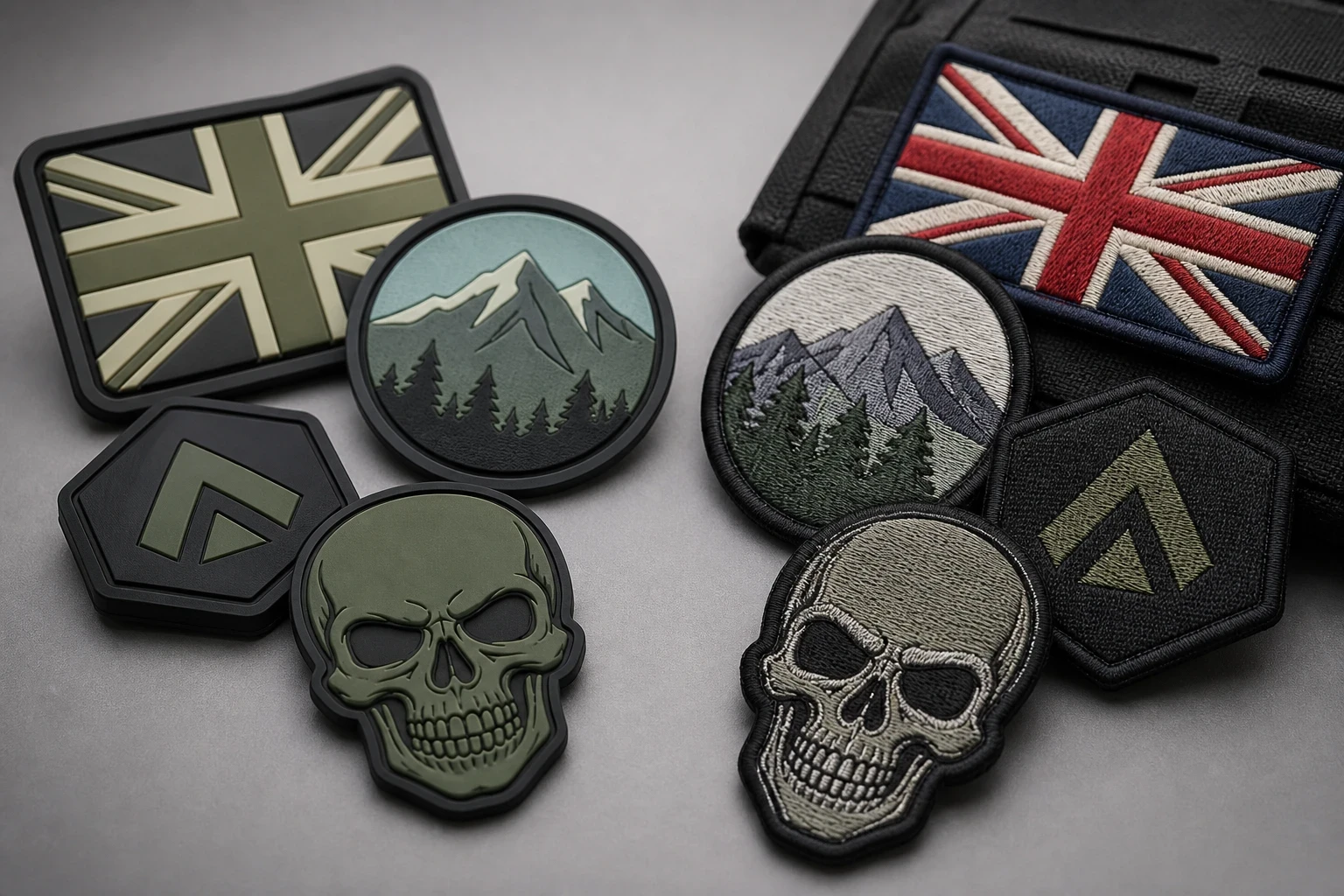
PVC patches suit hard-wearing, weather-exposed designs with bold lettering, raised details and a rubber-like finish. Embroidered patches suit traditional crests, textured thread work and garments such as blazers, polos and jackets. The right choice depends on the artwork, garment, washing conditions, backing and look you need.
Key takeaways
- PVC patches are a practical choice for rain, mud, frequent handling and bold graphic designs.
- Embroidered patches bring thread texture and a traditional crest appearance to blazers, polos, jackets and uniforms.
- PVC is usually clearer for simple lettering and raised details, while embroidery can soften fine detail as the design becomes smaller.
- The Customized Patches has a 5-piece minimum per design and provides a free digital mockup usually within 12 hours before production.
PVC patches are generally the better choice for hard-wearing, weather-exposed designs with bold shapes, raised lettering or a rubber-like finish. Embroidered patches are usually better for traditional crests, thread texture and garments such as school blazers, hospitality polos and club jackets.
The decision is not simply about which material lasts longer. The garment, artwork, washing routine, backing and intended appearance all matter. A football club badge on a rain jacket has different needs from a school crest on a wool blazer, even if both patches are the same size.
PVC patches and embroidered patches: the basic difference
PVC patches are made from a flexible rubber-like material, normally built in layers. The base gives the patch its shape, while raised lines, borders or lettering can sit above the surface. This creates a clean, graphic finish that works well for simple logos, tactical motifs, outdoor branding and designs that need to cope with rain.
Embroidered patches are formed with thread stitched into a fabric base. The stitches give the surface its familiar woven texture and can make a crest feel more traditional or uniform-led. A merrowed border, where the edge is covered with a raised overlocked thread, is often chosen for club badges, school insignia and classic jacket patches.
Neither option is automatically superior. PVC is flatter in colour and more resistant to surface moisture, but it can look too industrial for a heritage crest. Embroidery has warmth and texture, but very small lettering or complicated shading may need simplifying before it can stitch cleanly.
A quick decision rule
- Choose PVC when the patch needs bold contrast, raised features, easy wipe-clean care or a strong outdoor appearance.
- Choose embroidery when the patch needs stitch texture, a formal crest effect or a familiar uniform finish.
- Ask about woven or printed patches if the artwork depends on very fine lines, small text, gradients or a flatter surface.
- Consider a removable Velcro panel when the same garment needs several interchangeable identifiers.
At The Customized Patches, we quote both styles for customers across the United Kingdom. The order has a 5-piece minimum per design, and a free digital mockup is usually supplied within 12 hours. Production starts only after the artwork and mockup have been approved.
How the materials look and feel on real garments
The surface is often the first thing people notice. PVC has a smooth, slightly flexible face. Raised sections can give the logo a useful two-level effect, while recessed areas create separation between colours. It feels more like a designed badge than a piece of stitched cloth, which suits outdoor teams, security suppliers, workwear and modern brands.
Embroidered patches have visible stitch direction and a fabric base. That texture can make a simple design feel more substantial, especially on a wool coaches jacket, denim jacket or school blazer. Thread catches light differently from PVC, so the same navy can appear softer and less uniform under changing conditions.
Printed patches are flatter; that is the point. They can reproduce a photographic image, soft shading or a complex illustration more naturally than a raised PVC design or dense embroidery. If your mark contains a face, a detailed landscape or several gradual colour changes, compare printed patches before removing that option.
Texture can affect the perceived quality
A hospitality polo with a small embroidered chest badge can look discreet and established. The same badge in thick PVC may feel too heavy or visually strong. On a rain shell, however, PVC can look intentional while embroidery may absorb water and become less crisp during wet use.
For a premium fashion or lifestyle label, the choice depends on the rest of the garment. A clean PVC badge can work with technical nylon, caps and utility overshirts. Embroidery often sits more naturally with cotton twill, fleece, wool and brushed fabrics. A woven patch is another useful middle ground where a smooth fabric face and fine lettering matter.
Which option handles detail, lettering and colour best?
PVC patches are strongest when the artwork uses clear shapes and sensible spacing. Bold initials, silhouettes, symbols and short words can remain legible because the edges are defined by the moulded material. Raised borders also help separate colours that might otherwise run together visually.
Tiny text remains a problem in any patch process. PVC can reproduce small lettering more cleanly than embroidery in some designs, but there still needs to be enough room for the letters to read at the finished size. A one-inch patch carrying a long slogan is likely to disappoint, regardless of the chosen material.
Embroidery works well for bold lettering, simple badges and large symbols. Dense fills can create a rich appearance, but too much detail in a small area makes the patch stiff and crowded. Fine outlines may disappear into neighbouring stitches, and a thin script font often needs changing to a heavier typeface.
Use the finished size, not the screen preview
A logo that looks clear on a laptop can lose detail at 2 inches wide. This is why the mockup matters. It should show the proposed size, border, colour separation and attachment method against the intended garment, rather than displaying the artwork at an unrealistic scale.
| Requirement | PVC patches | Embroidered patches | Practical note |
|---|---|---|---|
| Bold logo or initials | Very suitable, especially with raised sections | Suitable with solid lettering | Keep spacing open at small sizes |
| Fine lettering | Can work if the letters are not too small | May need a heavier font and fewer words | Test the actual finished size |
| Photographic detail | Not the natural choice | Not the natural choice | Consider printed patches instead |
| Traditional crest | Modern interpretation | Strong choice for a classic uniform look | A merrowed crest can suit blazers and club jackets |
| Raised effect | Built into the design | Possible through stitch density but different in appearance | PVC gives the clearest height contrast |
| Gradients and soft shading | Usually simplified into colour blocks | Usually simplified into thread colours | Printed or woven may preserve more detail |
A free mockup lets you compare the same logo in both materials before committing. If you are considering a more dimensional thread finish, 3D embroidered patches may also be worth reviewing, although they create a different raised effect from PVC.
Durability, rain and washing: what should UK buyers expect?
PVC is a sensible material for garments and equipment that face rain, splashes, mud or regular wiping. It does not have loose thread ends on the face, and its smooth surface is straightforward to clean. That makes it popular for outdoor clubs, cycling groups, workwear, tactical clothing and motorcycle gear.
Embroidery can also last well, but it behaves like stitched textile. A patch on a fleece or cotton jacket may remain attractive through regular use, while a patch on a wet nylon shell needs more care. Water is not the only issue: friction, hook-and-loop contact and repeated tumble drying can affect the backing, thread and garment.
The most common failure is not that a correctly specified patch suddenly disintegrated. It is an attachment problem. An iron-on patch can peel after a dryer cycle if the heat, pressure or fabric is unsuitable. A sew-on patch can lift if the stitching catches only the outer surface of a thick jacket. Velcro can lose grip when the hook side fills with lint.
Not sure whether moulded PVC or stitched thread will hold your logo best? Send the artwork and garment details for a free digital mockup usually within 12 hours, and compare both options before production.
GET A FREE MOCKUPCare depends on the patch and the garment
- Check the garment label before choosing an iron-on backing; nylon shells and heat-sensitive fabrics can be unsuitable.
- Use sew-on attachment for garments that will face heavy washing, high friction or uncertain heat.
- Choose Velcro for removable panels, but specify the panel size and hook-and-loop placement clearly.
- Avoid assuming that a water-resistant patch makes the whole garment waterproof.
- Follow the care advice for the garment rather than treating every patch as washable in the same way.
For a football club travelling between wet pitches, PVC may be the straightforward face material, with sew-on or suitable Velcro backing. For a cadet unit using removable rank or role identifiers, the backing may matter more than the face. For a school blazer, embroidered sew-on or iron-on can better match the formal garment.
Backing choices: sew-on, iron-on or Velcro
The face material gets most of the attention, but the backing decides how the patch joins the garment. Sew-on is the most broadly useful option. It works on jackets, bags, uniforms and fabrics where heat is risky, although the customer needs access to a sewing machine or a person who can stitch the border securely.
Iron-on is convenient for suitable cotton and polyester garments. It is not a universal solution for every nylon shell, coated fabric or heavily textured surface. Even where the first application looks secure, repeated washing and a hot dryer can cause lifting, especially around corners.
Velcro is useful for security clothing, event teams, outdoor groups and uniforms that need interchangeable identifiers. The hook-and-loop panel adds thickness, so it should be included in the design discussion from the start. A patch intended for a narrow sleeve or chest panel may need different dimensions from a sew-on version.
| Backing | Best suited to | Main advantage | Main caution |
|---|---|---|---|
| Sew-on | Jackets, bags, uniforms and workwear | Secure and suitable for many fabrics | Requires stitching and can take longer to apply |
| Iron-on | Suitable cotton and polyester garments | Quick application without sewing | Heat and washing can cause peeling on unsuitable garments |
| Velcro | Removable role, name or team panels | Allows patches to be changed | Adds thickness and needs accurate panel sizing |
| Adhesive | Temporary or light-use applications | Simple application | May not withstand washing, rain or heavy friction |
Tell us the actual garment before the quote is finalised. A patch for a wool coaches jacket, a nylon shell and a cotton polo may need different backing advice even when the artwork is identical. The biker and motorcycle club patches guide covers some of the heavier garment and placement questions that arise on leather and riding jackets.
Which patch works for football clubs, schools and businesses?
Football clubs often need a badge that can cope with muddy kit bags, changing weather and repeated handling. PVC is a good fit for an outer jacket or equipment bag, especially where a clear emblem and easy wipe-clean surface matter. Embroidery remains a natural choice for presentation jackets, club polos and traditional crest designs.
Cadet units and outdoor organisations tend to ask about identification panels, rank markings and removable insignia. PVC suits clear symbols and rough conditions, while Velcro makes sense if the panel has to change between roles or activities. The final size should leave enough room for legible text without making the patch bulky on the sleeve.
Schools often choose embroidered patches for blazers, jumpers and formal sportswear because the stitched surface matches the garment. A simple school crest can look excellent in thread. If the school also has a modern outdoor programme, a PVC version could be specified for waterproof coats or kit bags rather than using one material for every item.
Hospitality and business customers usually need a polished logo on polos, aprons, overshirts or work jackets. Embroidery is familiar on staff clothing and can give a restrained branded finish. PVC can work for a streetwear label, technical uniform or warehouse team where the badge needs to stand apart from the fabric.
A few common project matches
- Rain jackets and outdoor equipment: PVC with sew-on or suitable Velcro backing.
- School blazers: embroidered patches, often with sew-on or carefully selected iron-on backing.
- Hospitality polos: embroidered patches for a quiet stitched logo.
- Biker vests and leather jackets: embroidered or PVC depending on the club identity and attachment method.
- Modern brand merchandise: PVC for a bold badge, woven for fine lettering or printed for complex artwork.
- Event crew garments: PVC or embroidery, with backing chosen around whether the garments will be reused.
There is no rule saying a brand must use one patch type across every product. A company may use embroidery on staff polos, PVC on work jackets and printed patches on a limited-edition artwork. The important part is keeping the logo recognisable while allowing the production method to suit the garment.
Size, shape and border decisions that affect the result
Most customers begin with a logo and a rough idea such as 3 inches wide. That is enough for a first conversation, but the height, attachment area and intended viewing distance also matter. A long horizontal wordmark may need a different proportion from a round crest, and a sleeve patch cannot always use the same size as a chest badge.
PVC patches can use clean moulded borders, cut shapes and raised internal lines. Embroidered patches can use a merrowed edge, a laser-cut edge or another finished border depending on the construction. The border needs to support the artwork rather than swallow it; a heavy border around small text can leave too little usable area.
Ask for the patch dimensions in inches and state whether they refer to the full outer edge or the design area. This avoids a common mistake where a customer approves a 3-inch design but the final border makes the visible artwork smaller than expected. Placement should be checked too: shoulder, sleeve, chest, back panel and bag flap all have different practical limits.
Colour matching is a production conversation
A digital logo file viewed on a phone is not a physical colour reference. PVC uses coloured material, while embroidery uses thread, so the same brand colour may need a close production match rather than a perfect on-screen copy. A mockup helps set expectations, but the material itself also influences how the colour appears.
If colour consistency matters across a staff uniform programme, provide the clearest artwork and any available brand colour information. Mention existing garments or previous patches as well. This is particularly useful for businesses ordering a replacement batch several months after the first design.
Cost, minimum quantities and ordering in the UK
Patch pricing depends on the material, size, shape, number of colours, border, backing, artwork complexity and quantity. There is no responsible single price for every PVC or embroidered patch. A small batch with a detailed custom shape may be priced differently from a larger run of a simple round badge.
The Customized Patches has a 5-piece minimum per design. This means you can order a small first run for a club committee, sample garments, a new business launch or a test with your team, without needing to begin with hundreds of pieces. Different designs are normally treated separately, so list the artwork variations clearly when asking for a quote.
Name the patch type, size and backing on your quote request, and tell us which garment will carry it. We will show the proposed result on a free digital mockup usually within 12 hours, with production held until you approve it.
GET A FREE MOCKUPUK-wide shipping should also be considered in the order plan. Give the required delivery date, quantity, patch size, backing and garment type at the start. If the patches are needed for a tournament, school term, product launch or event, say so plainly rather than assuming the production schedule will fit.
What to include in a quote request
- Upload the best version of the logo, preferably a clear vector file where available.
- State whether you are comparing PVC patches, embroidered patches or another patch type.
- Give the finished width and height in inches, or explain the area where the patch will sit.
- Choose the face colours, border style and any raised or recessed features.
- Specify sew-on, iron-on, Velcro or another backing requirement.
- Name the garment or item, such as a nylon shell, wool jacket, polo, blazer, bag or leather vest.
- Give the quantity for each design, remembering the 5-piece minimum per design.
- Provide the date the patches are needed and the delivery postcode.
You do not need production-ready artwork before asking a question. A rough logo, photograph of the garment and an explanation of the intended use are enough for an initial discussion. The free digital mockup is usually supplied within 12 hours, and production only begins after approval, so changes can be discussed before the order is made.
If the project is still at the material research stage, the guide to PVC patches: Everything UK Buyers Need to Know covers construction, sizing and ordering points in greater detail. Customers comparing a photographic design may also find the Sublimation printed patches UK Sizing and Backing Options Explained guide useful.
Common mistakes when choosing between PVC and embroidery
The first mistake is choosing from the logo alone. A design can look excellent as embroidery but feel out of place on a waterproof shell, or look sharp in PVC but too modern for a traditional blazer. Always judge the face material alongside the garment, placement and expected care routine.
The second mistake is shrinking a detailed design until the words no longer read. Patch production cannot overcome a lack of physical space. Remove unnecessary text, enlarge the important symbol or create a separate small identifier instead of forcing every part of a full logo into one tiny badge.
The third mistake is treating backing as an afterthought. An iron-on may be convenient, but it is not automatically suitable for nylon. A sew-on patch may be durable, but it is not ideal for a garment that must be changed quickly. Velcro may solve that problem but can feel too thick on a fitted polo.
- Do not approve a design only from a large desktop preview.
- Do not assume every thread or PVC colour will look identical to a screen colour.
- Do not order before checking how the patch will be attached to the actual garment.
- Do not use one patch specification for garments with very different care and weather conditions.
- Do not forget to confirm the quantity per design and the required delivery date.
A short conversation before production usually prevents the expensive part of the problem. If the artwork, garment and intended use are clear, the material choice becomes much less uncertain. If you are still deciding between several surfaces, compare woven patches, printed patches and PVC patches alongside embroidery rather than judging one option in isolation.
So, which patch should you choose?
Choose PVC patches when the project needs a bold, wipe-clean, weather-aware badge with clear colour blocks or raised details. They are particularly practical for outdoor teams, technical clothing, equipment bags, motorcycle gear and modern brand merchandise.
Choose embroidered patches when the project needs stitched texture, a familiar crest appearance or a formal finish on polos, blazers, fleece, denim and jackets. Embroidery is often the safer visual choice for schools, clubs and businesses that want the patch to feel part of the garment rather than attached as a separate rubber-like badge.
If neither option handles the artwork properly, use the design as the deciding factor. Woven patches can suit fine lettering, while printed patches can preserve more detailed artwork and tonal variation. The best specification is the one that keeps the logo readable, fits the garment and survives the way the item will actually be used.
The Customized Patches can quote both PVC and embroidered versions for customers across the United Kingdom. Every design has a 5-piece minimum, a free digital mockup is usually provided within 12 hours, and production takes place only after the approved design is confirmed.
Frequently asked questions
Are PVC patches more durable than embroidered patches?
PVC patches handle rain, surface dirt and wiping well because the face is smooth and rubber-like. Embroidered patches can also be durable, but the thread and fabric behave differently under moisture, friction and washing. The backing and garment matter just as much: a correctly attached embroidered patch can outlast a poorly applied iron-on PVC patch.
Are PVC patches suitable for school blazers?
They can be made for a school blazer, but embroidered patches are usually the more natural visual match for formal wool or polyester uniform fabric. Embroidery gives a traditional crest effect. If the PVC version is preferred, check the size, weight, backing and blazer care instructions before ordering.
Can PVC patches have small text?
PVC patches can reproduce clear small lettering when the finished size, font weight and spacing are suitable. Very small text can still become difficult to read, so shorten the wording or enlarge the patch where possible. The Customized Patches provides a free digital mockup usually within 12 hours so the proposed size can be checked before production.
What backing should I choose for PVC patches?
Sew-on backing is a broadly suitable option for jackets, bags and workwear. Velcro is useful for removable panels, role identifiers and outdoor uniforms. Iron-on backing can be convenient on suitable garments, but it may peel after heat or a dryer cycle on unsuitable nylon shells, coated fabrics or heavily textured clothing.
What is the minimum order for PVC patches at The Customized Patches?
The minimum is 5 pieces per design. Different artwork versions, such as a staff badge and a club badge, should be listed separately when requesting a quote. You can also ask for a free digital mockup, usually within 12 hours, before production is approved.
Can I compare PVC patches and embroidered patches before ordering?
Yes. Send the artwork, preferred dimensions, garment details and quantity, and ask for both options to be shown. The Customized Patches can prepare a free digital mockup usually within 12 hours. Production only starts after you approve the design, material and backing.
Ready to produce custom patches for your UK team or brand?
GET A FREE MOCKUP