
Varsity chenille patches UK Best Practices for schools and colleges
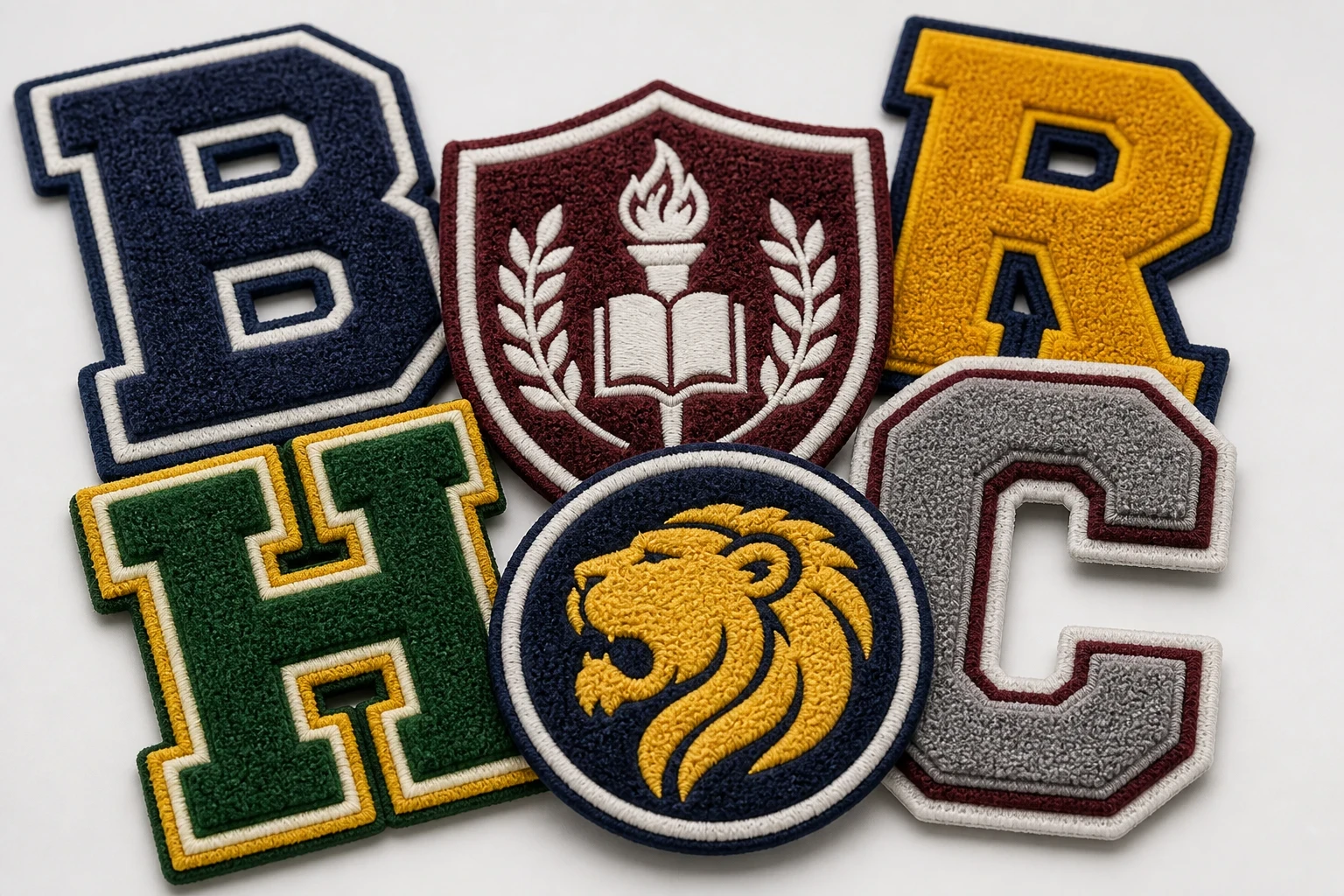
Varsity chenille patches UK are best suited to school, college and university garments that need a bold, raised letter, crest or achievement mark. Choose clear artwork, a size that suits the garment, and sew-on backing for wool or frequent washing. The Customized Patches provides a free digital mockup usually within 12 hours, with a 5-piece minimum per design.
Key takeaways
- Use varsity chenille for bold letters, simple crests, team marks and achievement badges rather than fine photographic detail.
- Sew-on backing is usually the safer school and college choice for wool, heavy cotton and garments that will be washed often.
- Keep each design to a 5-piece minimum and approve the digital mockup before production starts.
- The Customized Patches usually sends a free digital mockup within 12 hours so sizing, colours and backing can be checked first.
Varsity chenille patches UK work best for schools and colleges that want a substantial, raised badge rather than a flat printed mark. They suit bold initials, simple crests, house letters, sports achievements and society names on blazers, letterman-style jackets, hoodies and wool coaches. The right choice depends on the garment, the artwork and how the patch will be washed.
The Customized Patches supplies a free digital mockup usually within 12 hours, and production begins only after you approve it. There is a 5-piece minimum per design, so a school can order a small trial run for a team or house before committing to a larger batch.
Why schools and colleges choose varsity chenille
Chenille has a looped yarn surface that gives letters and simple shapes a soft, raised texture. That texture is the reason a single varsity letter can look considered on a navy wool jacket without needing a complicated border or a large amount of stitching. It has a traditional American letterman feel, but the format also works on UK sixth-form leavers' jackets, university society clothing and school sportswear.
The material is particularly effective for designs that need to be read from a short distance. A house letter on a blazer, a rowing club initial on a coach jacket or a bold university society name on a hoodie can all work well. It is less suitable for tiny mottos, detailed heraldic artwork or a crest containing several small faces, thin lines and miniature text.
- School house letters and initials
- University and college society names
- Sports team letters, numbers and mascots
- Leavers' jackets and graduation groups
- Music, drama and debating club badges
- Achievement marks for captains, prefects or competition winners
- Simple institutional crests with a limited number of colours
A merrowed crest or a flat embroidered badge may be the better answer for a formal blazer logo with fine heraldic detail. Chenille is chosen for texture and visual weight. It should not be specified simply because it sounds more premium; printed is flatter, and that is the point when a school needs a detailed image or a smooth full-colour mark.
Start with the garment, not the artwork
The same patch can behave very differently on a polyester sports jacket, a nylon shell and a heavy wool coach jacket. Before quoting, identify the actual garment or send a clear photograph of the placement area. A patch that looks comfortable on a flat hoodie front may sit across a curved sleeve, pocket or seam on a jacket.
Blazers and school uniform
Blazers normally call for a controlled size and a neat attachment. Measure the chest, upper sleeve or pocket area in inches, then allow room around the patch so the edge does not run into a seam. A compact letter or simple crest often looks more intentional than a large badge that overwhelms the blazer.
Hoodies, sweatshirts and leavers' jackets
Hoodies give more room, but their fleece and stretch can make an iron-on patch less reliable if the surface is handled roughly. A sew-on patch gives the garment a stronger connection, while a removable Velcro panel is useful for clubs that rotate names, roles or achievement badges.
Nylon shells and sportswear
Nylon shells need extra care. Heat can mark or distort some synthetic fabrics, so do not assume that iron-on is safe because it is convenient. Sew-on attachment, careful stitching and a patch position away from a waterproof seam are normally more sensible. The same point applies to lightweight team jackets supplied for athletics, football or outdoor activities.
| Garment or use | Suitable patch approach | Main check before ordering | Common risk |
|---|---|---|---|
| Wool coach jacket | Chenille with sew-on backing | Check the weave and curved placement | Patch edge can lift if only lightly fixed |
| School blazer | Small chenille letter or simple crest | Measure the chest or sleeve area in inches | Oversized badge looks out of proportion |
| Cotton hoodie | Chenille with sew-on or suitable iron-on backing | Check fleece thickness and care label | Iron-on can peel after a dryer cycle |
| Nylon sports shell | Usually sew-on after checking the fabric | Avoid seams and heat-sensitive areas | Heat may mark or distort the shell |
| Removable club garment | Velcro-backed patch | Confirm loop panel dimensions | Hook side may catch lining or other fabric |
For a wider comparison of surface types and backing choices, see Chenille patches Sizing and Backing Options Explained. It is worth checking this before a school orders hundreds of patches for garments that have already been purchased.
Choose artwork that chenille can reproduce clearly
A good chenille design usually has a strong outer shape, a small colour count and lettering that remains legible when the yarn loops soften the edges. Send the best version of the artwork available, even if it is a PDF, vector file, high-resolution PNG or a photograph of an existing badge. Our team can then identify what needs simplifying rather than guessing at missing detail.
Letters need enough space between them. Tight collegiate lettering can merge once converted into chenille, especially on a patch below about 3 inches wide. If the school name is long, consider an initial on the front and a separate wordmark on the back, or use a woven patches design for small text. Woven is flatter and more precise for narrow lettering.
- Use bold fonts with open counters in letters such as A, B, R and P.
- Avoid fine outlines that are only a fraction of an inch wide.
- Keep small text to a minimum and check it at the finished size, not only on a laptop screen.
- Use contrast between the yarn colour and the background so the letter can be read from several feet away.
- Separate overlapping elements instead of asking the chenille surface to show tiny layers.
- Tell us which colours are essential and which can be adjusted to suit available thread or yarn.
A school crest may need two versions: a detailed flat embroidered version for a blazer and a simplified chenille version for a leavers' jacket. That is not a failure of the design. Different materials have different limits, and a simplified badge that reads clearly is more useful than a detailed one that turns into a fuzzy block.
You can compare the surface and detail trade-off with Varsity chenille patches UK vs embroidered patches: Which Is Right for Your Project? and review other product options such as 3D embroidered patches or printed patches. Printed is often the practical route for a full-colour school illustration, while chenille supplies the raised tactile finish.
Size, shape and border decisions
There is no universal school patch size. A small blazer badge may need to stay under 3 inches, while a back-of-jacket design can be 8 to 12 inches depending on the garment. Measure the actual space and place a paper version on the garment before approving production. This quick test catches many problems, including a badge that covers a pocket opening or sits too close to a zip.
The outer shape should support the design. A varsity letter can stand alone, use a contrasting border or sit inside a shield, roundel or arch. A complex cut shape may cost more or need more careful finishing than a simple rectangle, circle or letter silhouette. A raised chenille face with a clean border normally gives a stronger result than several thin decorative outlines.
| School requirement | Useful starting direction | Why it works | What to confirm |
|---|---|---|---|
| Single house initial | Approximately 3 to 5 inches high | Large enough to read and simple enough for chenille | Chest, sleeve or jacket placement |
| Society name | Approximately 3 to 6 inches wide | Allows a short wordmark without crowding | Letter height and spacing |
| Sports mascot | Approximately 4 to 8 inches wide | Gives the silhouette room to read | Whether fine facial details need removing |
| Leavers' back badge | Approximately 8 to 12 inches wide | Uses the larger jacket area effectively | Seams, hood position and wearer size |
Not sure whether chenille, flat embroidery or print will hold the school mark clearly? Send the artwork and a garment photograph for a free digital mockup usually within 12 hours. We show the proposed size and layout before the 5-piece minimum per design is produced.
GET A FREE MOCKUPThese are working ranges, not fixed specifications. The mockup should show the patch at its intended dimensions and on the intended garment where possible. If the school is ordering different jacket sizes, check the smallest garment first; a design that fits an adult XL can look oversized on a pupil's smaller jacket.
Backing and attachment for everyday school wear
Backing is not a minor finishing choice. It controls how the patch is fitted, whether it can be removed and how much stress the garment receives during washing and wear. Sew-on is generally the dependable option for wool jackets, blazers, heavy cotton and garments expected to stay in service for several terms.
Sew-on backing
Choose sew-on when the patch is intended to stay on the garment. It works well for school blazers, wool coaches and thick hoodies, provided the needle can pass through the fabric and the stitching is placed securely around the edge. A tailor, uniform supplier or capable alterations service can fit a batch for a school.
Iron-on backing
Iron-on can be convenient for a controlled application on a suitable cotton or stable fabric. It is not a universal substitute for sewing. Heat, repeated washing, a tumble dryer and flexing can weaken the adhesive; an iron-on patch that looks fine on day one can peel after a dryer cycle. Follow the garment and application instructions and consider adding stitches for higher-wear items.
Velcro backing
Velcro is useful where pupils or club members need to swap badges between garments, or where a school uses one base jacket for several activities. The garment needs a properly fitted loop panel, and the hook side can catch lining, knitwear or other fabric if stored carelessly. Confirm the panel size rather than assuming a standard piece will fit.
If you need a leather-style badge for a sixth-form jacket or a tougher club garment, compare leather patches as well. For motorcycle and riding groups, biker and motorcycle club patches often use different layouts and backing expectations, so the garment and use case should guide the specification.
Colours and school identity
Schools often begin with a colour code from a crest, prospectus or sports kit supplier. A screen colour is not always a physical yarn colour, so send the reference and identify the priority: exact brand matching, contrast, or a close visual match to an existing uniform. Navy, burgundy, bottle green, royal blue, gold and white are common school colours, but the final appearance also depends on the surrounding garment.
Contrast matters more than a tiny shade difference in many school applications. Gold on white can lose definition, while white on navy reads immediately. Dark red on black may need a light border, and pale grey on a heather sweatshirt may disappear at a distance. A mockup should show the colour relationship rather than listing colours without context.
- Name the main background colour and the yarn or thread colours separately.
- Check the patch against the actual garment colour, not a generic black or white background.
- Use a border when the face colour is close to the jacket or blazer.
- Avoid adding extra colours simply to reproduce tiny crest details.
- Keep house colours consistent across repeated orders by retaining the approved artwork and colour notes.
For organisations spread across England, Scotland, Wales and Northern Ireland, keep one approved artwork file and one written specification. That reduces accidental changes between a school office, parent group, sports department and external uniform supplier. UK-wide delivery can then be planned from the same approved reference.
Quantity, budget and school ordering
The minimum is 5 pieces per design. A school can therefore test a house letter, order a small committee batch or sample a leavers' jacket design before moving to larger quantities. Each variation counts as its own design if the wording, shape, colour arrangement or backing changes, so list the versions clearly on the quote.
Budgeting is easier when the school separates the patch price from application. Ask whether the quote is for the badge only or includes fitting to garments. Sew-on fitting can be handled by a uniform shop, tailor or alterations service, while iron-on application may be completed internally only if the fabric and care instructions permit it. A larger badge, more complex shape, special backing and multiple versions can all affect the final price.
| Ordering detail | Information to provide | Why it affects the quote or result |
|---|---|---|
| Quantity | Number required for each design | The 5-piece minimum applies per design and larger runs may change unit pricing |
| Dimensions | Finished width or height in inches | Size affects material use, readability and garment suitability |
| Artwork versions | House, team, year or society variations | Different wording or layout may require separate production setups |
| Backing | Sew-on, iron-on or Velcro | Changes application, handling and garment compatibility |
| Delivery | UK address and required date | Allows the production and shipping plan to be checked |
For a fuller cost discussion, read How Much Do varsity chenille patches UK Cost in the UK?. The useful comparison is not only the price per patch. It is the cost of a badge that fits, survives its intended use and does not need replacing because the backing or artwork was wrong.
Lead times, approval and UK delivery
Send the artwork, quantity, finished size, backing, garment type and delivery postcode together. This avoids a long chain of questions and makes it easier to identify a problem early, such as a crest that is too detailed for a 2.5-inch badge or an iron-on request for a heat-sensitive nylon shell.
The free digital mockup is usually sent within 12 hours. Use it to check the exact wording, spelling, colours, dimensions, border, shape, backing and placement. Production starts only after approval, so corrections should be made at this stage rather than after the batch has been manufactured.
Production and delivery timing depends on the design, quantity, backing and current workload. If the patches are for a freshers' week, sports tour, prize-giving event or leavers' photo, give the date at quotation stage. UK-wide shipping can then be planned around the event rather than treated as an afterthought.
Name sew-on, iron-on or Velcro on the quote. We show the correct back on a free 12-hour mockup so production matches the garment, and we only produce after the design has been approved.
Care, fitting and long-term use
The care label on the garment takes priority. Chenille itself has a textured pile, so avoid treating it like a smooth printed transfer. Washing inside out, using a suitable cool or moderate cycle and allowing the garment to dry without excessive heat can help protect the patch and the fabric around it.
Ready to spec the run? Open the quote form for a free 12-hour mockup and UK-wide shipping after approval.
GET A FREE MOCKUPCheck sew-on patches after the first few washes, especially around corners and curved edges. A loose stitch should be repaired before the edge is pulled further. Do not drag a hot iron directly over the chenille face, and avoid a tumble dryer if the garment label or application instructions advise against it.
- Follow the garment's wash and drying instructions.
- Do not use high heat on an iron-on application unless the material instructions specifically allow it.
- Keep Velcro-backed patches attached to their loop panel during storage.
- Inspect school jackets before redistribution to another pupil.
- Keep one spare patch per key design where a school expects heavy use or repeated garment changes.
The most common avoidable failure is specifying the patch separately from the garment. A design can be attractive on a screen yet unsuitable for a nylon shell, a thin blazer sleeve or a fleece hoodie. A photograph, a measurement and a clear backing choice usually prevent that problem.
Chenille compared with other patch types
Schools sometimes ask for a chenille patch because they want a traditional varsity appearance, then discover that the crest contains small text or detailed artwork. Comparing materials before production is sensible. There is no single best patch type for every department, garment or budget.
| Patch type | Best for | Strength | Trade-off |
|---|---|---|---|
| Chenille | Bold initials, mascots and simple achievement marks | Raised, tactile varsity surface | Fine detail and tiny text are limited |
| Flat embroidered | School crests, names and traditional uniform badges | Good structure and familiar finish | Very small detail still needs simplification |
| Woven | Small lettering and flatter logos | Crisper fine lines than chenille | Does not have a raised yarn surface |
| Printed | Full-colour artwork and gradients | Smooth surface with broad colour freedom | Less tactile and can show wear differently |
| PVC | Outdoor clubs, sports equipment and hard-wearing uses | Raised moulded surface and easy wiping | Less traditional for a school blazer |
| Leather-style | Sixth-form, fashion or heritage jacket projects | Clean, understated appearance | Not the same collegiate texture as chenille |
Browse embroidered patches for the wider embroidered range, or compare PVC patches if the badge will be used outdoors. Schools that want a clean, flat crest may prefer embroidery; schools that want a large raised letter may prefer varsity chenille. The right decision follows the use rather than the name of the trend.
A practical approval checklist
Before a school office, student union or club committee approves the batch, one person should check the final mockup against the original brief. This is the stage to catch a missing year, a reversed colour, a wrong house name or a badge that is too large for the smallest garment.
- Is the school, college, university or team wording spelt correctly?
- Is the finished width or height shown in inches?
- Has the design been checked on the actual garment colour?
- Are the patch colours and border clear at normal viewing distance?
- Is the artwork simple enough for the chenille surface?
- Does the backing suit the garment and expected washing?
- Are there at least 5 pieces for each design?
- Has the delivery date and UK address been supplied?
- Has one authorised person approved the digital mockup?
- Has the school retained the approved artwork for future repeat orders?
For more checks before payment or production, see Common Mistakes to Avoid When Ordering varsity chenille patches UK. A short review at this point is quicker than removing a patch from a finished jacket or explaining to a team why its lettering is not readable.
Final guidance for UK schools and colleges
Varsity chenille patches are a strong choice for bold school identity: house initials, sports letters, society marks and leavers' jackets. Specify them with the garment in mind, keep the artwork readable, measure the available space and select backing based on how the item will be worn and washed.
The Customized Patches serves customers across the United Kingdom with a 5-piece minimum per design. A free digital mockup is usually provided within 12 hours, and production only begins after approval, giving the school or college a clear opportunity to check the details before the order is made.
If you are comparing suppliers or arranging delivery to several UK locations, you can also view the UK city pages. Keep the specification consistent, name every design variation and ask for the proposed backing to be shown before confirming the batch.
Frequently asked questions
What are varsity chenille patches UK schools commonly used for?
Schools and colleges commonly use them for house initials, sports teams, society names, leavers' jackets, prefect or captain marks, music groups and simple achievement badges. They are most effective where the design is bold and readable rather than filled with fine text or detailed artwork.
What is the minimum order for varsity chenille patches UK?
The minimum is 5 pieces per design. If a school orders separate house letters, years, names or colour versions, each distinct design should be listed separately so the quantity and quotation are clear.
How quickly can I see a mockup?
The Customized Patches usually provides a free digital mockup within 12 hours. The mockup should be checked for size, spelling, colours, border, placement and backing. Production starts only after the customer approves the design.
Is sew-on or iron-on backing better for a school blazer?
Sew-on is usually the safer choice for a school blazer, wool jacket or garment that will be worn and washed regularly. Iron-on can be suitable for some stable fabrics, but heat, washing and tumble drying can weaken the adhesive. Check the garment care label before choosing it.
Can a varsity chenille patch go on a nylon sports jacket?
It may be possible, but nylon needs checking because heat can mark or distort some shells. Sew-on attachment is often more suitable than iron-on, and the patch should avoid waterproof seams, zips and areas that flex heavily. Send a garment photograph when requesting a quote.
Are varsity chenille patches suitable for a detailed school crest?
They can suit a simplified crest, but fine heraldic lines, tiny text and miniature symbols may not reproduce clearly in chenille. A flat embroidered or woven patches design may be more suitable for detail, while chenille can be reserved for a bold initial or simplified version of the crest.
Ready to produce custom patches for your UK team or brand?
GET A FREE MOCKUP