
Varsity chenille patches UK vs embroidered patches: Which Is Right for Your Project?
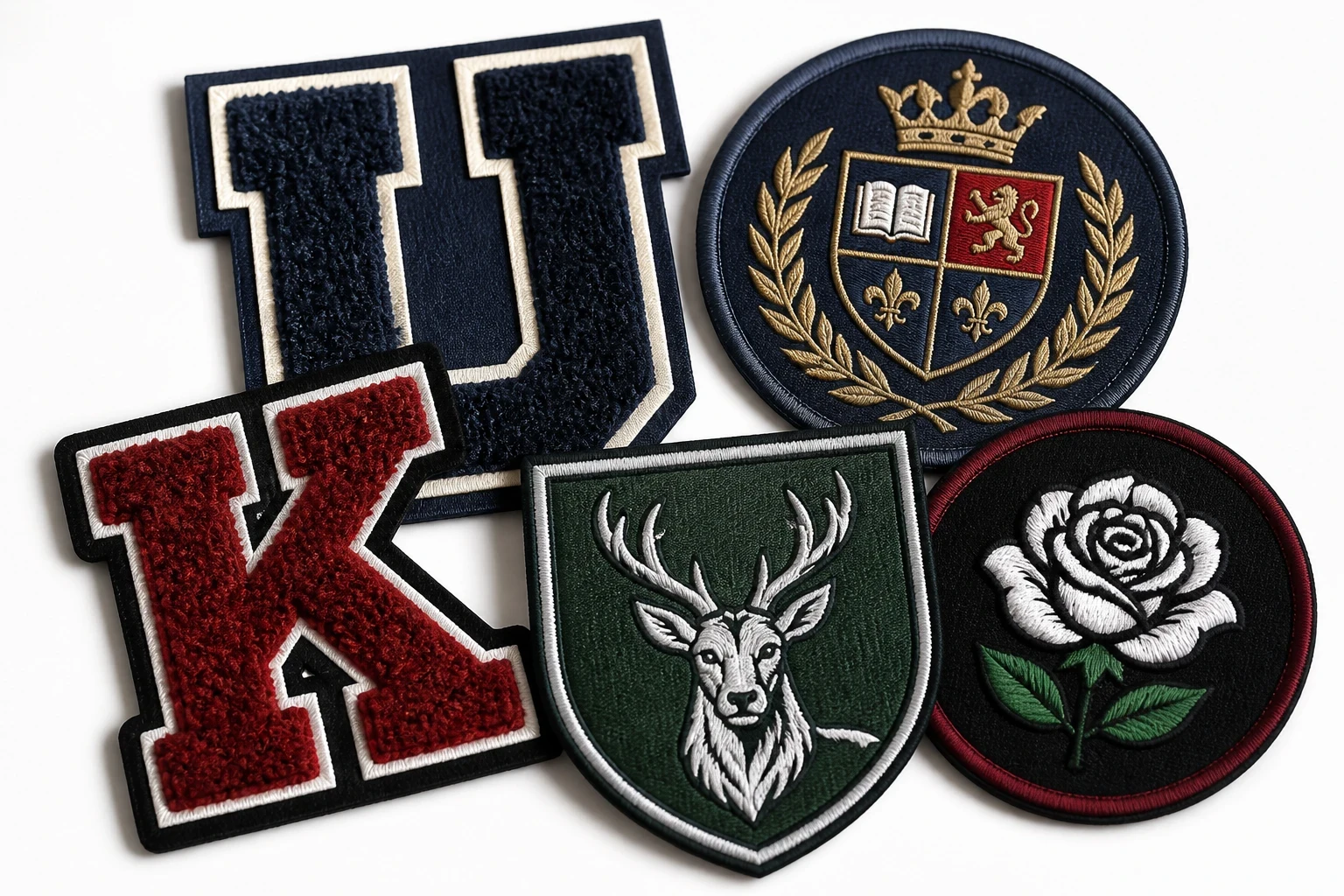
Varsity chenille patches UK suit bold letters, school emblems and substantial wool or fleece garments, while embroidered patches suit detailed logos, small lettering and workwear. Chenille has a raised, soft pile; embroidery is flatter and sharper. The right choice depends on artwork, garment, washing, backing and budget.
Key takeaways
- Chenille is best for bold, tactile designs on varsity jackets, wool coaches and substantial teamwear.
- Embroidered patches are usually better for fine lettering, detailed crests, workwear and logos that need a flatter surface.
- A 5-piece minimum applies to each design, and production starts only after artwork and the digital mockup are approved.
- The Customized Patches usually sends a free digital mockup within 12 hours, so you can compare thread and chenille before ordering.
Varsity chenille patches UK are the better choice for bold initials, school letters and traditional team emblems on substantial jackets. Embroidered patches are usually the better choice for fine detail, small lettering and flatter logos on polos, shirts and workwear. The decision is mainly about the artwork, garment and finish you need, not which material sounds more premium.
At The Customized Patches, we quote for football clubs, cadet units, hospitality polos, biker vests, school blazers and brand merchandise across the United Kingdom. Every design has a 5-piece minimum. We provide a free digital mockup usually within 12 hours, and produce only after you approve the artwork, size, colours and backing.
The short answer: chenille or embroidered?
Choose chenille if the patch needs to be noticed from a few metres away. Its cut yarn creates a raised, soft pile that gives block letters and simple symbols a strong varsity identity. It works particularly well on wool coaches, heavyweight fleece, varsity jackets and other garments with enough structure to support the patch.
Choose embroidery if the patch has small text, narrow outlines, a detailed crest or several internal shapes. Embroidery is flatter, more familiar on uniforms and easier to read on a polo or shirt. Printed patches can be even flatter and can reproduce photographic or highly detailed artwork; printed is flatter, and that is the point.
- Best for chenille: large initials, school letters, sports numbers, simple mascots and bold club marks.
- Best for embroidery: company logos, service badges, unit crests, small text and detailed line artwork.
- Best for a removable garment panel: Velcro backing, provided the garment already has the matching hook or loop panel.
- Best for heat-sensitive fabric: sew-on backing or suitable Velcro rather than relying on an iron-on adhesive.
- Best for a photographic or gradient image: printed construction, subject to artwork and size checks.
How the construction changes the appearance
Chenille and embroidery are not simply two colours of the same product. They are made in different ways, so the face of the patch behaves differently under light, against a garment and after repeated handling. Chenille has a pile that catches the light and feels soft under a finger. Embroidery uses stitched thread with a clearer, more defined surface.
What gives chenille its varsity look
Chenille is particularly effective for large letters such as a school initial, a football club abbreviation or a number on the back of a jacket. The raised yarn fills broad areas without making the design look like a flat printed sticker. A merrowed border can frame the shape neatly, although very small internal lettering is not a good match for this construction.
The pile also hides some small surface variation that would be obvious in a smooth print. That does not mean chenille can reproduce every logo. Thin strokes, tight corners and detailed illustrations need simplifying before production. If your mark contains a fine compass, a tiny crown or several lines of small wording, ask for a mockup rather than assuming the original file will translate unchanged.
Why embroidered patches remain the flexible option
Embroidery gives the production team more control over outlines, lettering and separate colour areas. It is the familiar finish for scout badges, football crests, staff uniforms, hospitality polos and work jackets. The result is still tactile, but the face is generally lower and more defined than chenille.
A detailed brand mark can often be separated into a clean border, filled shapes and readable text. There are still limits: very small lettering may need enlarging, and a crowded design can become difficult to read at two or three inches wide. Our embroidered patches guide explains the practical choices before you commit to a size.
| Specification | Varsity chenille | Embroidered | Practical UK example |
|---|---|---|---|
| Surface | Raised, soft pile with a strong texture | Flatter stitched thread surface | Chenille on a wool coach jacket; embroidery on a polo |
| Best artwork | Bold letters, simple shapes and large symbols | Detailed logos, crests and readable small lettering | A large school initial versus a cadet unit emblem |
| Fine detail | Limited by pile height and the available patch size | More suitable, although tiny text may still need adjustment | Use embroidery for thin outlines and several internal elements |
| Typical visual effect | Traditional varsity, collegiate or retro sports appearance | Uniform, club, business or branded appearance | A team jacket versus hospitality workwear |
| Recommended garments | Varsity jackets, wool coaches, heavyweight fleece | Polos, shirts, blazers, work jackets and bags | Match the patch thickness and weight to the fabric |
| Smallest artwork risk | Letters and narrow gaps can close visually | Fine lines can lose definition if reduced too far | Approve a sized mockup rather than judging only the full logo |
| Backing choices | Sew-on, iron-on or Velcro, depending on garment | Sew-on, iron-on or Velcro, depending on garment | Nylon usually needs more care than cotton or wool |
Match the patch to the garment and its use
The garment often settles the argument. A patch that looks right on a thick wool jacket may feel bulky on a lightweight shirt. It is common to see customers choose a substantial chenille crest for a thin nylon shell, then need to reconsider the backing and placement because the shell flexes more than the patch.
Think about how the item will be worn, stored and washed. A football club may want chenille for the players' presentation jackets but embroidery for training tops. A hospitality business may prefer a flat embroidered badge on a polo because staff need to sit, move and wash the garment regularly.
- School blazer: embroidered crest is usually the practical starting point, especially where a formal, flatter badge is expected. Chenille can suit a sixth-form or house jacket with larger lettering.
- Football or rugby jacket: chenille works well for a large club initial or season mark; embroidery suits a detailed crest and sponsor information.
- Cadet or service-style uniform: embroidery generally handles compact wording, insignia and defined borders more effectively.
- Hospitality polo: embroidery is usually easier to read and less bulky than chenille. Keep the design clear at the actual chest size.
- Biker vest: chenille can give a traditional club feel, while embroidery is often easier for complex back panels and detailed rocker text. See our guide to biker and motorcycle club patches.
- Nylon shell: avoid assuming iron-on is suitable. Heat, coating and movement can cause an adhesive to weaken, so sew-on or Velcro may be the safer route.
- Removable teamwear: Velcro is useful if players or staff need to change names, roles or club panels, but both sides must be specified.
Backing is part of the specification, not a finishing detail to decide at the end. An iron-on patch that peels after a dryer cycle is usually a garment, heat or care mismatch rather than proof that every adhesive backing is unsuitable. For more detail on chenille dimensions and backing, read Chenille patches Sizing and Backing Options Explained.
Artwork, lettering and size: the decisions that matter
The same logo can work in both constructions if it is prepared for the chosen process. A supplied vector file is helpful, but it does not remove the need to check scale. A design that looks clean on a laptop may have lettering under 0.1 inch high once it is reduced to a two-inch chest badge.
Start with the finished size, not the screen preview
Measure the space on the actual garment in inches. A left-chest logo may be about 3 to 4 inches wide, while a large back emblem may be 8 to 12 inches wide depending on the jacket and wearer. A school blazer badge needs to sit comfortably within the pocket or chest area; a jacket back can support a much larger composition.
Not sure whether chenille or embroidery will hold your logo on the garment? Send the artwork and a garment photograph for a free digital mockup, usually within 12 hours, so you can compare both before production.
GET A FREE MOCKUPFor chenille, use broad letterforms and leave sensible gaps between shapes. For embroidery, protect the readability of small words by increasing the letter height, reducing the wording or changing the layout. If the brand name must remain small, a woven or printed construction may be worth considering. Compare those options with woven patches and printed patches.
Colour matching needs a real-size check
Colours can appear different on a bright monitor, a wool garment and a pile surface. Chenille creates shadow between yarns, while embroidered thread can show more defined edges. Strong contrast is usually safer than two close shades, particularly for club badges viewed outdoors or from the touchline.
- Supply the brand colours or a clear reference, rather than describing a colour as simply 'dark blue'.
- State whether the border should match the lettering, contrast with it or follow the garment.
- Check white thread or yarn against pale garments, where a border may need a darker outline.
- Check black and navy separately; they can look similar on a screen but behave differently on a jacket.
- Approve the actual proposed size, not only a large artwork preview.
- Confirm spelling and punctuation before production, especially for school mottos, unit names and club dates.
Backing, attachment and durability
Sew-on backing is the most broadly adaptable option for jackets, blazers and bags. It is a sound choice for a patch that will stay in one position and can be stitched through the garment. A merrowed edge gives the patch a finished perimeter, but the sewing route still needs to suit the fabric and the person attaching it.
Iron-on backing is convenient on compatible cotton, denim and some stable fabrics. It is less straightforward on coated nylon, waterproof shells and materials that cannot tolerate heat. A household iron may also fail to apply even pressure around a thick chenille edge. If the garment will go through a tumble dryer, follow the care advice and consider sewing the patch as well.
Velcro backing makes sense for equipment bags, tactical-style panels, changing team roles or garments shared between people. It adds thickness and needs a correctly sized loop panel on the garment. Do not request Velcro simply because it sounds removable; specify where the matching panel is and how often the patch will be taken off.
| Backing | Good fit | Watch for |
|---|---|---|
| Sew-on | Wool, denim, blazers, jackets, bags and long-term placement | Requires stitching and may leave visible thread on delicate lining |
| Iron-on | Stable, heat-tolerant fabrics where quick attachment is useful | Can peel after washing or a dryer cycle if heat, pressure or fabric is unsuitable |
| Velcro | Removable team panels, equipment and role changes | Needs matching loop fabric and adds thickness to the garment |
Both embroidered and chenille patches can be supplied with different attachment options, but the correct answer depends on the garment. A five-inch chenille patch on a lightweight shell may pull differently from a three-inch embroidered chest badge. Tell us the fabric, placement and care routine when requesting a quote.
Ordering, proofing and UK lead times
Good patch orders are decided before the first production run, not corrected after delivery. The quantity, finished size, backing and delivery address all affect the quote. The Customized Patches has a 5-piece minimum per design, which suits a small club trial, a five-person team or a new brand testing its first garment range.
- Send the artwork and explain what the patch will be attached to. A photograph of a nylon shell, wool coach jacket, polo or blazer is useful.
- State the preferred construction, or ask us to compare chenille and embroidery if the decision is not settled.
- Give the finished dimensions in inches, the quantity required and the UK delivery postcode or region.
- Choose the backing: sew-on, iron-on or Velcro. If you are unsure, explain how the garment will be washed and worn.
- Review the free digital mockup. It is usually supplied within 12 hours and shows the proposed layout, colours, size and construction.
- Check every word, number, border and placement note. Production begins only after approval.
- Keep the approved mockup with the order details so the delivered patches can be checked against the agreed specification.
The mockup is not a decorative extra. It gives you a chance to see whether the chenille pile will swallow a narrow gap, whether embroidery looks too dense at the requested size and whether the badge sits correctly on the garment. It also gives clubs and businesses a clear file to circulate internally before approving production.
Lead time depends on the design, quantity, backing and the production schedule at the time of approval. A simple repeat design is easier to plan than a large order with several names, sizes or backing types. If your patches are needed for a match, graduation, launch or event, give the date at quotation stage rather than assuming standard UK shipping will meet it.
Care, washing and common failures
The patch is only one part of the finished item. Washing temperature, detergent, drying method and garment movement all affect the result. A chenille patch may need gentle handling because its pile can catch on rough surfaces, while an embroidered patch can lose definition if it is repeatedly scrubbed or exposed to harsh washing.
The most familiar failure is an iron-on edge lifting after a dryer cycle. This can happen when the garment coating prevents adhesion, the heat was too low or uneven, the patch was washed before the adhesive fully settled, or the item was dried at a temperature that the backing could not tolerate. For hard-working jackets and regularly washed workwear, sew-on attachment is often the more dependable specification.
- Follow the garment care label rather than treating every patch as machine-proof.
- Turn garments inside out where practical to reduce rubbing against the drum and other clothing.
- Avoid placing a hot iron directly on chenille pile or exposed embroidered thread.
- Do not pull loose pile or trim with scissors; ask for advice if an edge has lifted.
- Explain the intended care routine before choosing backing, especially for nylon shells and waterproof garments.
- Store spare patches flat and dry, away from direct heat and pressure.
Cost and value for a UK order
A patch price is not based only on the material name. Size, quantity, number of colours, backing, border, artwork complexity and the number of individual designs all matter. Five patches of one simple design are a different production job from five patches split across five names and five layouts.
Name sew-on, iron-on or Velcro on the quote and include the garment type. We will show the correct back on a free digital mockup, usually within 12 hours, and production starts only after you approve it.
GET A FREE MOCKUPChenille can be a sensible choice when the raised varsity finish is the main feature and the artwork is simple enough to use it well. Embroidery can offer better value for a detailed logo that would need to be simplified heavily for chenille. If you are comparing budgets, ask for the same size, quantity and backing in both constructions so the figures are meaningful.
There are also alternatives. A 3D embroidered patches design can add height to selected elements while retaining more defined stitched detail. For a different tactile direction, PVC patches or leather patches may suit bags, outdoor equipment and workwear, but they create a different visual and handling result.
Real project examples from our team
A school wanting one large house initial for a wool jacket is a classic chenille enquiry. The artwork is usually simple, the garment has enough structure and the raised surface supports the traditional look. The same school may still choose embroidery for a small blazer crest, because the crest contains a motto and several fine symbols.
A football club often needs more than one answer. Chenille can work on presentation jackets for the senior squad, while embroidered player initials or a detailed club crest may be better on lighter training jackets. Supplying one design across every garment without checking weight, placement and care can create avoidable problems.
Cadet units and uniformed groups tend to prioritise legibility. Small wording, dates and insignia normally point towards embroidery, especially where the badge must be read at arm's length. A large commemorative patch can use chenille if the design is reduced to clear shapes and bold text.
A hospitality brand may prefer a flat embroidered chest badge because staff wear polos under aprons and jackets. The logo has to remain neat after repeated washing and should not feel heavy. Printed patches can be considered for gradients or very fine artwork, but they will not provide the raised thread texture of chenille.
For a biker vest, the decision often comes down to the club's visual language. A bold chenille centre mark can have a strong old-school feel, while an embroidered back panel gives more control over rocker text and detailed symbols. The vest material, patch size and attachment method should be discussed together.
Our recommendation for your project
Select varsity chenille patches UK when texture, large lettering and a collegiate jacket appearance matter most. Keep the artwork bold, allow enough space around the shapes and place the patch on a garment with enough weight to support it. Chenille is not the automatic answer for every club or school order, but it is very effective in the right setting.
Select embroidery when you need a flatter finish, finer detail, smaller text or a badge for regular workwear. If the design contains gradients, photographic detail or very small elements, ask about printed patches or woven patches as well. The best material is the one that preserves the important part of the design on the garment you will actually use.
If you are still deciding, compare your artwork at its finished size and show us the garment. The The Difference Between chenille patches and embroidered patches, Explained guide covers the core construction differences, while How to Choose the Right varsity chenille patches UK for Your Brand takes a closer look at branding decisions.
The Customized Patches supplies UK-wide orders with a 5-piece minimum per design. Send the artwork, dimensions, quantity and garment details for a free digital mockup usually within 12 hours. We produce only after you have approved the proposed design.
Frequently asked questions
Are varsity chenille patches UK better than embroidered patches?
Neither is universally better. Varsity chenille patches UK are better for bold letters, simple symbols and a raised collegiate finish on substantial jackets. Embroidered patches are usually better for detailed crests, small text, polos, blazers and workwear. The garment and artwork should decide the construction.
What is the minimum order for chenille or embroidered patches?
The Customized Patches has a 5-piece minimum per design. If you need five different names or five different artworks, ask how the designs will be counted before approving the quote. A small club, school group or new business can therefore test one design without ordering a large batch.
How quickly can I see a patch mockup in the UK?
The Customized Patches usually provides a free digital mockup within 12 hours. The mockup should show the proposed construction, size, colours, border and backing. Production starts only after you approve the artwork, so check spelling, dimensions and garment placement before confirming.
Can chenille patches go on nylon jackets?
They can, but the backing and attachment need careful consideration. Nylon shells can be lightweight, coated or heat-sensitive, so iron-on adhesive may not be the best choice. Sew-on or Velcro may be more suitable. Send a photograph or fabric description so the backing can be assessed before production.
Is embroidery easier to read than chenille for small lettering?
Usually, yes. Embroidery creates a flatter, more defined stitched face and generally handles small lettering better than chenille. There are still size limits, so text should be checked at the finished dimensions. If the lettering is extremely small or the artwork contains gradients, woven or printed construction may be worth comparing.
Can I use iron-on backing for a school blazer or football jacket?
Iron-on backing can work on compatible, heat-tolerant fabrics, but it is not suitable for every blazer or jacket. A dryer cycle, coated fabric, uneven heat or heavy patch can cause an edge to lift. Sew-on backing is often the safer long-term option for garments that are washed frequently or worn hard.
Ready to produce custom patches for your UK team or brand?
GET A FREE MOCKUP