
Sublimation printed patches UK vs embroidered patches: Which Is Right for Your Project?
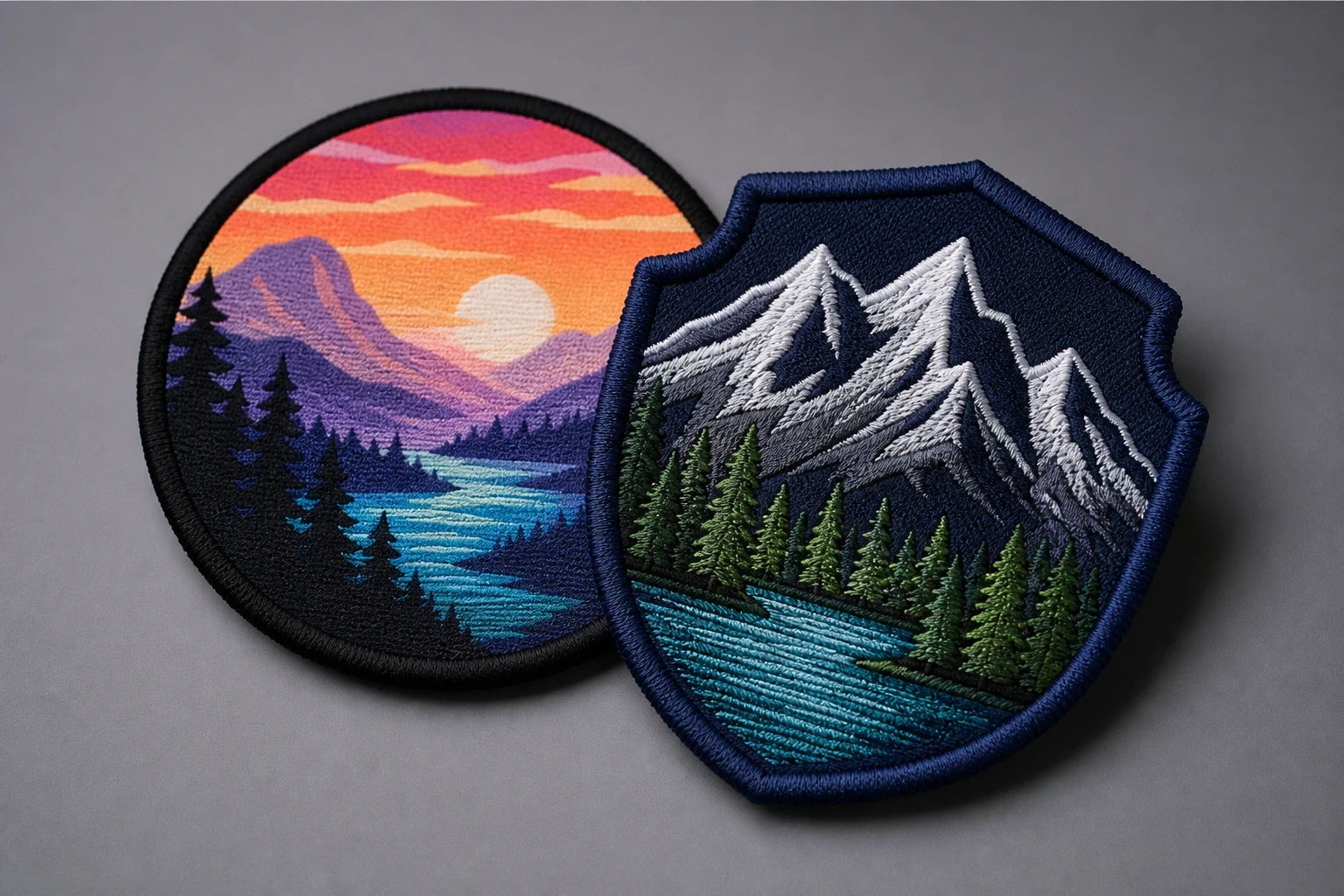
Sublimation printed patches UK suit detailed artwork, gradients, photographs and flatter branding on lightweight garments. Embroidered patches suit bold lettering, raised thread texture and traditional club or uniform designs. The right choice depends on artwork, garment, washing conditions and preferred finish. The Customized Patches supplies a free digital mockup, usually within 12 hours, before production.
Key takeaways
- Sublimation printed patches UK are a practical choice for gradients, small details, photographs and flat artwork.
- Embroidered patches add raised thread texture and suit bold crests, short lettering and traditional uniforms.
- The Customized Patches has a 5-piece minimum per design and sends a free digital mockup usually within 12 hours.
- Production starts only after artwork and the mockup have been approved, so backing and finish can be checked first.
Sublimation printed patches UK are usually the better choice for photographs, gradients, shaded logos and artwork with more detail than thread can show. Embroidered patches are usually better for bold club crests, short lettering and a raised, traditional finish. The right answer depends on the artwork, garment, washing routine and the feel you want on the finished item.
At The Customized Patches, we quote for football clubs, cadet units, hospitality polos, biker vests, school blazers and business uniforms across the United Kingdom. It is common to see iron-on patches peel after a dryer cycle, lettering disappear into a busy embroidered border, and a beautifully detailed logo lose clarity because the patch was simply too small. A free digital mockup usually arrives within 12 hours, and production starts only after approval.
The short answer: printed or embroidered?
Pick sublimation printing if the design relies on colour blending, a full-colour illustration, a photograph, a map, a fine line drawing or several small colour changes. The artwork is printed onto a suitable patch face, giving a clean, flat image without asking individual threads to reproduce every tiny transition.
Pick embroidery if you want the patch to look and feel like a conventional uniform badge. Thread gives the surface height, a tactile edge and a familiar crest appearance. It works particularly well for simple shields, initials, large symbols and names that need to be read quickly from a few feet away.
- Choose printed for photographic detail, gradients, shadows and broad colour coverage.
- Choose embroidered for raised texture, bold lettering, simple crests and traditional workwear.
- Choose a removable Velcro solution if the badge needs to move between garments or kit bags.
- Choose a sewn application for frequent washing, rough handling or valuable outerwear.
- Ask for a mockup if the artwork sits close to the detail limit of either method.
There is no quality contest that makes one method right for every job. Printed is flatter; that is the point. Embroidered is more textured; that is also the point. The useful question is which finish supports the logo and the way the garment will be used.
How sublimation printed patches UK are made
Sublimation printing uses heat to transfer colour into a polyester-based surface rather than laying a thick layer of ink on top in the way some people imagine. The exact face fabric, border and finishing method can vary by supplier, so the quote and mockup should confirm what is being produced. For most buyers, the practical result is a smooth patch face with strong colour coverage and no stitched fill pattern.
That smooth face is useful on modern sportswear, branded workwear and lightweight jackets. A football club can reproduce a sponsor mark with a colour fade. A hospitality business can use a small illustrated food or drinks motif. A streetwear brand can keep the fine linework in a drawn character instead of simplifying it into a few thread blocks.
What printed patches do well
- Gradients from one colour into another.
- Fine outlines and small internal details, subject to the final size.
- Photographic or illustrated artwork with several tones.
- Large areas of colour without visible stitch direction.
- A flatter finish that sits neatly on shirts, polos and lighter jackets.
Printed does not mean unlimited detail at any size. A one-inch patch still has very little physical space for tiny text, whether the design is printed or embroidered. The image may technically contain the detail, but the wearer will not necessarily be able to read it once the patch is sewn to a moving garment. We normally check the actual size rather than promising that every supplied file will work unchanged.
If you are considering the printed route, our guide to Sublimation printed patches UK: Everything UK Buyers Need to Know covers artwork, sizes and practical UK ordering questions. The printed patches product hub is also useful if you are comparing a fully printed face with other surface finishes.
What embroidered patches offer instead
Embroidery builds the design with thread stitched into a fabric base. This creates a visible grain and height that many people associate with military badges, football crests, school insignia and motorcycle club patches. A merrowed crest, for example, has a rolled stitched edge that gives the badge a defined, finished outline.
Thread is at its best with clear shapes and controlled detail. A cadet unit may need a shield, crossed symbols and a short name. A school blazer may need a simple house emblem. A biker vest may need a large back patch where strong lettering and a heavy border matter more than a photographic image.
Where embroidery can be the stronger fit
- Traditional crests and badges for clubs, schools and uniformed groups.
- Large lettering that benefits from a solid stitched form.
- Designs where a raised, tactile finish is part of the identity.
- Hard-wearing outer garments that need a conventional sewn badge.
- Simple logos intended to be recognised at a distance.
Embroidery has trade-offs. Small sans-serif text can close up. Fine facial features can become indistinct. Very smooth gradients usually need to be simplified into thread colours. If you want a dense, photographic image, embroidery may require a redesign rather than a direct conversion.
You can see the main options through our embroidered patches hub, including traditional finishes and backing choices. For a more raised surface, 3D embroidered patches may suit selected lettering or logo areas, although they are not a substitute for photographic detail.
Sublimation printed patches UK versus embroidered patches: specification table
The table below gives a working comparison rather than a promise that every design will behave identically. Size, base material, border, backing, garment and washing conditions all affect the final result. A mockup is the sensible check before a larger run.
| Consideration | Sublimation printed patches UK | Embroidered patches |
|---|---|---|
| Visual finish | Smooth, flat printed image with broad colour coverage | Raised thread surface with visible stitch texture |
| Best artwork | Photographs, gradients, illustrations, shading and fine colour changes | Bold logos, short text, simple crests and strong symbols |
| Small detail | Often retains more visual detail, provided the patch is large enough | Fine lines and small lettering may need to be enlarged or simplified |
| Colour transitions | Good fit for blended tones and continuous shading | Usually represented with selected thread colours and stitch changes |
| Garment feel | Flatter and lighter against many shirts, polos and jackets | More tactile, with stitch density adding body |
| Traditional badge look | Modern and graphic | Classic crest and uniform appearance |
| Common UK uses | Brand marks, event artwork, sports graphics and detailed illustrations | Schools, cadets, football clubs, workwear and biker vests |
| Backing choices | Sew-on, iron-on, adhesive or Velcro subject to the garment | Sew-on, iron-on, adhesive or Velcro subject to the garment |
| Main limitation | Flat appearance may not suit a design that needs raised texture | Very fine detail, photographs and smooth gradients may need simplification |
Backing deserves as much attention as the face method. An iron-on backing can be convenient, but heat, fabric type and washing matter. Nylon shells can react badly to direct heat. A wool coaches jacket may need a sewn application rather than an iron-on attempt. A Velcro panel requires the correct hook or loop side and a matching size, not simply a standard badge with an extra layer added later.
For a closer look at measurements and attachment choices, see Printed patches Sizing and Backing Options Explained. If neither surface gives the right feel, woven patches can be a useful middle ground for fine lettering and a flatter woven texture, while chenille patches suit bold, soft, varsity-style lettering.
Choosing by garment and real UK use
The garment often settles the argument. A sports club ordering badges for polyester training tops may favour a flat printed face, especially if the design contains a sponsor logo, player number or multi-colour illustration. A school putting house badges on wool blazers may prefer embroidery because the crest needs a conventional uniform appearance and regular washing.
Not sure whether thread or ink will hold your logo at the finished size? Send the artwork and garment details to The Customized Patches. We provide a free digital mockup usually within 12 hours, so you can compare the printed and embroidered look before production.
GET A FREE MOCKUPNylon shells need care. Heat can mark, distort or weaken some lightweight fabrics, so an iron-on instruction that works on cotton is not automatically suitable for a waterproof jacket. For a cycling or outdoor team, sew-on or a properly specified removable backing may be the safer route. We ask about the fabric rather than treating every jacket as the same.
Football clubs and sports teams
Football clubs commonly need a badge that stays legible on kit bags, jackets and staff polos. Printed patches can reproduce a detailed mascot, sponsor artwork or shaded ball illustration. Embroidered patches can give the club crest the familiar raised finish supporters expect. If the same logo will be used on several garment types, a printed version for lightweight kit and an embroidered version for staff outerwear may be sensible.
Cadet units, schools and uniformed groups
Uniform badges need clear hierarchy: emblem first, wording second, decorative detail last. Embroidery is often a natural fit for shields and formal insignia. Printed patches can work for activity badges, event artwork or a design that includes a small scene. Check the required size in inches and the application method before approving, particularly for a blazer or structured jacket.
Brands, hospitality and workwear
A hospitality polo usually benefits from a patch that stays neat and does not feel overly heavy on the chest. A printed logo can preserve a subtle gradient or illustrated mark. Embroidery is a strong choice for a simple wordmark, especially where the business wants a conventional uniform appearance. For workwear, consider how often the garment is washed and whether staff will use tumble dryers.
Biker vests and club jackets
A large back patch on a biker vest normally needs strong contrast, readable lettering and a border that holds the shape. Embroidery is common because the raised thread and heavy outline suit the garment. A detailed bike illustration or landscape-style scene may be better printed, but the final dimensions need to be generous enough to show the detail. Our biker and motorcycle club patches page covers the kind of layouts commonly requested.
Durability, washing and backing: what buyers should check
A patch is only as reliable as its attachment and its care routine. A well-made face can still fail if the backing is wrong for the garment, the adhesive is applied to a heat-sensitive shell, or the patch edge is left exposed to repeated pulling. Sew-on attachment is often the dependable choice for frequent washing and heavy use, but it takes more time to fit.
Iron-on is convenient, not universal. It is common to see a patch peel after a dryer cycle because the garment, temperature and adhesive were not a suitable combination. Follow the supplied application guidance, test on an inconspicuous area where appropriate, and sew the perimeter if the item will be washed heavily or used outdoors.
- Tell us if the garment is nylon, polyester, cotton, wool, denim, leather or a coated fabric.
- Tell us whether the patch will be washed weekly, occasionally or rarely.
- Use sew-on for demanding use where the garment permits it.
- Use Velcro for removable badges on compatible panels and kit systems.
- Do not assume an iron-on backing is suitable for a waterproof or heat-sensitive shell.
- Check the border and backing in the mockup before approving production.
Leather garments bring another consideration: stitching holes and application pressure are difficult to reverse. If the patch is for a leather vest, confirm the position carefully before fitting. For a different surface altogether, leather patches may provide a more integrated result than a textile badge.
Artwork, size and colour decisions before you order
Start with the actual patch dimensions, not just the artwork file. Measure the available space in inches and consider the border, corner radius and the distance from zips, seams or pockets. A design that looks detailed on a laptop can become crowded at 2 inches wide, especially if the wording runs around a small circular crest.
For sublimation printed patches, supply the cleanest artwork available. Vector artwork is useful for logos, while a high-resolution image may be suitable for photographic designs. For embroidery, expect some adjustment: thread colours are selected rather than infinitely blended, and tiny gaps may need to be opened so they do not close during stitching.
A practical artwork checklist
- Confirm the wording and spelling, including apostrophes, dates and club names.
- State the finished width and height in inches, or tell us the available garment area.
- Identify colours by a reference where possible, while allowing for the difference between a screen and a physical patch.
- Mark any part of the artwork that must remain visible, such as a sponsor mark or registration wording.
- Tell us if the design must match existing uniforms or earlier badges.
- Choose printed, embroidered or ask us to show both in the mockup.
- Confirm the border shape and backing before approving.
A colour difference between a digital proof and a physical surface is not automatically a production error. Screen brightness, fabric texture, thread and ink all affect appearance. The mockup is primarily for layout, scale, spelling, border and method; if an exact colour match matters, include the relevant reference in your enquiry.
Our guide on How to Design Artwork for printed patches That Production-Ready gives further preparation advice. It is also worth reading The Difference Between printed patches and embroidered patches, Explained if your team is discussing the choice internally.
Quantity, pricing and UK lead-time questions
The Customized Patches has a 5-piece minimum per design. This means five patches of one approved design, not one patch each of five unrelated designs. If you need several names, colourways or club branches, list them clearly so the quote reflects the actual artwork count.
Price depends on size, quantity, artwork, border, backing and production method. A small printed badge may be more straightforward for a detailed design, while a heavily stitched embroidered crest may involve more thread coverage and preparation. The lowest unit price is not always the best comparison if one option needs a redesign, extra backing or a second production run.
Lead time should be discussed before payment or approval, particularly for a tournament, school presentation, launch event or club anniversary. Artwork changes after approval can affect timing. UK-wide shipping is available, but the delivery date also depends on production scheduling and the destination postcode.
Name sew-on, iron-on or Velcro on the quote and tell us what the badge will be fitted to. We will show the proposed backing on a free digital mockup usually within 12 hours, and production will not start until you approve the details.
GET A FREE MOCKUPOur normal quoting process is straightforward: send the artwork, quantity, size, garment and backing preference; receive a free digital mockup usually within 12 hours; check the details; then approve production. We produce only after approval. If you are comparing several options, ask for both printed and embroidered mockups rather than guessing from a screen image.
For more ordering detail, see A Step-by-Step Guide to Ordering printed patches and 10 Questions to Ask Before Ordering printed patches. You can also start a free mockup quote with the design and garment information.
A simple decision guide for your project
Use sublimation printed patches UK when the image itself is the priority. That includes a detailed brand illustration, a shaded mascot, a photographic reference, a gradient or a design with many small colour areas. Allow enough physical size for the detail to be seen, and select a backing that suits the garment rather than choosing iron-on by default.
Use embroidery when the physical badge is part of the identity. A raised crest on a school blazer, a bold football club badge on a jacket, or large lettering on a biker vest can look more convincing in thread. Simplify fine details where needed and give small text enough height to remain readable.
| If your priority is... | Start by considering... |
|---|---|
| A photograph or shaded illustration | Sublimation printed patch |
| A classic raised crest | Embroidered patch |
| A smooth, lighter face on a polo | Sublimation printed patch |
| Bold lettering on a biker vest | Embroidered patch |
| A removable badge | Either method with correctly specified Velcro |
| Very fine small lettering | Printed or woven, then confirm the size in a mockup |
| A soft varsity-style letter | Chenille patch |
There are also projects where two methods make sense. A brand may use printed patches for detailed seasonal artwork and embroidered patches for a permanent staff uniform. A club may use embroidered player or committee badges but printed event patches for a one-off tournament. Choosing by use rather than forcing one method across every garment usually produces the more consistent result.
Why the mockup matters before production
A digital mockup catches the mistakes that are easy to miss in an email attachment. It shows the proposed proportions, border, colour arrangement and method. It also gives you a chance to see whether a name is too small, whether a border crowds the design or whether the selected patch would dominate a small polo chest.
The mockup is not a replacement for asking questions. Tell us if the patch will sit on a curved sleeve, over a seam, beside a zip or on a removable panel. Tell us whether the garment is a nylon shell, wool coach jacket, denim vest, cotton polo or school blazer. Those details affect the recommended backing and application.
The Customized Patches offers a free digital mockup usually within 12 hours. There is a 5-piece minimum per design, and we produce only after you approve the design and specifications. That process gives small UK clubs and businesses a chance to check the practical details before committing to production.
Final recommendation
If your artwork is detailed and you want a flatter, graphic finish, start with sublimation printed patches UK. If your artwork is a bold crest and you want visible texture, start with embroidery. If the answer is not obvious, there is no benefit in making the decision from a tiny preview on a phone: ask for both versions at the real finished size.
Send The Customized Patches your artwork, quantity, finished size, garment type and preferred backing. We will advise on the practical route, prepare the free digital mockup usually within 12 hours and wait for approval before production. UK-wide shipping is available, and the minimum is five pieces per design.
If you are still comparing materials, PVC patches suit a rubberised, weather-resistant style, while the printed patches and embroidered patches hubs give a clearer starting point for textile badges. Buyers in different parts of the country can also use the UK city pages to find relevant delivery information.
Frequently asked questions
Are sublimation printed patches UK better than embroidered patches?
Neither method is always better. Sublimation printed patches UK are usually better for photographs, gradients, shading and fine colour detail. Embroidered patches are usually better for raised texture, bold lettering and traditional crests. The garment, finished size, backing and washing routine should decide the final choice.
What is the minimum order for patches from The Customized Patches?
The minimum order is 5 pieces per design. Different designs, names or colourways may count as separate designs, so include the full breakdown when requesting a quote.
How quickly can I see a patch mockup?
The Customized Patches provides a free digital mockup usually within 12 hours. The timing can depend on receiving usable artwork and clear information about size, garment and backing. Production starts only after the mockup and specifications have been approved.
Can printed or embroidered patches go on nylon jackets?
They can, but the backing and application method need checking first. Nylon shells may be sensitive to heat, so an iron-on application is not automatically suitable. Sew-on or a correctly specified removable backing may be more appropriate, depending on the garment.
Are printed patches suitable for small text?
Printed patches can retain more visual detail than embroidery, but small text still needs enough physical space to be readable on a moving garment. Ask for the wording to be shown at the intended size in the mockup. If the lettering is extremely fine, a larger patch or a simplified design may be needed.
Do you make both sublimation printed and embroidered patches for UK customers?
The Customized Patches can quote both options for UK teams, brands, clubs and businesses. Send the artwork, quantity, size, garment and preferred backing. You will receive a free digital mockup usually within 12 hours, and production takes place only after approval.
Ready to produce custom patches for your UK team or brand?
GET A FREE MOCKUP