
Sublimation printed patches UK: Everything UK Buyers Need to Know
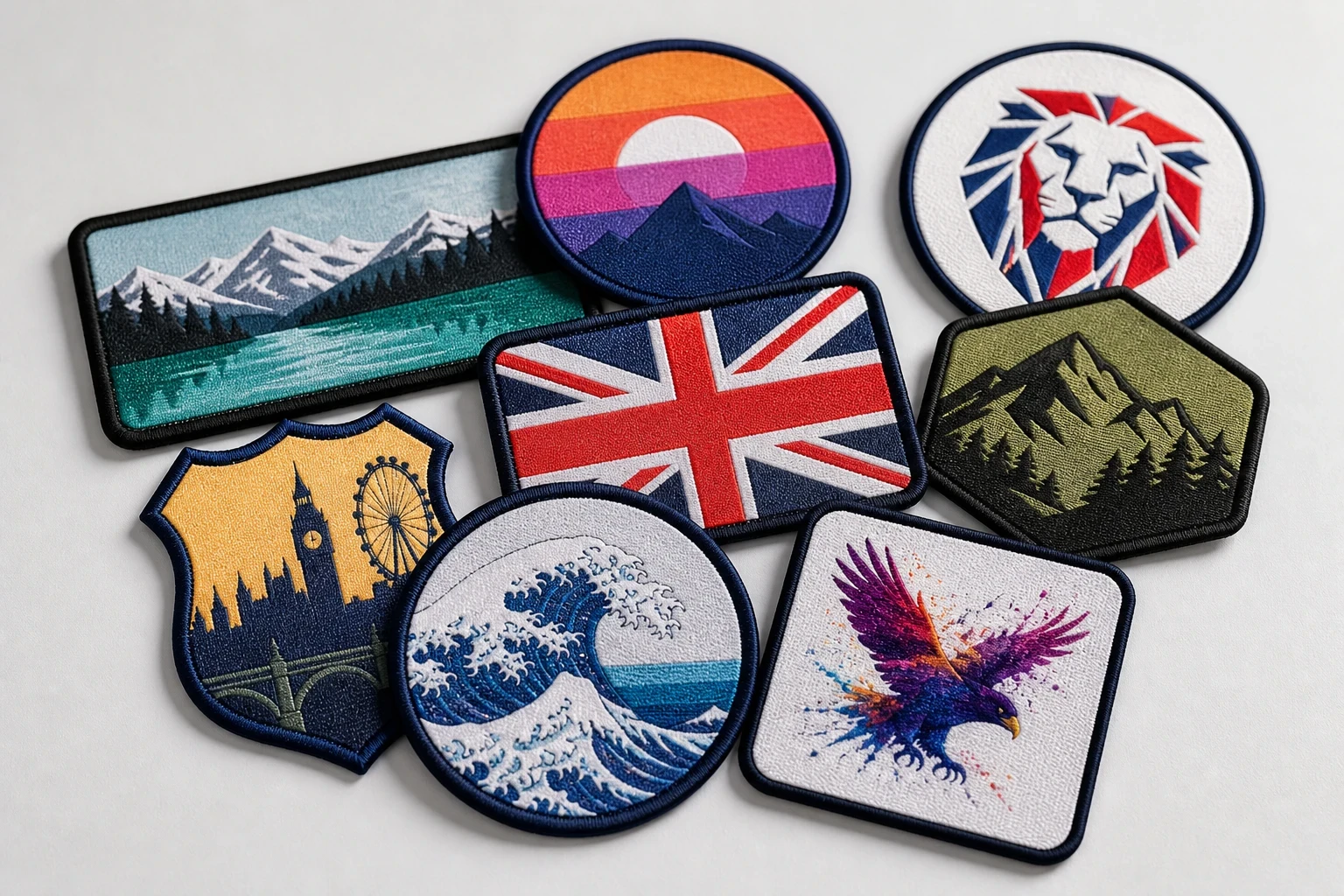
Sublimation printed patches UK are fabric patches made by transferring a full-colour design into a polyester surface using heat. They suit photographs, gradients, small text and detailed artwork better than raised embroidery, while remaining flatter and lighter. The Customized Patches offers a free digital mockup usually within 12 hours, with a 5-piece minimum per design and production only after approval.
Key takeaways
- Sublimation printed patches UK work best for detailed, full-colour artwork, photographs, gradients and small lettering.
- Printed patches are flatter than embroidery; that is the point, but they do not provide the raised thread texture of a merrowed or embroidered crest.
- The Customized Patches has a 5-piece minimum per design, supplies a free digital mockup usually within 12 hours, and produces only after approval.
- Backing, garment fabric, washing conditions and patch size should be agreed before production, especially for nylon shells, Velcro panels and workwear.
Sublimation printed patches UK are best for buyers who need a flat, full-colour patch with detail that would be difficult to reproduce in thread. The design is transferred into a suitable polyester fabric using heat, so photographs, gradients, shaded illustrations and small lettering can remain visible without building the image up in raised stitches.
The Customized Patches supplies UK teams, brands, clubs and businesses with a 5-piece minimum per design. You receive a free digital mockup usually within 12 hours, and production starts only after you approve the artwork, size, border and backing.
What are sublimation printed patches UK?
Sublimation is a heat-transfer printing method. Rather than stitching the design with separate thread colours, the artwork is printed onto a polyester-based patch surface and fixed through heat. The result is a continuous printed image rather than a pattern made from individual embroidered stitches.
That distinction matters when you are comparing patch styles. A printed patch can show a sunset, a shaded mascot, a map, a photographic face or a logo containing many colour changes. Embroidery has a more tactile, traditional finish, but each small detail has to be translated into thread, stitch direction and workable shapes.
Printed is flatter; that is the point. It can sit comfortably on a polo shirt, running top or light jacket without adding much bulk. It will not give you the raised surface of a merrowed crest or a heavily stitched club emblem, so the right choice depends on the garment and the impression you want.
When should a UK buyer choose a sublimation printed patch?
Start with the artwork, not the product name. If the design contains a photograph, soft shadow, fine linework, a painted effect or a gradient from one colour into another, printing is usually the more practical route. It is also useful when the original artwork has a large colour palette and you do not want to simplify it into a limited set of thread colours.
- Football and rugby clubs needing sponsor marks, player illustrations or colourful tournament badges.
- Cadet units and outdoor groups wanting a detailed unit emblem without a thick raised surface.
- Hospitality polos carrying a colourful restaurant, hotel or event logo.
- Small businesses testing a new brand mark in a short run before ordering a larger quantity.
- Biker and motorcycle club designs that use artwork, scenery or lettering too fine for a heavily stitched finish.
- School blazers, leavers’ jackets and activity clothing where a lighter, flatter patch is preferred.
- Brands producing event merchandise with artwork that needs to match a screen design closely.
A flat patch is not automatically a weaker patch. It is simply made for a different job. For a clean badge with bold lettering and a classic uniform feel, compare embroidered patches or 3D embroidered patches. For a photographic or illustrated design, printed construction normally gives the artwork more room to remain recognisable.
Practical examples
A football crest with three solid colours and a strong outer border is often straightforward in embroidery. A club anniversary badge with a stadium photograph, a date, a sponsor line and a fading sky is a different job. Printing keeps those visual changes together rather than forcing them into many stitch areas.
The same applies to a cadet unit badge with a detailed landscape or an independent brand using a hand-drawn illustration. A printed finish can retain the character of the original file. For a biker vest, however, the choice may be driven as much by the backing and border as by the artwork, because the patch needs to sit securely on a heavier garment.
Printed versus embroidered patches: the practical differences
The common mistake is to ask which type is universally better. There is no useful universal answer. Printed patches handle continuous artwork and fine colour transitions well; embroidery gives a textured, durable-looking surface with visible thread and a more traditional badge appearance.
| Specification | Sublimation printed patch | Embroidered patch | Best fit |
|---|---|---|---|
| Artwork | Full-colour graphics, photographs, gradients and shaded illustrations | Bold logos, simple icons and designs suited to separate thread areas | Choose printing for complex artwork; embroidery for a classic badge |
| Surface | Flat and light, with the design integrated into the printed fabric surface | Raised or textured, with visible thread coverage | Choose based on the garment and desired feel |
| Small text | Can reproduce fine lettering when the finished patch is large enough to read | Very small letters may close up or need simplifying | Printing often suits detailed wording, subject to size |
| Colour changes | Smooth blends and many colours are possible in the artwork | Each colour needs practical thread coverage and stitch planning | Printing suits gradients and photographic colour |
| Garment weight | Works well on polos, sports tops and lighter jackets | Works well on uniforms, denim, heavy cotton and structured jackets | Match patch construction to garment weight |
| Texture | Low-profile and smooth | Tactile and visibly stitched | Printing for a discreet finish; embroidery for texture |
| Backing | Can be supplied with sew-on, iron-on or Velcro-style options where suitable | The same backing decision still matters | Backing depends on washing, fabric and use |
There are also alternatives worth considering. Woven patches can be a good middle ground for fine lettering and a flatter woven texture. PVC patches suit waterproof, hard-wearing applications and a moulded appearance, while leather patches are often selected for heritage clothing, bags and premium casualwear.
Do not choose a printed patch simply because the design has many colours. Consider how it will be handled, washed and attached. A football shirt may need a lighter finish, while a wool coaches jacket or denim biker vest may call for a stronger border and a more secure sew-on application.
Artwork requirements for sublimation printed patches
Good artwork gives the production team something workable to reproduce. Send the original logo or the highest-resolution file available rather than a screenshot copied from social media. Vector files such as AI, EPS or PDF are helpful for logos, while a high-resolution PNG or JPG may be suitable for photographs and painted artwork.
- Use clear lettering with enough space between characters, particularly if the patch will be under 3 inches wide.
- Keep important detail away from the outer edge so the border does not cover it.
- Tell us if a colour needs to match a brand reference, team kit or existing garment.
- Include the complete design, including any background, border or knockout area that should appear on the patch.
- Avoid enlarging a very small web image and assuming it will become sharp at production size.
- Check that faces, fine lines and sponsor wording remain readable at the proposed finished dimensions.
Colour on a screen is not the same as colour on fabric. Bright monitor blues, fluorescent shades and subtle gradients may appear differently once printed on a textile surface. The digital mockup is the point at which to check the layout, border, proportions and overall appearance. It is not a substitute for a physical colour swatch, but it gives you a clear production reference before approval.
How size changes the result
A design that looks clear at 4 inches may become crowded at 2 inches. Measure the available garment area first: a left-chest polo mark, a sleeve badge, a football shirt crest and a large back patch all have different practical limits. Give the finished width and height in inches, or send a photograph with a ruler beside the placement area.
If the patch includes a long name, date or slogan, increasing the width may be more useful than increasing the height. If the design is circular, state the diameter. Our guide to Printed patches Sizing and Backing Options Explained covers the measurements and attachment choices that are easiest to get wrong.
Not sure whether thread or ink will hold your logo best? Send the artwork and garment details for a free digital mockup usually within 12 hours, then compare the flat printed finish with an embroidered option before production.
GET A FREE MOCKUPBacking and garment compatibility in the UK
Backing is not a finishing detail to leave until the end. It affects how the patch is fitted, how it behaves after washing and whether it can be removed or repositioned. Sew-on backing is a dependable choice for many garments, especially when the patch will be washed often or exposed to pulling.
- Sew-on: suitable for football kit, workwear, denim, wool, school blazers and garments that will be washed repeatedly. It takes longer to fit but gives a direct mechanical attachment.
- Iron-on: convenient for suitable cotton or cotton-blend surfaces when applied with the correct heat, pressure and time. It may not suit coated nylon, waterproof shells or delicate fabrics.
- Velcro: useful for removable unit badges, tactical clothing, event teams and garments with an existing loop panel. The hook-and-loop parts should be specified clearly so the finished patch matches the panel.
- Adhesive options: useful in some short-term or display situations, but they should not be treated as a replacement for sewing on garments that will be pulled, washed or worn outdoors.
Nylon shells need particular care. Heat can affect coated or technical fabrics, and an iron-on that holds on a cotton shirt may peel after a dryer cycle or fail to bond evenly to a slippery jacket. For nylon outdoor clothing, ask about sew-on or a compatible Velcro panel rather than assuming iron-on is the safest shortcut.
Wool coaches jackets, heavy fleece and biker vests also behave differently. The surface may be thick, textured or difficult to press evenly. On a school blazer, check the patch placement against the pocket, badge and seam before ordering. A mockup can show the patch shape, but the final attachment method still needs to suit the actual cloth.
Borders, shapes and finishing
A border gives the eye a clean stopping point and can help a patch stand out against a busy garment. Rounded corners are practical for casual clothing, while shield, circle, rectangle and custom silhouettes are common for clubs and uniforms. The border should be wide enough to finish cleanly without swallowing fine detail.
For a raised, stitched edge, ask whether a merrowed finish is suitable for the shape and size. A printed patch can also use a defined border, but the visual result is different from a thick embroidered edge. The mockup should show that difference clearly rather than making every patch look like a stitched badge.
Durability, washing and everyday use
A patch’s service life depends on more than the print. The fabric, backing, stitching, garment, washing programme and amount of abrasion all contribute. A patch sewn securely onto a polo shirt and washed according to the garment instructions will have a different experience from an iron-on patch placed on a coated nylon shell and put through a hot tumble dryer.
For club kit and workwear, follow the garment care label and avoid treating the patch as indestructible. Turn garments inside out where practical, use a suitable wash temperature and check the attachment after repeated wear. If a patch is likely to catch on equipment, bags or vehicle seats, a secure sew-on method is usually worth considering.
Printed patches are often chosen for a clean, low-profile appearance, but they are not the correct answer for every high-abrasion application. A moulded PVC patch may be better for wet outdoor use, while a dense embroidered patch may suit a heavy jacket where texture and stitch coverage are part of the design.
How much do sublimation printed patches cost in the UK?
The price depends on the finished size, quantity, shape, backing, border, artwork complexity and delivery requirements. A small run of 5 pieces has a different unit cost from a larger order for a football squad, retail launch or hospitality group. The number of designs matters too: five pieces of one design is not the same production job as one piece of five different designs.
When requesting a quote, provide the details that affect the calculation. State the quantity per design, finished dimensions in inches, preferred backing, garment type, artwork format and delivery postcode or UK destination. If you have an event date, include it at the start rather than after the quote has been prepared.
- Quantity: the minimum is 5 pieces per design, with larger runs usually changing the unit economics.
- Size: larger patches use more material and may need different finishing decisions.
- Shape: standard shapes can be simpler to plan than complex outlines with tight corners.
- Backing: sew-on, iron-on and Velcro-style options have different material and fitting requirements.
- Artwork: a clean file can reduce clarification, while a damaged or low-resolution file may need production advice.
- Delivery: UK-wide shipping and a fixed deadline should be discussed before approval.
A low unit price is not useful if the patch is the wrong size, cannot attach to the garment or arrives after the event. The sensible comparison is the complete specification and the approval process. See How Much Do printed patches Cost in the UK? for more detail on the information needed for a realistic quotation.
Ordering sublimation printed patches from a UK supplier
The straightforward process is artwork, specification, mockup, approval, production and delivery. Send the design with the intended garment and use. A football club ordering sleeve badges needs different advice from a brand ordering removable Velcro patches for jackets, even if both designs are 3 inches wide.
- Send the artwork and explain what the patch represents, where it will be fitted and how often the garment will be washed.
- Confirm the finished size in inches, quantity per design, shape, border and backing.
- Review the free digital mockup, usually supplied within 12 hours, and check spelling, colours, proportions and placement.
- Request any changes before approval. Do not rely on a verbal assumption about size or backing.
- Approve the final mockup. Production starts only after approval.
- Check the delivery address, required date and any separate designs included in the order.
- Fit the patches using the agreed method and test one sample on the intended fabric where the garment is valuable or technically coated.
The 5-piece minimum per design is useful for small teams, new businesses and pilot merchandise. It lets you check the finished look without committing to a large quantity. If several designs are needed, list each design separately so the quantities and approval artwork cannot be confused.
The A Step-by-Step Guide to Ordering printed patches is useful if you are collecting specifications from several people. For a wider comparison before you decide, read The Difference Between printed patches and embroidered patches, Explained.
Lead times, approval and UK delivery
Lead time depends on the design, quantity, backing, production schedule and the point at which the artwork is approved. The mockup stage is normally quick, but changes, missing garment information or several separate designs can add time. A deadline should be included with the first enquiry so the quote can be assessed properly.
Name sew-on, iron-on or Velcro on the quote and tell us about the garment. We will show the proposed backing and layout on a free digital mockup usually within 12 hours, with production starting only after you approve it.
GET A FREE MOCKUPThe approval date is the practical starting point for production. Sending artwork does not mean production has begun. The Customized Patches produces only after approval, which gives you a chance to correct a team name, date, colour, border or backing before material is made.
UK-wide shipping should also be allowed for separately from production. If the patches are for a tournament, product launch, wedding party, school presentation or trade event, avoid leaving the order until the final week. A clear quantity, final address and agreed artwork reduce avoidable delay.
Common mistakes UK buyers can avoid
- Ordering from a tiny social-media preview and expecting crisp detail on a large patch.
- Choosing iron-on for a coated nylon jacket without checking heat compatibility.
- Forgetting that a Velcro patch needs a loop panel on the garment.
- Approving a design without checking the wording at the actual finished size.
- Measuring the patch area by eye instead of using inches and checking nearby seams.
- Treating every design in a mixed order as one quantity when each design has its own 5-piece minimum.
- Assuming a printed patch will have the raised texture of embroidery.
- Leaving the deadline out of the first quote request.
- Using a high-temperature dryer when the garment or patch backing requires gentler care.
- Skipping the mockup and discovering that a border covers important lettering.
These problems are usually specification problems rather than printing problems. A production desk can advise on size, backing and garment suitability, but it needs the intended use to do that properly. A photograph of the garment, the patch position and a rough measurement often answer questions that a logo file cannot.
Which patch type should your organisation use?
For a brand with a photographic illustration, choose printed if retaining the artwork is more important than having raised thread. For a traditional regiment-style badge, club crest or simple company emblem, embroidery may provide the appearance you want. If the patch needs to be removed regularly, the backing may decide the product more than the decoration method.
| Your requirement | Likely starting point | Reason |
|---|---|---|
| Photograph, gradient or detailed illustration | Sublimation printed patch | Continuous colour and fine visual detail are easier to retain |
| Bold crest with a traditional uniform appearance | Embroidered patch | Raised thread and stitched texture suit the design |
| Fine lettering with a flatter woven surface | Woven patch | The woven face can suit compact text and clean lines |
| Outdoor or wet-use badge | PVC patch | Moulded construction may suit exposure and easy cleaning |
| Removable unit or tactical badge | Printed or embroidered Velcro patch | Hook-and-loop backing allows the badge to be changed |
| Heritage clothing or a casual bag | Leather patch | The material contributes to the overall garment style |
There is no need to force every design in a range into one construction. A hospitality business might use printed patches for a detailed seasonal illustration and embroidered patches for staff names. A club might use a printed event badge alongside its established embroidered crest. The key is to specify each design separately and approve each mockup.
Final checklist for sublimation printed patches UK
- Is the design a good fit for a flat printed surface?
- Will the smallest lettering still be readable at the finished size?
- Have you measured the garment area in inches?
- Is the garment cotton, polyester, nylon, wool, denim, fleece or a coated technical fabric?
- Should the patch be sewn on, ironed on or attached with Velcro?
- Have you allowed for the border and any edge finishing?
- Is the quantity at least 5 pieces per design?
- Have you included your UK delivery address and required date?
- Have you reviewed the free digital mockup?
- Has production been approved in writing?
If the answers are clear, the quotation should be much more useful and the finished patches should be easier to fit. Send the artwork, garment details and quantity to The Customized Patches for a practical recommendation rather than guessing from a product photograph.
Related guides and product options
For more printed patch planning, read The Complete Guide to Sublimation printed patches UK in 2026, 10 Questions to Ask Before Ordering printed patches and How to Design Artwork for printed patches That Production-Ready. These guides cover artwork preparation, questions for a supplier and decisions that affect the finished result.
If you are comparing product families, browse embroidered patches, woven patches, chenille patches, biker and motorcycle club patches or the UK city pages. Each option suits a different garment, use and visual brief, so the best route is to start with the artwork and the clothing rather than a generic patch label.
Frequently asked questions
What are sublimation printed patches UK used for?
Sublimation printed patches UK are used for full-colour club badges, photographs, gradients, detailed illustrations, sponsor marks, branded workwear, sports kit and event merchandise. They are particularly useful when the artwork would be difficult to reproduce as separate embroidered thread areas.
What is the minimum order for sublimation printed patches?
The minimum order is 5 pieces per design. If you need several different logos or badges, each design should be listed separately because the 5-piece minimum applies to each design rather than to the total number of patches across an order.
How quickly can I receive a mockup?
The Customized Patches usually provides a free digital mockup within 12 hours. The mockup should be checked for spelling, size, colours, border, shape and backing. Production starts only after the customer approves the final artwork.
Are printed patches better than embroidered patches?
Neither is better for every job. Printed patches are flatter and suit photographs, gradients and detailed full-colour artwork. Embroidered patches provide raised thread, visible texture and a traditional badge appearance, which can suit simple crests, uniforms and heavy garments.
Can sublimation printed patches go on nylon jackets?
They can be suitable for nylon jackets, but the backing and attachment method need checking first. Iron-on backing may not bond safely to coated or technical nylon and can be affected by heat. Sew-on or a compatible Velcro panel may be more appropriate for a nylon shell.
Can I order printed patches for a small UK business or club?
Yes. The Customized Patches accepts orders from UK businesses, teams and clubs with a 5-piece minimum per design. A small run can be used to test a new logo, prepare staff clothing, supply a club squad or check the finished design before ordering a larger quantity.
Ready to produce custom patches for your UK team or brand?
GET A FREE MOCKUP