
Custom rubber PVC patches UK: Everything UK Buyers Need to Know
Custom rubber PVC patches UK are moulded badges made from flexible PVC, with raised or recessed details that suit outdoor clothing, uniforms, bags and Velcro panels. The Customized Patches supplies them across the United Kingdom, with a 5-piece minimum per design, a free digital mockup usually within 12 hours, and production only after approval.
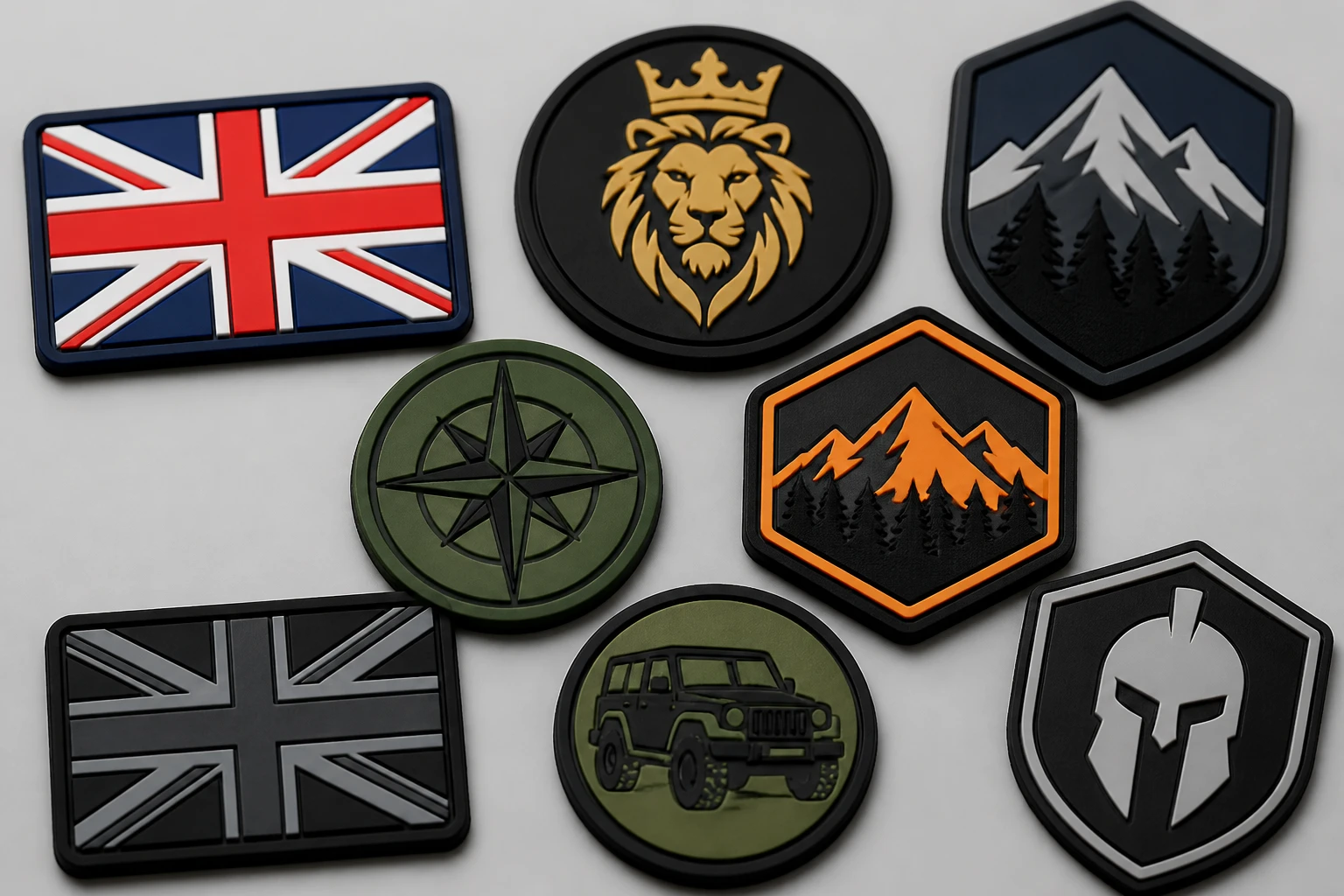
Key takeaways
- PVC patches are moulded, washable and suited to bold logos, outdoor kit and Velcro panels.
- The Customized Patches has a 5-piece minimum per design and sends a free digital mockup usually within 12 hours.
- Raised PVC gives a tactile finish, while recessed PVC keeps the face flatter and often suits detailed badge layouts.
- Production begins only after the customer approves the mockup, colours, size and backing.
Custom rubber PVC patches UK buyers order are moulded badges made from flexible polyvinyl chloride, usually known as PVC. They are a good fit for bold logos, outdoor clothing, workwear, bags, uniforms and Velcro panels because the face is wipeable and the raised detail does not rely on loose thread. The Customized Patches supplies them across the United Kingdom with a 5-piece minimum per design.
The choice is not simply PVC versus embroidery. You need to settle the patch size, relief level, border, colours, backing and garment before production. A free digital mockup is usually sent within 12 hours, and production starts only after you approve it. That approval stage matters, particularly when a small club badge, company mark or unit crest contains lettering.
What are custom rubber PVC patches UK buyers can order?
A PVC patch is formed in a mould rather than stitched from thread. Liquid PVC is placed into the mould to create the outline and coloured sections, then cured into a flexible badge. Depending on the design, the face can include raised lettering, recessed channels, a flat background, a textured surface or more than one level.
The word rubber is often used in everyday buying language, but most modern products sold as rubber patches are PVC. It is sensible to confirm the actual material rather than relying on the label. PVC gives the smooth, slightly flexible finish people expect from tactical patches and branded workwear badges.
The edge is normally part of the mould. That gives the patch a clean outline and avoids a thread border being pulled out of shape. A simple roundel, shield, rectangle or equipment label usually works well. Very fine points and tiny internal gaps need checking because PVC has practical production limits.
Why UK clubs and businesses choose PVC
- The surface can be wiped clean after use on workwear, outdoor kit or bags.
- Raised lettering remains easy to feel and see on a simple, high-contrast design.
- Velcro-backed versions can be removed from a jacket or plate carrier cover.
- The moulded finish gives a modern alternative to a stitched crest.
- PVC is useful for designs that need solid colour blocks rather than fine thread shading.
Typical enquiries cover PVC patches for football clubs, cadet units, hospitality polos, biker groups and school equipment. Each has a different practical need. A removable name panel for a nylon shell is not specified in the same way as a crest for a wool coach jacket or a permanent badge for a school blazer.
PVC, embroidered, woven or printed: which patch is best?
The right material depends on what must be visible and how the garment will be used. PVC is strong for clean shapes, solid colours and outdoor use. Embroidery gives a traditional raised thread surface, woven patches hold small lettering more neatly, and printed patches are flatter and better for gradients or image-like artwork.
Printed is flatter; that is the point. If a sponsor mark contains a photograph, fine shading or a colour fade, forcing it into a moulded PVC design may remove the detail that makes the artwork work. For a classic club crest with a bold border, PVC may be the more practical choice. For a school blazer, a merrowed crest or embroidered badge may look more familiar.
| Patch type | Best suited to | Main visual effect | Points to check |
|---|---|---|---|
| PVC | Outdoor clothing, bags, tactical kit, workwear and Velcro panels | Moulded, tactile face with raised or recessed detail | Tiny text, narrow lines, colour separation and mould detail |
| Embroidered | Sports clubs, school blazers, uniforms, jackets and traditional crests | Thread texture with a familiar stitched appearance | Small lettering, thread coverage, garment thickness and border |
| Woven | Detailed logos, labels, names and compact badges | Flat, neat thread construction with fine line definition | Very small type, edge finish and the desired level of texture |
| Printed | Photographic designs, gradients, fine shading and artwork with many colours | Flat printed surface with precise tonal detail | Wash care, surface wear and the difference between a flat and textured finish |
| Leather | Biker jackets, heritage clothing, premium bags and simple marks | Natural material with stamped, engraved or printed detail | Leather colour, thickness, edge treatment and attachment method |
If you are comparing finishes rather than just searching for a supplier, the guide to PVC patches vs embroidered patches is a useful next step. You can also compare woven patches, printed patches and leather patches before committing to a sample direction.
Choosing the PVC patch specification
The artwork is only half of the specification. Tell us where the patch will sit, how often it will be washed and whether it needs to come off. A patch for a nylon shell may need a sew-on or Velcro backing because the shell fabric can be heat-sensitive. A badge for a cotton work shirt may be approached differently.
Size and proportion
Measure the usable area, not just the overall garment. For a left-chest company mark, a width around 3 to 4 inches may be suitable, but the correct size depends on the logo and the fabric. A large back patch or club crest may need a much wider format. Send a photograph with a ruler beside the placement if the fit is difficult to describe.
Do not make a long wordmark too narrow simply to save space. The letters may need to be made larger or shortened to remain readable. A round patch can be easier to balance than a wide rectangle, while a shield may suit a football club or cadet unit better than a generic shape.
Raised and recessed detail
Raised PVC brings the logo forward. It is useful for bold initials, simple icons and strong borders. Recessed detail sits into the face and can help separate colour fields without making every element stand proud. Some designs use both, but adding levels does not automatically improve a busy logo.
Ask for a mockup that shows the relief clearly. A flat logo file cannot always show how a thin line, inner border or small word will translate into a mould. Our free digital mockup usually arrives within 12 hours, giving you a chance to alter the design before production.
Colours and artwork
- Send vector artwork where possible, such as an editable PDF, AI or SVG file.
- Include a reference for important brand colours and state if a close visual match is acceptable.
- Keep text large enough to read at the finished size; do not rely on a screen zoomed to 400%.
- Use clear contrast between the base, raised detail and border.
- Mention if the design must match existing embroidered, woven or printed merchandise.
- Check the spelling of names, unit numbers, dates and slogans before approval.
For more artwork preparation advice, see How to Design Artwork for PVC patches That Production-Ready. It is worth taking ten minutes to simplify a logo rather than producing a patch where the small wording merges into the border.
PVC patch backings for jackets, uniforms and Velcro
Backing controls how the patch attaches and how it behaves in use. Sew-on is normally the safest choice for a permanent badge, especially on garments that are washed regularly. Iron-on is convenient, but it is not suitable for every nylon shell, coated fabric or high-heat application.
Sew-on backing
Sew-on PVC patches can be stitched around the edge by hand or machine. This suits work jackets, club coats, bags and heavier fabrics. It takes longer to fit than heat application, but the attachment is not dependent on adhesive alone. If the patch will be washed often, sew-on is usually the first backing we discuss.
Iron-on backing
Iron-on backing uses heat-activated adhesive. The fabric must tolerate the temperature, and the application needs firm, even pressure. We regularly warn customers not to treat it as a universal solution. An iron-on patch can peel after a dryer cycle if the garment, heat setting or application method is wrong.
Not sure whether PVC, thread or ink will hold your logo best? Send the artwork and garment details for a free digital mockup usually within 12 hours, then compare the finish before you produce.
GET A FREE MOCKUPHook-and-loop backing
Hook-and-loop, often called Velcro, is useful when a patch must be removed or swapped. It is common on tactical clothing, event teams, security-style kit, bags and modular panels. The receiving loop panel must already be present or fitted separately. A Velcro patch will not attach to an ordinary smooth nylon shell without the matching loop side.
| Backing | Good for | Main advantage | Main caution |
|---|---|---|---|
| Sew-on | Permanent badges, jackets, bags and regular washing | Reliable attachment through the garment | Needs stitching and may leave needle marks |
| Iron-on | Suitable cotton garments and quick application | Fast fitting without sewing | Heat, washing and fabric compatibility must be checked |
| Hook-and-loop | Removable panels, tactical kit and rotating identifiers | Patch can be removed or changed | Needs a matching loop panel on the garment |
The PVC patches Sizing and Backing Options Explained guide covers the decision in more detail. Name sew-on, iron-on or Velcro on the quote. We show the correct back on the mockup so the finished specification matches the garment rather than leaving the attachment method until the last minute.
Where custom PVC patches work particularly well
PVC suits products that need a clean badge face and straightforward care. It is often selected for outdoor and tactical brands because mud, rain and handling are easier to manage on a wipeable moulded surface than on a heavily textured thread face. That does not mean PVC is indestructible; sharp abrasion, high heat and poor application can still damage clothing or the patch.
- Football and rugby club training jackets with a bold crest or squad identifier.
- Cadet unit kit where a compact, high-contrast badge is needed on a removable panel.
- Hospitality polos with a company emblem that must stay visually clean between shifts.
- Biker jackets and bags where a large, tactile club mark suits the garment.
- School sports bags and equipment labels where a wipeable surface is useful.
- Outdoor brands using simple logos on shell jackets, rucksacks and caps.
- Trade and event teams that need matching badges on workwear or equipment bags.
For motorcycle groups, the choice often includes a large back badge, a smaller front identifier and a separate name patch. See the range of biker and motorcycle club patches for ideas about proportions and layouts. On a wool coaches jacket, a traditional embroidered or chenille badge may sit more naturally than PVC, particularly if the rest of the garment is heritage styled.
Ordering custom rubber PVC patches UK buyers should plan for
Start with the quantity per design. The Customized Patches has a 5-piece minimum per design, so five identical football crests meet the minimum, but three crests plus two different name patches would normally be treated as separate designs. Confirm this before approving a quote if you have several versions of a logo.
Next, send the artwork, finished dimensions, backing preference, quantity, colours and intended garment. If there are several sizes, list them separately. A 3-inch chest badge and a 10-inch back badge may use the same logo but require different spacing and may not share the same mould specification.
- Send the design and explain where it will be attached.
- Confirm the size in inches and the number of pieces for each design.
- Choose PVC detail, border, colours and backing.
- Review the quote and ask about any small lettering or fine-line concerns.
- Receive the free digital mockup, usually within 12 hours.
- Request changes if needed and approve the final mockup.
- Production starts only after approval, followed by UK-wide shipping.
Lead time depends on the design, quantity and current production schedule. A simple five-piece badge is not planned in exactly the same way as several hundred patches in multiple colours. If the patches are needed for a tournament, launch, wedding party, trade show or club presentation, give the date at the quotation stage rather than assuming the shortest possible schedule.
A clear approval record prevents avoidable mistakes. Check the spelling, border, patch orientation, colours, backing and size. If you are ordering a batch for several garments, send one garment photograph or a placement diagram so the intended proportions are understood.
How much do PVC patches cost in the UK?
There is no single price for a PVC patch because the specification changes the work involved. Size, quantity, number of colours, relief levels, backing, mould requirements and delivery all affect the quote. A small run of five simple patches has a different cost structure from a larger order with a wide back badge and several versions.
The most useful way to request a price is to provide the complete specification in one message. Include the artwork, finished size in inches, quantity per design, backing, delivery postcode and required date. If the design is still being developed, say so; a mockup can identify a production issue before a final price is accepted.
Avoid comparing two prices that describe different products. One supplier may quote a flat PVC face with sew-on backing, while another has included raised detail, Velcro and a larger size. The How Much Do PVC patches Cost in the UK? guide explains the main variables without pretending there is a universal price list.
Care, washing and common PVC patch failures
Care begins with attachment. If an iron-on badge is applied to a fabric that cannot take the heat, the adhesive may fail or the garment may mark. If a sew-on badge is only secured through a loose outer layer, the edge can lift. If a Velcro badge is fitted to a panel that is too small, the corners may catch during use.
- Follow the garment maker’s wash instructions rather than assuming every patch can be tumble-dried.
- Turn patched garments inside out where practical.
- Avoid high heat when the backing or fabric is heat-sensitive.
- Check sewn edges after repeated washing and repair loose stitches early.
- Do not scrape the PVC face with sharp tools or stiff wire brushes.
- Store removable Velcro patches flat so the hook side does not damage other clothing.
The failures are usually specification or application problems, not mysterious material defects. Iron-on that peels after a dryer cycle, a tiny word that disappears into a border, and a PVC badge placed on a curved seam are all issues that could have been spotted at the mockup or garment-check stage.
Artwork mistakes to avoid before approval
The most common mistake is sending a logo designed for a screen or website without considering its finished patch size. A thin outline may look clear on a monitor but become too narrow in a mould. A slogan may be technically present yet unreadable once reduced to a 2.5-inch badge.
- Do not use too many tiny internal shapes in a small patch.
- Do not assume a gradient will reproduce as separate PVC colour areas.
- Do not leave the final wording for after the mockup has been approved.
- Do not copy a visual size from a website without measuring the garment.
- Do not mix versions of a logo without labelling each design clearly.
- Do not approve a mockup without checking the backing and edge.
A good production conversation is not a rejection of your artwork. It is a way to preserve the part of the design that matters. Sometimes that means enlarging the lettering, removing a fine line, changing the border colour or switching to printed patches if the artwork depends on shading.
PVC patches versus embroidered patches for UK uniforms
For a school blazer, formal hospitality uniform or traditional sports jacket, embroidery often feels familiar. Thread adds visible texture and works well with crests, initials and classic borders. Browse embroidered patches if the patch needs to match existing school, club or workwear branding.
PVC is usually the better conversation when the garment is exposed to rain, mud, frequent handling or removable identification. It also gives a different visual language: cleaner, more graphic and more tactile. Neither finish is automatically superior. The garment, logo and care routine decide the sensible option.
| Question | PVC may suit you if... | Embroidery may suit you if... |
|---|---|---|
| Where will it go? | A shell jacket, bag, tactical panel or outdoor item | A blazer, club jacket, polo or traditional uniform |
| What should it look like? | Moulded, smooth and tactile | Threaded, textured and familiar |
| How detailed is the artwork? | Bold shapes and solid colour areas | Crests, lettering and stitched linework |
| Does it need to come off? | Velcro-backed PVC works well | Removable embroidered versions are also possible |
Name sew-on, iron-on or Velcro on the quote and tell us the garment material. We show the correct backing and proportions on a free digital mockup usually within 12 hours, with production only after your approval.
GET A FREE MOCKUPIf you are still undecided, our guide to Are PVC patches Right for Your Project? A Decision Guide gives a useful checklist. The aim is to choose the material that will still look right after it has been fitted, washed and used, not just the one that looks best in an isolated product photograph.
A straightforward UK buying checklist
Before sending a quote request, gather the information below. It makes the first reply more useful and reduces the chance of a second round of basic questions. If you do not know one of the answers, say that clearly and we can discuss the practical options.
- Design file or the clearest image available.
- Finished width and height in inches, or a photograph showing the available area.
- Quantity for each separate design, with at least 5 pieces per design.
- PVC finish: raised, recessed, flat or a combination.
- Base, detail and border colours.
- Backing: sew-on, iron-on or hook-and-loop.
- Garment, bag or equipment type, including nylon, wool, cotton or coated fabric.
- Required delivery date and UK delivery postcode.
- Any existing patch that the new badge must match.
- The name of the person who will approve the mockup.
The Customized Patches ships across the United Kingdom. You receive the free digital mockup usually within 12 hours, and nothing goes into production until the approved version is on record. That gives teams, clubs and businesses a clear point to check the order before materials and production time are committed.
Frequently asked questions about custom rubber PVC patches UK
What are custom rubber PVC patches UK customers usually buying?
They are moulded flexible PVC badges made to a customer’s logo, crest, label or artwork. UK customers commonly use them on jackets, bags, uniforms, outdoor clothing, workwear and hook-and-loop panels. The face can include raised or recessed detail, a border and several solid colours.
What is the minimum order for PVC patches?
The minimum is 5 pieces per design. If you need several versions, such as different names or numbers, each version may count as a separate design. Confirm the quantities in your quote so the order is specified correctly.
How quickly can I see a PVC patch mockup?
The Customized Patches usually sends a free digital mockup within 12 hours. The exact response can depend on receiving usable artwork and the details needed for the quote. Production begins only after you approve the mockup.
Can PVC patches go on nylon jackets?
Yes, PVC patches can be used on nylon jackets, but the backing and attachment method need checking. Sew-on or hook-and-loop may be more suitable than iron-on for a heat-sensitive shell. Send a garment photograph or fabric details before choosing the backing.
Are PVC patches better than embroidered patches?
Neither is best for every project. PVC suits bold, wipeable, moulded designs and removable outdoor panels. Embroidery suits traditional crests, textured thread effects and many school, club or formal uniform applications. Compare the garment, artwork and washing routine before deciding.
Can small lettering be used on a PVC patch?
Small lettering can be possible, but readability depends on the finished patch size, font, contrast and relief. Send the wording with the artwork and check it on the mockup at its intended size. Simplifying or enlarging the lettering may produce a clearer result.
Frequently asked questions
What are custom rubber PVC patches UK customers usually buying?
They are moulded flexible PVC badges made to a customer’s logo, crest, label or artwork. UK customers commonly use them on jackets, bags, uniforms, outdoor clothing, workwear and hook-and-loop panels.
What is the minimum order for PVC patches?
The minimum is 5 pieces per design. Different names, numbers or artwork versions may count as separate designs, so list each version and quantity when requesting a quote.
How quickly can I see a PVC patch mockup?
The Customized Patches usually sends a free digital mockup within 12 hours. Production begins only after the customer approves the mockup, colours, size and backing.
Can PVC patches go on nylon jackets?
Yes, but the backing and attachment method need checking. Sew-on or hook-and-loop can be more suitable than iron-on for a heat-sensitive nylon shell. Send garment details before confirming the specification.
Are PVC patches better than embroidered patches?
Neither is best for every project. PVC suits bold, wipeable, moulded designs and removable outdoor panels, while embroidery suits traditional crests, thread texture and many school, club or formal uniform applications.
Can small lettering be used on a PVC patch?
It can be possible, but readability depends on the finished size, font, contrast and relief. The free digital mockup lets you check the wording at its intended size before production.
Ready to produce custom patches for your UK team or brand?
GET A FREE MOCKUP