
The Complete Guide to Fine-detail woven patches UK in 2026
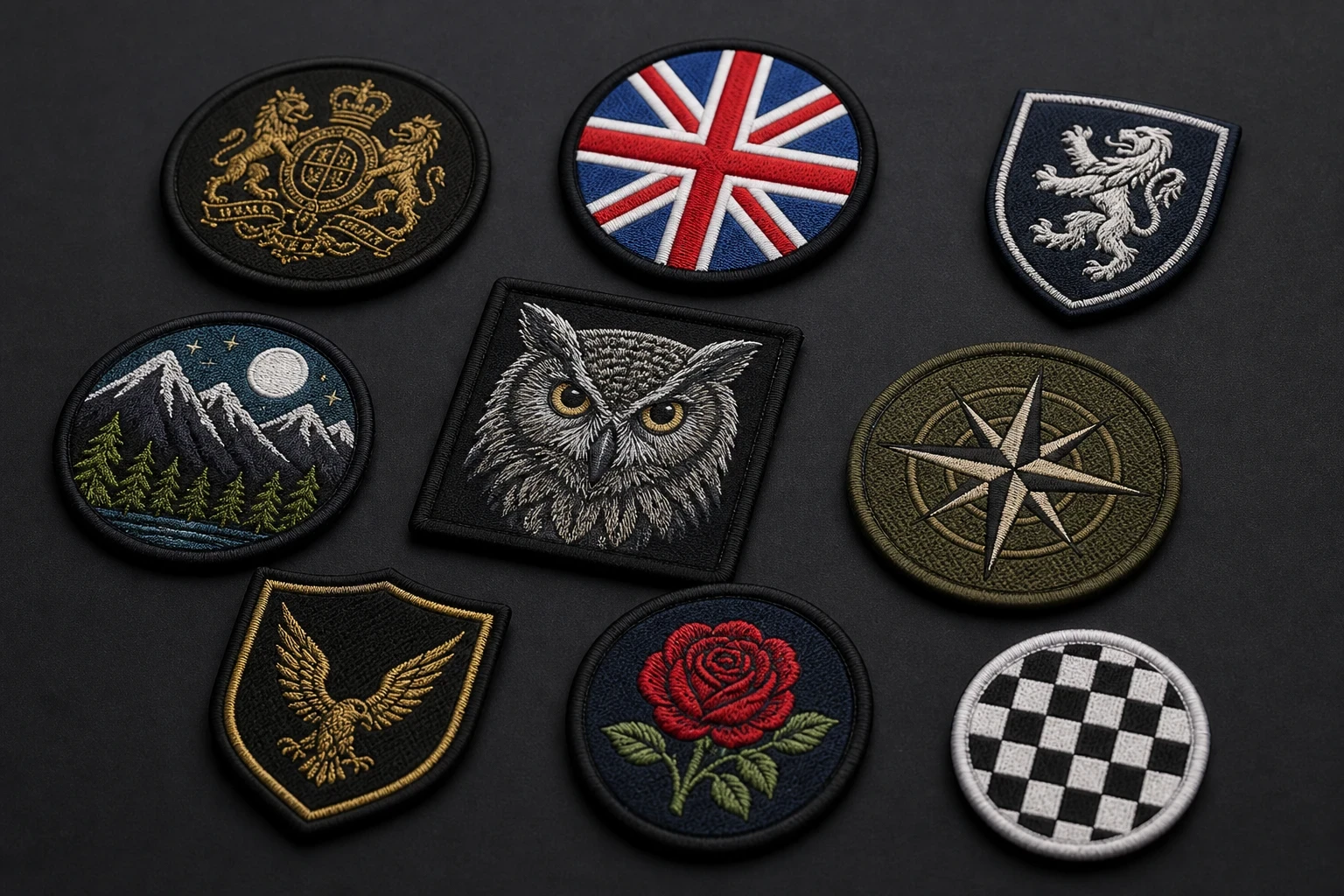
Fine-detail woven patches UK use tightly woven thread rather than raised embroidery, giving small lettering, outlines and shaded artwork a flatter, cleaner finish. They suit team badges, branded clothing, uniforms and labels where detail matters. The Customized Patches offers a free digital mockup usually within 12 hours, with a 5-piece minimum per design.
Key takeaways
- Fine-detail woven patches use a dense, flat thread structure that usually handles small lettering and narrow lines more clearly than raised embroidery.
- A woven patch is not automatically the best choice: printed patches remain flatter for gradients and photographic artwork, while embroidered patches give more texture and height.
- The Customized Patches has a 5-piece minimum per design and normally supplies a free digital mockup within 12 hours.
- Production starts only after you approve the mockup, including the size, colours, border, backing and attachment method.
Fine-detail woven patches UK are made for logos where small lettering, narrow outlines and several colour changes need to stay readable on a relatively flat patch. The dense woven construction gives a cleaner surface than raised embroidery, while still providing the stitched appearance people expect from a fabric badge. They are commonly used on football kits, club jackets, hospitality polos, school blazers, workwear and branded merchandise.
The right choice depends on the artwork, garment and attachment method rather than the word ‘woven’ alone. The Customized Patches can prepare a free digital mockup usually within 12 hours. There is a 5-piece minimum per design, and patches are produced only after you approve the mockup and specification.
What fine-detail woven patches are
A woven patch is formed from tightly packed horizontal and vertical threads. Instead of building the design from thick raised stitches, the manufacturer places fine threads closely together to create the background, lettering, borders and image. The surface is generally flatter and more even than a standard embroidered patch, which helps when a logo contains compact detail.
That does not mean every tiny mark can be reproduced at any size. A patch that looks detailed on a laptop may have lettering too small to read at 2 inches wide. Our team checks the finished dimensions, not just the source file. It is common to see detailed crests supplied for small shirt sleeves where the club name would have turned into a coloured line. Increasing the patch size or simplifying the lettering usually gives a better result.
Why the surface looks different from embroidery
Embroidery has a visible stitch direction and a raised, tactile finish. Woven construction is flatter, with the design reading more like a tightly made textile label. For a modern clothing brand, a small woven neck label or chest badge can look neat and controlled. For a school blazer crest or a traditional club emblem, the extra texture of embroidered patches may be part of the appeal.
Neither finish is universally superior. Printed is flatter; that is the point. It can be the sensible route for gradients, very fine continuous shading or a photographic image. Woven is often the middle ground for crisp thread-based detail without the bulk of heavy embroidery. Our The Difference Between woven patches and embroidered patches, Explained guide gives a side-by-side explanation.
When fine-detail woven patches are the sensible choice
The strongest use case is a design with small but important features: a company name around a logo, a football club motto, a unit number, a thin map outline or a badge containing several flat colour areas. Woven threads can create a tidy edge between those areas without the heavy fill associated with a densely embroidered patch.
- Football and rugby club badges where small sponsor or division text must remain legible.
- Cadet units and outdoor groups needing a compact insignia for jackets, shirts or Velcro panels.
- Hospitality polos and workwear where a neat, low-profile brand badge is more comfortable than a heavily raised design.
- Biker and motorcycle club clothing where a detailed back or chest emblem may need a combination of woven detail and a strong border.
- School blazers and sports jackets where a clean crest is required, provided the backing suits the fabric and washing routine.
- Small business merchandise, caps, tote bags and packaging where the patch also works as a branded label.
There are sensible limits. A very soft gradient, a full photographic scene or a design that relies on painted-looking shadows may be better as a printed patch. A large varsity letter with a deep, fuzzy texture may call for chenille patches. If the patch will be removed and swapped between garments, a hook-and-loop backing is usually more useful than adhesive or iron-on.
Examples from real garments
A nylon shell needs a different conversation from a wool coaches jacket. Nylon can be marked by excessive heat, so an iron-on backing should not be treated as a universal solution. A wool coaches jacket often benefits from sew-on attachment, particularly if the patch is large or will be handled regularly. A Velcro panel is practical for tactical kit, club equipment or removable name tabs, but the loop panel must already be available on the garment.
For school blazers, check the inside construction before choosing an attachment method. For hospitality polos, consider how often the item will be washed. An iron-on patch that looks secure on day one can peel after a dryer cycle if the temperature, pressure or fabric is unsuitable. Sew-on is slower, but it is often the safer long-term option for a frequently washed uniform.
Choosing the specification: size, border, colour and backing
Most patch problems begin with an incomplete specification. ‘Make it like the logo’ does not tell a manufacturer whether the finished patch should be 2, 3 or 4 inches wide, whether the edge should be merrowed, or whether the garment needs sew-on, iron-on or Velcro. A short written brief prevents avoidable changes later.
| Specification | What to decide | Practical effect |
|---|---|---|
| Finished size | Width and height in inches, or the largest allowed dimension | Controls readability, placement and the amount of detail that can be retained |
| Shape | Circle, shield, rectangle, custom outline or another profile | A custom outline can follow the artwork, while a regular shape may be easier to position |
| Border | Woven edge, stitched edge or merrowed edge where suitable | Separates the design from the garment and protects the perimeter |
| Colour | Thread colour references and the number of colours required | Affects contrast and how clearly small marks are separated |
| Backing | Sew-on, iron-on, hook-and-loop, adhesive or a combination | Determines how the patch is attached and how well it suits washing and fabric type |
| Quantity | At least 5 pieces per design | Allows a small run while keeping the same approved artwork across the batch |
Size is particularly important for fine lettering. As a working rule, ask to see the actual proposed patch dimensions rather than judging only a large screen preview. The mockup should show the design at its intended size, with any recommended changes noted. Our guide to Woven patches Sizing and Backing Options Explained covers the measurements and attachment choices in more detail.
Border style also changes the character of the finished piece. A merrowed crest has a rounded, cord-like edge that suits many traditional badges. A clean stitched edge can suit a modern logo or a shaped design. The correct option depends on the outline, dimensions and fabric. It is worth confirming this before approval rather than assuming every patch edge is made in the same way.
Colour matching needs a practical approach. Screens, thread and printed colour references do not behave identically. If a brand colour is critical, send the colour reference and explain which elements must remain distinct. A dark navy logo on a black jacket may be technically accurate but visually weak. Contrast on the actual garment matters more than a perfect screen preview.
Not sure whether thread or ink will hold your logo? Get a free digital mockup usually within 12 hours and compare the proposed woven finish with another suitable option before you produce. The Customized Patches accepts 5 pieces per design, and production starts only after approval.
Artwork preparation for small woven details
Send vector artwork if you have it, but do not worry if the original file is a high-quality raster image. A clear PNG, PDF, SVG or AI file can give the production team a useful starting point. The artwork still needs to be checked at the requested finished size. A vector file keeps edges sharp; it does not make a 1 mm letter readable.
If you are still choosing type, size, or backing, send the artwork and the garment. Free digital mockup in 12 hours — 5-piece minimum per design. We do not produce until you approve.
GET A FREE MOCKUPWhat usually needs simplifying
- Very small text, especially curved text around a badge.
- Hairline outlines that are thinner than the woven construction can reproduce clearly.
- Tiny gaps between letters or symbols that may close when the design is reduced.
- Subtle shadows that are too close in colour to the main fill.
- Complex photographic detail that would be clearer as print.
- Fine distress marks and texture intended to look random at a much larger scale.
Simplification is not the same as losing the identity of the logo. Often the answer is to enlarge the wording, make two colours more distinct or remove a shadow that contributes little at patch size. Keep the most recognisable shapes. A football crest can usually lose a few decorative lines while retaining the club initials, shield and main symbol.
The How to Design Artwork for woven patches That Production-Ready guide is useful before sending a quotation request. It is also sensible to include a photograph of the garment or panel. A badge intended for a black nylon shell should be judged against that shell, not a white artboard.
Woven, embroidered, printed and PVC: a practical comparison
The material choice should follow the job. A brand may use woven patches for a detailed chest logo, embroidered patches for a traditional club crest and PVC for outdoor equipment. Using different constructions across a product range is not a problem if the colour, size and placement have been considered together.
| Patch type | Best suited to | Main advantage | Trade-off |
|---|---|---|---|
| Fine-detail woven | Small text, clean outlines, compact logos and flat colour areas | Clear detail with a relatively flat textile surface | Less raised texture than embroidery; very fine or photographic detail still has limits |
| Embroidered | Traditional crests, bold lettering, uniforms and tactile badges | Raised thread texture and familiar stitched appearance | Small text can fill in, and dense areas can become heavier |
| Printed | Gradients, photographs, continuous shading and very flat labels | Fine visual detail without relying on stitch separation | Can look less tactile and may not give the same thread-based badge finish |
| PVC | Outdoor kit, equipment, bold marks and designs needing a moulded surface | Water-resistant style and strong solid shapes | Not the natural choice for soft textile detail or a classic woven appearance |
| Leather | Premium-style labels, bags, caps and heritage clothing | Distinct material character and clean debossed or printed branding | Fine colour detail and wash requirements need careful consideration |
For a detailed brand mark on a polo, woven is often a good starting point. For a large biker back patch with bold lettering, embroidery may provide the visual weight expected by the wearer. For waterproof kit, review PVC patches as well as the garment's care requirements. For a leather bag or heritage jacket, leather patches may be a better material conversation altogether.
Backing choices for UK garments and equipment
Sew-on backing is the dependable choice for many jackets, blazers, heavy cotton garments and items that will be washed often. It allows the patch to follow the fabric and can be repaired or replaced by a competent seamstress or tailor. The downside is the extra time and the need for access to the garment.
Iron-on backing is convenient for suitable cotton or cotton-blend garments, especially when a batch needs to be applied quickly. It is not a guarantee of permanent attachment. Heat, pressure, fabric finish and washing all matter. Nylon shells, coated fabrics and some performance garments may not tolerate the application temperature, so sewing can be safer.
- Choose sew-on for long-term uniforms, wool coaches jackets, school blazers and heavy outerwear where durability is the priority.
- Choose iron-on only when the fabric and care instructions support heat application, and reinforce it with stitching if the garment will be worked hard.
- Choose hook-and-loop for removable identifiers, tactical equipment and garments already fitted with a loop panel.
- Ask about adhesive options for short-term promotional use, but do not treat them as equivalent to sewn attachment.
- Confirm the backing on the quote and mockup so the production team does not make an assumption.
A backing decision can change the whole order. A detailed patch for a cadet unit may need to be removed before laundering, making Velcro useful. The same artwork for a hospitality polo may need to stay attached through repeated washing, making sew-on or a suitable iron-on-and-stitch approach more appropriate. State the garment and care routine when requesting a quote.
Ordering quantities, pricing and UK lead times
The Customized Patches has a minimum order of 5 pieces per design. If you need three different logos, that means 5 of each approved design rather than 5 pieces spread across all three. Tell us the quantity, finished size, backing and delivery postcode at the start so the quotation reflects the actual job.
Pricing is affected by size, construction, number of colours, edge treatment, backing, artwork preparation and quantity. A 2-inch woven chest badge and a 10-inch back emblem may use the same logo but require very different production planning. A low quantity can also have a different unit cost from a larger run because setup and preparation are spread across fewer pieces.
For UK orders, include the date the patches are needed, not just the date you hope to place the order. Allow time for artwork questions, mockup review, approval, production and delivery across the United Kingdom. A clear brief generally moves faster than a rushed message followed by several changes.
- Send the logo, requested quantity and preferred finished dimensions in inches.
- Name the garment: nylon shell, wool jacket, polo, blazer, cap, bag or Velcro panel.
- Choose a starting construction, or ask for a comparison if you are unsure.
- Confirm the border, colours and backing.
- Review the free digital mockup, usually supplied within 12 hours.
- Check every word, number, colour, size and attachment detail.
- Approve the final mockup. Production begins only after approval.
- Arrange delivery and apply the patches according to the selected backing and garment care instructions.
If your order has a fixed event date, say so before approval. A club may need badges before a tournament, a hospitality company may have a launch date, or a school may be preparing a new blazer order. We can then discuss the specification and available timing honestly rather than promising a date without the required information.
Name sew-on, iron-on or Velcro on the quote. We show the correct back on a free digital mockup usually within 12 hours, so production matches the garment. Send the artwork and delivery details for a UK quotation; the minimum is 5 pieces per design.
Quality checks before you approve
Approval is the point where the design becomes a production instruction. Read the wording at the proposed size, not just at full screen width. Check club initials, postcode areas, squad numbers, company names and dates one character at a time. A typo caught before production is easy to correct; a typo found on a delivered batch is not.
Ready to spec the run? Open the quote form for a free 12-hour mockup and UK-wide shipping after approval.
GET A FREE MOCKUP- Is the finished width and height correct in inches?
- Can the smallest text be read at the actual size?
- Are the background and lettering colours sufficiently different on the garment?
- Does the border follow the intended shape?
- Is the backing suitable for nylon, wool, cotton, polyester or the chosen panel?
- Does the mockup show the correct number of colours and any requested brand references?
- Has the quantity been stated as at least 5 pieces for each design?
- Have you approved the final version in writing?
Keep the approved mockup with your order records. It is useful when you reorder six months later, particularly if the patch is part of a uniform programme. If a club changes its kit supplier or a business updates its logo, the previous specification gives the production team a clear comparison without relying on memory.
Common failures and how to avoid them
The most common failure is asking a small patch to carry a large amount of information. A circular logo with eight words, a date, a thin outline and a detailed central image may work on a poster but not at 2 inches. Remove secondary wording or increase the finished size before production.
The next is choosing attachment by convenience alone. Iron-on that peels after a dryer cycle is a familiar example. The adhesive may have been applied to a fabric that could not accept the heat, or the garment may have been washed in a way that weakened the bond. For workwear and school clothing, ask how the item will be worn and cleaned.
- Ordering from a low-resolution screenshot and expecting the missing detail to be recreated exactly.
- Approving a mockup without checking the words and numbers.
- Choosing black thread on a dark navy jacket because it looks correct on a white screen.
- Using a rigid backing on a flexible shirt where the patch needs to move with the fabric.
- Assuming a Velcro backing will work without a loop panel on the garment.
- Mixing different patch sizes across a uniform set without checking how they sit together.
- Requesting production before the final artwork and backing have been approved.
A short production conversation usually prevents these issues. Our 10 Questions to Ask Before Ordering woven patches checklist can be sent to a committee, kit manager or purchasing team so everyone approves the same information.
Where to go next with fine-detail woven patches UK
If the design is detailed but compact, start by requesting a woven mockup at the actual proposed size. Compare it against the garment, especially if the garment is black, textured, waterproof or stretchy. If the mockup shows that the smallest text is too tight, consider a larger patch, simpler wording or a printed construction rather than forcing the artwork into an unsuitable format.
For teams comparing several constructions, the embroidered patches hub is a useful starting point. You can also review 3D embroidered patches for raised lettering, biker and motorcycle club patches for larger club designs, or UK city pages if you want to see options for local delivery and regional ordering.
The process is straightforward: send the artwork, garment details and quantity; receive the free digital mockup usually within 12 hours; check every production detail; then approve. The Customized Patches produces only after approval, with a 5-piece minimum per design and UK-wide shipping arrangements discussed as part of the quotation.
Further reading for a more confident order
Frequently asked questions
What are fine-detail woven patches UK used for?
Fine-detail woven patches UK are used for logos, badges and labels containing small lettering, narrow outlines or several flat colour areas. Common applications include football clubs, cadet units, hospitality polos, workwear, school blazers, caps, bags and branded merchandise.
Are woven patches better than embroidered patches for small text?
Woven patches can reproduce small text more cleanly because the surface is made from closely packed fine threads rather than thick raised stitches. The result still depends on the finished size, font and contrast. Very small wording may need enlarging or simplifying, even on a woven patch.
What is the minimum order for fine-detail woven patches?
The Customized Patches has a minimum of 5 pieces per design. If you order three different designs, the minimum is normally 5 pieces of each design. Confirm the quantity on the quotation so different logos are not treated as one design.
How quickly can I see a woven patch mockup in the UK?
The Customized Patches usually supplies a free digital mockup within 12 hours of receiving suitable artwork and the key specification. The mockup should be checked for size, spelling, colours, border and backing. Production starts only after you approve it.
Is iron-on backing suitable for nylon jackets and school blazers?
Not automatically. Nylon shells may be damaged or marked by heat, while blazer fabric and lining can affect how well a patch bonds. Sew-on is often the safer choice for regular washing or heavier garments. The garment type and care instructions should be stated before the backing is selected.
Can fine-detail woven patches include gradients or photographs?
They can include some colour transitions, but a continuous gradient or photograph may be clearer as a printed patch. Woven construction works best when the design can be separated into defined thread colours and readable shapes. A mockup can show whether the artwork needs simplifying or a different construction.
Ready to produce custom patches for your UK team or brand?
GET A FREE MOCKUP