
The Difference Between woven patches and embroidered patches, Explained
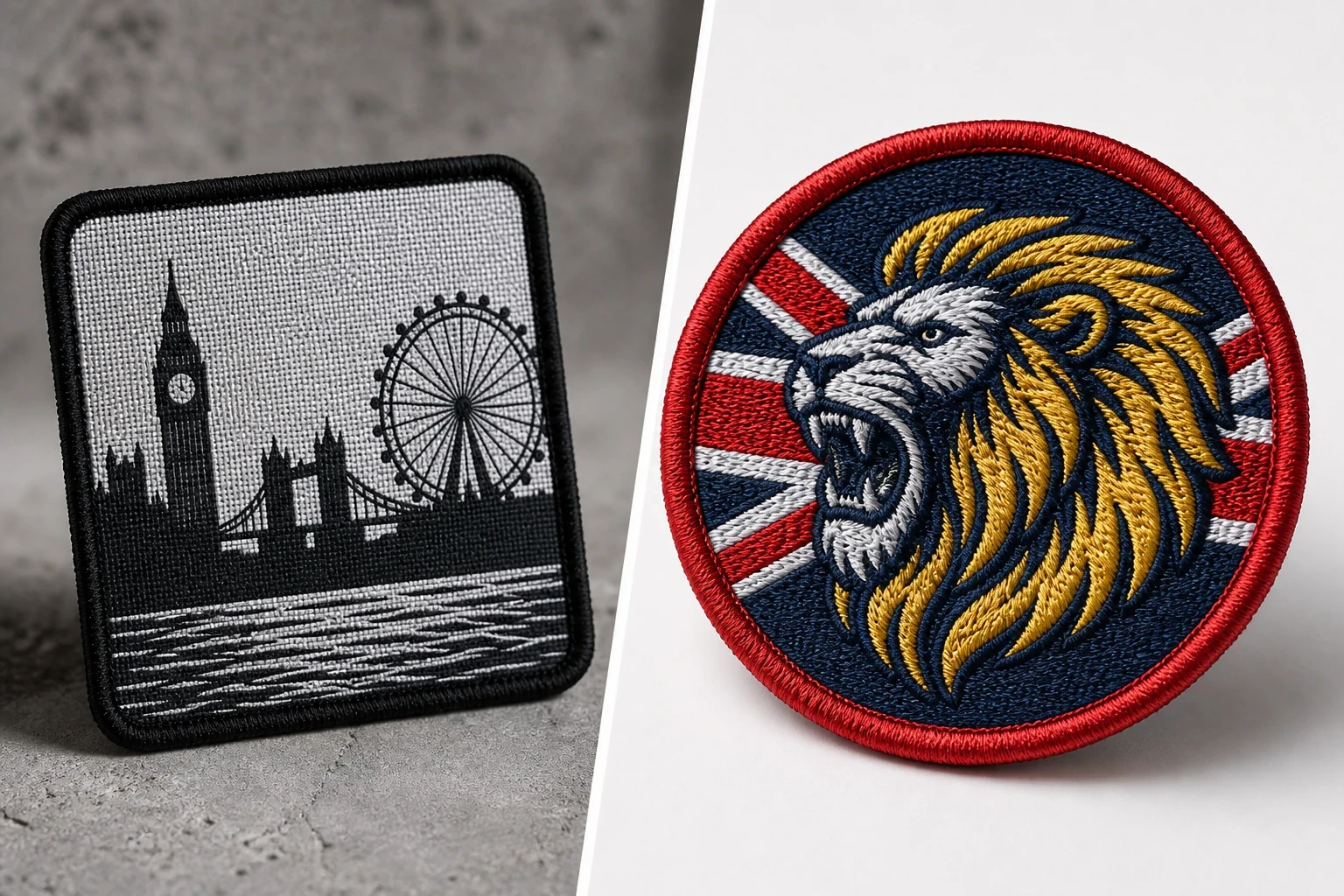
Woven patches use tightly woven threads to create a smooth, detailed surface, while embroidered patches use raised stitching for texture and a traditional badge appearance. Woven patches suit small lettering and fine logos; embroidered patches suit bold crests, workwear, sports kit and designs where visible thread texture is part of the look.
Key takeaways
- Woven patches have a flatter, smoother face and usually reproduce small lettering or fine logo detail more clearly.
- Embroidered patches have raised thread coverage, visible stitch texture and the familiar traditional crest or badge finish.
- The best choice depends on the artwork, garment, backing, washing conditions and the visual impression you want at arm's length.
- The Customized Patches accepts a 5-piece minimum per design, provides a free digital mockup usually within 12 hours and produces only after approval.
The main difference is the way the face of the patch is made. Woven patches use tightly woven threads to create a smooth surface with fine detail, while embroidered patches use stitched thread coverage that gives the badge a raised, textured finish. Woven patches are usually the better fit for small lettering and detailed logos; embroidered patches are often the better fit for bold crests, sports kit and a traditional badge look.
That is the short answer, but the choice becomes clearer once you place both types on a real garment. A football club crest on a tracksuit, a company logo on a hospitality polo, a cadet unit badge on a jacket and a biker back patch all put different demands on the patch. The Customized Patches supplies both options across the United Kingdom, with a 5-piece minimum per design, a free digital mockup usually within 12 hours and production only after you approve the artwork.
What is the difference between woven patches and embroidered patches?
A woven patch is made by weaving fine threads across the face of the badge. The threads sit close together, so the finished surface is comparatively flat and even. This makes it useful for detailed marks, thin lettering, small symbols and logos that would lose definition if every element had to be built from thick embroidered stitches.
An embroidered patch is made by stitching thread into a backing fabric. The thread coverage creates height and direction, particularly in satin borders, filled lettering and large areas of colour. That raised surface is the reason embroidered badges still work so well on football shirts, school blazers, work jackets and club clothing: the texture is part of the identity, not a production fault.
| Feature | Woven patches | Embroidered patches |
|---|---|---|
| Surface | Smooth, compact and relatively flat | Raised, textured and visibly stitched |
| Fine detail | Usually stronger for small lettering, thin lines and detailed logos | Best for simpler artwork with bolder shapes and wider lettering |
| Visual character | Clean, neat and closer to a printed label or woven badge | Traditional, tactile and recognisable as a classic cloth badge |
| Best garment examples | Caps, technical jackets, detailed brand uniforms, bags and modern outerwear | Football kit, school blazers, wool coaches, denim, workwear and club jackets |
| Texture | Low profile, with little raised thread | Noticeable thread relief and stitched direction |
| Small lettering | Often easier to read at a modest patch size | May need larger lettering or a simpler typeface |
| Typical decision | Choose when detail and a flatter face matter most | Choose when texture, tradition and a strong crest effect matter most |
Neither construction is automatically better. Printed patches are flatter still; that is the point when a photographic image, gradient or very smooth artwork needs to remain faithful. PVC patches bring a rubberised, weather-resistant character, while 3D embroidered patches deliberately add raised foam to selected areas. The right comparison is not simply woven versus embroidered; it is which surface makes sense on the garment and for the job.
How construction changes the look of your logo
Why woven patches suit detailed artwork
The close weave gives a designer more room to keep small features visible. Fine outlines, compact wording and several colour changes can sit neatly beside one another without the heavy stitch coverage that can make a small embroidered badge look crowded. This is why brands with a detailed wordmark often ask us to compare woven and embroidered samples before placing a larger run.
A woven face is also useful where the patch should look tidy rather than heavily textured. Think of a detailed logo on a nylon shell, a small badge on a cap or a branded emblem on a technical rucksack. The surface will not look exactly like ink, but it gives a clean fabric finish without pretending to be a flat print. Our guide to woven patches covers the construction and common uses in more detail.
Why embroidered patches suit bold crests
Embroidered thread gives a crest presence. A thick merrowed edge, raised lettering and visible stitch direction can make a simple shield feel substantial on a jacket or blazer. It is especially effective when the design uses large initials, a mascot, a broad border or a limited number of strong colours.
There is a practical limit to how much detail can be packed into embroidery at a small size. Tiny words may close up, narrow gaps can disappear and a thin line may become a thicker stitch than expected. That is not a reason to avoid embroidery. It is a reason to size the patch properly and simplify artwork before production. The embroidered patches hub shows the wider range of embroidered finishes available.
Choose the patch type by artwork, garment and use
Start with the logo at the size it will actually be worn. A design that looks clear on a laptop screen may become unreadable at 2 inches wide. This is common with school crests, hospitality logos and club badges: the customer is not short of colour, but the lettering and spaces need more room.
- Choose woven patches when the design contains small lettering, fine outlines, compact symbols or several close colour changes.
- Choose embroidered patches when the design is a bold crest, large initial, mascot, club emblem or traditional badge with visible thread texture.
- Choose printed patches when a flat image, smooth gradient or photographic detail matters more than stitched texture. Printed patches are not a failed embroidery job; printed is flatter, and that is the point.
- Consider PVC for a rubberised finish on outdoor, workwear or technical applications. See PVC patches if you want a hard-wearing moulded appearance.
- Consider chenille for large varsity lettering and a soft, high-pile surface rather than fine logo detail. Chenille patches are commonly associated with school, college and sports lettering.
- Consider leather when the design calls for a restrained, premium material statement and the artwork works with a simpler debossed, embossed or stitched treatment.
The garment changes the answer too. A woven badge can sit neatly on a lightweight nylon shell or cap, while an embroidered crest has more visual weight on a wool coaches jacket, denim overshirt or school blazer. For a football club, embroidered lettering may feel right on a match jacket; for a detailed sponsor logo on staff outerwear, woven may keep the mark clearer.
Not sure whether the thread surface or a flatter woven face will hold your logo best? Send the artwork and garment details for a free digital mockup usually within 12 hours, then compare the two directions before you produce.
GET A FREE MOCKUPThink about the wearer and the setting. A removable Velcro morale patch for a club or event team has a different brief from a permanently sewn badge on a biker vest. A hospitality business may want a small, legible logo on polo shirts, whereas a motorcycle club may deliberately want a large, textured back piece. Our guide to biker and motorcycle club patches covers larger club layouts and attachment choices.
Backing, borders and garment fit matter as much as the face
A good face can still disappoint if the backing is wrong. Sew-on remains the dependable choice for wool coaches jackets, denim, heavy workwear and garments that will see repeated washing. Iron-on can be convenient on suitable cotton and polyester fabrics, but an iron-on patch that looks secure on day one can peel after a dryer cycle if the temperature, pressure, fabric or adhesive is unsuitable.
Nylon shells need particular care because heat can mark or distort the fabric. We often suggest sewing for lightweight technical jackets, or using Velcro where the wearer needs to remove the patch. Velcro is also practical for teams with interchangeable names, roles or event identifiers, but the hook-and-loop panel adds thickness and should be included in the size check.
- Sew-on: the most secure general option for jackets, blazers, denim, wool and long-term club clothing.
- Iron-on: convenient for suitable fabrics when the application instructions can be followed and the garment is not exposed to unsuitable heat.
- Velcro: useful for removable patches on team kit, tactical clothing, workwear and event uniforms.
- Merrowed edge: a raised, rolled border that gives many traditional embroidered crests a finished outline.
- Laser-cut or clean edge: useful where a compact shape or a modern outline is more suitable than a rolled border.
The border also affects the apparent size. A merrowed edge takes up part of the overall width, so a 3-inch outer measurement does not leave 3 inches for the internal logo. Tell us the finished size you need, whether the measurement includes the border and where the patch will be attached. That helps prevent a crest arriving too large for a chest panel or too small for a jacket back.
Ordering woven patches or embroidered patches in the UK
A useful quote includes more than a logo file. Send the finished width and height, quantity, preferred construction, backing, border, garment type, delivery postcode and the date you need the patches. If you are unsure, say so. A production desk can compare the options rather than forcing a decision from a product name alone.
The Customized Patches has a 5-piece minimum per design. That means you can order a small test batch for a club, new clothing range or staff uniform without committing to a large run, but each separate artwork still needs to meet the minimum. Changing a sponsor name, club year or colour arrangement may make it a separate design, so mention those variations on the quote.
- Send clear artwork, ideally as a vector file, or send the highest-resolution version available if the original design is not in vector format.
- State the intended patch size in inches and explain where it will be fitted, such as left chest, sleeve, cap, back panel, school blazer or Velcro panel.
- Choose woven, embroidered or another construction based on detail, texture and garment rather than choosing from price alone.
- Specify sew-on, iron-on or Velcro backing, plus any border preference and whether the patch needs to be removable.
- Review the free digital mockup, request changes if the lettering, proportions or backing are not right, and approve the final version.
- Production starts only after approval. Allow time for manufacture and UK-wide shipping rather than treating the mockup as the finished patch.
The free digital mockup usually arrives within 12 hours, although artwork complexity, weekends and missing specifications can affect the response time. It is a visual confirmation, not a photograph of the final thread. Colours and fine details can appear slightly different on a screen, which is why the mockup should be checked for size, wording, proportions, border and backing before approval.
For a step-by-step ordering checklist, read A Step-by-Step Guide to Ordering woven patches. If you are still preparing the logo, How to Design Artwork for woven patches That Production-Ready covers line weight, lettering and file preparation. Both are useful before asking for a final quote.
Cost, minimum quantities and value
There is no honest single price for woven or embroidered patches without the design specification. Size, quantity, number of colours, border, backing, artwork complexity and delivery all affect the quote. A small five-piece set with a simple shape is a different job from a large embroidered back patch with several borders and Velcro.
Woven patches can offer good value when they prevent a detailed logo being simplified or enlarged. Embroidery can offer better value when the design is bold and the stitched texture is doing useful visual work. Choosing a cheaper-looking construction and then correcting unreadable lettering, unsuitable backing or the wrong finished size can cost more than comparing the options at the start.
| Quote detail to confirm | Why it affects the result |
|---|---|
| Finished size in inches | Determines readability, garment fit, thread density and overall visual weight. |
| Quantity per design | The Customized Patches works to a 5-piece minimum per design; larger quantities may change the unit price. |
| Artwork detail | Small text, thin lines, gradients and fine borders may change the recommended construction. |
| Backing | Sew-on, iron-on and Velcro suit different garments and levels of removability. |
| Border | A merrowed or clean edge changes the look and the usable internal area. |
| Delivery requirement | UK-wide shipping and the required date need to be considered alongside production time. |
Common mistakes
The most common mistake is judging the artwork only on a large monitor. Customers approve a tiny line of text because it looks fine at full size, then discover that it is too small on a 2-inch badge. A second common issue is putting a detailed logo on an embroidered patch without allowing enough space for the stitches.
Name sew-on, iron-on or Velcro on the quote and tell us what garment will carry the badge. We will show the proposed backing on a free digital mockup usually within 12 hours, with production beginning only after you approve it.
GET A FREE MOCKUP- Ordering the patch before measuring the actual chest, sleeve, cap or Velcro panel.
- Assuming an iron-on backing will suit a nylon shell, waterproof fabric or a garment that goes through a hot dryer.
- Using a very thin typeface for embroidery when the lettering needs to be read at arm's length.
- Treating a woven patch as a printed patch and expecting smooth photographic gradients without any woven texture.
- Forgetting that a large merrowed border reduces the room available for internal lettering.
- Submitting several colour or wording versions without explaining whether they are separate designs.
- Approving a mockup without checking the spelling, size, backing, border and placement.
A practical test is to print the proposed patch at its finished size and hold it against the garment. It will not reproduce the thread, but it will reveal whether the badge feels too large, whether the wording is crowded and whether the position works beside a pocket, zip or seam. For more detail on avoiding errors, see Common Mistakes to Avoid When Ordering woven patches.
Which should you choose?
Choose woven patches when the priority is a clean, relatively flat face and the artwork contains small lettering or fine detail. They are a sensible option for detailed brand marks, modern labels, technical jackets, caps and compact uniform badges. They still have a fabric surface, so expect a woven appearance rather than the perfectly smooth finish of ink.
Choose embroidered patches when the priority is raised texture, a traditional crest and a strong tactile impression. They work naturally on football club clothing, school blazers, denim, wool coaches jackets, workwear and motorcycle club garments. Give the design enough size and simplify small details where necessary.
If neither option quite fits, ask for a comparison rather than guessing. A printed patch may be more appropriate for a flat image, a chenille patch may suit varsity lettering and a PVC patch may suit a moulded outdoor badge. The useful decision is the one that still looks right after it has been sewn, worn, washed and seen at normal distance.
Further UK guides and product options
If you are buying for a UK club, brand or business, the surrounding details are worth checking before you place the order. Read 10 Questions to Ask Before Ordering woven patches for a quote checklist, or compare the wider material choices through woven patches: Everything UK Buyers Need to Know.
For alternative finishes, browse leather patches for a material-led badge, printed patches for a flatter image-based result and chenille patches for large, soft varsity lettering. The Customized Patches also supports UK-wide orders and can advise on garment fit, backing and artwork before production.
Frequently asked questions
Are woven patches better than embroidered patches?
Neither is better for every order. Woven patches are usually better for small lettering, fine lines and detailed logos because their face is smooth and compact. Embroidered patches are usually better for bold crests, sports badges and designs where raised thread texture is part of the appearance. The garment and finished size should decide the choice.
Do woven patches have a raised texture?
Woven patches have some fabric texture, but their face is generally flatter and smoother than an embroidered patch. The threads are woven closely together rather than built up through heavy stitch coverage. They are not the same as a perfectly flat printed label, so a woven design will still have a textile appearance.
Are woven patches suitable for small text?
Woven patches are often the better starting point for small text, but there is still a physical limit. The finished size, letter height, typeface and contrast all matter. Send the wording and intended width for a mockup rather than assuming every small slogan will remain readable.
What backing should I use for a nylon jacket?
Sew-on or removable Velcro is often safer for a nylon shell than relying on heat. Nylon can mark, distort or react poorly to an iron, depending on the fabric and coating. Tell the manufacturer the garment material and whether the patch needs to be permanent before choosing the backing.
What is the minimum order for patches from The Customized Patches?
The minimum is 5 pieces per design. A different wording, logo arrangement or colour version may count as a separate design, so list each variation clearly when requesting a quote. This minimum applies whether you choose woven patches or embroidered patches.
How quickly can I see a woven or embroidered patch mockup?
The Customized Patches provides a free digital mockup usually within 12 hours. The mockup is sent for checking and production starts only after approval. Response time can vary if the artwork, finished size, backing or garment information is missing, so include those details with the quote.
Ready to produce custom patches for your UK team or brand?
GET A FREE MOCKUP