
How to Choose the Right PVC patches for Your Brand
Choose PVC patches by matching the design, garment and working conditions to the patch specification. Decide the size, shape, number of raised layers, colour detail, edge style and backing before ordering. The Customized Patches supplies a free digital mockup, usually within 12 hours, and has a 5-piece minimum per design.
Key takeaways
- PVC patches work best for bold logos, short wording, simple shapes and designs that benefit from a raised moulded finish.
- Choose the backing from the garment and use: sew-on is dependable, iron-on is convenient, and Velcro suits removable badges.
- A larger patch gives lettering and small shapes more room, but an oversized badge can look heavy on a polo or blazer.
- The Customized Patches has a 5-piece minimum per design, provides a free digital mockup usually within 12 hours, and produces only after approval.
The right PVC patches start with the job they need to do. For a bold club crest, workwear mark or removable equipment badge, choose the size, raised detail, edge, backing and colour count around the garment and the artwork—not just the logo on a screen. The best specification is the one that remains clear and practical after it is fitted.
The Customized Patches supplies PVC patches across the United Kingdom for teams, brands, clubs and businesses. We provide a free digital mockup usually within 12 hours, and production begins only after approval. There is a 5-piece minimum per design, so a small test run is possible without committing to a large batch.
What makes PVC patches different?
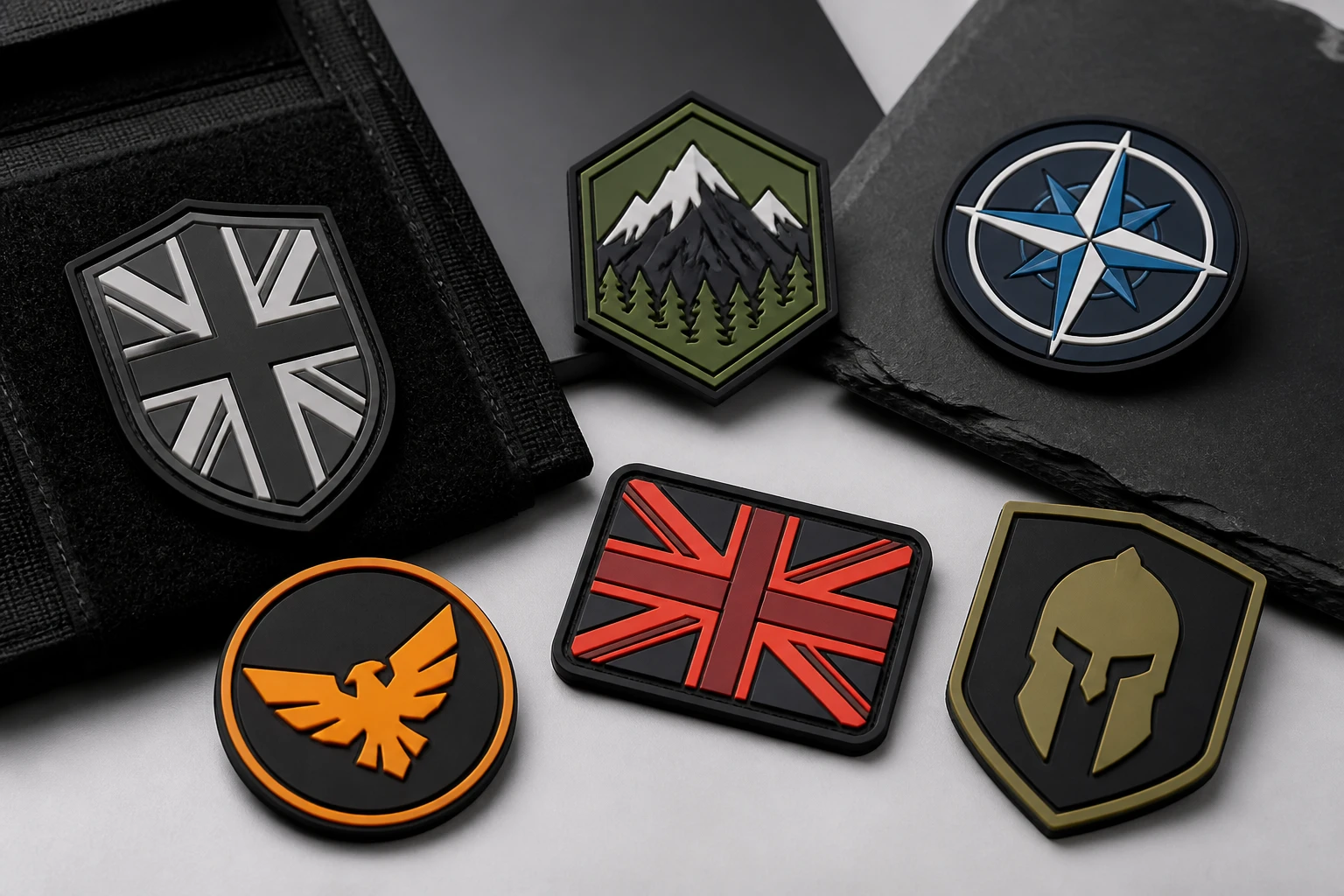
PVC patches are moulded badges made from flexible polyvinyl chloride. Instead of stitching thread into a fabric base or printing ink onto a flat surface, the design is formed in coloured PVC. That creates a smooth face, defined borders and, if requested, raised sections that you can feel with a fingertip.
This construction is useful for a football club training top, a nylon shell, a work jacket or a Velcro panel on equipment. Dirt can usually be wiped from the surface more easily than from a heavily textured thread design. PVC also gives a consistent graphic look across a batch, provided the artwork uses shapes and colours that suit the moulded process.
It is not the right answer for every identity. A detailed heritage crest with tiny lettering may need embroidered patches or woven patches, while a photograph or smooth tonal illustration may be better as printed patches. Printed is flatter; that is the point. It preserves detail that a raised PVC design may need to simplify.
Start with the brand mark, not the material
Look at the logo at the size it will actually be worn. A mark that looks clean at 10 inches on a presentation slide may become crowded at 2.5 inches on a chest. Count the lettering, narrow gaps, outlines and small symbols. PVC patches are strongest visually when the main forms are decisive and the colour areas are easy to separate.
Use raised layers with purpose
A single-level PVC patch is often the clearest option for a straightforward wordmark or club badge. Two or more levels can separate a foreground icon from a background, give a border more presence or make a short message stand out. Extra height adds visual structure, but it cannot rescue lettering that is too small or a design with too many tiny islands.
- Use a raised border to make a crest read clearly against a dark jacket.
- Use a raised icon when the brand symbol matters more than a long slogan.
- Keep very small text out of the design unless the finished size leaves enough room for it.
- Ask for a mockup at the proposed finished dimensions rather than approving a large artwork preview.
- Check that the colour contrast works on the actual garment, not only on a white artboard.
A school blazer badge often needs a restrained, traditional appearance, so a flatter embroidered treatment may be more suitable. A biker and motorcycle club badge, by contrast, can benefit from a bold moulded border and compact lettering; compare the construction with biker and motorcycle club patches before deciding.
Choose the right PVC patch size and shape
Size affects legibility, comfort and price. Measure the available placement in inches, including the space needed around a pocket, zip, seam or badge panel. A chest mark commonly needs a different proportion from a large back emblem, and a sleeve patch must not interfere with a cuff or elbow.
Do not select a size from the logo file alone. Place a paper rectangle on the garment and look at it from normal standing distance. This simple check catches many ordering mistakes: a badge that dominates a hospitality polo, a crest that touches the seam on a jacket, or lettering that is too small to read on a cap.
| Typical use | Useful starting size | What to check |
|---|---|---|
| Small chest or sleeve mark | Around 2 to 3 inches wide | Short wording, clean outline and clearance from seams |
| Football or club chest crest | Around 3 to 4 inches wide | Badge proportion, player movement and contrast with the shirt |
| Workwear or outdoor jacket badge | Around 3 to 4.5 inches wide | Jacket fabric, fastening method and wash or weather exposure |
| Large back or equipment emblem | Around 5 to 8 inches wide | Weight, flexibility, panel dimensions and how the badge sits when worn |
| Removable Velcro identifier | Matched to the loop panel | Hook-and-loop dimensions, corners and the direction of attachment |
These are starting points rather than fixed rules. A narrow horizontal wordmark may work at 4 inches wide but only 1.25 inches high. A circular crest may need more height to keep its lettering open. If your design needs a different balance, the mockup is where that decision should be checked.
Think about the edge
A clean moulded edge gives PVC patches their recognisable outline. A simple rounded rectangle is efficient for a brand name or uniform identifier. A custom-cut edge can follow a shield, mascot, tool or emblem, but very narrow points and close internal gaps need careful checking so the shape remains practical to produce and attach.
Merrowed crests are a different construction. They use a stitched overlocked border around a fabric patch and can give a classic sports or school appearance. If the brand needs the raised rubber-like finish, choose PVC; if the border itself is part of a traditional textile look, compare chenille patches and embroidered options.
Match the backing to the garment
Backing is not a finishing detail to leave until the end. It determines how the badge is fitted, whether it can be removed and how much confidence you can have in the attachment after wear. Tell us if the patch is going on a nylon shell, wool coach jacket, cotton polo, football shirt, school blazer, rucksack or existing Velcro panel.
Sew-on backing
Sew-on is usually the most dependable choice for a badge that will stay on a garment for a long time. It suits jackets, club kit, workwear and heavier fabrics, particularly where repeated washing or movement is expected. A sewing machine may handle a simple area, but curved badges, thick PVC and awkward jacket panels can be easier for an experienced alterations service to fit.
Not sure whether your logo needs one level, a raised border or a simpler fabric construction? Send the artwork and the intended size. We will show the proposed finish on a free digital mockup, usually within 12 hours.
GET A FREE MOCKUPIron-on backing
Iron-on can be convenient for a clean, flat cotton or polyester area, but it needs correct heat, pressure and cooling time. It is not automatically suitable for every nylon shell or coated fabric. It is common to see an iron-on badge peel after a dryer cycle because the garment and care routine were never checked together.
Velcro backing
Velcro is the practical option for removable unit identifiers, kit panels and equipment that needs different badges at different times. Measure the loop panel rather than guessing from the patch face. If the hook section is wider than the loop area, the edges can catch on clothing; if it is too small, the badge may not sit securely.
| Backing | Best suited to | Main advantage | Main caution |
|---|---|---|---|
| Sew-on | Jackets, club kit, workwear and long-term use | Strong permanent attachment when fitted properly | Needs stitching and may be slower to remove |
| Iron-on | Flat compatible fabrics and straightforward applications | Quick fitting without visible stitching | Heat, fabric finish and dryer use can affect adhesion |
| Velcro | Removable badges, equipment and tactical-style panels | Badge can be changed or removed | Must match the loop panel dimensions and placement |
| Adhesive | Short-term display or clean smooth surfaces where appropriate | Simple temporary positioning | Not the first choice for repeated washing, flexing or heavy use |
For a branded polo used by hospitality staff, sew-on may look more considered but can feel too formal if the garment is replaced regularly. For a cadet unit or event crew using removable identifiers, Velcro is often the more sensible specification. A nylon shell needs particular care because heat and coated surfaces can make iron-on attachment unreliable.
Check colours, wording and artwork before production
Send the cleanest artwork available. Vector files are helpful, but a high-resolution raster logo can also be assessed. Include the correct brand colours, preferred background, finished dimensions, backing and any instruction about raised or recessed elements. If the design has been copied from a small social media image, expect some rebuilding before it is production-ready.
PVC colour is best handled as defined areas rather than a promise of unlimited tonal shading. Gradients, photographic effects and tiny texture can lose their character when converted into moulded sections. A simplified two- or three-colour version may look more recognisable on a small chest badge than a faithful but crowded copy of the original artwork.
- Check every word, apostrophe, number and date before approving.
- Confirm the background colour and border colour separately.
- Ask how a fine line will be represented at the finished size.
- View the mockup on a garment colour close to the final item.
- Keep a written record of the approved dimensions and backing for repeat orders.
A free mockup is useful because it turns a design discussion into something measurable. You can check the badge against a polo, jacket or panel before production. The Customized Patches usually sends the digital mockup within 12 hours, but the production stage does not begin until the artwork and specifications have been approved.
PVC patches compared with other patch types
The material should follow the appearance and use of the brand. There is no benefit in choosing PVC simply because it sounds more technical. A football club wanting a classic stitched crest, a café needing a flat photographic illustration and a construction business wanting a wipe-clean equipment badge have three different jobs.
| Patch type | Surface and appearance | Good choice for | Trade-off |
|---|---|---|---|
| PVC patches | Smooth moulded face with optional raised layers | Bold logos, outdoor-style badges, equipment and removable identifiers | Small text and complex tonal artwork may need simplifying |
| Embroidered patches | Textured thread with a traditional stitched appearance | Football crests, school blazers, uniforms and heritage branding | Very fine detail can be limited by stitch width |
| Woven patches | Flat woven surface with finer small lettering than embroidery | Detailed labels, compact badges and clean line work | Less raised texture and a softer textile presence |
| Printed patches | Flat printed image or colour field | Photographic designs, gradients and artwork needing a smooth surface | May not deliver the tactile raised effect of PVC |
| Leather patches | Natural or manufactured leather-like surface | Premium casualwear, denim, bags and heritage-style marks | Colour and fine graphic treatment follow the leather surface |
| Chenille patches | Deep, soft, tufted yarn texture | Varsity lettering, sportswear and large simple motifs | Not suited to tiny lettering or fine line illustrations |
The useful comparison is not simply PVC versus embroidery. It is raised versus flat, wipeable versus textile, removable versus permanent, and bold versus detailed. Read our guide to PVC patches: Everything UK Buyers Need to Know if you are comparing construction, uses and ordering questions in more depth.
For a brand with a small icon and strong block colours, PVC can make the mark easy to spot on a jacket or kit bag. For a detailed sponsor panel with multiple small words, fine-detail woven patches UK Sizing and Backing Options Explained may lead to a cleaner result. Our team should be told what the badge must communicate first.
Order quantities, pricing and lead-time questions
The price of a patch is affected by the finished size, shape, number of colours or raised levels, backing, quantity and artwork preparation. A small run can cost more per piece than a larger repeat order because setup and preparation are spread across fewer patches. The right comparison is based on the complete specification, not just a headline price for an unspecified badge.
The Customized Patches has a 5-piece minimum per design. If you need three different logos, each design should be listed separately so the quote and mockup reflect the actual order. Changing only a name, year or number may also require separate artwork approval; ask before assuming that several variations count as one design.
For a useful quote, send the artwork, finished width and height, quantity, preferred backing, garment or panel information, delivery postcode and required date. If the order is for a football season, a trade event or a club presentation, say so at the start. We can then discuss the production schedule rather than guessing from the dispatch date.
A mockup is normally supplied free and usually arrives within 12 hours. Allow time to check it internally, especially if the brand manager, kit officer, school lead or club committee must approve the design. Production starts only after approval, so quick feedback on the mockup is one of the simplest ways to protect the planned delivery date.
Ready to quote a club run, staff uniform or equipment badge? Send the design, quantity, finished size and backing. We will prepare a free digital mockup, usually within 12 hours, and produce only after you approve it.
GET A FREE MOCKUP- Send the logo or artwork with the intended quantity and finished size.
- Tell us whether the patch is sew-on, iron-on, Velcro or another agreed backing.
- Review the free digital mockup, including colour, wording, dimensions, shape and garment placement.
- Approve the final specification so production can begin.
- Check the delivery details and allow time for fitting the badges to the garments.
For a first order, it is sensible to keep one approved sample or a photograph of the finished badge with the specification. This helps a repeat order match the original and prevents a later conversation about whether the new batch should use the same size, border, backing and raised detail.
Practical examples
A football club usually needs a crest that reads quickly from the touchline and sits comfortably on a shirt or jacket. A compact PVC badge with a firm border can work well for training wear, but the club should check whether the kit supplier permits heat application and whether the badge will go through a tumble dryer. Sew-on is often the safer choice where long-term attachment matters.
Cadet units and outdoor teams often ask for Velcro because identifiers change between activities. The critical measurement is the existing loop panel. A badge that is visually correct but two millimetres wider than the panel can be awkward in use, especially if the corners catch on webbing or clothing.
Hospitality polos tend to need a neat, restrained mark rather than a large heavy emblem. A small PVC logo can look crisp, but the backing and wash instructions matter. If the polo is replaced frequently, a sewn badge may be unnecessary; if it is part of a long-running uniform, a more permanent attachment may justify the fitting work.
Biker vests and jackets give larger graphics more room, so raised borders, shield shapes and strong lettering can be effective. The garment may be leather, denim, waxed cotton or a synthetic shell, and each surface affects how the badge should be attached. Do not assume an iron-on backing will behave on a coated or heat-sensitive jacket.
School blazers are another case where the brand appearance and garment tradition need to agree. A PVC badge may suit a modern activity programme, but an embroidered or woven crest can look more natural on wool or wool-blend fabric. The best choice is the one that fits the school uniform rather than the one with the most noticeable surface.
A final checklist before choosing PVC patches
Before requesting production, look at the badge as a garment component, not only as artwork. Will the edge sit clear of the seam? Can the wearer read the name at the intended distance? Will the backing suit the fabric and washing routine? Is the badge meant to stay on, or must it be changed?
- The design is approved by the person responsible for the brand.
- The finished width and height are stated in inches.
- The shape and edge treatment are agreed.
- The number of colours and raised levels match the approved mockup.
- Small text has been checked at finished size.
- The garment or panel has been identified.
- The backing has been chosen for the actual attachment method.
- The quantity is clear, with at least 5 pieces per design.
- The delivery address and required date are included.
- Production approval is recorded before manufacture begins.
If you are still weighing up the surface, our The Complete Guide to PVC patches in 2026 covers the wider buying decision. You can also compare the product families through 3D embroidered patches, printed patches and leather patches before sending a quote request.
Frequently asked questions about PVC patches
Frequently asked questions
What are PVC patches best used for?
PVC patches are well suited to bold logos, club badges, workwear marks, outdoor-style graphics, equipment identifiers and removable Velcro panels. Their smooth moulded face and optional raised layers give a different result from stitched or printed patches. Designs with clear colour blocks and limited small lettering usually translate most effectively.
What is the minimum order for PVC patches?
The Customized Patches has a 5-piece minimum per design. If you require several different logos, list each design separately when requesting a quote. The quantity, size, backing, raised detail and artwork requirements all affect the final quotation.
How quickly can I receive a PVC patch mockup in the UK?
A free digital mockup is usually supplied within 12 hours. The timing can depend on receiving usable artwork and clear instructions about size, backing and colours. Production starts only after the mockup and specification have been approved, so allow time for your team, club or client to review the details.
Can PVC patches go on nylon jackets?
PVC patches can be used on nylon jackets, but the backing and attachment method must suit the fabric. Sew-on is often the safer route for a nylon shell because heat can affect some coated materials. Iron-on should not be assumed to work without checking the garment care instructions and the surface finish.
Should I choose PVC or embroidered patches for a club crest?
Choose PVC for a smooth moulded surface, strong colour blocks and raised detail. Choose embroidered patches for a traditional stitched texture, textile appearance and a familiar football, school or uniform look. The crest size and amount of small wording also matter; a crowded design may need simplifying or a different construction.
Can PVC patches have Velcro backing?
Yes, PVC patches can be made with Velcro backing for removable identifiers and equipment panels. Measure the loop area on the garment or kit and provide those dimensions with the artwork. The patch face can be attractive and correctly sized yet still be inconvenient if the hook-and-loop sections do not match.
Ready to produce custom patches for your UK team or brand?
GET A FREE MOCKUP