3D embroidered patches vs flat embroidered patches: Which Is Right for Your Project?
3D embroidered patches use raised foam beneath selected stitches, giving logos and lettering a raised, tactile finish. Flat embroidered patches use thread stitched level across the surface, making fine details and smaller text easier to reproduce. Choose 3D for bold simple branding; choose flat embroidery for detailed crests, uniforms and smaller designs.
Key takeaways
- 3D embroidered patches are best for bold, uncomplicated logos where raised lettering or shapes are part of the design.
- Flat embroidered patches handle fine lines, small text and detailed crests more predictably.
- The Customized Patches has a 5-piece minimum per design and produces only after you approve the artwork.
- A free digital mockup is usually supplied within 12 hours, so you can compare a raised and flat treatment before ordering.
3D embroidered patches suit bold logos, large initials and simple shapes that benefit from a raised finish. Flat embroidered patches are usually the better choice for detailed crests, small wording and designs that need to remain clear on a work uniform. The right option depends on the artwork, garment, patch size and how often it will be washed.
The short version from our production desk is this: choose 3D when the raised effect is part of the identity, and choose flat embroidery when clean detail matters more than height. Both use stitched thread, but they behave differently during digitising, stitching and wear.
What is the difference between 3D and flat embroidered patches?
A flat embroidered patch is stitched directly across the patch fabric. The thread builds colour and texture, but the surface stays broadly level. It is the familiar finish used for school crests, football club badges, company logos and many embroidered patches supplied for jackets, polos and uniforms.
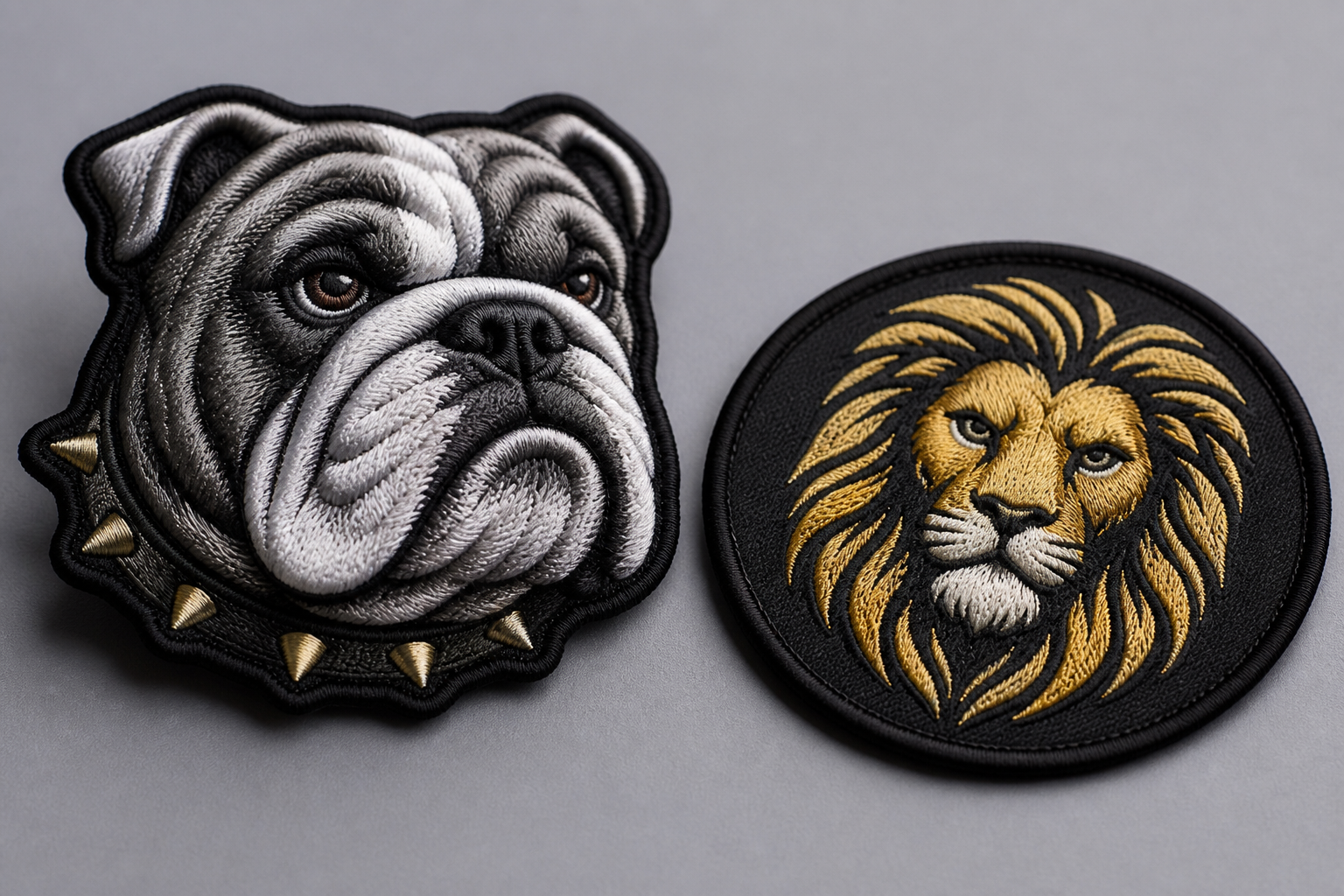
A 3D embroidered patch uses a layer of embroidery foam beneath selected areas. The machine stitches over the foam, then the excess is trimmed away, leaving raised lettering or shapes. It is not a fully raised patch from edge to edge; usually, only the key parts of the design are given height while the background and border remain flat.
That distinction matters. A football club badge with a raised ball, initials or crown can look strong in 3D, while the fine wording around a traditional crest may need flat stitching. Many successful designs combine both finishes rather than forcing the whole patch into one method.
3D embroidered patches versus flat embroidery at a glance
The table below gives a useful starting point, but it is not a substitute for checking the actual artwork at its finished size. A design that looks simple on a laptop may contain narrow gaps, tiny text or thin lines that cannot be raised cleanly.
| Specification | 3D embroidered patches | Flat embroidered patches |
|---|---|---|
| Surface | Selected areas are raised with embroidery foam | Thread is stitched level across the patch |
| Best design style | Bold logos, initials, sports marks and simple lettering | Detailed crests, badges, illustrations and smaller wording |
| Small text | Often difficult if the letters are narrow or tightly spaced | Usually more suitable, subject to the final patch size |
| Visual effect | Tactile, dimensional and easy to notice from a distance | Traditional stitched texture with a flatter profile |
| Fine lines | Can be lost where foam cannot be trimmed cleanly | Generally easier to reproduce with thread |
| Garment use | Caps, jackets, streetwear, teamwear and promotional clothing | Uniforms, blazers, polos, workwear, jackets and bags |
| Cleaning and wear | Raised edges can catch more easily if treated roughly | Less exposed surface and usually easier to press or brush clean |
| Backing options | Can be made sew-on, iron-on or hook-and-loop subject to the garment | Can be made sew-on, iron-on or hook-and-loop subject to the garment |
| Artwork tolerance | Needs simpler shapes and sensible spacing | Allows more detail, although very small details still need checking |
Why the raised effect changes the artwork
Foam needs enough room to be covered and trimmed. Very narrow strokes may not hold their shape, and small enclosed spaces can fill in. A bold block letter usually works well; a thin serif letter at a fraction of an inch may not.
A good digitiser will simplify the design where necessary rather than quietly forcing every detail into the file. This is why a mockup matters. It gives you a chance to see the proposed treatment before a football jacket, nylon shell or batch of branded polos reaches production.
When should you choose 3D embroidered patches?
Choose 3D embroidery when the patch needs visual impact and the main elements are large enough to support the foam. Sportswear, caps, varsity-style jackets and streetwear often suit this finish because the raised areas catch the light and can be felt as well as seen.
- A football club wants raised initials across the chest of a team jacket.
- A clothing brand has a simple wordmark that needs a raised retail-style finish.
- A biker group wants a strong central emblem without fine internal detail.
- A hospitality business is adding a bold icon to a cap or overshirt.
- A school leavers' design uses large numbers or initials rather than a detailed crest.
3D can be particularly effective for a one-to-three-colour mark. It gives the logo presence without relying on gradients or photographic shading. If the design contains a large central symbol and a flat border, the combination can look more considered than making every section raised.
There are limits. A raised finish is not a way to rescue a crowded logo. If your artwork includes a full address, several lines of small wording or a detailed illustration, flat embroidery may produce a more legible result. For highly detailed work, woven patches or printed patches may also be worth comparing.
When are flat embroidered patches the safer choice?
Flat embroidery is the dependable option for badges that need to communicate detail. It is commonly chosen for school blazers, cadet units, work shirts, club crests and company uniforms because the flatter surface makes lettering and narrow outlines easier to manage.
A merrowed crest with a defined outer edge, shield, banner and multiple thread colours will often be easier to balance in flat embroidery. The same applies to a business logo with a small strapline. The result may have less physical height, but printed is flatter; that is the point. A clean, readable mark is more useful than a dramatic finish that loses its wording.
- Choose flat embroidery for detailed sports badges with several small elements.
- Use it for staff uniforms where the logo must look consistent across shirts and jackets.
- Consider it for school blazers where the crest includes a motto or fine border.
- Choose it for a patch that will be pressed under bags, belts or other clothing.
- Use it when the design needs small lettering that cannot be enlarged.
Flat embroidery is not automatically better for every working garment. Thread still has a practical limit, and a patch that is too small can make any method look cramped. The solution may be a larger patch, shorter wording, fewer colours or a separate small emblem.
How size and lettering affect the decision
Patch size should be settled before the embroidery method. A logo intended to sit on the left chest of a polo may need to stay compact, while a back patch on a biker jacket can give the artwork much more room. The same file cannot be judged in isolation from its final dimensions.
As a working guide, large bold initials can suit 3D treatment at around 3 to 4 inches wide, depending on the letter shape. A detailed crest or a design with small words may need more space, often 3.5 to 5 inches or larger. These are starting points rather than fixed production rules; the artwork and garment decide the sensible measurement.
Lettering that usually causes trouble
- Thin script fonts with narrow joins.
- Small capital letters packed closely together.
- Long business names forced into a narrow badge.
- Fine outlines surrounding a raised shape.
- Tiny gaps inside A, B, R, P and similar enclosed letters.
- Mottos or dates that are readable on screen but not at the finished size.
Not sure whether a raised or flat finish will hold your logo clearly? Send the artwork and garment details for a free digital mockup, usually within 12 hours, so you can compare both before production.
GET A FREE MOCKUPIf you need a long name, a woven or printed solution may preserve more detail than embroidery. PVC patches can also suit bold, weather-resistant marks, while chenille patches offer a deliberately soft, collegiate texture. Those options are not direct replacements in every case, but they can prevent the artwork being squeezed beyond its useful size.
Backing and garment choice matter as much as the stitch style
A well-designed patch can still fail if the backing does not suit the garment. Sew-on is usually the most adaptable option for nylon shells, wool coaches' jackets, bags and items that will be washed regularly. Iron-on is convenient, but it needs a compatible, clean, heat-safe surface and correct application.
We have seen iron-on patches peel after a dryer cycle, particularly where the garment was not pressed for long enough or the fabric was too textured. A football jacket with a smooth polyester panel may behave differently from a waterproof nylon shell. A wool coaches' jacket may need sewing because heat and pressure can mark the cloth.
| Garment or use | Practical backing starting point | Points to check |
|---|---|---|
| Nylon shell or waterproof jacket | Sew-on or suitable hook-and-loop | Heat may damage the fabric; check the lining and coating |
| Wool coaches' jacket | Sew-on | Avoid relying on heat alone; protect the wool during application |
| Football or training jacket | Sew-on, iron-on or hook-and-loop depending on the panel | Check the fabric, washing method and whether the badge must be removable |
| Velcro panel | Hook-and-loop backing | Measure the panel and confirm the hook or loop side required |
| School blazer | Sew-on is often the practical choice | Check the blazer fabric, lining and school application instructions |
| Polo or hospitality shirt | Sew-on or carefully applied iron-on | Consider comfort, laundering and the weight of a raised design |
A raised patch can also feel more noticeable against a thin polo or lightweight shirt. That may be exactly what a brand wants on a jacket, but less comfortable for staff wearing a shirt for a full shift. Tell us the garment rather than only saying 'embroidered'; the backing and construction should follow the item being decorated.
Durability, washing and everyday wear
Both 3D and flat embroidery can be durable when the patch is correctly made and applied. Durability does not come from the word 'embroidered' alone. It depends on thread coverage, border construction, backing, attachment, garment fabric and how the item is washed.
Raised foam has more exposed edges than flat stitching. On a cap or jacket that is handled normally, this may not be an issue. On a patch that rubs against a seatbelt, rucksack strap or hard equipment, the raised sections can catch sooner. A flat patch may be the more sensible choice for heavy daily abrasion.
- Follow the garment care label rather than assuming every patch can be tumble dried.
- Turn patched garments inside out where practical before washing.
- Avoid high heat when the patch has iron-on backing.
- Do not drag a brush or abrasive object across raised foam lettering.
- Inspect sew-on edges if the garment is used for sport or outdoor work.
- Use hook-and-loop when the patch needs to be removed before washing or laundering.
For uniforms used five days a week, flat embroidery with sew-on attachment is often the conservative specification. For a limited-run brand jacket or a cap designed to make a visual statement, 3D can justify the extra care. The right choice is the one that suits the real use, not only the product photograph.
Cost, quantity and what affects the quote
Patch pricing depends on more than whether the design is 3D or flat. Size, quantity, number of colours, border, backing, artwork preparation and the number of separate designs all affect the quote. A simple 3D logo may be straightforward, while a complicated flat crest can take more digitising and stitch work.
The Customized Patches accepts a 5-piece minimum per design. If a club needs three different badges, each design is assessed separately rather than treating fifteen mixed patches as one identical run. Larger quantities can change the unit price because setup and production time are spread across more pieces.
| Quote detail | Why it affects the job |
|---|---|
| Finished width and height | A larger patch uses more fabric, thread and stitching time |
| 3D areas | Foam placement and trimming must be planned for the raised sections |
| Number of colours | More thread changes and colour matching can add production work |
| Border type | A merrowed edge or detailed border needs room and accurate finishing |
| Backing | Sew-on, iron-on and hook-and-loop use different materials and processes |
| Quantity per design | The 5-piece minimum applies to each design, while larger runs may reduce the unit cost |
| Artwork condition | Clean production artwork can reduce redraw or digitising questions |
The best way to get a useful price is to provide the artwork, finished size in inches, quantity, garment type, backing and required date. If you are comparing methods, ask for the same specification in flat and 3D rather than comparing two different patch sizes.
Ordering 3D or flat patches from a UK manufacturer
Start with the actual job, not only the logo file. Tell us whether the patches are for a football club, cadet unit, hospitality team, school blazer, biker jacket, promotional cap or business uniform. Mention if they will go on nylon shells, wool coaches' jackets, Velcro panels or bags.
- Send the artwork in the best format available, ideally a vector file or a clear high-resolution image.
- State the finished patch size in inches, or provide the garment and preferred placement if you need advice.
- Confirm whether you want 3D, flat embroidery or a comparison of both treatments.
- Choose a backing: sew-on, iron-on or hook-and-loop where suitable for the garment.
- Confirm the number of pieces for each design, remembering the 5-piece minimum per design.
- Review the digital mockup carefully, including wording, colours, border, size and backing.
- Approve the final mockup. Production starts only after approval.
The Customized Patches usually provides a free digital mockup within 12 hours. That mockup is not a generic computer preview; it is the point at which practical questions about size, raised areas, thread colours and attachment can be resolved before production.
Lead time depends on the design, quantity, backing and current production schedule. If the patches are needed for a kit launch, match day, event or uniform rollout, say so at quotation stage. UK-wide shipping can then be planned around the approved specification rather than guessed from the first enquiry.
Examples from football, clubs, uniforms and brands
A football club badge often needs a balance between identity and readability. If the central initials or ball are large, they may work well in 3D while the club name and founding year remain flat. If the badge is small on a training top, all-flat embroidery may be easier to read and less bulky.
Cadet units and schools tend to prioritise recognised insignia, wording and consistent placement. Flat embroidery is commonly the sensible starting point, especially for a shield with a motto. A school blazer also needs an attachment method that copes with regular wear without relying on a single hot press.
Name sew-on, iron-on or Velcro on the quote and tell us which garment the patch will fit. We will show the proposed backing and finish on a free digital mockup, usually within 12 hours; production begins only after approval.
GET A FREE MOCKUPHospitality polos need a different answer. A bold hotel or restaurant icon can look effective as a small raised mark, but a long venue name may need flat embroidery or a printed treatment. Staff comfort, frequent laundering and the fabric weight should be considered alongside appearance.
Biker and motorcycle club patches are often larger, and the back-panel format gives more room for strong lettering. Raised embroidery can work for a central emblem, while flat stitching may be preferable for curved text, small chapter details or a detailed border. See our guide to biker and motorcycle club patches for more context.
For a clothing brand, the choice can be part of the product design. A raised wordmark may feel more substantial on a heavyweight jacket, while a flat patch may sit better on a lighter overshirt. If the design needs photographic detail or colour shading, look at printed patches before deciding that embroidery must do everything.
Common mistakes that lead to disappointing patches
Most problems begin before stitching. The artwork is judged on a large screen, the patch size is left vague, or the customer chooses iron-on without checking the garment. By the time the issue is visible on the finished item, the patch has already been produced.
- Choosing 3D for a logo whose smallest text is the main message.
- Assuming a raised finish will make a crowded design clearer.
- Ordering a small patch without checking the lettering at finished size.
- Using iron-on on a coated nylon shell or a fabric that cannot take the heat.
- Forgetting to specify hook-and-loop for a removable Velcro panel.
- Comparing prices without keeping size, quantity and backing the same.
- Approving a mockup without checking the exact wording and colour order.
- Expecting a patch to replace a print when the design contains gradients or photographic detail.
A free mockup is useful only if you review it properly. Check the patch beside the intended garment colour, read every letter, measure the proposed width and decide whether the raised sections are helping. If you need broader preparation advice, read Custom embroidered patches UK Sizing and Backing Options Explained.
A practical decision checklist
Use the following questions before selecting the finish. They are the same questions we use when a customer sends a logo and says they are not sure which patch type will work.
- Is the main goal a raised tactile effect, or is it clear reproduction of detail?
- Does the design contain small lettering, narrow lines or enclosed spaces?
- What is the finished patch width and height in inches?
- Will it sit on a cap, football jacket, nylon shell, wool jacket, polo, blazer, bag or Velcro panel?
- Will it be washed often, tumble dried, brushed, pulled or exposed to outdoor use?
- Does the garment need a removable patch?
- Would a combination of raised and flat areas solve the design better?
- Would woven, printed, PVC, chenille or leather be more suitable?
- How many pieces are needed for each separate design?
- Has the artwork been checked and approved at the real size?
If the answers point in different directions, do not force a decision from a product photograph. Ask for two mockups. Seeing the same logo in 3D and flat treatments on the intended garment often settles the question faster than another hour of comparing descriptions.
The final choice: raised impact or dependable detail?
3D embroidered patches are the stronger choice for bold, uncomplicated artwork where height is part of the appeal. They can give a cap, sports jacket or brand mark a distinct tactile finish, especially when the lettering is large and the colour contrast is clear.
Flat embroidered patches are usually the better choice for detailed crests, small text, school insignia, workwear and garments that need a more restrained profile. They are not a lesser version of 3D. They solve a different production problem.
The Customized Patches supplies both approaches across the United Kingdom, with a 5-piece minimum per design. You receive a free digital mockup usually within 12 hours, and we produce only after you approve the final specification. If you are still comparing materials, you can also review The Difference Between custom embroidered patches UK and printed patches, Explained.
Frequently asked questions
What are 3D embroidered patches?
3D embroidered patches use embroidery foam beneath selected stitched areas to create raised lettering or shapes. The background and border can remain flat. They work best for bold logos, initials and simple symbols with enough space around each raised element.
Are 3D embroidered patches more durable than flat embroidered patches?
Neither finish is automatically more durable. Both can perform well when correctly made and attached, but raised foam has exposed edges that may catch under heavy rubbing. Flat embroidery is often the safer choice for daily uniforms, abrasive equipment and patches pressed beneath straps.
Can small text be used on 3D embroidered patches?
Small text can be difficult in 3D because narrow letters and enclosed gaps may fill or lose their shape during foam trimming. Flat embroidery is usually more suitable for small wording, although every design still needs checking at the finished patch size.
What backing should I use for an embroidered patch on a nylon jacket?
Sew-on backing is often the practical starting point for a nylon jacket, especially if the fabric is coated or heat-sensitive. Hook-and-loop may suit a removable patch panel. Iron-on should only be selected after checking that the nylon and lining can safely take the required heat.
What is the minimum order for 3D embroidered patches from The Customized Patches?
The minimum is 5 pieces per design. If you need several different logos, each design is treated separately for the minimum. The Customized Patches can quote the quantity, size, backing and finish together so the specification is clear.
Can I compare 3D embroidered patches with flat embroidery before ordering?
Yes. The Customized Patches provides a free digital mockup usually within 12 hours. Ask for both treatments if you are undecided, then check the lettering, size, colours, raised areas, backing and garment placement. Production takes place only after approval.
Ready to produce custom patches for your UK team or brand?
GET A FREE MOCKUP