
Varsity chenille patches UK: A Worked Example for a UK Brand
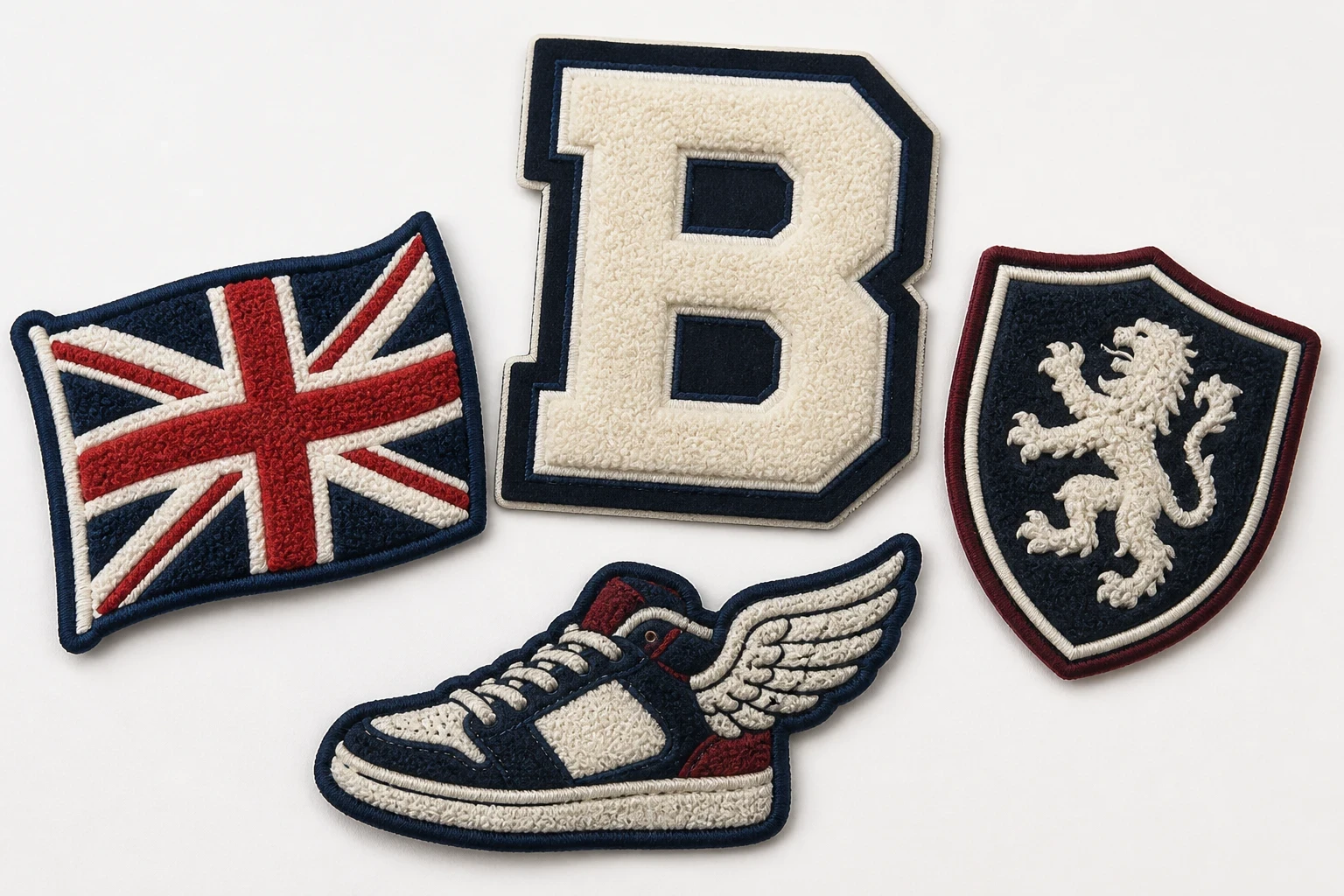
In this illustrative worked example, varsity chenille patches UK give clothing brands, schools and teams a raised chenille finish with strong visual impact. In this UK worked example, a streetwear brand used a simple wool-style crest, a measured 4-inch size and sew-on backing for coaches’ jackets. The Customized Patches supplies a free digital mockup within 12 hours, with production starting only after approval.
Key takeaways
- A simple varsity crest usually works better than fine lettering once the design is reduced to a patch-sized format.
- A 4-inch patch gave the case-study brand enough room for a bold letter, border and short text without crowding the garment.
- Sew-on backing suited wool coaches’ jackets, while Velcro would have made more sense for removable club or event panels.
- The Customized Patches has a five-piece minimum per design, supplies a free digital mockup usually within 12 hours, and produces only after approval.
Please note: this is an illustrative worked example, not a report on a real customer. The brand, garments and decisions below are a hypothetical scenario based on common UK patch briefs, written to show the questions worth asking and the choices involved. No customer results, sales figures or reviews are claimed.
Varsity chenille patches UK can give a small clothing range a proper teamwear identity without covering the garment in print. In this worked example, a UK streetwear brand used a bold chenille crest on wool coaches’ jackets, keeping the design simple enough to read and practical enough to attach securely.
The successful part was not simply choosing chenille. The brand matched the patch size, backing, colours and edge to the jacket, then approved a digital mockup before anything was made. The Customized Patches supplied that free digital mockup usually within 12 hours, confirmed a five-piece minimum per design and produces only after approval.
The UK brand’s brief: a varsity crest for a small clothing launch
The customer was a UK streetwear label preparing a small first release of heavyweight coaches’ jackets. The garments had a wool-style outer with a smooth lining, press studs at the front and enough space on the left chest for a compact badge. The brand did not want a large printed panel. It wanted the raised, tactile look associated with American college jackets and club kit.
The original artwork contained a large initial, a short brand name and a narrow ornamental line. At full screen size it looked balanced. At patch size, the ornamental line was too fine and the lettering was too close to the outside edge. That is a normal production issue: artwork designed for a website or label is not automatically ready for chenille.
What the customer needed the patch to do
- Stand out against a dark navy and cream jacket colourway.
- Look like a deliberate part of the garment rather than a cheap add-on.
- Remain readable from normal talking distance on the chest.
- Work for a first order rather than requiring a large factory run.
- Allow the brand to use the same core identity on later garments.
This is where a useful worked example differs from a product photograph. The patch is only one part of the decision. A design that looks excellent on a flat sample can fail on a nylon shell, disappear into a dark wool fabric or become awkward near a seam. We quote football clubs, cadet units, hospitality polos, biker vests and school blazers, so the garment is always part of the conversation.
Why varsity chenille patches UK suited the project
Chenille gave the brand the raised yarn surface it was looking for. The texture catches light differently from a flat embroidered patch, and a large letter can feel more like a badge than a printed logo. That physical quality suited the heavy jacket better than a thin, detailed mark would have done.
The brand also wanted a patch that could be handled and photographed close up. Chenille helped with that because the pile is part of the design. It is not the right answer for every logo, though. Printed is flatter; that is the point. If the design has a photographic image, a fine gradient or a very small amount of text, printed patches may communicate it more accurately.
Flat embroidered patches would have been another credible option. They suit outlines, fine lettering and compact symbols particularly well. The customer chose chenille because the raised varsity appearance was central to the garment concept, not because chenille is universally better.
The specification selected for the first run
| Specification | Case-study choice | Reason |
|---|---|---|
| Finished size | Approximately 4 inches wide | Large enough for the initial and short name, while still fitting the left chest |
| Main shape | Rounded varsity crest | A clear outer shape was easier to position than a complicated silhouette |
| Surface | Chenille yarn with embroidered detail | Gave the letter a raised texture while keeping small supporting details controlled |
| Colour plan | Cream base, burgundy letter and dark border | Strong contrast against navy and black jacket options |
| Edge | Merrowed-style border | Gave the badge a traditional finished outline |
| Backing | Sew-on | Better suited to a fixed badge on a substantial jacket |
| Quantity | Five pieces minimum per design, with the final quantity confirmed on the quote | Allowed a small launch order without changing the design between pieces |
The four-inch measurement included the finished patch, including the border. This point matters. A customer may request a 4-inch letter and then discover that the full badge is closer to 4.5 inches once the edge is added. We ask for the finished width or height, then show that proportion in the mockup.
How the artwork was changed before production
The first useful change was removing the thin ornamental line. It did not add enough recognition to justify the production risk, and it made the central letter feel cramped. The short brand name remained, but its spacing was opened slightly and the border was given more breathing room.
The second change was colour order. The customer initially supplied a burgundy base with a dark letter. On the navy jacket, that combination had less separation than expected. A cream base and burgundy letter made the crest easier to see without adding another bright colour.
A practical artwork check for chenille
- Use bold letterforms rather than thin script.
- Keep short words away from the outer border.
- Check contrast against the actual garment, not a white artboard.
- Avoid assuming that tiny gaps will remain open in a textured surface.
- Confirm whether the quoted dimensions include the edge.
- Supply vector artwork where possible, but include a clear image if that is all the brand has.
The customer did not need to redraw the entire logo. A production-ready version can often be made by simplifying the smallest features and adjusting spacing. Our How to Design Artwork for varsity chenille patches UK That Production-Ready guide covers the same checks in more detail.
Size, placement and backing decisions
A chest patch has less usable space than a back patch, especially on a jacket with a pocket, seam or press stud. The brand measured from the centre of the chest rather than from the garment edge, then checked the distance from the collar and armhole. That prevented the finished crest from sitting too high.
Not sure whether chenille, flat embroidery or print will suit the garment? Send the logo and jacket details for a free digital mockup usually within 12 hours, and compare the visual direction before you produce.
GET A FREE MOCKUPFor a back design, the same mark could have been 8 or 10 inches wide. On the chest, 4 inches was a better balance. A 3-inch version would have reduced the letters too far, while a 5-inch version would have started to dominate the jacket.
| Backing | Best fit | Points to check |
|---|---|---|
| Sew-on | Wool coaches’ jackets, denim, canvas and substantial workwear | Needs a suitable needle, thread and access to the garment; the patch is intended to stay in place |
| Iron-on | Compatible smooth cotton or blended fabrics where quick application is useful | Heat, pressure and fabric compatibility matter; an iron-on patch can peel after a dryer cycle if applied or washed incorrectly |
| Velcro | Removable club panels, tactical-style garments and event uniforms | Requires the matching hook-and-loop panel and adds thickness beneath the patch |
| Adhesive | Short-term display or temporary positioning | Usually less suitable for repeated washing or a heavy jacket that is handled often |
Sew-on was selected for the case-study jackets because the brand wanted a permanent, considered finish. It also avoided asking heat to bond a thick textured patch to a wool-style outer. For a nylon shell, we would check the shell construction and recommend a method that does not distort the fabric. A backing decision should follow the garment, not a generic product description.
The Chenille patches Sizing and Backing Options Explained guide is useful if you are comparing a fixed sew-on badge with a removable Velcro design.
Mockup approval: the step that prevented a poor first batch
The mockup showed the patch at its intended proportion on a jacket image. That exposed two details which were easy to miss in the original file: the name line was too close to the border, and the first colour combination lacked contrast on navy. Both were corrected before production.
The Customized Patches provides a free digital mockup usually within 12 hours. It is a planning visual, not a photograph of the finished patch, so it cannot reproduce every strand of yarn or the exact feel of the pile. It can, however, confirm layout, approximate size, colour order, wording and backing direction.
What to check on a patch mockup
- Read every letter at the displayed size.
- Check the finished width and height in inches.
- Look at the patch against the actual garment colour.
- Confirm the border is included in the dimensions.
- Check that the backing matches the way the garment will be used.
- Make sure the quantity and design version are written on the quote.
- Approve only after all requested changes are shown in the revised mockup.
Production starts only after approval. That is a straightforward but valuable control. It keeps an early design discussion separate from the final manufacturing instruction and gives the customer a clear point at which spelling, size and colour have been checked.
Ordering varsity chenille patches UK from the first email to delivery
A useful first message includes the artwork, garment type, finished size, quantity, preferred backing, colour references and delivery location. If you do not know the size, photograph the garment with a ruler or tape measure beside the placement area. That gives our team something more useful than the phrase “standard jacket patch”.
The five-piece minimum applies per design. Five identical patches count as one design; changing the letter, wording, colour layout or shape can make it a separate design. If a club has five player initials, ask us to quote the set clearly rather than assuming each variation will be treated as one design.
- Send the artwork and garment information.
- State the finished size in inches or ask for a size recommendation.
- Confirm the quantity per design, with the five-piece minimum in mind.
- Choose sew-on, iron-on or Velcro backing.
- Review the free digital mockup usually supplied within 12 hours.
- Request any wording, colour or proportion changes.
- Approve the final mockup in writing.
- Allow production and UK-wide shipping time shown on the quote.
Lead time depends on the design, quantity, backing and current production schedule. A simple five-piece crest is not planned in exactly the same way as a large order for a football club, cadet unit or retail launch. We give the practical timing on the quote rather than promising one fixed number for every order.
For customers comparing suppliers, ask whether the stated price includes the border, backing, artwork preparation, delivery and VAT where applicable. Also ask what happens if the garment changes after approval. Clear questions at the start reduce surprises later. Our guide to 10 Questions to Ask Before Ordering varsity chenille patches UK covers the points we would expect a careful buyer to raise.
What made the project successful, and what was not suitable
The project worked because the brand made a deliberate choice rather than asking the patch to solve every design problem. The crest was short, bold and high contrast. The 4-inch size respected the chest area. The sew-on backing matched the substantial jacket. The design was approved before production.
There were also clear limits. Chenille was not used for the brand’s small care label, fine sleeve text or detailed graphic. Those applications needed a flatter and more controlled surface. A woven patches option could suit small lettering, while 3D embroidered patches could add raised detail with a different visual character.
| Requirement | Chenille result | Alternative to consider |
|---|---|---|
| Large varsity letter | Strong choice because the raised pile supports bold forms | Flat embroidery if a cleaner, sharper edge is preferred |
| Very small text | Risk of reduced clarity and crowded texture | Woven or flat embroidered patch |
| Photographic artwork | Not the natural strength of chenille | Printed patch, where colour detail is the priority |
| Removable uniform badge | Possible, but backing must be planned | Velcro-backed design |
| Leather-look premium mark | Different character from a wool-style crest | leather patches may suit the garment better |
| Outdoor or technical kit | Needs careful backing and fabric assessment | PVC patches may be worth comparing for a weather-focused application |
This honest comparison matters for UK buyers. A football club may want a traditional crest on a tracksuit, a hospitality company may need a small badge on polos, and a biker group may need a large back design for a vest. The right material changes with the garment, washing routine, position and artwork.
Lessons for schools, clubs and UK businesses
Schools and colleges often use chenille for house letters, leavers’ jackets, sports teams and society clothing. A clear school crest can work well, but long mottos should be reviewed carefully. If the full wording does not fit at a readable size, use the crest on the patch and place the longer information elsewhere on the garment.
Name sew-on, iron-on or Velcro on the quote and send the garment details with your artwork. We will show the proposed backing and placement on a free digital mockup usually within 12 hours; production starts only after you approve it.
GET A FREE MOCKUPClubs should also agree one master design before ordering. A slightly different border on each batch can make a team look inconsistent. Keep the approved mockup, colour references and finished dimensions with the order record so a repeat order can be checked against the original.
Common garment problems
- A patch is placed across a zip, making the garment difficult to open.
- An iron-on is applied to a heat-sensitive nylon shell and the fabric marks.
- An iron-on patch peels after a dryer cycle because the application instructions were not followed.
- A Velcro patch is ordered without the matching loop panel on the garment.
- A merrowed crest is made too close to a sleeve seam, leaving no room for the edge.
- A school blazer has a badge positioned over a pocket or existing embroidery.
- A biker vest has a back patch measured without accounting for the vest’s centre seam.
These are not reasons to avoid patches. They are reasons to confirm placement before manufacture. The Common Mistakes to Avoid When Ordering varsity chenille patches UK guide gives a useful pre-order check for teams, brands and businesses.
How to decide if chenille is right for your next order
Choose chenille if the main attraction is a raised, collegiate or teamwear appearance and the artwork uses bold shapes. It is particularly effective on jackets, hoodies, varsity garments and substantial casualwear where texture will not look out of place.
Choose another patch type if the artwork depends on tiny detail, photographic shading or a very flat finish. The Varsity chenille patches UK vs embroidered patches: Which Is Right for Your Project? guide sets out the visual and practical differences without treating one material as the answer for every order.
- Start with the garment and placement area.
- Decide whether texture is part of the brand identity.
- Reduce the artwork to the details that must remain visible.
- Set a finished size that includes the border.
- Choose backing based on use, washing and whether the patch must be removable.
- Check the five-piece minimum per design and quantity variations.
- Review the free mockup and approve the final version before production.
The UK streetwear project succeeded because those decisions were made in that order. The brand did not begin with a patch size copied from another garment. It began with the jacket, the placement and the intended visual effect, then adjusted the artwork to fit.
Request a UK varsity patch mockup
The Customized Patches supplies custom patch production for UK teams, brands, clubs and businesses, with UK-wide shipping. Send your artwork, garment type, approximate size, quantity and backing preference. If you are unsure, say so; a production conversation is more useful than choosing a backing from a product photograph.
The five-piece minimum applies to each design. A free digital mockup is usually supplied within 12 hours, and production begins only after approval. That gives you a clear opportunity to check the crest, wording, proportions and backing before the order is made.
Frequently asked questions
What are varsity chenille patches UK used for?
They are commonly used on varsity jackets, coaches’ jackets, hoodies, school blazers, sportswear, club clothing and branded workwear. They suit bold letters, crests and simple symbols where a raised wool-style texture is wanted. They are less suitable for photographic artwork or very small detailed text.
What was the successful UK brand worked example about?
The project involved a UK streetwear brand using a 4-inch chenille crest on wool-style coaches’ jackets. The design was simplified, the colours were changed for stronger contrast, and sew-on backing was selected because the patch was intended to stay on the garment. The brand approved a digital mockup before production.
What is the minimum order for varsity chenille patches UK?
The Customized Patches has a five-piece minimum per design. Five identical patches count as one design. Different letters, wording, shapes or colour layouts may be treated as separate designs, so include each variation when requesting a quote.
How quickly can I receive a mockup?
The Customized Patches usually supplies a free digital mockup within 12 hours. The mockup can show the proposed size, layout, colours and backing direction. Production does not start until the customer approves the final version.
Is sew-on or iron-on backing better for a varsity jacket?
Sew-on backing is often the safer choice for a substantial wool, denim or canvas jacket intended for regular use. Iron-on can suit compatible smooth fabrics, but heat, pressure, washing and drying must be considered. An iron-on patch can peel after a dryer cycle if the application or care is unsuitable. Velcro is better if the badge needs to be removed.
Can you make a chenille patch from a detailed logo?
A detailed logo can often be adapted, but the smallest lines, gaps and text may need simplifying. Chenille works best with bold forms and strong contrast. If fine detail is essential, compare woven, flat embroidered or printed options before approving the design. A mockup will show which parts need attention.
Ready to produce custom patches for your UK team or brand?
GET A FREE MOCKUP