
Top 10 Uses for PVC patches in 2026
PVC patches are used for outdoor clothing, workwear, sports kits, club uniforms, bags, morale patches, branded merchandise and Velcro panels. They suit designs needing raised detail, clear colours and resistance to rain or regular handling. The Customized Patches supplies UK orders from a 5-piece minimum and sends a free digital mockup, usually within 12 hours, for approval before production.
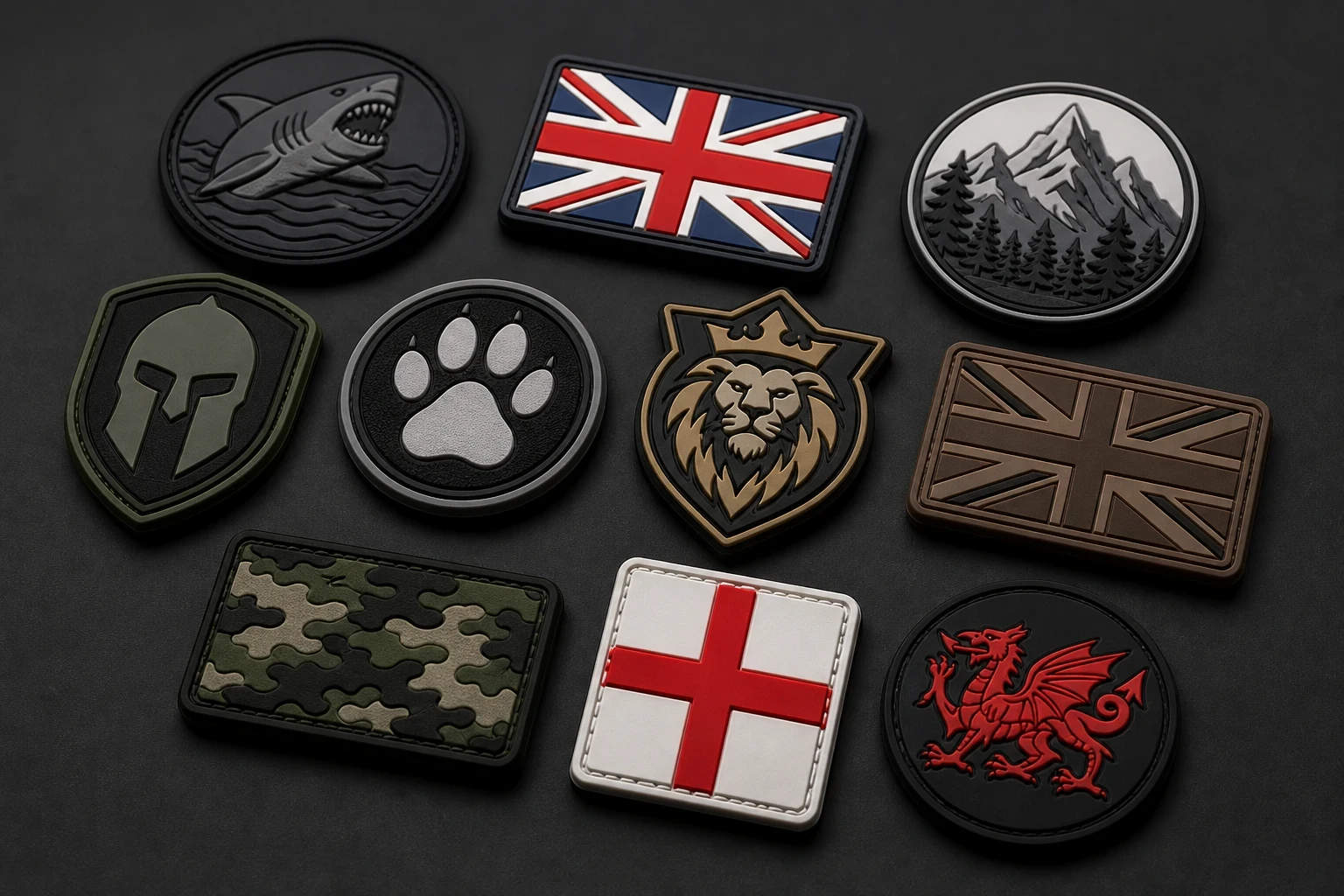
Key takeaways
- PVC patches are a strong choice for raised logos, simple lettering, bold colours and garments exposed to rain or regular handling.
- The ten most useful applications include outdoor clothing, workwear, sports clubs, cadet and uniformed groups, bags, biker gear, hospitality clothing, events, branded merchandise and Velcro panels.
- The backing matters as much as the face: sew-on suits permanent placement, iron-on suits suitable fabrics, and Velcro suits removable patches or morale panels.
- The Customized Patches has a 5-piece minimum per design, provides a free digital mockup usually within 12 hours, and produces only after the artwork and mockup are approved.
PVC patches are most useful where a logo needs clear colour, raised detail and a face that can cope with outdoor clothing, workwear, kit bags or repeated handling. The ten applications covered here include sports clubs, cadet units, businesses, biker groups, hospitality teams, events and removable Velcro panels.
The right choice still depends on the garment and the artwork. PVC is not automatically better than thread or print: printed is flatter; that is the point, while embroidered has a stitched surface that many clubs prefer. The Customized Patches supplies UK orders from a 5-piece minimum per design, sends a free digital mockup usually within 12 hours, and produces only after approval.
Why PVC patches suit certain jobs
PVC is a moulded material rather than a woven or stitched face. That gives the patch its raised edge, solid colour areas and tactile finish. Simple text, shield shapes, mascots, numbers and high-contrast symbols tend to read well because the design is built in layers instead of relying on individual thread stitches.
The material also handles damp conditions more comfortably than a cotton-rich embroidered face. That does not make every backing waterproof, and it does not mean a patch should be put through harsh washing without checking the garment instructions. A nylon shell, waterproof jacket or football equipment bag needs a backing and attachment method chosen for that surface.
The main trade-offs
- PVC gives a raised, rubber-like finish, but very tiny lettering may need simplifying before production.
- PVC is practical for rain-exposed clothing and bags, but it does not reproduce a soft photographic image as naturally as a printed patch.
- Sew-on PVC is a dependable permanent option, while iron-on is quicker to apply but can peel after a dryer cycle or on a very stretchy fabric.
- Velcro is useful for interchangeable identifiers, but it adds thickness and needs a suitable loop panel on the garment.
- The moulded look is distinctive, but teams wanting a traditional merrowed crest may prefer embroidered patches or 3D embroidered patches.
1. Outdoor jackets and technical clothing
Outdoor clubs, walking groups, mountain-bike teams and volunteer organisations often put patches on nylon shells, softshell jackets and technical gilets. PVC works well here because a raised logo is easy to wipe clean and remains visually strong against a dark jacket. A compact crest on the upper sleeve or chest can identify the group without covering a large area of breathable fabric.
Placement deserves attention. A thick patch on a heavily articulated elbow can catch during movement, while a broad patch across a waterproof seam may affect how the garment folds. For a shell jacket, we usually ask for the garment type, patch position and preferred backing before recommending a construction.
Good outdoor designs
- A one- or two-colour hill, bike or compass emblem.
- A club name with lettering large enough to read at arm's length.
- A high-contrast badge with a clean border and limited internal detail.
- A small sponsor mark on a team gilet, provided the logo is simplified for its final size.
2. Workwear and trade uniforms
Tradespeople, facilities teams, security staff and local service businesses need branding that can be seen on jackets, fleeces, polo shirts and hi-vis layers. PVC patches can add a defined badge to a work garment without the loose thread texture found on some embroidered designs. They are particularly useful for a logo made from solid blocks of colour.
Think about laundering before choosing the attachment. A contractor may wear the same jacket in rain, dust and van storage, then wash it frequently. Sew-on is usually the sensible route for a permanent workwear mark. Iron-on may suit a controlled application to a compatible fabric, but heat, flexing and repeated washing can reduce its hold.
For a complete uniform order, compare PVC with woven patches if the logo includes finer flat lettering. Woven is lower-profile and can show small detail neatly; PVC is better if the raised edge and wipe-clean feel are part of the brief.
3. Football, rugby and other sports clubs
Sports clubs use patches on coaches' jackets, kit bags, tracksuits, presentation coats and supporters' clothing. A football club might use a PVC crest on a black equipment bag, then order a separate embroidered version for a wool coach jacket. Matching the artwork across both versions is possible, but the two materials will not look identical.
Keep the patch size practical for the item. A 3-inch badge can work on a jacket chest or kit bag, while a smaller sleeve position may need fewer words. Long club names often read better as an outer ring with a simple central symbol rather than as several lines squeezed into a small rectangle.
What sports clubs should specify
- The garment or accessory: football shirt, coach jacket, tracksuit, kit bag or pennant.
- The finished patch width and height in inches.
- Whether each design needs a permanent sew-on back or a removable Velcro back.
- The club colours, including any different home, away or junior-team versions.
- The quantity per design, remembering that the minimum is 5 pieces per design.
Choosing the face, edge and backing
A good PVC patch starts with a design that can be moulded cleanly. Solid outlines, separated colour areas and readable type are easier to manufacture than gradients, hairline strokes or a detailed photographic mascot. A raised border can frame the design, but it also takes up part of the available face, so the final size should be agreed before artwork is prepared.
The edge can be part of the design or simply a neat boundary. Rounded rectangles, shields, circles and custom silhouettes are common. If you are choosing between materials, the PVC patches vs embroidered patches guide explains the differences in surface, detail and garment suitability.
| Requirement | PVC option | Alternative to consider | Practical note |
|---|---|---|---|
| Raised badge with bold colours | Moulded PVC with raised border | 3D embroidered patches | PVC gives a smoother rubber-like face; 3D embroidery gives a raised thread effect. |
| Permanent club crest | Sew-on PVC | Embroidered patches | Sew-on is suitable for jackets, bags and uniforms that will keep the badge. |
| Removable identifier | Hook Velcro PVC patch | Sew-on loop panel with interchangeable badges | The garment needs a compatible loop panel before the patch can be attached. |
| Small flat lettering | PVC with simplified type | Woven patches | Woven can be a better fit for fine, flat lettering and detailed lines. |
| Photographic or tonal artwork | PVC with simplified colour blocks | Printed patches | Printed is flatter; that is the point, and it handles tonal images more naturally. |
| Traditional formal crest | PVC if a modern finish is wanted | Embroidered or chenille | A chenille patch has a visibly different, textured varsity finish. |
4. Cadet units, scouts and uniformed groups
Cadet units, scouts, guides and other uniformed groups often need clear identifiers that survive regular use. PVC suits unit badges, activity badges, morale designs and removable identifiers on jackets, rucksacks or kit bags. A simple emblem with a unit name can remain legible at a distance, which helps when several groups are together at an event.
Uniform policy matters. Some groups require a specific location, size or traditional appearance, so confirm the rules before ordering. A PVC morale patch may be appropriate for a training bag but not as a replacement for an official woven or embroidered insignia. For formal blazers, a stitched badge can sit more naturally against wool than a thick moulded patch.
5. Biker and motorcycle club clothing
Biker groups use patches on leather jackets, textile motorcycle jackets, waistcoats and luggage. PVC can give a modern club look with a raised border, clear lettering and strong contrast. It is also easier to wipe than a heavily textured thread face after a wet ride.
Not sure whether thread, ink or moulded PVC will hold your logo? Send the artwork and garment details for a free digital mockup usually within 12 hours, so you can compare the finish before production.
GET A FREE MOCKUPLeather needs a careful decision about attachment. Sewing through a thick leather panel is possible, but the needle holes are permanent and the patch should not be placed where it interferes with armour, seams or a zip. For traditional club layouts, review our guide to biker and motorcycle club patches before finalising the back.
Some motorcycle clubs prefer a large back panel with a top rocker, centre emblem and bottom rocker. PVC can work for a modern interpretation, but the scale must leave enough separation between each piece. A small mockup viewed at the approximate jacket size is more useful than judging the artwork only on a phone screen.
6. Bags, rucksacks and equipment cases
A kit bag, school rucksack, camera case or tool bag is often a better home for a patch than a shirt. These items have broad panels, are handled frequently and can carry a bold badge without competing with a printed garment logo. PVC is a sensible option for sports equipment bags because the face is easy to wipe after travelling to matches.
Velcro-backed PVC patches are especially useful for bags with loop panels. A team can change from a club badge to a tournament badge, sponsor mark or player identifier without sewing a new patch onto every item. Check the loop area first: a patch cannot attach securely to plain nylon without a compatible loop panel or another fixing method.
Common bag mistakes
- Ordering a patch wider than the flat panel, so corners sit over a curved seam.
- Choosing a tall design for a narrow shoulder strap where the badge will fold.
- Assuming iron-on is enough for a heavily handled kit bag.
- Leaving no spare space around a Velcro patch, making it difficult to remove by hand.
- Using very small lettering that looks clear in the artwork but disappears at the actual patch width.
7. Hospitality, retail and branded uniforms
Independent cafés, street-food traders, breweries, bar teams and retail staff can use patches to give a uniform a more distinctive identity. A PVC badge on a work jacket or overshirt can make a simple garment feel connected to the brand without printing a large logo across the back. It can also be a useful replacement for a standard chest embroidery when the brand has a bold icon.
Hospitality clothing is washed often, so the patch should be tested against the chosen garment and care routine. A cotton apron, polycotton polo and nylon delivery jacket each behave differently under heat and washing. For a smart wool coach jacket, compare PVC with a leather patch or a traditional embroidered crest before deciding.
Do not force a long strapline into a 2-inch badge. Use the icon at small size and place the full name elsewhere on the garment, or increase the patch size enough for the words to remain readable. The most successful staff patches are usually simple and recognisable rather than packed with every brand message.
8. Events, teams and limited-run merchandise
A one-day event, trade stand, charity challenge or team trip can use PVC patches as a physical keepsake. They can be attached to a cap, jacket, tote, rucksack or event bag, giving participants something more substantial than a small printed sticker. A date, short event name and recognisable symbol are enough for a useful commemorative design.
The 5-piece minimum per design makes a small run possible, although the unit cost depends on size, colours, backing, shape and quantity. If you need several colourways, each artwork version is treated as its own design for quoting. Combining versions into one order can help with planning, but it does not remove the need to approve each visual version.
PVC or printed for event artwork?
Choose PVC for a bold emblem, raised lettering or a modern badge people can feel. Choose printed patches for a flatter face, gradients, detailed illustrations or artwork that depends on subtle colour changes. Neither is a universal winner; the artwork and the event garment decide the better fit.
9. Brand merchandise and customer giveaways
Brands can use PVC patches as add-ons for clothing drops, subscription boxes, outdoor products, music merchandise and customer loyalty packs. A small badge takes less storage space than a garment and can be attached to several compatible items. A removable Velcro version may appeal to customers who already have a patch panel on a jacket or bag.
Merchandise artwork needs to work without the surrounding product. If the brand normally relies on a large printed photograph, a separate icon or short wordmark may make a better PVC design. If you need the full artwork reproduced, a printed or woven patch may preserve more of the original detail.
Packaging and fulfilment also matter. Confirm whether patches are supplied loose, paired with a garment, or packed for individual dispatch. Give the quote a realistic quantity, as adding a second run later may mean a new setup and a different delivery date.
10. Removable morale patches and Velcro panels
Morale patches are one of the clearest uses for PVC. Outdoor teams, airsoft groups, gaming communities, security suppliers and collectors can swap designs on jackets, packs and cases fitted with loop fabric. The raised face helps a short phrase, call sign or symbol stand out without requiring a large patch.
The patch and the panel should be treated as one system. Hook on the patch attaches to loop on the garment or bag; two hook sides will not provide the same connection. Measure the loop panel rather than guessing from the garment's overall size, and leave enough clearance for fingers to remove the patch.
How to order PVC patches in the UK
Start with the real item the patch will sit on. Tell us if it is a nylon shell, wool coach jacket, leather waistcoat, cotton apron, football kit bag or Velcro panel. The material, curve, seam and washing routine can change the sensible size and backing.
Send the cleanest artwork available, ideally as a vector file or a high-resolution image, and state the finished width and height in inches. Include Pantone references or brand colour information where colour matching matters. If the design contains tiny wording, we may suggest a larger size or a simplified version rather than promising detail the finished patch cannot show.
We then prepare a digital mockup showing the proposed shape, colours, size and backing. The Customized Patches usually sends this free mockup within 12 hours. We produce only after approval, so check spelling, dimensions, colours, attachment method and the garment position before confirming.
Name sew-on, iron-on or Velcro on the quote. We show the correct back on a free digital mockup usually within 12 hours, so the production details match the garment before you approve the order.
GET A FREE MOCKUPLead time and delivery points
The delivery date depends on the design, quantity, backing, approval time and production schedule. A five-piece sample-style order may have different timings from a large club run with several colourways. UK-wide shipping is available, but the shipping time is separate from production time.
If a match, launch, camp or event has a fixed date, tell us at quote stage. Approving the mockup promptly helps, but it is not a substitute for allowing production time. For a wider comparison of material and ordering decisions, see PVC patches: Everything UK Buyers Need to Know.
PVC patches compared with other patch types
The best material is the one that fits the garment, artwork and use. A football club may need PVC for a wet kit bag, embroidery for a wool coach jacket and print for a detailed sponsor panel. Ordering the same logo in three materials is sometimes sensible, provided each version is designed for its own finished size.
| Patch type | Best suited to | Main advantage | Watch for |
|---|---|---|---|
| PVC patches | Outdoor clothing, bags, workwear, morale designs and bold club badges | Raised detail, solid colour and a wipeable surface | Tiny lettering, thick edges and unsuitable backing for the garment |
| Embroidered patches | Traditional crests, uniforms, jackets and school blazers | Visible stitch texture and a familiar textile finish | Very fine detail may need simplifying; iron-on can peel after a dryer cycle |
| Printed patches | Gradients, illustrations, photographs and flat artwork | Fine tonal detail and a smooth, low-profile face | The printed face can be less textured and may not give the raised badge look |
| Woven patches | Small flat lettering, labels and detailed line work | Neat low-profile construction with fine woven detail | Less raised and tactile than PVC |
| Chenille patches | Varsity, school, sports and retro-style designs | Soft, high-pile texture with a bold collegiate appearance | Not suited to every corporate or technical garment |
| Leather patches | Biker clothing, heritage garments and premium casual merchandise | Natural material and a distinctive understated finish | Leather thickness, stitching and care requirements need checking |
For a direct decision based on logo detail and garment type, read How to Choose the Right PVC patches for Your Brand. It is also worth viewing the embroidered patches hub if your design is a crest, school badge or thread-led emblem rather than a moulded mark.
Artwork and sizing checks before approval
A patch that looks excellent on a large monitor can fail at the requested size. Check the smallest text, narrow gaps, sharp corners and any internal outlines. If a line is too fine to mould clearly, widening it or removing it is usually better than allowing it to fill in.
- State the finished size in inches, not only a percentage of the original artwork.
- Mark the front and back if a hook Velcro backing is required.
- Confirm every word, number and date before approval.
- Use a clear colour reference where an exact brand shade matters.
- Show the patch on the actual garment or bag in the mockup if placement is uncertain.
- Allow for an edge or border when calculating the space available for text.
- Keep separate artwork versions for different club teams, sponsors or event dates.
The mockup is the point where these details become visible. It is not just a sales image; it is the production reference. If the approved mockup shows a different size, backing or spelling from the original message, the approved version is the one to query before production begins.
Final recommendation for UK buyers
Choose PVC patches when the brief calls for a raised, modern badge with clear colour blocks and practical use on jackets, bags, uniforms or removable panels. They are a particularly good fit for outdoor groups, sports clubs, workwear, biker gear and brands that want a tactile mark rather than a flat print.
Choose another construction if the design depends on photographic detail, very small flat lettering, a soft varsity texture or a traditional stitched crest. The Customized Patches can quote the alternatives as well as PVC, with a 5-piece minimum per design, UK-wide shipping and a free digital mockup usually within 12 hours. Production only begins after approval.
Related guides and product hubs
For more material advice, read The Complete Guide to PVC patches in 2026, then compare the relevant product hub before sending artwork. Teams ordering across the United Kingdom can also view our UK city pages for regional information and shipping context.
- PVC patches for raised, practical badge designs.
- Embroidered patches for stitched crests and traditional textile finishes.
- Printed patches for flat artwork, gradients and detailed illustrations.
- Woven patches for fine flat lettering and compact labels.
- Biker and motorcycle club patches for jacket layouts and attachment choices.
Frequently asked questions
What are PVC patches mainly used for?
PVC patches are mainly used for outdoor jackets, workwear, sports club clothing, kit bags, rucksacks, biker gear, hospitality uniforms, event merchandise and removable Velcro panels. They suit bold logos, raised borders, short lettering and solid colour designs. The material is practical for regular handling and damp conditions, although the backing and garment still need to be matched correctly.
Are PVC patches suitable for football and rugby clubs?
Yes. PVC patches can work well on football kit bags, tracksuits, coach jackets, equipment cases and supporters' clothing. A simple club crest usually reads better than a crowded design at a small size. Many clubs use PVC for bags and outdoor layers, then choose embroidered patches for wool jackets or formal teamwear.
Can PVC patches go on a nylon jacket or waterproof shell?
They can, but the attachment method and placement need checking. Nylon shells may flex, have seams or include a waterproof finish, so a patch should not be placed across a zip, articulated elbow or critical seam without considering the effect. Sew-on, iron-on and Velcro backs suit different situations. Send a garment photograph for a mockup before confirming.
What is the minimum order for PVC patches from The Customized Patches?
The minimum order is 5 pieces per design. Different artwork versions, club colourways or dates may count as separate designs for quoting. The Customized Patches sends a free digital mockup usually within 12 hours, and production begins only after the design, size, backing and other details have been approved.
Are PVC patches better than embroidered patches?
Neither is automatically better. PVC is a good choice for raised detail, bold colours, wipeable surfaces and modern outdoor or workwear designs. Embroidery is often better for traditional crests, wool coaches' jackets, school blazers and customers who want visible stitching. Printed is flatter; that is the point, and it can suit gradients or detailed illustrations. Compare both in PVC patches vs embroidered patches: Which Is Right for Your Project?.
How long does a PVC patch order take in the UK?
Timing depends on the patch size, number of colours, backing, quantity, approval speed and production schedule. UK-wide shipping is available, but delivery time is separate from production time. Tell us about any match, launch or event date when requesting a quote. A free digital mockup is usually sent within 12 hours, and that approval stage comes before production.
Ready to produce custom patches for your UK team or brand?
GET A FREE MOCKUP