
The Complete Guide to PVC patches in 2026
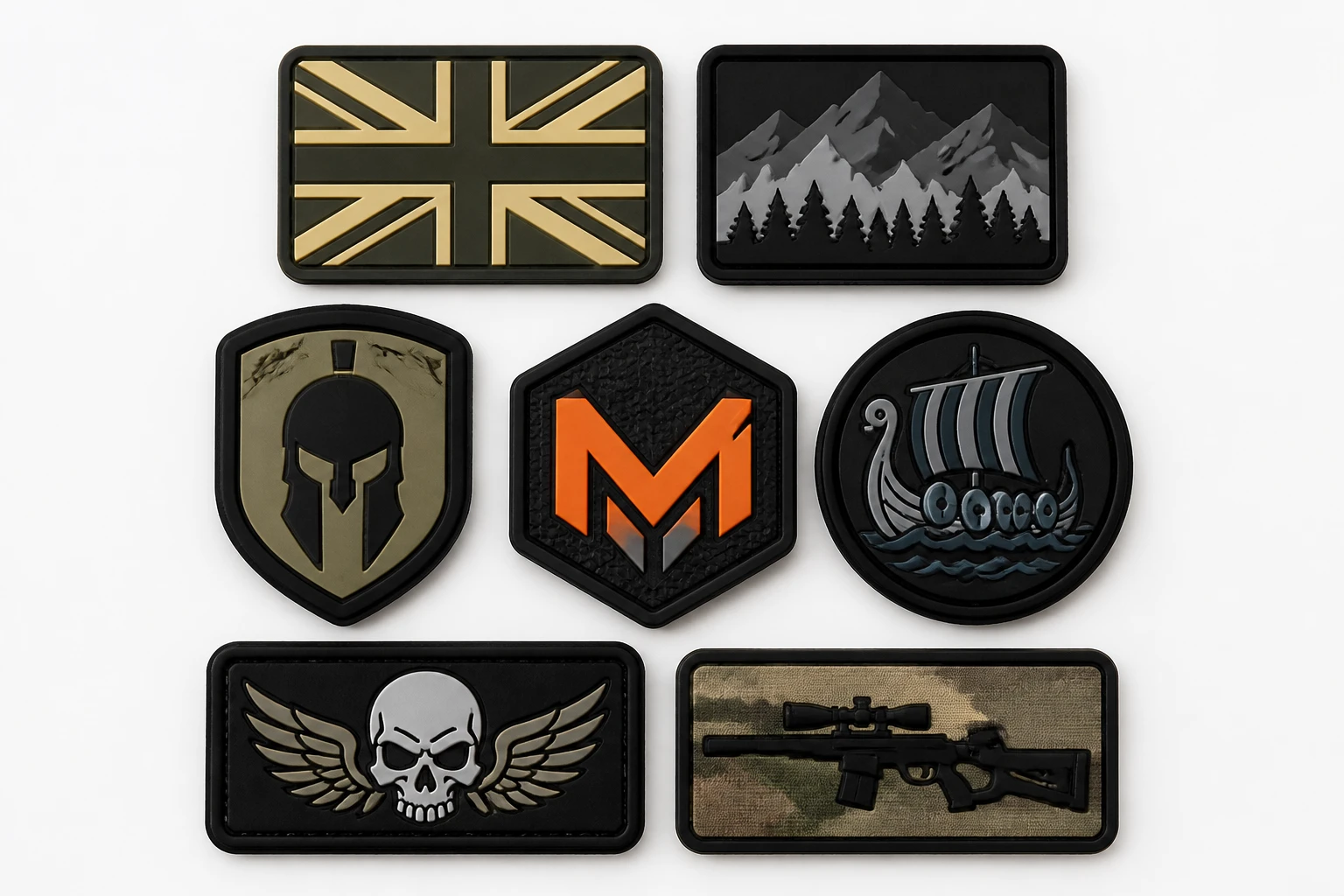
PVC patches are moulded, rubber-like badges made from flexible polyvinyl chloride. They suit outdoor kit, workwear, club clothing and Velcro panels because raised and recessed details remain visible without loose thread. The Customized Patches supplies UK customers from a 5-piece minimum, with a free digital mockup usually sent within 12 hours before production.
Key takeaways
- PVC patches are moulded badges with a smooth or textured rubber-like finish, raised details and recessed colour areas.
- They are a strong choice for outdoor kit, workwear, Velcro panels and logos that need visible relief rather than stitched texture.
- The Customized Patches has a 5-piece minimum per design and sends a free digital mockup usually within 12 hours.
- Production begins only after you approve the mockup, artwork, size, colours and backing.
PVC patches are moulded, rubber-like badges made for designs that benefit from raised detail, strong colour blocks and a practical surface. They work particularly well on outdoor clothing, workwear, club kit and hook-and-loop panels, but the right choice still depends on the garment, artwork and how the badge will be used.
For UK customers, The Customized Patches has a 5-piece minimum per design. You receive a free digital mockup usually within 12 hours, and production starts only after you approve the mockup and final details. That approval stage matters: it is where we check tiny lettering, border width, backing and the fit on the intended garment.
What are PVC patches?
PVC stands for polyvinyl chloride. In patch production, it is formed into a flexible badge rather than stitched from thread. The finished piece normally has a smooth, slightly rubber-like feel, a raised outer edge and recessed or raised parts of the design. Some designs use several levels of relief, although not every logo needs a multi-level mould.
That construction changes the appearance. A merrowed embroidered crest has thread texture and a traditional edge; a PVC badge has a clean moulded outline and more graphic depth. The surface is usually easy to wipe, and it generally copes well with rain and outdoor use. It is not a reason to ignore the care label, tumble-dryer heat or aggressive solvents.
What PVC does well
- Raised logos, borders, lettering and simple symbols remain easy to see at a short distance.
- The material does not have loose thread ends, which helps on practical outdoor and work garments.
- Strong colour blocks suit club marks, department identifiers, morale patches and brand icons.
- The surface can be wiped after use, useful for site clothing, outdoor events and equipment bags.
- Hook-and-loop backing makes the badge removable when a garment has different roles or name panels.
PVC is not automatically the best answer for every design. A detailed illustration with many small colour changes may need a larger finished size, simplified artwork or a different patch method. If you want fine woven lines or a flatter face, compare woven patches and printed patches before deciding.
Why UK teams and businesses choose PVC patches
The common thread in our quote requests is not one particular industry. It is a need for a badge that looks deliberate on clothing that gets worn properly. Typical enquiries cover football clubs for training tops and kit bags, cadet units for removable uniform identifiers, hospitality teams for branded polos, biker groups for outerwear, and schools for patches on blazers and sports kit.
A PVC badge is particularly useful where the garment is exposed to drizzle, mud or frequent handling. It can sit on a nylon shell, a rucksack, a softshell jacket or a work gilet without the raised thread texture that some customers do not want. A hook-and-loop version can move between jackets, while a sew-on version is better for a badge intended to stay in place.
Common applications
- Football and rugby clubs needing squad, sponsor or staff identifiers on kit bags and jackets.
- Cadet, scout and outdoor groups using removable patches on uniform panels.
- Biker and motorcycle clubs wanting bold back, chest or arm graphics with a solid edge.
- Trades and businesses adding a wipeable logo to workwear, fleeces and equipment bags.
- Hospitality and event teams branding jackets, aprons or polos for temporary campaigns.
- Schools and colleges using simple crests or activity badges on outerwear and sports clothing.
For motorcycle garments, measure around zips, seams and curved leather panels before choosing the shape. A large back badge may need a flexible layout with fewer narrow points. Our guide to biker and motorcycle club patches covers the practical issues that do not show on a flat artwork file.
PVC patches compared with other patch types
The material should follow the design and garment, not the other way round. PVC is raised and tactile. Embroidery is stitched and textured. Woven is flatter and can hold smaller lettering than standard embroidery. Printed is flatter still; that is the point when a design depends on a continuous image, gradient or fine illustration.
| Patch type | Surface and appearance | Good for | Points to check |
|---|---|---|---|
| PVC | Moulded, smooth or textured face with raised and recessed details | Outdoor kit, workwear, Velcro panels, bold logos and club badges | Very fine details may need simplifying; relief affects the final look |
| Embroidered | Thread texture with stitched fill and a stitched or merrowed edge | Football crests, school blazers, uniforms, heritage branding and classic badges | Tiny text and gradients can become difficult; loose threads need sensible care |
| Woven | Flatter woven face with fine lines and smaller lettering than standard embroidery | Detailed labels, brand marks, fashion garments and flatter applications | Less raised texture; the final feel is not the same as PVC or embroidery |
| Printed | Flat printed image with continuous colour and fine visual detail | Photographic artwork, gradients, illustrations and detailed brand graphics | Ink appearance is flatter; abrasion, washing and backing should be discussed |
| Chenille | Soft, high-pile yarn with a pronounced tactile surface | Varsity clothing, sports lettering and large collegiate-style designs | Not suited to small detail; the pile changes the character of the artwork |
| Leather | Natural or synthetic leather face with stamped, engraved or printed detail | Premium-looking labels, biker wear, bags and heritage products | Material, edge finish and attachment method need checking against the garment |
A football club may use embroidered crests for match shirts and PVC patches for rain jackets. A brand might choose printed patches for a detailed illustrated launch and PVC for a simpler equipment mark. There is no rule that one supplier order must contain only one method, as long as each design has the correct specification.
If you are deciding between thread and ink, the difference is especially clear in small proofs. The difference between printed patches and embroidered patches explains why a flatter printed face can be the correct result rather than a fault.
Choosing size, shape and raised detail
Start with the space on the garment, not the dimensions of the logo file. Measure the panel in inches and leave room for seams, zips, pockets and the outer border. A patch that is technically the right width can still look crowded if the edge runs into a sleeve seam or the badge sits over a curved chest panel.
Typical size decisions
- Small chest or sleeve badges need simple lettering and a clear border. If the text is important, do not reduce the patch until it becomes unreadable.
- Medium front badges give a logo more room and are often suitable for work jackets, polos and team outerwear.
- Large back patches allow stronger club graphics, but check the garment cut and the wearer’s movement before finalising the shape.
- Long rectangular labels suit names, departments and short slogans, while circular patches suit crests and club marks.
- Irregular die-cut shapes can follow an icon or mascot, but narrow points and deep internal corners should be checked in the mockup.
Raised borders are useful because they frame the artwork and protect its visual edge. They also take up space. A logo with a thin outer line may need that line thickened for a moulded result, while tiny gaps between raised sections may close up if the artwork is reduced too far.
Not sure whether PVC, thread or ink will hold your logo best? Send the artwork and garment details for a free digital mockup usually within 12 hours, then compare the shape, colours and finish before you produce.
GET A FREE MOCKUPDo not judge the final size only on a screen. Print the artwork at its intended width, place it over the garment and inspect it from the distance at which people will see it. A badge for a football jacket is read from several metres away; a chest mark on a hospitality polo may be viewed at arm’s length.
Artwork requirements for PVC patches
Clean artwork gives the production team something clear to build. Vector files are helpful because logos can be scaled without soft edges, but a good high-resolution raster file can also be reviewed. The important part is knowing which areas are background, which are raised, which are recessed and which need a contrasting border.
Prepare the design before requesting a quote
- Remove hidden layers, unused colours and accidental marks from the file.
- Name or explain each colour rather than relying on a tiny colour swatch that may look different on different screens.
- Convert text to outlines where possible, or supply the font information if the wording must be edited.
- Mark the intended raised areas and identify any part that should remain flat.
- Check small letters, narrow gaps and sharp internal corners at the proposed finished size.
- Include the shape, approximate dimensions and a photograph of the garment or panel.
PVC is well suited to clear iconography, bold type and simple mascot artwork. It is less suited to a design that depends on soft shading, photographic texture or many hairline details. We can often suggest a practical simplification, but that suggestion should be agreed before production rather than assumed.
A digital mockup is not just a sales image. It is the point where you can spot a spelling mistake, a border that is too narrow, a Velcro panel that is the wrong proportion or a crest that has lost a small feature. Review it at full size and tell us what must change.
Choosing the right backing
Backing decides how the patch meets the garment. Sew-on is the dependable choice for a permanent badge, especially on jackets, bags and uniforms that will be washed regularly. Iron-on is convenient for suitable fabrics, but heat, repeated washing and a dryer cycle can weaken the adhesive; an iron-on patch that looks secure on day one may peel after a dryer cycle.
Hook-and-loop backing is the practical choice for removable identifiers. It is commonly used on tactical-style clothing, outdoor kit, equipment bags and team garments where one jacket may need different names or roles. It adds thickness, so check pocket flaps, straps and the available panel before ordering.
| Backing | Best suited to | Main advantage | Main caution |
|---|---|---|---|
| Sew-on | Permanent club, school, workwear and biker garments | Secure attachment and no reliance on adhesive | Needs stitching through the patch and garment |
| Iron-on | Suitable cotton or compatible fabric where quick fitting matters | Fast application with household or press heat | Heat and washing conditions affect hold; some nylon shells are unsuitable |
| Hook-and-loop | Removable uniform panels, outdoor clothing and equipment | Patch can be changed or removed | Adds thickness and requires a matching loop panel |
Nylon shells deserve a specific warning. They can be heat-sensitive, coated or slippery, so an iron-on finish may not be suitable. Wool coaches, thick fleece, leather and lined jackets also need a sensible attachment plan. If the badge matters for regular use, sew-on or hook-and-loop is often easier to maintain than hoping adhesive will do everything.
Ordering PVC patches from a UK manufacturer
A useful quote includes more than a logo attachment. Send the quantity per design, finished width and height in inches, shape, colours, backing, intended garment and required date. Tell us if several designs share the same size, or if each department needs a different name panel. That information prevents a second round of basic questions.
The approval process
- Request a quote with the artwork, quantity and garment information.
- Confirm the patch method, size, shape and backing in writing.
- Review the free digital mockup, usually provided within 12 hours.
- Check spelling, colour areas, raised details, border, backing and scale.
- Request revisions if anything is not right.
- Approve the final mockup and production details.
- Production begins only after approval, followed by UK-wide shipping.
The minimum is 5 pieces per design. If you need five red department badges and five blue department badges, treat those as separate designs unless the quote confirms otherwise. Larger quantities can change the unit price, but a lower price is not a reason to order a finish that does not suit the garment.
Build a little time into the project for artwork changes, internal sign-off and garment delivery. A football committee may need a captain or sponsor to approve the crest. A business may need a brand manager to confirm the exact colour. Getting those decisions made before approval is quicker than correcting a finished batch.
PVC patch pricing and quantities
There is no honest single price for PVC patches without the specification. Finished size, number of colours, raised levels, shape, backing, quantity and artwork complexity all affect the quotation. A small, simple five-piece order and a large multi-design team order are different production jobs.
For a useful UK quote, provide the quantity and size in inches rather than asking only for a price per patch. Mention whether the design is one colour or includes several moulded sections, and say if the badge needs a hook-and-loop back. If you are comparing suppliers, compare the same specification, backing and delivery requirement.
What can increase the cost?
- A larger finished patch requiring more material.
- Several colours or multiple raised levels in the mould.
- A complex die-cut outline rather than a straightforward circle, rectangle or shield.
- Small lettering that needs artwork adjustment or a larger finished size.
- Hook-and-loop backing, especially where a matching panel is also required.
- Separate designs, names or colourways that cannot share one production setup.
- A short deadline that requires a different production or delivery arrangement.
Name sew-on, iron-on or hook-and-loop on the quote and include the garment type. We will show the proposed backing and patch shape on a free digital mockup usually within 12 hours; production starts only after you approve it.
GET A FREE MOCKUPThe 5-piece minimum makes small tests possible, but it does not remove the need to specify the job accurately. If you are unsure, order a few pieces for a real garment test before committing to a larger club or staff run. Check comfort, visibility, attachment and washing instructions rather than judging the badge only on a desk.
Care, washing and common failures
Follow the garment care label first. A PVC surface is generally easier to wipe than a thread-filled badge, but the attachment can still fail if the garment is exposed to unsuitable heat, harsh chemicals or repeated high-temperature drying. Washing the jacket inside out and avoiding unnecessary heat is a sensible starting point.
Most failures are specification or application problems rather than the PVC face itself. The patch was made too small for the lettering, iron-on was applied to a coated nylon shell, the hook panel was omitted, or the edge was stitched through a difficult seam. Check the garment and backing before approving the order.
- Do not iron directly over raised PVC unless the garment and patch instructions specifically allow it.
- Avoid placing the badge across a zip, pocket opening or high-flex seam.
- Use sew-on or hook-and-loop where the garment is washed often or the patch must be reliable.
- Do not use solvents or strong cleaning products on the patch without checking compatibility.
- Keep removable patches attached to their loop panel when stored so the hook does not catch other fabric.
- Ask about the best application method for coated nylon, leather, wool and heavily lined garments.
PVC patches: a practical 2026 buying checklist
Before sending the final order, run through the checklist below. It is simple, but it catches the details most likely to cause an avoidable revision. A clear brief also helps our team give a useful quote instead of a vague estimate.
- Is PVC definitely the right finish, or would embroidered, woven or printed give the artwork a better result?
- What is the finished width and height in inches?
- Will the patch sit on a chest, sleeve, back, pocket, bag or Velcro panel?
- Does the shape need to follow a shield, crest, circle, rectangle or custom outline?
- Which details are raised, recessed or flat?
- Are all letters readable at the finished size?
- Is the garment cotton, nylon, wool, leather, fleece or a coated material?
- Will the patch be permanent, removable or occasionally replaced?
- Which backing is required: sew-on, iron-on or hook-and-loop?
- How many pieces are needed per design?
- Has someone checked the colours, spelling and dimensions on the mockup?
- Has production approval been given in writing?
The Customized Patches serves customers across the United Kingdom, with UK-wide shipping available for approved orders. You do not need a perfect production file to start a conversation, but you do need to explain what the badge has to do in real life. A photograph of the garment often tells us more than a logo file on its own.
Final decision: are PVC patches right for your project?
Choose PVC patches if you want a raised, graphic badge with a wipeable rubber-like face, clear colour blocks and the option of removable hook-and-loop attachment. They make sense for outdoor clothing, workwear, team equipment and club graphics that need a firm outline rather than a soft stitched surface.
Choose another method if the artwork depends on gradients, photographic detail, a flat woven label or traditional thread texture. An embroidered school crest, a woven fashion label and a printed illustrated badge can all be better choices in the right setting. The correct patch is the one that keeps the important parts of the design readable and stays suitable for the garment.
Start with the artwork, intended size, garment and backing. The Customized Patches will review the brief, provide a free digital mockup usually within 12 hours and produce only after approval. The minimum order is 5 pieces per design, so you can test a small run before ordering for a full UK team, club or business.
Frequently asked questions
What are PVC patches made from?
PVC patches are moulded from polyvinyl chloride, creating a flexible, rubber-like badge with a smooth or textured face. Raised and recessed sections form the design instead of stitched thread. The exact feel and flexibility depend on the specification, thickness, backing and moulded detail.
Are PVC patches waterproof?
PVC patches are generally water resistant and commonly suit outdoor clothing, bags and workwear exposed to rain. They are not a reason to ignore the garment care label or the attachment method. Sew-on or hook-and-loop is often more suitable than iron-on for coated nylon and clothing used in wet conditions.
How many PVC patches do I need to order?
The Customized Patches has a 5-piece minimum per design. Different colourways, names or artwork versions may count as separate designs, so confirm the quantity breakdown on the quote. Larger runs may offer a different unit price, but the final quote depends on size, colours, backing and mould complexity.
Can PVC patches have hook-and-loop backing?
Yes. Hook-and-loop backing is suitable for removable patches on outdoor clothing, equipment bags, uniform panels and team jackets. The garment needs a matching loop panel, and the extra thickness should be checked around straps, pockets and flaps. Include a photograph or measurement of the panel when requesting a quote.
Are PVC patches better than embroidered patches?
Neither is always better. PVC gives raised moulded detail, a firm outline and a practical wipeable face, while embroidered patches provide stitched texture and a traditional crest appearance. PVC suits outdoor and removable applications; embroidery often suits school blazers, football crests and heritage-style branding. Compare embroidered patches with the artwork and garment in mind.
How quickly can I approve PVC patch artwork in the UK?
The Customized Patches usually sends a free digital mockup within 12 hours. The timing of production and delivery depends on the approved specification, quantity and current schedule. Production starts only after you approve the mockup, artwork, size, colours and backing. UK-wide shipping is available for approved orders.
Ready to produce custom patches for your UK team or brand?
GET A FREE MOCKUP