
PVC patches: A Worked Example for a UK Brand
In this illustrative worked example, a UK outdoor brand used PVC patches to create a clear, weather-tolerant badge for nylon jackets, equipment bags and Velcro panels. The successful result came from simplifying small artwork, choosing a raised rubber-style finish, checking the backing against each garment, and approving a digital mockup before production. The Customized Patches requires five pieces per design.
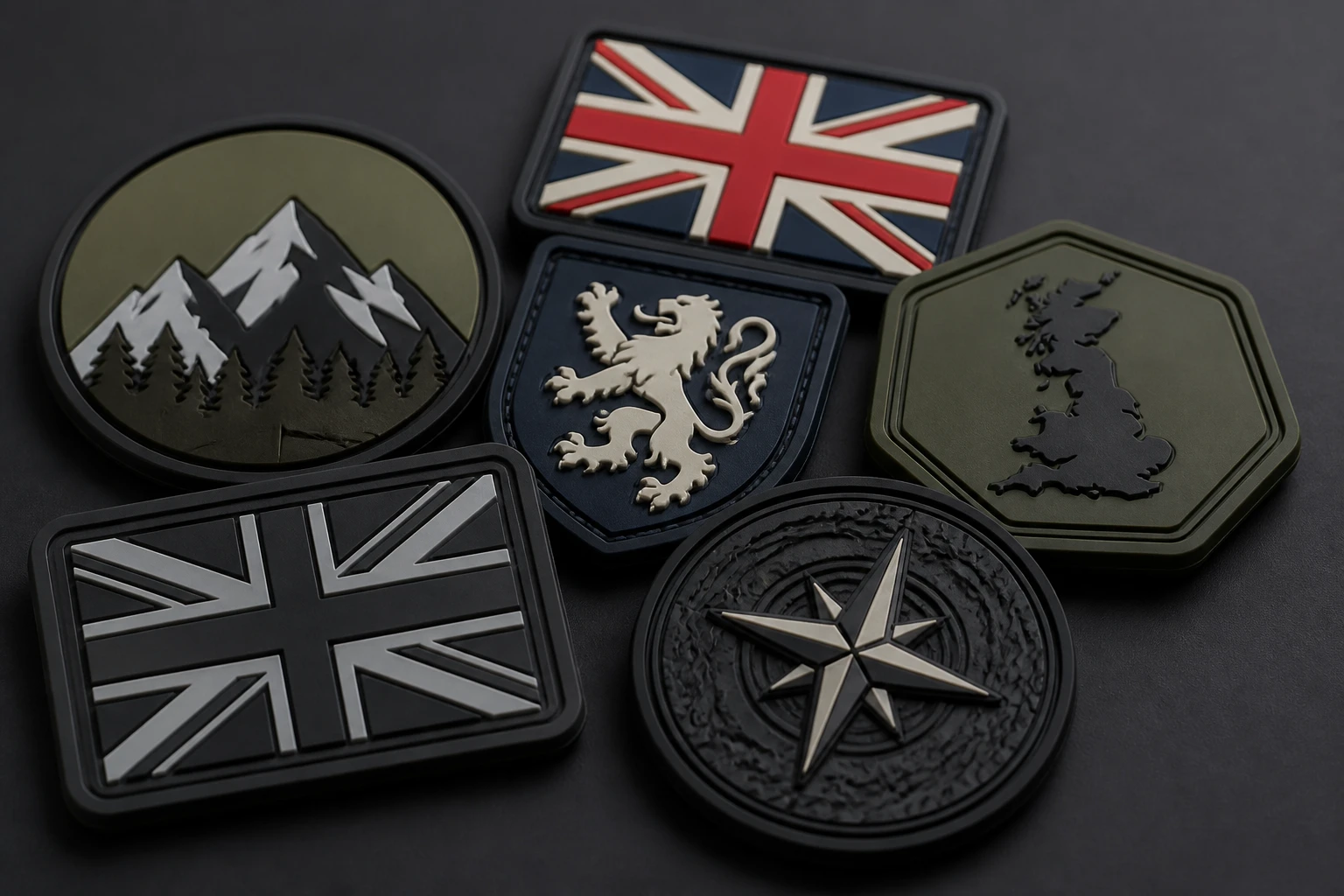
Key takeaways
- PVC patches suited the brand because the badge needed clean lines, raised detail and a surface that was easier to wipe than thread.
- Artwork was simplified for the physical size; tiny lettering and narrow gaps were not carried into production unchanged.
- The backing was selected by garment: sew-on for permanent placement and hook-and-loop for removable equipment panels.
- The Customized Patches uses a five-piece minimum per design and normally supplies a free digital mockup within 12 hours before production.
Please note: this is an illustrative worked example, not a report on a real customer. The brand, garments and decisions below are a hypothetical scenario based on common UK patch briefs, written to show the questions worth asking and the choices involved. No customer results, sales figures or reviews are claimed.
The UK brand in this worked example used PVC patches for a compact outdoor badge that had to work on nylon jackets, equipment bags and removable Velcro panels. The choice was successful because the design used bold shapes, limited colours and short lettering that remained easy to read at a practical size.
For a project like this, The Customized Patches checks the artwork, discusses the backing and prepares a free digital mockup, usually within 12 hours. The brand approved the mockup before production, and the order met the five-piece minimum per design.
The brief: one badge for several types of kit
The customer was a hypothetical UK outdoor brand preparing branded kit for staff, event teams and customers. Its clothing range included lightweight nylon shells, heavier fleece layers and a wool coach-style jacket. The same mark also needed to appear on kit bags, which made the attachment method just as important as the face of the patch.
This is a common brief on our team. A football club may want one crest for tracksuits and kit bags, a cadet unit may need a removable identifier on a tactical panel, and a hospitality business may want a smart badge on polos. One artwork can serve those uses, but one backing does not always suit them all.
- The patch needed to be recognisable at roughly 2.5 to 3.5 inches wide.
- The brand wanted a raised edge and raised symbol rather than a flat printed surface.
- The design had to cope with regular handling and occasional surface wiping.
- The patch needed to sit neatly beside pockets, zips and seams.
- The customer wanted a small first order rather than committing to a large run.
- The design had to be checked visually before any units were made.
That last point prevented an avoidable mistake. The original logo looked fine on a screen, but the narrow gap inside one letter would have been too tight at the chosen size. It was widened in the production artwork, while the main outline was kept close to the supplied brand mark.
Why PVC patches fitted the brand’s visual brief
PVC patches were selected for their solid, moulded appearance. They give a badge a distinct raised profile, clean borders and a surface without loose thread ends. That suited an outdoor identity built around simple symbols and strong block lettering.
The material was not chosen because it is automatically better than every other patch type. Printed is flatter; that is the point. Woven is useful for fine, small detail. Embroidery brings texture and a traditional crest feel. For this customer, the decision came down to the intended look, the clothing, the handling conditions and the need for a wipeable face.
| Patch type | Best fit for this brief | Main advantage | Trade-off |
|---|---|---|---|
| PVC patches | Outdoor jackets, bags and Velcro panels | Raised detail, clear edges and a wipeable surface | Less soft and less traditional than thread |
| Embroidered patches | Club crests, school blazers and uniforms | Textured thread finish with a familiar badge appearance | Fine detail can become crowded and the face is less easy to wipe |
| Woven patches | Small lettering and detailed flat artwork | Fine lines can remain sharper than standard embroidery | Flat surface and less of the raised PVC appearance |
| Printed patches | Gradients, photographs and very flat artwork | Smooth, flat colour reproduction | The surface does not provide moulded raised detail |
| Leather patches | Premium casualwear and wool garments | Natural material with a restrained finish | Not the right visual language for every technical outdoor product |
The brand also considered embroidered patches before settling on PVC. That comparison was useful because the customer could see the difference between a thread-based crest and a moulded badge rather than choosing from a product name alone. For a more detailed material decision, our guide to PVC patches vs embroidered patches: Which Is Right for Your Project? sets out the same trade-offs.
Raised detail was useful, but not every detail could be raised
The first artwork contained a fine contour line around the central symbol. At the size requested, that line was too close to the border to read as a separate raised element. The sensible fix is to merge it into the main shape. This kept the visual idea while giving the moulded lines enough room to hold their definition.
This is where a production mockup matters. A design can have the correct colours and still need changes to line weight, spacing or letter height. The digital proof is not a photograph of the finished patch, but it is a practical way to inspect the planned shape, size, colour arrangement and backing before production.
Artwork changes that made the PVC patches work
The supplied logo was not redrawn from scratch. It was prepared for manufacture. That distinction matters. A brand owner should expect the production version to respect the original identity while adapting features that cannot survive at a small physical scale.
- The internal gap in one letter was opened slightly so the colour would not close up.
- A very thin outline was thickened and joined to the surrounding shape.
- The number of surface colours was kept under control rather than matching every shade in the wider brand guide.
- The outside border was made clear enough to separate the badge from dark nylon and fleece.
- The final shape was checked against the chosen width in inches, not just viewed as a large computer graphic.
- The artwork was reviewed for both the face and the selected attachment method.
The brand had originally supplied a detailed illustration for a larger sign. That version would have been a poor patch at 2.75 inches wide. The recognisable centre mark stays and two decorative lines go. The result was less detailed on paper but more legible on a jacket, which is the useful measure.
Customers preparing artwork can use our guide, How to Design Artwork for PVC patches That Production-Ready, before sending a file. It covers line spacing, lettering, colour planning and the information that helps a quote move without repeated questions.
Backing choices: sew-on, iron-on or hook-and-loop
The brand did not put the same backing on every item. Permanent staff jackets were marked for sew-on attachment. Removable equipment panels were planned for hook-and-loop. That split was more sensible than forcing one backing to do two different jobs.
| Backing | Suitable use | What to check | Practical warning |
|---|---|---|---|
| Sew-on | Nylon shells, fleece, wool coaches and workwear intended to keep the badge | Access to the reverse of the garment, seam placement and thread colour | Allow time for careful stitching; a thick seam or pocket can make sewing awkward |
| Iron-on | Compatible smooth fabrics where the care label and heat tolerance allow it | Fabric composition, heat setting, pressure and washing instructions | An iron-on patch can peel after a dryer cycle if the fabric, heat or application is unsuitable |
| Hook-and-loop | Tactical clothing, bags and dedicated removable panels | Loop panel size, hook direction, usable area and whether the garment already has a panel | The patch needs a matching loop area; it is not a substitute for a panel that is missing |
| Adhesive | Temporary display or short-term placement in suitable conditions | Surface cleanliness, duration and exposure to moisture | Not normally the first choice for repeatedly washed clothing |
Iron-on deserves a plain warning. It is common to see an iron-on badge look fine on application day and then lift at the corners after a dryer cycle. That does not mean iron-on is always wrong, but it does mean the fabric, heat, pressure and care routine need checking. Nylon shells, coated materials and technical fabrics are not all suitable for the same treatment.
On wool coaches and school blazers, sew-on is often the safer route because the garment may not tolerate direct heat. On a Velcro panel, hook-and-loop is the obvious functional choice. A backing decision made early prevents the common problem of receiving a good-looking patch that cannot be attached as intended.
Not sure whether a raised PVC finish or a thread-based badge suits the logo? Send the artwork and garment details to The Customized Patches for a free digital mockup, usually within 12 hours, so you can compare the planned result before production.
GET A FREE MOCKUPSize, shape and colour decisions
The customer first requested a badge close to 2 inches wide because it looked tidy on the screen. Once placed over the pocket area of the nylon shell, that size made the lettering too small. A wider version, close to 3 inches, with the height adjusted so the badge does not interfere with the zip, solves it.
There is no universal best patch size. A sleeve badge, chest badge, cap badge and bag badge have different working areas. Measure the available panel in inches, allowing room for stitching, borders and movement. A patch that fits the blank space on a product photograph may not fit around a real pocket or seam.
- Chest and sleeve badges should be checked against the garment’s seams and pockets.
- A bag badge should not sit across a fold, handle attachment or frequently rubbed corner.
- A cap has a curved surface, so a wide rigid shape may not sit as neatly as a smaller badge.
- A Velcro patch should be slightly smaller than the usable loop panel unless the panel was made for an exact fit.
- Dark garments need a border and colour contrast that can be seen in shade, not only under bright studio lighting.
PVC colour planning also needs restraint. Matching a brand guide colour may be possible, but small patches do not always benefit from many close shades. A strong base, a contrasting border and one or two supporting colours often read better than a crowded miniature version of a full identity system.
The border did more than finish the edge
The border separated the mark from black and navy garments, but it also helped protect the visual shape of the badge. Without a defined outside edge, a dark PVC patch can lose its silhouette against a dark jacket. The border was therefore treated as part of the design, not an afterthought.
Customers who prefer thread texture can compare the same design with 3D embroidered patches or woven patches. Those materials may suit a different garment or brand position. The correct choice is the one that remains readable, attachable and appropriate after considering the actual item.
How the order moved from quote to approval
The quote was prepared around the design rather than a vague request for “some patches”. The customer supplied the artwork, approximate width, quantity, backing requirement, garment types and UK delivery details. That gave us enough information to identify the practical questions before the mockup was made.
The Customized Patches has a five-piece minimum per design. That makes a small trial run possible for a club, start-up or event team, while keeping the production instructions clear. If several colourways are needed, each distinct design should be counted separately rather than treating the whole collection as one artwork.
- Send the logo or artwork, even if it is not yet in a production-ready format.
- State the intended finished size in inches or provide the available garment area.
- Name the garments and equipment: nylon shell, fleece, wool coach, bag, cap or Velcro panel.
- Confirm whether each item needs sew-on, iron-on or hook-and-loop backing.
- Provide the quantity per design, with a minimum of five pieces per design.
- Review the free digital mockup, usually supplied within 12 hours.
- Request amendments while the design is still at proof stage.
- Approve the final mockup in writing before production starts.
The customer made two useful changes during approval: the badge became slightly wider, and the hook-and-loop version was separated from the sew-on specification. Those changes were inexpensive at proof stage and would have been inconvenient after manufacture. The approved artwork then became the reference for the production run.
For a more detailed checklist, see A Step-by-Step Guide to Ordering PVC patches. It is especially useful if several people are involved, such as a brand manager, garment supplier and club administrator.
Lead times, quantities and UK delivery planning
A good order plan separates approval time from production and delivery. The mockup is normally supplied within 12 hours, but the customer still needs time to review it, ask questions and approve the final version. Production should not be treated as started while artwork, size or backing remains undecided.
For a UK order, provide the delivery postcode and the date the patches are needed for. A trade show, club season, outdoor event or uniform launch can make a few days significant. We can discuss the practical timetable from the approved specification, but a final production date depends on the agreed details and order requirements.
- Send one consolidated list of changes rather than separate messages from several team members.
- Keep the approved artwork, quantity and backing specification together.
- Order samples or a small run first if the garment fabric is unusual or the placement is critical.
- Allow time for attaching sew-on patches to a large batch of jackets or bags.
- Check care labels before choosing heat application.
- Keep spare patches for later replacements if the garment will be used outdoors or by a busy team.
The brand’s first run was deliberately modest. It gave the team enough pieces for the initial jackets, bags and display stock without ordering a large quantity before the badge had been seen on the actual kit. A five-piece minimum makes that type of staged decision possible, provided each design meets the minimum.
What the brand avoided by checking the details early
Most patch problems are not caused by the material alone. They come from a mismatch between the artwork, garment, backing or expected use. The customer avoided several of these issues by showing the real jacket and asking about attachment before approving the quote.
| Potential problem | What could have happened | Preventive check |
|---|---|---|
| Tiny lettering | Letters become difficult to read or merge into the border | Review the actual proposed width and simplify small text |
| One backing for every garment | A removable equipment patch becomes permanent, or an iron-on is unsuitable for nylon | Specify backing by garment and use |
| Badge placed over a seam | The patch sits unevenly or is difficult to sew | Mark the intended position on a sample garment |
| Too many colours | The small face appears busy and close shades lose separation | Prioritise contrast and identify essential colours |
| Artwork approved only on screen | The physical proportions feel wrong at the chosen size | Review a mockup with dimensions and request changes before production |
| Ignoring care instructions | Heat or washing affects the attachment or garment | Check the label and use a suitable application method |
It is common to see similar issues with merrowed crests on football jackets, school badges on blazers and iron-on logos on workwear. A merrowed edge can give an embroidered crest a neat border, but it still needs room around the artwork. A clean digital file is not the same as a production-ready badge.
Our guide to Common Mistakes to Avoid When Ordering PVC patches covers the checks in more detail. It is worth reading before a deadline, particularly if the badge will be attached by a third party rather than by the patch supplier.
Where the result worked, and where PVC was not the answer
The PVC version worked for the brand because the badge was compact, graphic and intended for practical clothing and equipment. The raised details made the central symbol stand apart, while the solid surface suited a product that would be handled, packed and wiped down.
Name sew-on, iron-on or hook-and-loop on the quote, and include the garment or panel photograph. The Customized Patches will show the planned backing on a free digital mockup, usually within 12 hours; production starts only after approval.
GET A FREE MOCKUPThere were clear limits. A photograph-heavy illustration would have been better suited to printed patches. A soft heritage crest for a wool coach or school blazer might have looked more natural as embroidery. A premium casualwear label could reasonably choose leather patches instead. Material choice should follow the design and garment, not a general claim that one option works for everything.
- Choose PVC for raised, graphic marks and equipment that benefits from a wipeable face.
- Choose embroidery for thread texture, traditional club identity and many uniform crests.
- Choose woven construction for small flat detail where a smooth face is preferred.
- Choose printed construction for gradients, photographs and artwork where flat colour is central.
- Choose leather for a natural, understated badge on suitable garments.
- Choose hook-and-loop only when the garment or bag has a compatible loop panel.
For biker clubs, motorcycle groups and outdoor crews, the shape and backing can change the whole impression of the badge. You can compare options through the biker and motorcycle club patches product page, while our PVC patches hub gives a closer look at the material and common specifications.
A practical specification for a similar UK project
If you are planning a comparable order, the following specification is a sensible starting point. It is not a fixed template; the correct dimensions and backing depend on the artwork and garment. Use it to prepare the information needed for a useful quote.
| Specification | Example for this type of project | Why it matters |
|---|---|---|
| Material | Moulded PVC with raised symbol and border | Sets the surface appearance and available detail |
| Finished size | Approximately 3 inches wide, adjusted to the garment | Keeps lettering readable without crowding the pocket or zip |
| Shape | Custom outline following the brand mark | Supports recognition and avoids unnecessary empty space |
| Colours | Strong base colour, contrasting border and limited accent colours | Maintains separation at a small physical scale |
| Attachment | Sew-on for permanent jackets; hook-and-loop for equipment panels | Matches the way each item will be used |
| Quantity | At least five pieces per design | Meets the minimum and allows a small initial run |
| Proof | Free digital mockup usually within 12 hours | Allows size, artwork and backing to be checked before production |
| Approval | Written approval of the final mockup | Confirms the agreed design before manufacture begins |
The useful lesson from this worked example is not simply “choose PVC”. It is to define the job properly. The best badge is the one that can be read, attached and cared for in the conditions where it will actually be used.
Questions to ask before ordering PVC patches
A short internal checklist can save several rounds of emails. Ask who will wear or carry the item, how often it will be washed, whether the patch must move between garments, and what size looks correct on the real product rather than in the artwork file.
It is also worth deciding who has final approval. For a business, that may be the brand manager. For a club, it may be a committee member. Keeping one approved version avoids a situation where production follows one file while the garment supplier is working from another.
- What garment or equipment will carry the patch?
- Is the badge permanent or removable?
- Does the fabric tolerate heat?
- Is there an existing Velcro panel?
- What is the available area in inches?
- Can the smallest lettering be read at that size?
- How many separate colourways count as separate designs?
- Does the quantity meet the five-piece minimum per design?
- Who will approve the digital mockup?
- What UK delivery date is required?
The Customized Patches can advise on the production side, but the customer still knows the garment and use best. A clear photograph, accurate dimensions and an honest description of washing and wear are more helpful than a long brand presentation with no physical measurements.
The main lesson from this UK PVC patches worked example
The brand’s result came from matching material, artwork and attachment method. PVC patches provided the raised graphic appearance the customer wanted, but the success of the order depended on opening tight artwork, increasing the usable width, separating sew-on and hook-and-loop versions, and approving the mockup before manufacture.
For a UK team, brand, club or business, that is the part worth copying. Start with the garment, measure the space, state the backing, keep the design readable and ask for a proof. The Customized Patches supplies a free digital mockup usually within 12 hours, works from a five-piece minimum per design, and produces only after approval.
Frequently asked questions
Why did the UK brand choose PVC patches?
The brand wanted a raised, graphic badge with clear borders for nylon jackets, equipment bags and Velcro panels. PVC patches suited that brief better than a soft thread finish because the design used bold shapes and limited colours. The choice was based on the intended appearance, garment and use, not a claim that PVC is right for every project.
What is the minimum order for PVC patches from The Customized Patches?
The minimum is five pieces per design. If you need two different colourways or shapes, confirm whether they count as separate designs before ordering. This allows a small test run for a UK club, start-up, event team or business without requiring a large first batch.
How quickly can I see a PVC patches mockup?
The Customized Patches usually supplies a free digital mockup within 12 hours. Send the artwork, approximate size, garment details, backing preference and quantity for the most useful proof. Production begins only after the mockup has been reviewed and approved.
Are PVC patches suitable for nylon jackets?
They can be suitable for nylon jackets, but the attachment method needs checking. Sew-on is often the straightforward option for a permanent badge. Iron-on application must be considered carefully because some nylon and coated technical fabrics do not tolerate the required heat, and an iron-on patch can peel after an unsuitable dryer cycle.
Should I choose sew-on or hook-and-loop PVC patches?
Choose sew-on when the patch should stay on a jacket, fleece, wool coach or bag. Choose hook-and-loop when the item has a compatible loop panel and the badge needs to be removed or moved. State the intended use on the quote so the backing shown on the mockup matches the garment or equipment.
Can PVC patches reproduce small logos and lettering?
They can reproduce clear small details, but very fine lines, narrow gaps and tiny lettering may need adjustment at the finished size. The production artwork may open gaps, thicken lines or remove decorative detail so the badge remains legible. A digital mockup is the right stage to check those changes before production.
Ready to produce custom patches for your UK team or brand?
GET A FREE MOCKUP