
How to Choose the Right chenille patches for Your Brand
Choose chenille patches by matching the pile, size, border, backing and colour to the garment and logo. Chenille suits bold letters, crests and varsity-style artwork, but fine text and detailed gradients may need embroidered, woven or printed patches instead. The Customized Patches has a 5-piece minimum per design and sends a free digital mockup, usually within 12 hours, for approval before production.
Key takeaways
- Chenille works best for bold initials, numbers, crests and simple symbols where raised yarn is part of the look.
- Measure the usable garment area before choosing a size; a patch that fits a jacket back may overwhelm a polo chest.
- Choose sew-on for the most dependable long-term fixing, iron-on for suitable fabrics and light use, or Velcro for removable team and workwear badges.
- The Customized Patches has a 5-piece minimum per design, provides a free digital mockup usually within 12 hours, and produces only after approval.
The right chenille patches depend on the artwork, garment, placement and fixing method, not just the logo itself. Choose chenille for bold letters, numbers, crests and simple symbols that benefit from a raised yarn finish; choose another patch type if your design relies on tiny text, fine lines or photographic detail.
The Customized Patches supplies UK teams, brands, clubs and businesses with a 5-piece minimum per design. You receive a free digital mockup usually within 12 hours, and we produce only after you approve the design, size, colours and backing.
Start with the job the patch has to do
A football club badge on a fleece jacket has a different job from a small logo on a hospitality polo. The first needs presence from a few metres away. The second needs to sit neatly on a relatively small chest area and survive regular washing without making the garment look crowded.
I have quoted chenille designs for football clubs, cadet units, hospitality teams, biker groups and school blazers. The common mistake is choosing a material before deciding what the patch must communicate. If the wearer needs to be recognised across a touchline or in a school corridor, a large, uncomplicated crest is usually more effective than a detailed miniature badge.
- For varsity jackets and wool coaches, use bold initials, large numbers or a simple mascot where the raised pile can be seen clearly.
- For football, rugby and other club kit, check the patch against the jacket or travel top rather than only viewing the logo on a white screen.
- For cadet or uniform use, keep wording short and make sure the patch does not interfere with existing name tapes, rank slides or insignia.
- For hospitality polos, consider a flatter embroidered or woven option if the branding includes small words that must remain crisp.
- For biker vests, confirm the available back panel and the relationship between the main back patch, rocker text and smaller chest patches.
Understand what chenille can and cannot show
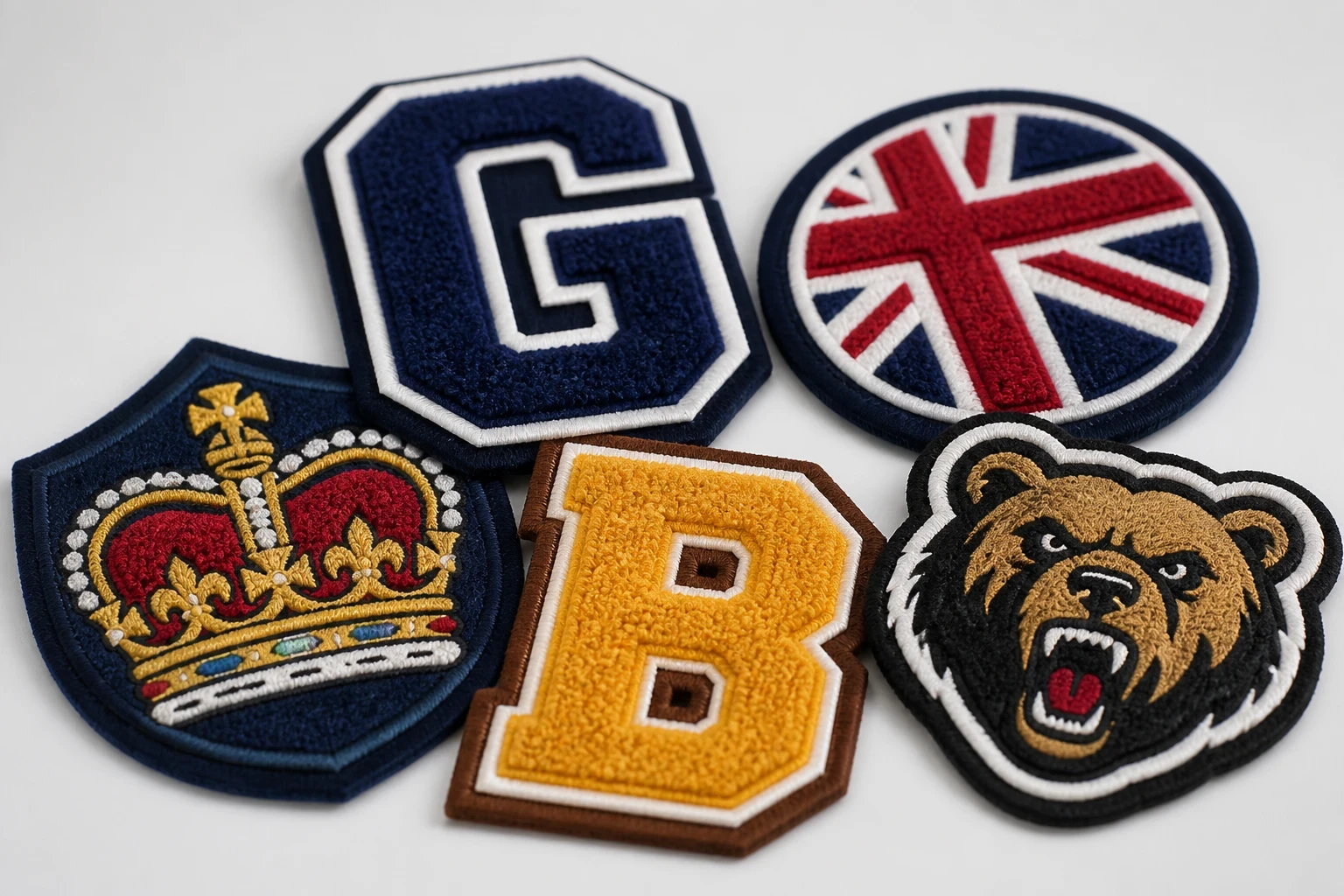
Chenille is made with a raised, tufted yarn surface. That pile gives letters and shapes a soft, tactile appearance and a strong outline when the artwork is kept clear. It is why chenille has become associated with varsity jackets, school awards, sports clubs and large collegiate-style lettering.
The same pile creates limits. Very small text can close up, narrow gaps can disappear and intricate line drawings may lose their character. A merrowed crest with a wide border can look excellent, but a crest containing several tiny internal words may need to be simplified or made as a different patch construction.
Good chenille artwork
- Large initials with a contrasting border.
- One or two bold numbers.
- Simple shields, stars, animals and mascots.
- Short club names with generous spacing.
- Two or three strong colours rather than many close shades.
- A clear outer shape that can be recognised without reading every detail.
Artwork that needs a different treatment
A detailed landscape illustration, a long slogan, a fine line drawing or a logo with delicate gradients may be better as embroidered patches, woven patches or printed patches. Printed is flatter; that is the point. A flat surface can retain small artwork that would be lost in a deep yarn pile.
For a raised single letter or a small three-dimensional accent, compare 3D embroidered patches with chenille. For workwear that needs a hard-wearing technical surface, PVC patches may be more suitable. The correct answer is the one that preserves the mark and behaves properly on the garment.
Choose the size, shape and border together
Size should be measured against the usable garment area, not the garment label. A large adult varsity jacket back might take a patch around 10 to 12 inches wide, while a chest patch may need to stay closer to 3 to 4 inches. Those are starting points, not fixed rules. Seams, pockets, zips and existing badges can reduce the available space.
Lay the garment flat and measure the area where the patch will actually sit. On a school blazer, avoid the pocket opening and lapel. On a nylon shell, leave room for the patch to flex without catching on a zip or binding. On a Velcro panel, measure the panel itself because a patch that overhangs it may lift at the edges.
| Use | Typical starting size | What to check | Likely construction decision |
|---|---|---|---|
| Large varsity jacket back | 8 to 12 inches wide | Back seams, lining and the visual balance with sleeves | Chenille for bold letters, numbers or a large crest |
| Jacket or coaches' coat chest | 3 to 5 inches wide | Pocket, zip, buttons and the wearer’s movement | Chenille or embroidered for a compact club mark |
| Football or rugby travel jacket | 3.5 to 5 inches wide | Existing sponsor marks and repeated washing | Embroidered or chenille depending on logo detail |
| School blazer | 2.5 to 4 inches wide | Pocket, school badge position and formal appearance | Chenille for a bold house letter; embroidered for a detailed crest |
| Biker vest back | 8 to 12 inches wide | Back panel, rockers and curved seams | Chenille for a bold centre badge where the style suits the club |
| Removable workwear panel | 3 to 4 inches wide | Panel dimensions and hook-and-loop placement | Velcro-backed embroidered or chenille patch |
The border also affects the apparent size. A thick outer border gives the patch a definite edge and helps the design read against a busy garment, but it takes space away from the lettering inside. A narrow border can look cleaner on a compact chest patch, although it gives less separation from a similar-coloured jacket.
Shape matters for production and placement. A rectangle suits a name or number, a shield suits a club crest, and a circular design can work well on a blazer or cap. Do not force every logo into a circle. The outer cut should support the mark and leave enough material around the yarn without creating awkward corners.
Match yarn colours to the real brand colour
A chenille colour choice is not simply a matter of picking the nearest screen colour. Your monitor may show navy as almost black, while the yarn sample has a visible blue cast. Bright red can also look different beside black wool than it does on a white digital proof.
Send brand colour references where you have them, but also tell us what the patch will sit on. A school crest intended for a dark green blazer needs enough contrast in the yarn and border. A hospitality logo on a white polo may need a darker outer edge so it does not disappear under indoor lighting.
- Use contrast between the main letter or symbol and its border.
- Avoid putting two very similar dark colours together in a small patch.
- Treat metallic-looking colours carefully; a digital gold effect is not the same as metallic thread or yarn.
- Keep the number of colours sensible for a bold chenille design.
- Check the approval mockup against a photo of the actual garment where possible.
- Ask for clarification if a brand guide specifies Pantone, RGB or HEX values but does not show a physical textile reference.
If exact colour matching is central to the project, a flatter construction may provide more control across small details. That does not make chenille a poor choice. It means the material should be selected for the visual job it performs, rather than being asked to reproduce every feature of a digital logo.
Not sure whether chenille, flat embroidery or printed ink will hold your logo best? Send the artwork and the intended garment for a free digital mockup, usually within 12 hours, so you can compare the size and finish before production.
GET A FREE MOCKUPSelect the backing for the garment and the wearer
Backing is often left until the end of a quote, then treated as a minor detail. It is not. The backing affects how the patch is fitted, how easy it is to remove, how it behaves after washing and whether the garment can accept heat or stitching.
Sew-on backing
Sew-on is the usual choice for a long-term club badge, school blazer, wool jacket or biker vest. It avoids relying on adhesive and suits garments that may be washed regularly. A proper stitch line around the edge keeps the patch secure, but the person fitting it needs access to the inside of the garment and a suitable needle.
Iron-on backing
Iron-on is convenient on suitable cotton or blended fabrics with a firm, smooth surface. It is not automatically right for nylon shells, waterproof coatings, delicate wool or garments that cannot tolerate heat. It is common to see iron-on patches peel after a dryer cycle when the garment, temperature and adhesive were not compatible.
Velcro backing
Velcro is useful for removable team identifiers, security and event clothing, tactical-style outerwear and work garments where one jacket may carry different roles. It adds thickness and requires the garment to have the matching loop panel. Check the panel size before ordering, particularly if the patch has a wide border.
| Backing | Best suited to | Main benefit | Points to check |
|---|---|---|---|
| Sew-on | Blazers, wool jackets, biker vests and regular clubwear | Reliable long-term fixing | Access for stitching and the garment’s seam position |
| Iron-on | Suitable cotton or blended garments | Quick fitting without a separate sewing service | Heat tolerance, washing instructions and adhesive compatibility |
| Velcro | Removable workwear, event kit and role-based uniforms | Patch can be removed or exchanged | Matching loop panel, added thickness and exact panel dimensions |
For a nylon shell, ask about sewing rather than assuming an iron will be safe. For a wool coach jacket, test the position and stitch access. For a school blazer, check whether the school expects a sewn badge and whether an iron-on adhesive could mark the lining. A small backing decision can prevent an expensive garment problem.
Compare chenille with other patch types
There is no universal winner among patch materials. Chenille is tactile and visually strong, but a flat construction may be easier to read at a small size. A printed patch can reproduce detailed artwork, while leather gives a very different, understated finish. Compare the actual use rather than choosing from a photograph of a fashionable jacket.
| Patch type | Surface and appearance | Good choice for | Trade-off |
|---|---|---|---|
| Chenille | Raised, tufted yarn with a soft varsity look | Bold initials, numbers, simple crests and school or sports identity | Fine text and detailed artwork may need simplifying |
| Flat embroidered | Thread-covered surface with clear stitched detail | Club badges, uniforms, workwear and logos with moderate detail | Less raised and less plush than chenille |
| Woven | Flat woven surface with neat small detail | Small labels, fine lettering and compact brand marks | Does not provide the same deep pile or varsity texture |
| Printed | Flat printed image | Gradients, illustrations, photographs and very fine detail | Flatter appearance and a different tactile feel |
| PVC | Moulded, rubber-like technical surface | Outdoor, workwear and designs needing a bold hard-edged finish | Less traditional for school or varsity styling |
| Leather | Smooth or textured leather-look surface | Premium casualwear, heritage brands and simple marks | Usually less suitable for colourful, yarn-based crests |
A football club may use chenille for a limited-edition supporters’ jacket and embroidered patches for its regular staff kit. A fashion label may use leather for a subtle overshirt mark but chenille for a collegiate capsule. A business may use printed patches for an illustrated campaign and woven patches for a compact woven label.
The chenille patches product page is a useful starting point, while the Complete Guide to Chenille patches in 2026 covers wider material and ordering considerations. If you are deciding between raised and flat thread effects, the Difference Between puff embroidery patches UK and flat embroidered patches, Explained explains the practical distinction, although puff embroidery and chenille are not identical constructions.
Plan the order around quantities and repeat use
The minimum order is 5 pieces per design. That works for a small club committee, a five-person team, a pilot run for a new clothing range or a replacement set for a school house. If you need two different badges, each artwork is treated as its own design rather than combining five pieces across unrelated designs.
Before requesting a quote, list the number of each design, the finished size in inches, the garment type, the placement, the backing and the date the patches are needed. If the same crest will go on jackets and bags, confirm whether the size and backing can be shared. A chest badge and a large back badge may need separate dimensions even if the artwork is identical.
- Upload the cleanest logo file available, preferably vector artwork or a high-resolution image.
- State the finished width or height rather than saying ‘standard size’.
- Name the exact garment: nylon shell, wool coach jacket, polo, blazer, fleece or vest.
- Explain whether the patch will be stitched, ironed or attached to a Velcro panel.
- Give the required delivery postcode in the UK and the date of the event or launch.
- Keep a record of the approved mockup so repeat orders use the same size and colours.
A free digital mockup usually arrives within 12 hours, although the timing can depend on the artwork and the information supplied. Review the wording, outer shape, border thickness, colour contrast, dimensions and backing. Production starts only after approval, so this is the point to correct a spelling mistake or move a crest away from a pocket.
Avoid the most common failures
Most patch problems begin before manufacture. The artwork is too detailed for the selected finish, the patch is sized from the logo file rather than the garment, or the customer assumes every adhesive works on every fabric. A clear brief prevents more trouble than a last-minute production change.
The patch is too small for the wording
A long club name may fit neatly in a vector file but become unreadable at 3 inches wide. Shorten the wording, use initials, increase the size or move the text to a separate rocker or label. Do not rely on a screen zoomed to 200 per cent.
Name sew-on, iron-on or Velcro on the quote and tell us what garment will carry the patch. We will show the proposed backing and layout on a free digital mockup, usually within 12 hours, before production starts.
GET A FREE MOCKUPThe colour contrast is weak
Navy yarn on black wool and dark green yarn on a black nylon shell can merge under ordinary indoor lighting. A light border, a stronger internal contrast or a different base fabric may solve it. The mockup should be checked at the approximate viewing size, not only as a large image.
The backing does not suit the fabric
Iron-on that peels after a dryer cycle is a common avoidable failure. Waterproof nylon, coated fabrics, delicate wool and garments with heat-sensitive finishes need particular care. If the patch matters for repeated use, sew-on is often the safer instruction, subject to the garment and fitting method.
The patch is placed over a seam or pocket
A patch can look centred on a flat artwork preview but sit crooked once it meets a curved sleeve, pocket flap or jacket seam. Photograph the garment flat, mark the intended area and send that information with the artwork. This is especially useful for biker vests, coaches’ jackets and structured school blazers.
Use the approval mockup properly
A mockup is not just a formality. It is the final chance to judge the balance between patch and garment before the order is made. Ask the person who owns the brand, the kit manager and the person fitting the patches to review the same version, rather than approving separate screenshots with different changes.
- Check the exact spelling of every word and initial.
- Confirm the patch width and height in inches.
- Check that the outer border does not crowd the letters.
- Compare the colours with the real garment or a reliable brand reference.
- Confirm sew-on, iron-on or Velcro backing.
- Check the position against zips, pockets, seams and existing badges.
- Approve one named version and retain it for future reorders.
If the project is part of a wider clothing launch, keep the patch specification with the garment specification. Record the design name, size, colours, backing and quantity. This reduces confusion when a club orders replacements six months later or a brand adds another jacket colour.
Where to get further UK patch guidance
For a broad introduction, read Chenille patches: Everything UK Buyers Need to Know. It is useful if you are still comparing yarn, edging, sizing and placement. The custom embroidered patches UK sizing guide is also relevant when your logo is better suited to a flatter embroidered finish.
If you are ordering for a club with members across the country, The Customized Patches can arrange UK-wide shipping once the specification is agreed. For local searches, you can also view the UK city pages and compare the practical requirements for teams, businesses and organisations in different parts of the United Kingdom.
The best order is usually the one with the clearest brief. Tell us what the patch is for, show us the garment, give us the finished size and be open about the washing and fitting conditions. We can then advise whether chenille is the right construction or whether embroidered, woven, printed, PVC or leather would protect the design better.
Frequently asked questions
Are chenille patches suitable for business branding?
Yes, if the brand mark is bold enough for the raised yarn surface. Chenille patches work well on staff jackets, hospitality outerwear, event clothing and branded varsity-style garments. For small chest logos with fine wording, embroidered patches or woven patches may preserve more detail.
What is the minimum order for chenille patches?
The minimum order is 5 pieces per design. If you need five club badges and five different initials, those are normally separate designs. State the quantity for each artwork when requesting a quote so the production specification is clear.
How quickly can I see a chenille patch mockup?
The Customized Patches provides a free digital mockup usually within 12 hours. The timing can depend on the quality and complexity of the artwork, but production does not begin until you have reviewed and approved the design, size, colours and backing. You can request a free mockup quote.
Should I choose sew-on or iron-on chenille patches?
Choose sew-on for a dependable long-term fixing on blazers, wool jackets, biker vests and frequently washed clubwear. Iron-on can suit compatible cotton or blended fabrics, but it may not suit nylon shells, coated fabrics or delicate wool. If the garment will go through a dryer, confirm the care requirements before choosing adhesive.
Can chenille patches include small text?
They can include text, but small lettering may become difficult to read because chenille has a raised pile. Short words, initials and large numbers usually work best. If the logo contains a long name or fine lettering, compare it with printed patches or a flat embroidered construction before approving the design.
Are chenille patches good for school blazers and sports jackets?
They can be a strong choice for bold house letters, team numbers and simple club crests on school blazers or sports jackets. Measure the available area around the pocket and existing badge first. The chenille patches product information and mockup will help confirm whether the size, border and backing suit the garment.
Ready to produce custom patches for your UK team or brand?
GET A FREE MOCKUP