
The Difference Between puff embroidery patches UK and flat embroidered patches, Explained
Puff embroidery patches UK use foam beneath selected stitched areas to create raised, three-dimensional lettering or shapes. Flat embroidered patches have thread stitched directly across the surface, giving a thinner, more detailed finish. Puff suits bold logos and fashion-led garments; flat embroidery suits fine detail, small text, formal uniforms and traditional crests.
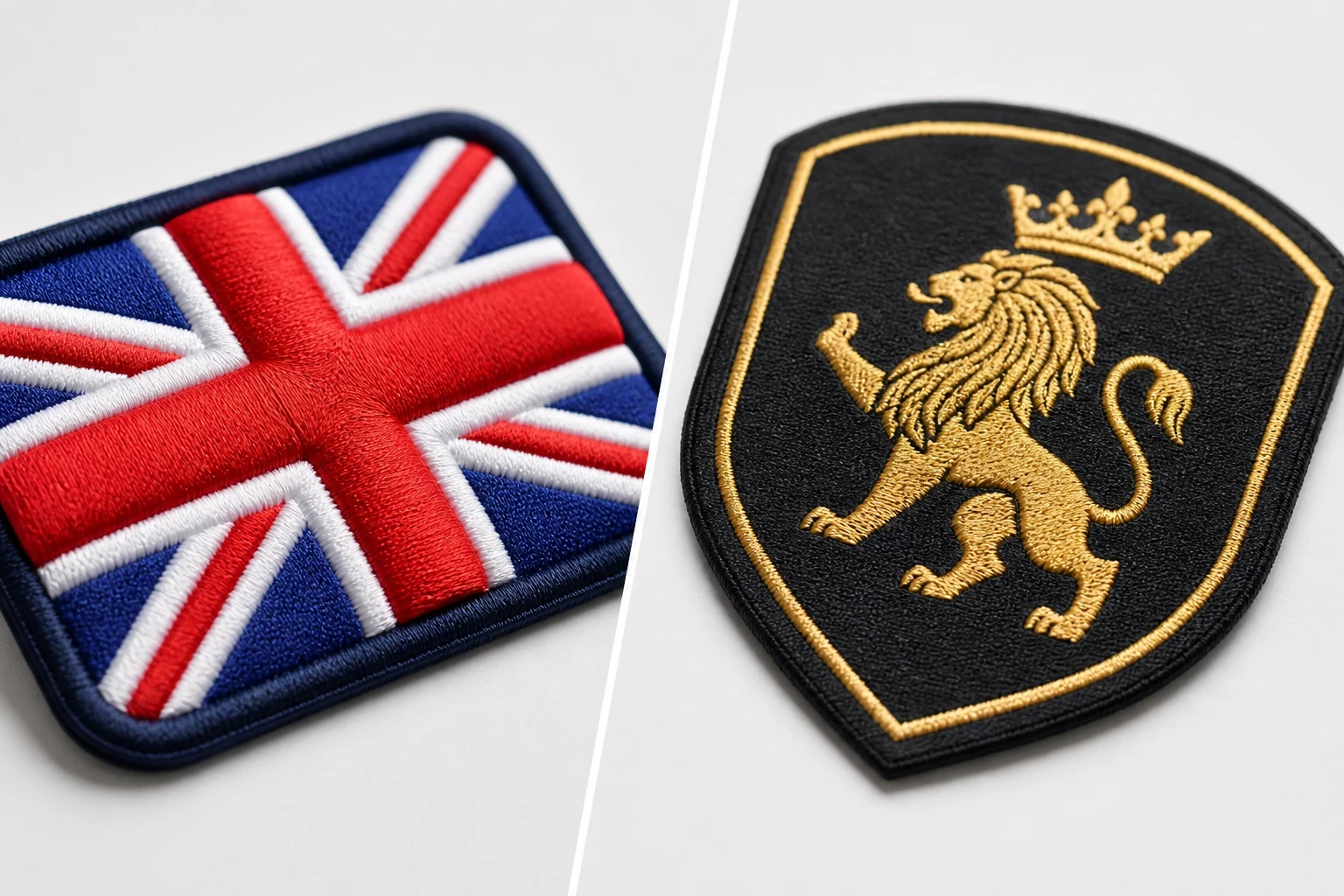
Key takeaways
- Puff embroidery uses foam under selected stitches, while flat embroidery is stitched directly onto the patch surface.
- Puff works best for bold lettering, simple logos and fashion-led garments; flat embroidery handles finer detail and smaller text more reliably.
- Both methods can use sew-on, iron-on or Velcro backing, but the garment and intended washing routine should guide the choice.
- The Customized Patches has a 5-piece minimum per design, provides a free digital mockup usually within 12 hours, and produces only after approval.
Puff embroidery patches UK are raised because foam is placed beneath selected stitched areas, while flat embroidered patches use thread directly across the patch surface. Puff gives bold lettering and logos a noticeable three-dimensional profile; flat embroidery stays thinner and usually preserves finer detail.
The right choice depends on the artwork and the garment, not simply on which finish looks more impressive on a screen. A football club badge with broad initials may suit puff, while a cadet crest with small wording may need flat embroidery. Both can be made for UK teams, brands, clubs and businesses, but they have different production limits.
What are puff embroidery patches UK?
Puff embroidery is a form of raised or 3D embroidery. During production, a foam layer is placed over the chosen area of the patch and the machine stitches through it. Once the stitching is complete, the excess foam is removed, leaving thread held above the base rather than lying fully level with it.
The raised section is normally used selectively. A large letter, initials, a simple icon or a wide stripe can be made in puff, while the border and smaller supporting detail remain flat. Trying to make every part of a complicated badge raised can make the design crowded and reduce legibility.
Puff is often chosen for caps, varsity-style jackets, streetwear, workwear branding and club merchandise. It gives a logo a shadowed edge and a tactile surface that is easy to notice at arm's length. It is less suited to very small words, narrow outlines, detailed maps or artwork with many close internal gaps.
The term 3D embroidered patch is sometimes used for puff embroidery, although suppliers may use the term 3D for other raised construction methods too. If the height matters to your order, ask which areas will use foam and which will remain flat. Our guide to 3D embroidered patches covers the wider category, including sizing and backing questions.
How flat embroidered patches differ
Flat embroidery is the familiar stitched patch finish used for team badges, company logos, school crests and uniform decoration. The thread is sewn across the base fabric and follows the artwork in a controlled pattern. The completed patch has texture, but its face remains comparatively level.
That lower profile is not a weakness. Printed is flatter; that is the point. Flat embroidery gives a clean surface for detail and usually works better where lettering, narrow borders or several small colour areas need to be read. It can also be easier to position under a jacket or alongside other badges.
Flat embroidery is a sensible option for a football club crest containing a motto, a school blazer badge with small text, or a hospitality polo carrying a company name. It has the traditional stitched appearance many organisations expect. If a design contains photographic shading or very fine tonal changes, a printed patch may be a better comparison than either embroidery method.
The visible difference
Look at the centre of the design first. Puff areas catch light differently and cast a small shadow at the edge of the raised stitching. Flat areas show the thread direction and texture but do not stand proud from the patch in the same way.
The difference is easier to see on bold block letters than on a detailed crest. A small puff monogram on a cap can look strong, whereas a long sentence in puff may lose its counters and become difficult to read. A flat embroidered version may look less dramatic but communicate the wording more accurately.
Puff versus flat embroidery: side-by-side comparison
The table below gives a starting point for a quotation. The final result also depends on patch size, stitch density, colours, border, fabric and backing. A four-inch design has more room for detail than a two-inch design using the same artwork.
| Specification | Puff embroidery | Flat embroidery |
|---|---|---|
| Surface | Raised where foam is used beneath the stitches | Thread sits directly across the patch face |
| Best visual effect | Bold, tactile, dimensional lettering and simple logos | Traditional stitched detail, crests and clean line work |
| Small text | Often difficult if letters are narrow or tightly spaced | Usually the safer choice for readable small wording |
| Artwork tolerance | Needs open shapes, wider strokes and fewer congested details | Can accommodate more internal detail and finer lines |
| Common garments | Caps, varsity jackets, bomber jackets, streetwear and merchandise | Polos, football kits, school blazers, workwear and formal uniforms |
| Feel | Noticeably raised and textured in selected areas | Textured thread surface with a lower profile |
| Backing options | Sew-on, iron-on or Velcro, subject to the garment | Sew-on, iron-on or Velcro, subject to the garment |
| Main trade-off | More visual impact but less room for fine detail | More detail and a lower profile but less raised impact |
Neither method is automatically more durable simply because it is raised or flat. A patch can fail because the backing is unsuitable, the edge is poorly secured, the garment is washed incorrectly or an iron-on is applied to a heat-sensitive fabric. The stitch method is only one part of the specification.
For a removable team identifier on a tactical or sports garment, Velcro may matter more than the difference between puff and flat. For a permanent crest on a wool coach jacket, sew-on is often the more dependable route. We discuss broader custom embroidered patches UK sizing and backing options separately because size and attachment affect the finished result.
Which method suits your artwork?
Artwork is usually the deciding factor. Our team can often tell within a few minutes whether a design needs editing, but a mockup is the proper way to check it. A logo that looks clear at 1,000 pixels wide may not work at two inches once thread, border and foam are involved.
Choose puff for bold, open designs
- Large initials on a cap or varsity jacket.
- A short wordmark with thick, rounded letters.
- A simple animal, shield or emblem with broad colour areas.
- A fashion or merchandise logo where touch and shadow are part of the look.
- A club design that needs to stand out from a distance rather than show a long motto.
Not sure whether your logo has enough room for raised stitching? Send the artwork, preferred size and garment details for a free digital mockup usually within 12 hours. The mockup shows the proposed puff and flat treatment before you decide, and production starts only after approval.
GET A FREE MOCKUPPuff needs enough width for the foam and covering stitches to form a clean raised edge. Very narrow strokes can collapse into the surrounding embroidery. Small counters inside letters such as A, B, R and P can also close up if the artwork is reduced too far.
Choose flat embroidery for detail and wording
- School or cadet crests with small mottos.
- Football badges containing several fine lines.
- Business logos with narrow lettering or detailed symbols.
- Hospitality uniforms where a neat, lower-profile finish is preferred.
- Patches that will sit beneath a jacket, strap or other garment layer.
Flat embroidery can still be bold. A dense satin stitch, strong border and high-contrast thread can make a flat patch visible without adding foam. It is often the sensible choice for a badge that must remain legible after repeated use rather than make a raised fashion statement.
Use a mixed treatment where it helps
A mixed puff and flat design can give the main feature height while protecting the smaller information. For example, a brand might use puff for its two-letter initials, flat embroidery for a thin underline and a merrowed border around the outside. A football club might raise the club initials but keep the season wording flat.
This approach needs clear artwork instructions. Mark the areas intended for foam rather than assuming every solid colour will be raised. If you want to compare options, our guide to choosing the right puff embroidery patches UK for your brand explains the questions worth answering before production.
Garment, backing and wear considerations
A patch is attached to a real garment, not displayed as a flat digital image. Nylon shells can be slippery and heat-sensitive, wool coaches need care around pressing, and stretch sports fabrics may need a backing and stitch approach that does not distort the panel. Send a garment photograph or state the material when requesting a quote.
Iron-on backing is convenient, but it is not right for every fabric or washing routine. A customer may apply an iron-on correctly and still find it lifts after a dryer cycle if the garment is unsuitable or the heat and pressure were inadequate. Sew-on is slower to attach but is normally the safer choice for heavily used jackets, bags and uniforms.
Velcro works well for removable identifiers, role patches and equipment panels. It is useful for teams whose members change positions or for garments that need washing separately. Check the panel dimensions before ordering: a patch can be made correctly and still feel wrong if the hook-and-loop area is smaller than the patch.
- Nylon shell or rain jacket: confirm heat suitability before selecting iron-on.
- Wool coach jacket: sew-on is often the safer attachment, with care around the fabric.
- Cotton polo: flat embroidery commonly gives a neat lower-profile result.
- Cap: puff can work well for bold initials, provided the curved panel has enough width.
- Football shirt or kit: check stretch, washing temperature and the club's preferred attachment.
- School blazer: flat embroidery is usually easier for detailed crests and small wording.
- Biker vest: consider sew-on construction and a strong merrowed edge for regular wear.
For motorcycle clothing, the patch may face rain, friction and repeated handling. A raised finish can look effective on a bold back emblem, but a detailed front chest badge may be clearer in flat embroidery. See the dedicated biker and motorcycle club patches hub for garment and layout considerations.
Cost, quantity and production expectations
Puff embroidery can require more production planning because the raised areas must be separated, digitised and stitched cleanly around their edges. Flat embroidery may be simpler for detailed artwork, but a dense design, many thread colours or a large patch can still affect the quotation. Size, quantity and the number of finished designs matter as much as the word puff.
The Customized Patches has a 5-piece minimum per design. That means five patches of one approved design is the starting order quantity; changing the logo, wording or layout can make it a separate design. Ask for a quote in pounds sterling with the size, quantity, thread colours, border and backing listed so the comparison is useful.
A small business may order five puff logo patches for sample jackets, while a football club may need 30 flat crests for a squad. A hospitality group might begin with five approved polo patches before placing a larger repeat order. The most economical method is not always the one with the lowest unit figure: reworking unreadable artwork or replacing a failed attachment costs more than choosing correctly at the start.
The process is straightforward. Send the artwork and requirements, review the digital mockup, request any sensible changes, and approve the final version. The Customized Patches usually sends a free digital mockup within 12 hours and produces only after approval, so colours, wording, dimensions and raised areas are agreed before manufacture.
How to order the right patch in the UK
- State the intended garment and where the patch will sit. A left chest, sleeve, cap front and jacket back each have different practical limits.
- Give the finished width or height in inches. If you are unsure, measure the available area rather than guessing from the screen.
- Send a clear logo file, ideally vector artwork, but include the original image if that is all you have.
- List the wording exactly as it should appear and identify any areas that must be raised.
- Choose a border style, thread colours and backing: sew-on, iron-on or Velcro.
- Confirm the number of patches required, remembering the 5-piece minimum per design.
- Ask for the free digital mockup and check it at the intended physical size.
- Approve the mockup only after checking spelling, colour contrast, border, backing and the position of puff sections.
A quote is more useful when it includes the details that change manufacture. “Twenty patches of this logo” is a starting point; “twenty 3-inch wide patches, flat embroidered, black merrowed border, sew-on backing, for cotton polos” gives our team something specific to price and show.
Our step-by-step guide to ordering puff embroidery patches UK covers the same journey in checklist form. If the artwork needs simplifying, the guide to designing artwork for puff embroidery patches UK explains why stroke width, spacing and text size matter.
Name sew-on, iron-on or Velcro on the quote and tell us whether you want puff, flat or a mixed finish. We will show the proposed construction on a free digital mockup usually within 12 hours; production starts only after you approve it.
GET A FREE MOCKUPCommon examples from UK orders
A football club may want a traditional flat embroidered crest for shirts and training tops, then choose puff initials for a supporters' cap. The two finishes can use the same colours while serving different purposes. The crest needs readable detail; the cap needs a compact mark that holds attention from a few feet away.
Cadet units and schools often need badges that remain easy to inspect. Flat embroidery usually makes sense where a motto, year or small emblem is part of the identity. A raised border can be considered for a larger ceremonial or presentation badge, but the written information should not be forced into puff if the letters are too small.
For hospitality polos, flat embroidery is commonly chosen because it sits neatly on the chest and does not catch against an apron or overshirt. A restaurant or drinks brand launching merchandise may use puff on a heavyweight jacket or cap instead. Printed patches can also be considered for gradients and artwork with photographic detail.
Biker clubs and motorcycle groups often favour a strong stitched look with a bold back emblem and smaller front identifier. Puff can suit large initials, but a detailed club name around a circle is usually easier to control in flat embroidery. Sew-on backing is often specified for leather or heavy textile vests, with the garment material confirmed before manufacture.
Puff or flat: a practical decision
Choose puff if the main purpose is visual impact, touch and a raised logo that reads quickly. Keep the design bold, use sufficiently wide strokes and avoid packing small words into the foam area. It is a strong option for caps, varsity jackets, fashion pieces and simple club or brand marks.
Choose flat if the main purpose is accurate detail, a lower profile or a traditional uniform appearance. It is usually the safer option for crests, school blazers, football badges, hospitality polos and logos with fine wording. Printed, woven and PVC alternatives may also be worth comparing if the artwork is not naturally suited to thread.
- Use puff for bold impact and flat for fine information.
- Use a mixed treatment if only the main mark needs height.
- Do not judge the result from a large computer preview alone.
- Confirm the garment before choosing iron-on backing.
- Ask for a physical-size mockup and approve the construction before production.
- Remember that The Customized Patches accepts orders from 5 pieces per design.
There is no universal winner. The best patch is the one that remains readable, attached and appropriate after it reaches the garment. If you are comparing several techniques, the embroidered patches hub is a useful starting point, while woven patches and PVC patches provide different surface and detail options.
Questions to ask before approving the design
Before approval, check the patch at its intended size rather than relying on a phone screen. Look at the smallest wording, the gaps between letters, the outside border and the areas marked as raised. If the patch is for a team, show it to the person who will wear the garment, not only the person who supplied the logo.
Also ask how the patch will be washed and attached. A correct design can still be a poor order if it is ironed onto a nylon shell, put through a hot dryer or fitted to a Velcro panel that is too small. Clear specifications prevent avoidable surprises and make repeat orders easier.
Frequently asked questions
What is the main difference between puff embroidery patches UK and flat embroidered patches?
Puff embroidery patches UK have foam beneath selected stitches, creating a raised three-dimensional surface. Flat embroidered patches are stitched directly across the base and remain lower profile. Puff normally suits bold logos and short lettering, while flat embroidery is better for fine detail, traditional crests and small wording.
Are puff patches more durable than flat embroidered patches?
Not automatically. Durability depends on the thread, base, edge, backing, garment and care routine as well as the embroidery method. A well-made puff patch can perform well, but foam may not suit every detail or high-friction position. Confirm the garment and washing routine before choosing.
Can a patch combine puff and flat embroidery?
Yes. A design can use puff for bold initials or a central icon and flat embroidery for fine outlines, small wording or supporting detail. This mixed treatment needs clear artwork instructions and a mockup so the raised areas are agreed before production.
Can I use puff embroidery on a school blazer or football shirt?
You can, but flat embroidery is often more suitable for detailed school crests and football badges. Puff can work on larger, simpler lettering or a separate merchandise item such as a cap. The fabric, available space, washing method and required detail should be checked first.
What is the minimum order for these embroidered patches?
The Customized Patches has a 5-piece minimum per design. A design means the approved logo, wording and layout. If those details change substantially, the revised artwork may count as a separate design. Request a quote with the required quantity, size, backing and finish.
How quickly can I see a mockup for puff embroidery patches UK?
The Customized Patches provides a free digital mockup usually within 12 hours. The mockup should be checked for wording, dimensions, colours, border, backing and the areas intended to be raised. Production begins only after approval, so customers can request changes before manufacture.
Ready to produce custom patches for your UK team or brand?
GET A FREE MOCKUP