
Are chenille patches Right for Your Project? A Decision Guide
Chenille patches are right for projects that need a soft, raised, varsity-style finish with strong visual impact. They suit sports clubs, school teams, colleges, lifestyle brands and statement garments. Choose another patch type if you need tiny text, photographic detail, a very flat finish or frequent washing on technical nylon clothing.
Key takeaways
- Choose chenille patches for a soft, raised varsity look and a bold design that does not depend on fine detail.
- Flat embroidered, woven or printed patches are usually better for small lettering, gradients, photographs or a low-profile finish.
- The Customized Patches has a 5-piece minimum per design, and a free digital mockup is usually supplied within 12 hours.
- Production begins only after you approve the mockup, backing, size, colours and final artwork.
Chenille patches are right for your project if you want a soft, raised, varsity-style badge that stands out on a jacket, sweatshirt, blazer or team garment. They work particularly well for football clubs, school teams, colleges, lifestyle brands and bold front-of-garment logos. If your design relies on tiny text, photographic shading or a very flat finish, embroidered, woven or printed patches may be the safer choice.
The decision is less about which patch is best in general and more about the garment, artwork and use. A chenille crest can look excellent on a wool coaches jacket, yet feel too bulky on a lightweight nylon shell. Football clubs, cadet units, hospitality polos, biker vests and school blazers all ask for different things, and the same artwork often needs a different construction for each one.
What makes chenille patches different?
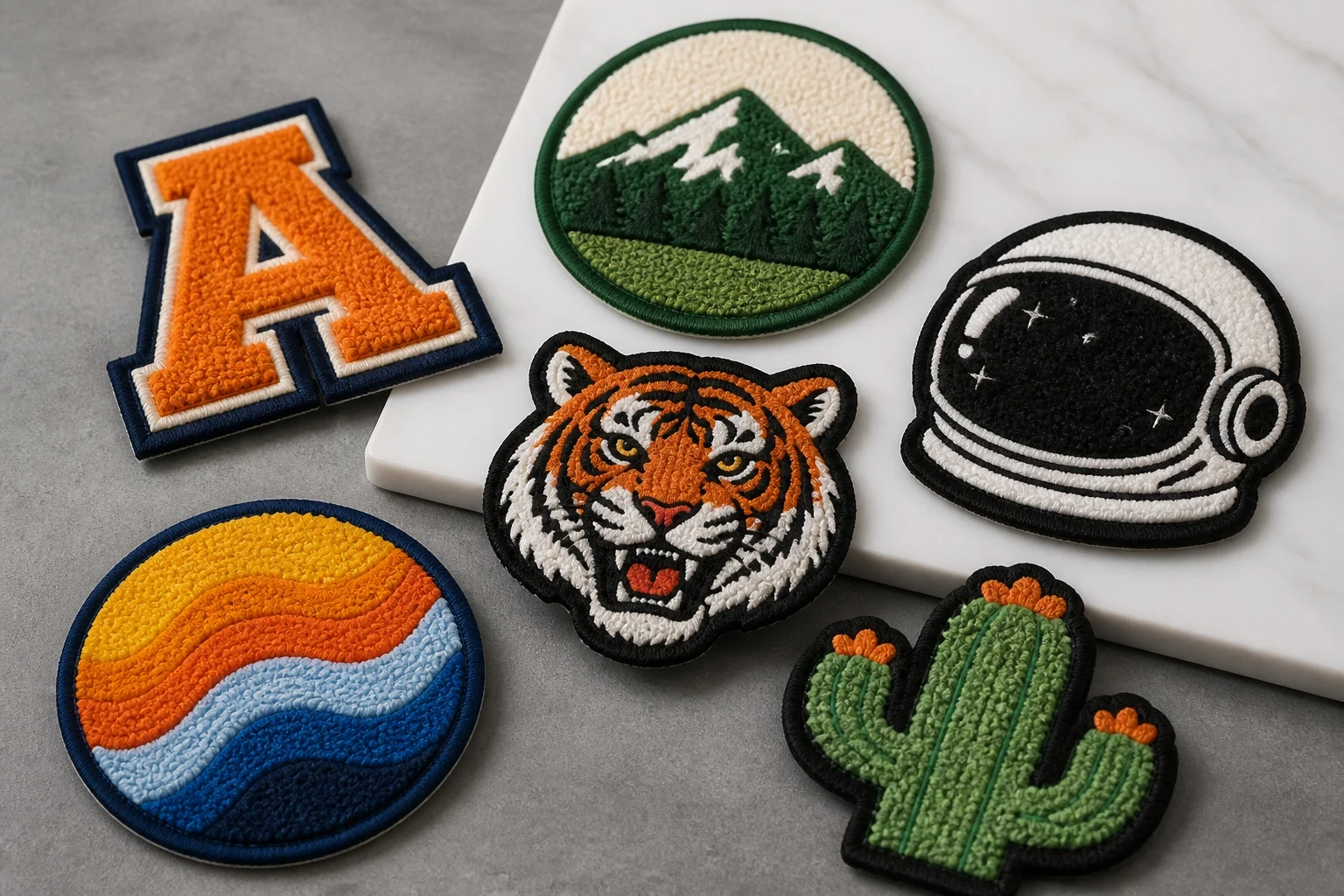
Chenille is made with soft, tufted yarn that gives the surface a raised pile. The result is tactile rather than flat: you can feel the lettering, border or main shape when you run a finger over it. That texture creates the familiar varsity and collegiate look associated with sports jackets, school teams and American-style letter badges.
The surface is also forgiving in a visual sense. A large block letter, simple mascot or two-colour club crest can look confident without being packed with fine stitching. The trade-off is that the yarn texture cannot reproduce every narrow line or tiny character cleanly. Chenille rewards clear shapes and sensible spacing.
The look is the main reason to choose them
- Raised yarn gives the patch a noticeable three-dimensional surface.
- Large letters and simple symbols remain easy to recognise from a short distance.
- The finish suits varsity jackets, wool coaches jackets, sweatshirts, overshirts and heavy cotton garments.
- A bold chenille border can make a simple club mark feel like a finished garment badge.
- The material adds texture that printed patches deliberately do not have.
That last point matters. Printed is flatter; that is the point. It can carry a shaded illustration or a detailed brand graphic with much less visual interruption. Chenille is chosen for the raised finish, not because it is a universal replacement for every other patch method.
Which projects suit chenille patches best?
The strongest projects usually have a clear central mark and a garment with enough structure to support it. A football club may use a large initial on a presentation jacket, while a sixth-form college may put a graduating-year design on heavyweight sweatshirts. A hospitality company could use a smaller raised emblem on a wool overshirt for a deliberately premium, tactile detail.
- Football, rugby, basketball and other team clothing where a bold crest or letter is wanted.
- School and college blazers, leavers' hoodies and society clothing.
- Varsity jackets, wool coaches jackets and heavyweight overshirts.
- Lifestyle and streetwear brands using a large chest, sleeve or back graphic.
- Cadet and youth organisations using a simple unit mark on structured clothing.
- Biker and motorcycle club garments where a substantial, visible badge is preferred.
For biker garments, placement deserves a separate check. A patch on a leather vest may need a sew-on finish and a firm border, while a removable identifier on a utility garment may be more practical with hook-and-loop backing. Our guide to biker and motorcycle club patches covers the wider considerations around vest layouts, club graphics and attachment.
When another patch type may be a better fit
A technical running top, thin nylon shell or close-fitting hospitality polo may not have the weight or structure that chenille prefers. The raised pile can also be awkward if the garment is regularly folded into a small bag or worn under a tight outer layer. In those cases, a flatter construction may sit more neatly.
- Choose embroidered patches for traditional stitched detail and a versatile all-round finish.
- Choose woven patches when small lettering and a flatter surface matter.
- Choose printed patches for gradients, illustrations, photographs and smooth tonal artwork.
- Choose 3D embroidered patches when you want selected raised stitching but not a full chenille pile.
- Choose PVC patches for a moulded, wipe-clean look on outdoor, workwear or tactical-style products.
- Choose leather patches when the material itself is central to the brand or garment.
A useful rule is to start with the garment rather than the logo. If the jacket is heavy and the mark is bold, chenille is worth considering. If the garment is thin, stretchy, waterproof or packed with seams, ask for a comparison rather than assuming the most textured option will perform best.
How artwork affects the choice
Chenille artwork normally works best with broad lettering, uncomplicated silhouettes and a limited colour plan. A monogram, mascot head, shield, initial or short word can translate well. Very narrow counters inside letters, tiny sponsor names and detailed line drawings need a careful review because yarn has physical width and cannot behave like a screen pixel.
Do not judge the design only at full size on a monitor. Print it at the intended patch size, then view it from the distance at which people will see the garment. A 1-inch line that looks clear on a large screen may disappear once converted to yarn. The free mockup is there to expose this before anything is made.
Size, lettering and layout
- Measure the available patch area in inches, including the space needed around a border.
- Keep lettering large enough to remain readable at the finished size.
- Avoid placing important detail directly beside a thick merrowed edge.
- Allow room for the design to breathe rather than filling every corner.
- Check that the patch will not cover a zip, pocket opening, button, seam or existing badge.
- Use a simplified version of the logo if the original contains fine detail that will not suit tufted yarn.
A merrowed crest can be an effective finish on a club badge, but it also adds a visible edge and takes up part of the footprint. We normally ask for the finished width and height, not just the artwork dimensions. That distinction prevents a crest from arriving larger than the chest panel or too close to the sleeve seam.
Colours and contrast
Chenille colour choices should be judged against the garment, not against a white artboard. Navy yarn on a black jacket may lose its outline, while a pale yellow border can be more legible on a dark wool body. Strong contrast between the main letter, inner fill and edge usually helps more than adding extra colours.
Send brand colours if you have them, but understand that thread and yarn are physical materials rather than illuminated pixels. The closest available shade may need to be selected for a practical match. The mockup gives the production team and customer a shared reference before approval.
| Project requirement | Chenille patches | Embroidered patches | Woven patches | Printed patches |
|---|---|---|---|---|
| Raised tactile surface | Strongest choice; tufted yarn creates visible pile | Low to moderate, depending on stitch style | Mostly flat | Flat |
| Large varsity letters | Very suitable | Suitable | Suitable but less textured | Suitable if a smooth graphic is wanted |
| Tiny lettering | Often limited by yarn width | Usually more flexible | Often very suitable | Suitable if the artwork remains clear |
| Gradients and photographs | Not the natural choice | Limited | Limited | Best suited |
| Lightweight nylon shell | Needs careful review | Often more practical | Often more practical | Can be practical with the correct backing |
| Varsity or wool jacket | Excellent visual match | Good all-round option | Good for a flatter badge | Good for a smooth graphic |
| Low-profile finish | No | Usually yes | Yes | Yes |
Not sure whether a raised yarn finish or flat stitching will hold your logo best? Send the artwork and garment details for a free digital mockup, usually within 12 hours, so you can compare the result before production.
GET A FREE MOCKUPThe table is a starting point rather than a promise about every design. Size, backing, garment fabric and washing conditions can change the recommendation. For a closer technical comparison, see The Difference Between chenille patches and embroidered patches, Explained.
Backing and garment compatibility
Backing is not a minor tick box. It controls how the patch is attached and affects how suitable it is for the garment. Sew-on backing is the dependable choice for many jackets, uniforms and heavier fabrics. Iron-on is convenient for suitable heat-tolerant garments, but it is not magic glue and can fail if the surface is damp, textured, heat-sensitive or repeatedly tumble dried.
Hook-and-loop backing is useful for removable identifiers, tactical garments, kit bags and Velcro panels. It is less suitable if the garment has no matching loop area or if the patch will catch on equipment. A nylon shell needs particular care because excess heat can mark or distort the fabric. We would rather flag that at quotation stage than send an iron-on patch that peels after a dryer cycle.
Common garments and sensible starting points
| Garment | What to check | Likely starting point |
|---|---|---|
| Wool coaches jacket | Weight, lining, seams and preferred position | Chenille with sew-on backing |
| Varsity jacket | Leather or synthetic sleeves, ribbing and panel width | Chenille or embroidered with sew-on backing |
| School blazer | Uniform policy, washing method and badge size | Chenille for a bold house or team mark; embroidered for a formal crest |
| Nylon shell | Heat sensitivity, waterproof coating and shell thickness | Embroidered, woven or printed; review chenille carefully |
| Hospitality polo | Stretch, repeated washing and staff comfort | Flat embroidered or woven construction |
| Leather biker vest | Leather thickness, lining and permanent placement | Chenille, embroidered or leather with sew-on backing |
| Removable uniform panel | Existing loop panel and patch dimensions | Any suitable face with hook-and-loop backing |
For a school blazer, the question may not be purely technical. The school could need a neat, restrained crest that matches existing uniform badges, while a leavers' sweatshirt may benefit from a larger chenille letter. For a hospitality polo, comfort, laundering and a low profile normally matter more than a raised surface.
Durability, care and real-world use
A well-specified patch can give good service, but no patch should be treated as indestructible. The garment, attachment method, washing temperature, detergent, tumble drying and frequency of wear all affect its life. Sew-on attachment is often the sensible route for items that will be worn heavily or washed repeatedly.
Chenille pile can collect lint and may be compressed by rough handling. That does not make it unsuitable; it means the care instructions should match the material. Turn garments inside out where practical, follow the garment label, avoid unnecessary high heat and check the attachment after washing. Iron-on backing is especially dependent on correct application and suitable fabric.
Failures we help prevent
- Choosing a chenille badge with lettering too small for the yarn construction.
- Putting an iron-on patch on a nylon shell that cannot safely take the required heat.
- Ignoring a pocket, zip or seam until the patch arrives.
- Using a dark border on a dark garment and losing the edge from normal viewing distance.
- Requesting a detailed crest without accepting that some elements need simplifying.
- Assuming the patch will be removable when sew-on backing has been selected.
- Approving a screen image without checking the actual finished width and height.
One common misunderstanding is confusing a strong face with a suitable attachment. The yarn may still look excellent after months of wear, but the patch can lift if the backing was wrong or the application was rushed. Give the garment details at the start, especially for technical fabrics, uniforms and anything that will go through an industrial laundry.
Quantity, pricing and the UK ordering process
The Customized Patches has a 5-piece minimum per design. That means a club can order five matching badges for a small trial, although the unit price may differ from a larger team run because setup and production time are spread across fewer pieces. If you have several designs, ask us to list them separately so the quote reflects the correct quantity for each design.
A useful quote includes the design, finished size in inches, quantity, face material, border, backing, garment type and delivery location. A rough logo image is enough to begin, but final pricing may need clearer artwork and dimensions. UK-wide delivery can then be planned around the production schedule rather than guessed from a generic product page.
What happens after you enquire?
- Send the artwork, quantity and intended garment. Mention if the patch will be sewn, ironed on or attached to a Velcro panel.
- Confirm the finished size and patch shape. If you are unsure, send a photograph of the available area with a ruler beside it.
- Review the proposed face, border and backing. Ask about a flatter alternative if the garment is thin or the artwork is detailed.
- Receive the free digital mockup, usually within 12 hours. The image should show the agreed design and help you judge proportion, contrast and placement.
- Request changes if the lettering, colours, size or backing is not right. Do not treat the first visual as final if something needs correcting.
- Approve the mockup and quotation. Production begins only after approval, not while artwork is still being changed.
- Check the finished patches on arrival before distributing them to a team or applying them across a large batch of garments.
The approval stage is where most avoidable mistakes are caught. It is much easier to change a border on a digital mockup than to unpick a badge from twenty jackets. Our A Step-by-Step Guide to Ordering chenille patches explains the same journey in more detail, including the information that helps a quote move quickly.
Lead times and planning around a UK deadline
A good deadline includes more than the time on the production line. Artwork changes, approval, backing decisions, garment delivery and UK-wide shipping all need room. A school presentation, club launch or brand pop-up can become stressful if the patches are ordered after the garments have already been printed or distributed.
Tell us the date the patches need to be in your hands, not only the date you hope to place the order. If the artwork is still being developed, say so. We can then advise whether the requested finish and quantity are realistic, or whether a simpler construction would protect the schedule.
A practical deadline checklist
- Confirm the event, match, launch or uniform handout date.
- Allow time for the free mockup and any requested amendments.
- Leave room for approval from a club committee, school office or brand owner.
- Order a sample or small run first if the garment is expensive or the placement is unfamiliar.
- Confirm who will apply the patches and whether they need sewing instructions.
- Keep a few spare pieces if garments will be distributed to children, teams or rotating staff.
- Do not promise a final wearer date until the specification and mockup have been approved.
The 5-piece minimum makes a small test run possible for many projects, but it does not remove the need to test the actual garment. A sample on a cotton sweatshirt tells you less about performance on a coated nylon shell than a sample applied to that shell would.
Name sew-on, iron-on or Velcro on the quote and tell us what the garment is made from. The Customized Patches will show the proposed finish on a free digital mockup, usually within 12 hours, and production starts only after you approve it.
GET A FREE MOCKUPA simple decision guide by project type
Different buyers tend to prioritise different things. A club wants recognition across a pitch or training ground. A brand may care about texture and shelf appeal. A school needs a design that fits uniform rules and survives regular care. The right answer follows that priority.
| Buyer or project | Chenille recommendation | Questions to ask before ordering |
|---|---|---|
| Football or rugby club | Good for bold initials, mascots and presentation jackets | Will the badge sit on a heavy jacket or a lightweight training top? |
| School or college | Good for house letters, leavers' designs and team clothing | Does the school need a formal crest, a raised statement or both? |
| Cadet unit | Possible for a prominent unit mark, subject to uniform rules | Does the design need small text or a removable identifier? |
| Hospitality business | Usually better on structured outerwear than close-fitting polos | Will staff wash the garment frequently or use industrial laundry? |
| Lifestyle brand | Strong choice for tactile, limited-colour branding | Does the badge need to show fine illustration or a clean logo? |
| Biker club | Suitable for a substantial vest or jacket badge | What is the leather thickness, placement and required attachment? |
If you are still undecided, ask for two visual routes: one chenille and one flat alternative. Comparing them at the same size often settles the choice quickly. Our chenille patches product page can be used alongside the embroidered patches hub when you want to compare the raised and stitched finishes.
Questions to answer before approving the design
A production-ready decision should be specific enough that another person could read the quote and understand what is being made. This is especially useful when a committee, school or purchasing team is involved. It prevents one person approving the artwork while another assumes a different size or backing.
- Is the main reason for choosing chenille the raised texture, the varsity appearance or both?
- What is the finished width and height in inches?
- Which garment will carry the patch, and what fabric is it made from?
- Will it be sewn on, ironed on or fitted to a hook-and-loop panel?
- Does the design contain text that may be too small for tufted yarn?
- Will the garment be washed at home, commercially laundered or dry cleaned?
- Is the border visible enough against the garment?
- Are there seams, pockets, zips or existing badges near the placement?
- Is the quantity at least 5 pieces for each individual design?
- Who has authority to approve the digital mockup?
- What date must the patches arrive in the United Kingdom?
- Has the final mockup been approved before production?
These questions are also useful for a second quote. Our 10 Questions to Ask Before Ordering chenille patches goes deeper into quantities, artwork, attachment and supplier communication. Clear answers reduce revisions and make the final comparison fair.
Final decision: are chenille patches right for you?
Choose chenille patches if your priority is a raised, soft and immediately recognisable badge on a suitable garment. They are particularly convincing for large letters, simple crests, mascots and team or college clothing. Their texture is the feature, so do not choose them expecting the flat precision of a printed logo.
Choose embroidered, woven or printed construction if the project needs fine detail, a low profile, photographic shading or a technical-fabric solution. There is no embarrassment in choosing the flatter option. A printed patch that keeps a detailed illustration clear is doing its job, just as a chenille letter that gives a jacket presence is doing its job.
The Customized Patches can help compare those routes for UK teams, brands, clubs and businesses. The minimum is 5 pieces per design. A free digital mockup is usually supplied within 12 hours, and we produce only after you approve the design, size, backing and quotation.
Related guides and product hubs
For more ordering detail, read the Chenille patches Checklist: What to Confirm Before You Order. If you are comparing textures rather than planning a specific order, the guide to chenille patches versus embroidered patches is a useful next step.
You can also browse printed patches, woven patches and 3D embroidered patches to see how a different face construction changes the look and practical specification. UK customers can ask about UK city pages and delivery details as part of the quote.
Frequently asked questions
Are chenille patches suitable for football club jackets?
Yes. Chenille patches are well suited to football club presentation jackets, varsity-style teamwear and heavyweight sweatshirts when the design uses bold letters, a simple mascot or a clear crest. Check the jacket fabric, patch size and backing first. Sew-on backing is often the sensible starting point for garments that will be worn and washed regularly.
What are the main disadvantages of chenille patches?
The raised yarn surface is less suitable for tiny lettering, very fine lines, photographic detail and gradients. Chenille can also feel too bulky for lightweight nylon shells or close-fitting polos. If you need a flat, highly detailed or low-profile finish, compare woven, embroidered or printed construction before ordering.
What is the minimum order for chenille patches?
The Customized Patches has a 5-piece minimum per design. If you have several different badges, each design should be listed separately so the quantity and quote are accurate. A small run can be useful for checking a garment and placement before a larger team or brand order.
How quickly can I see a chenille patch mockup?
The Customized Patches usually supplies a free digital mockup within 12 hours. Send the artwork, intended size, garment type and preferred backing to make the review useful. Production starts only after you approve the mockup and the agreed specification.
Can chenille patches go on nylon jackets?
They may be suitable, but nylon needs careful review because it can be thin, coated or sensitive to heat. Do not assume iron-on backing is safe for every nylon shell. Send a garment photograph or fabric details and consider sew-on or another flatter patch type if the jacket is lightweight or waterproof.
Should I choose chenille or embroidered patches?
Choose chenille for a soft, raised varsity finish and bold, simple artwork. Choose embroidered patches for a more traditional stitched appearance, greater flexibility with detail and a generally flatter profile. The best choice depends on the artwork, garment, washing conditions, placement and whether texture is a central part of the design.
Ready to produce custom patches for your UK team or brand?
GET A FREE MOCKUP