
Woven patches: Everything UK Buyers Need to Know
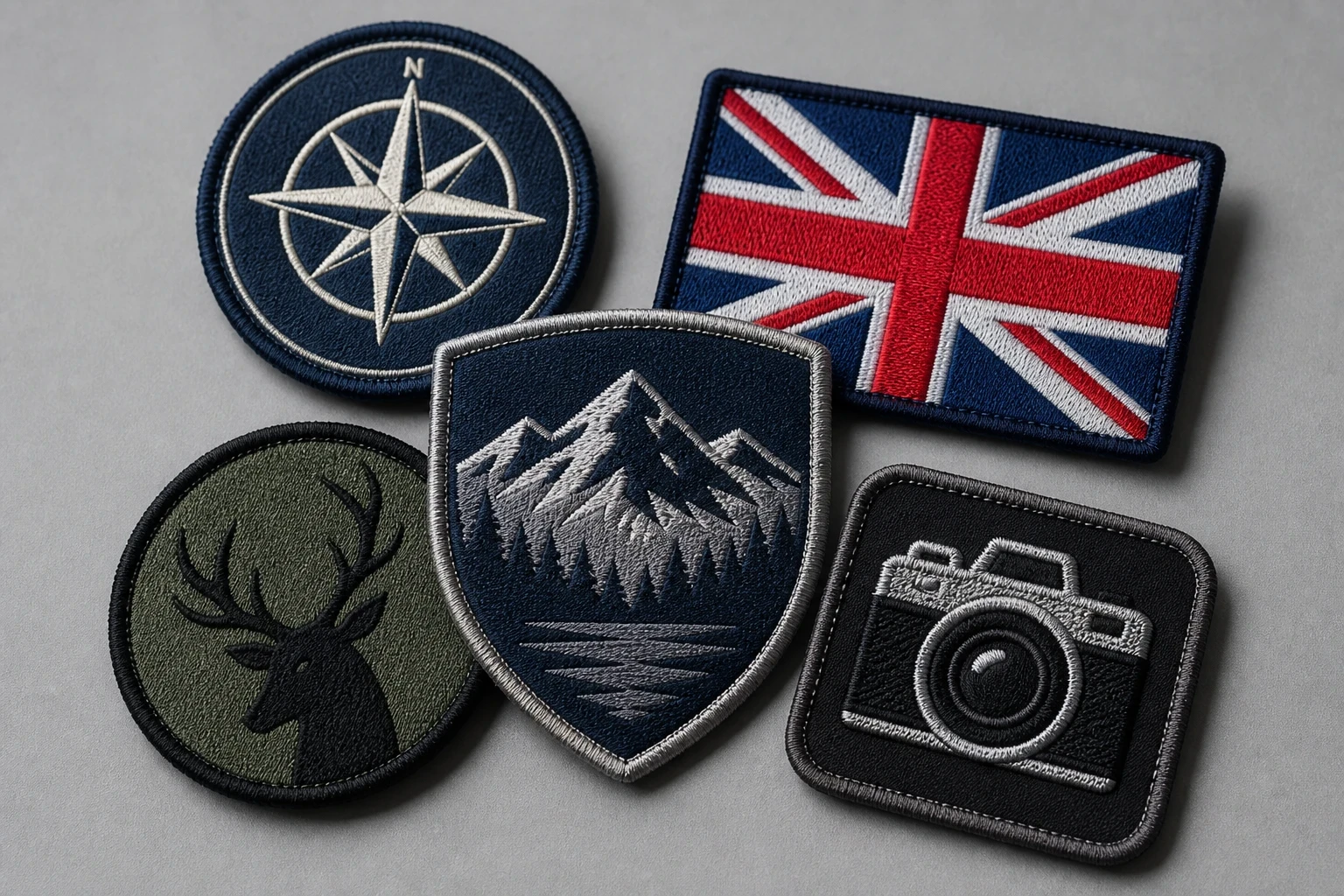
Woven patches are made by weaving fine threads into a smooth, detailed surface, making them suitable for small lettering, logos, badges and clean line work. They are flatter than embroidered patches and usually show fine detail more clearly. The Customized Patches supplies UK buyers with a free digital mockup, usually within 12 hours, and has a 5-piece minimum per design.
Key takeaways
- Woven patches use fine threads to create a flatter surface that suits small lettering, logos and detailed line work.
- They are usually a better choice than raised embroidery when the design needs a neat, compact finish on a polo, cap, shirt or light jacket.
- The backing should match the garment and use: sew-on is dependable, iron-on is convenient but needs care, and Velcro is useful for removable identifiers.
- The Customized Patches has a 5-piece minimum per design, sends a free digital mockup usually within 12 hours, and produces only after approval.
Woven patches are a good choice for UK teams, brands, clubs and businesses that need a flatter patch with clear lettering and tidy fine detail. The threads are woven closely together rather than laid as raised embroidery, so logos often look sharper on small chest badges, caps, polos and light jackets. The Customized Patches has a 5-piece minimum per design and sends a free digital mockup usually within 12 hours.
The right answer depends on the artwork and the garment, not just the word patch. A football club crest for a heavy tracksuit, a hospitality logo on a polo, a cadet identifier on a Velcro panel and a woven label for a clothing brand can all need different construction and backing. We produce only after you approve the mockup, giving you a chance to check the size, colours, border and attachment method first.
What are woven patches?
Woven patches are made by interlacing fine threads across a base, creating a smooth face with a relatively low profile. The process allows more compact detail than traditional embroidery because the surface is not built from thick, raised stitches. That makes woven patches useful for names, small symbols, narrow outlines and logos where a clean edge matters.
They are not printed labels. The design is formed from thread, although the face normally looks flatter and more even than an embroidered patch. A woven patch can have a border, shaped edge and several thread colours, but the final result still depends on the physical size. Tiny text that is readable on a 4-inch badge may become cramped on a 2-inch chest patch.
For a broader look at construction, sizing and ordering decisions, see our The Complete Guide to Woven patches in 2026. If you already know you want this finish, the woven patches product page is the sensible next step for a quote.
Why choose woven patches for a UK project?
The main reason is detail without a bulky surface. A woven crest can show a thin outline around a club name, a compact company mark or several small colour changes without the heavy texture associated with some embroidered designs. It sits comfortably on a shirt front and usually does not catch on bag straps as readily as a high pile.
They also suit repeat branding. A brewery placing the same mark on staff polos, a school adding house badges to blazers, or a cycling club issuing team gilets may want a consistent, restrained finish rather than a large decorative emblem. Woven patches can look particularly neat on garments where the patch needs to sit close to the fabric.
- Choose woven construction for small lettering, clean line drawings, flat logos and compact badges.
- Choose it for polos, caps, shirts, lightweight jackets, bags and garments where a low profile is helpful.
- Ask about a different construction if the design depends on deep texture, thick raised lettering or a soft varsity appearance.
- Use a mockup to check the finished proportion rather than judging only from a large screen version of the artwork.
A woven finish is not automatically better than embroidery. Printed is flatter; that is the point, particularly for photographic artwork, gradients or artwork that needs a continuous ink surface. For raised team initials, a traditional merrowed crest or a bold textured badge, compare embroidered patches before deciding.
Woven patches compared with embroidered, printed and PVC options
The simplest way to choose is to decide what the eye should notice first: fine detail, texture, colour depth, flexibility or resistance to weather. Woven patches sit between printed and embroidered products in appearance. They retain a thread-made face but keep the surface relatively flat.
| Patch type | Surface and detail | Good uses | Main trade-off |
|---|---|---|---|
| Woven patches | Flat to low-profile thread surface with clear small detail | Small logos, names, caps, polos, shirts, bags and compact badges | Less raised texture than standard embroidery |
| Embroidered patches | Raised stitched areas with a traditional textured appearance | Football crests, club jackets, uniforms, workwear and bold badges | Very small wording or fine lines may need simplifying |
| Printed patches | Flat printed face that can reproduce gradients and complex artwork | Photographic designs, tonal artwork, detailed illustrations and soft branding | Does not have the thread texture of woven or embroidered patches |
| PVC patches | Moulded rubber-like surface with defined layers | Outdoor clothing, tactical equipment, bags and weather-exposed applications | Can look too industrial for formal shirts or traditional school blazers |
| Chenille patches | Soft, high-pile yarn with a pronounced varsity texture | School teams, university clubs, college jackets and statement letters | Fine lettering and small intricate artwork are not its strongest use |
A printed patch may be the honest choice if your artwork contains a gradient or a detailed illustration. That is not a failure of woven construction; the materials do different jobs. Likewise, a PVC badge may be more practical on a rain shell, while a chenille letter is often chosen because the texture is the visual feature. You can compare printed patches, PVC patches and chenille patches before sending the final specification.
For school or university clothing, consider the garment as well as the badge. A traditional wool coaches jacket can carry a textured crest comfortably, while a lightweight nylon shell may look cleaner with a low-profile woven badge or a removable Velcro panel. The same club logo can therefore be produced in more than one construction for different parts of a kit.
How to choose woven patch size and shape
Start with the area available on the garment. Measure the space in inches, allowing room around seams, pockets, zips and existing badges. A chest patch for a hospitality polo might be around 2 to 3 inches wide, while a back or sleeve badge may need more presence. There is no universal best size because the logo, placement and wearer all change the decision.
The shape should support the artwork. A rectangular name patch works well for a uniform or Velcro panel. A shield can suit a football club or cadet unit. A circular badge is familiar for clubs and associations, but curved lettering needs enough height to remain legible. Irregular outlines can follow a mascot, map or symbol, although the cutting line should be clear in the artwork.
Small text and fine lines
Small text is where many orders become difficult. Screen artwork may show a six-word slogan clearly, yet the finished patch has only a few inches for those letters. Fine lines can close up when colours sit next to each other, and narrow gaps may disappear. The production team can suggest a shorter wording, heavier lettering or a larger finished size before anything is made.
Borders and merrowed edges
A border frames the design and gives the edge a deliberate finish. A merrowed crest has a raised overlocked edge that is familiar on traditional embroidered club badges. Woven patches can also use a defined stitched border, but the exact edge treatment should be shown on the mockup. If the badge will sit close to a zip or seam, a slimmer edge may be more comfortable.
Not sure whether woven thread, raised embroidery or ink will suit your logo? Send the artwork and the intended garment for a comparison. The Customized Patches provides a free digital mockup usually within 12 hours, with a 5-piece minimum per design.
GET A FREE MOCKUP- Measure the actual placement area on the garment rather than relying on an online image.
- Check the longest wording at the intended size, in inches.
- Keep essential lines and letters away from the cut edge.
- Tell us if the patch must fit a standard Velcro panel or an existing badge position.
- Ask for the artwork to be simplified if small details are decorative rather than essential.
Backing choices: sew-on, iron-on, adhesive or Velcro
Backing is part of the specification, not an afterthought. Sew-on backing is dependable for football jackets, wool coaches jackets, uniforms and bags that will be washed repeatedly. It also works well on fabrics that do not respond safely to heat. A few neat stitches around the border usually give the most secure long-term attachment.
Iron-on backing is convenient for a school blazer, casual jacket or one-off garment, but it needs the correct temperature, pressure and fabric. Nylon shells can be marked or distorted by heat, and a coated waterproof surface may not accept the adhesive properly. Iron-on that peels after a dryer cycle is a common avoidable problem, usually caused by unsuitable fabric, insufficient heat or repeated high-temperature washing.
Velcro is practical for cadet units, event crews, security teams and outdoor groups that need to change identifiers. One side is attached to the garment or panel and the matching side is attached to the patch. Tell us if you need the patch to fit a particular panel width, since a badge that overhangs the loop area may catch on other clothing.
| Backing | Best suited to | Check before ordering |
|---|---|---|
| Sew-on | Regularly washed uniforms, jackets, bags, wool and heavier garments | Allow time for stitching and check the garment can take a needle |
| Iron-on | Suitable cotton or blended garments where quick attachment matters | Confirm heat tolerance; avoid assuming it is suitable for nylon or coated fabric |
| Adhesive | Temporary display, packaging, samples or short-term use | It may not withstand repeated washing, flexing or outdoor exposure |
| Velcro | Removable club, cadet, tactical, event and work identifiers | Measure the existing panel and specify which side is needed |
For a biker vest or motorcycle club jacket, sewing is usually the safer discussion because leather, denim and heavy cotton behave differently from a polo. See the biker and motorcycle club patches hub for placement and construction considerations. For branded garments that need a softer raised finish, 3D embroidered patches may be worth comparing, although their surface is deliberately more pronounced.
Artwork and colour preparation for woven patches
Send the cleanest artwork available, preferably a vector file such as AI, EPS or PDF. A high-resolution PNG can still be assessed, especially for a straightforward logo. Include the correct spelling, preferred colours, border colour and any wording that must not be altered. If the only file is a screenshot from social media, production may need to redraw or simplify parts of it.
Woven patches use thread colours rather than unlimited screen colours. Close shades can appear more similar once converted to thread, particularly navy against black, dark green against black or two nearby reds. If colour matching matters for a company or sports brand, send a colour reference and ask for the proposed thread interpretation in the mockup.
What the mockup should show
- The finished width and height in inches, or a clear proportion if the size is still being discussed.
- The patch shape and border, including any merrowed or overlocked edge treatment.
- The main thread colours and how small wording has been handled.
- The chosen backing, such as sew-on, iron-on or Velcro.
- The artwork placed on a garment where scale or positioning is difficult to judge from a flat file.
The mockup is a checking stage, not a licence to assume every screen colour will look identical in thread. It is there to catch the practical errors: a missing word, a border that is too close, a logo that is too small, or a backing that does not suit a nylon jacket. The Customized Patches produces only after approval, so read the proof carefully.
Where woven patches work well
Woven patches suit many UK garments because they are compact and relatively flat. We regularly discuss football clubs wanting a crisp secondary badge, hospitality teams adding a discreet logo to polos, and businesses branding work bags without a large raised emblem. They can also work well for event passes, cycling groups, independent clothing labels and school house identifiers.
- Football and sports clubs: secondary crests, sponsor marks, player or staff identifiers and kit bags.
- Cadet units and outdoor groups: removable names or unit badges on Velcro panels.
- Hospitality and retail: small logos on polos, aprons, overshirts and caps.
- Schools and colleges: house badges, society marks and club clothing where detail needs to stay tidy.
- Clothing brands: woven labels and logo patches for jackets, knitwear, bags and limited collections.
- Businesses: uniform branding, event clothing, customer gifts and internal team identifiers.
Garment testing still matters. A woven patch on a cotton polo is a different job from one on a stretchy sports fabric. A heavy patch can pull at a lightweight shirt, while a thin adhesive may not survive on a bag that is dragged across a warehouse floor. Tell the quote team how the garment will be washed, worn and stored.
How much do woven patches cost in the UK?
The price depends on the finished size, quantity, shape, number of colours, border, backing and artwork preparation. A small run of five detailed badges has a different unit cost from a larger order for a club or company. Backing can also change the price because Velcro, for example, adds a matching attachment component rather than a simple sew-on finish.
The Customized Patches accepts a minimum of 5 pieces per design. If you need 20 badges with one logo and 20 with a second logo, treat those as two designs for quoting rather than assuming the total quantity applies across both. Supplying the exact number of designs, sizes and backings helps the quote reflect the finished order.
| Specification | Why it affects the quote | Useful information to provide |
|---|---|---|
| Quantity | Set-up and production time are spread differently across five pieces and larger runs | Number of pieces per design, with 5 pieces minimum per design |
| Finished size | A larger badge uses more material and may carry more detail | Width and height in inches, or the garment area available |
| Shape and border | Complex outlines and special edges require more preparation | Circle, shield, rectangle, custom outline or merrowed border |
| Backing | Attachment materials and finishing steps vary | Sew-on, iron-on, adhesive or Velcro |
| Artwork | Redrawing or simplifying artwork can add preparation work | Vector file, high-resolution PNG, colours and wording |
A proper quote should also confirm delivery to your UK address and any deadline. Avoid comparing unit price alone if one option includes a different backing, size or artwork service. The cheapest-looking figure can become the wrong choice if the patch cannot attach to the garment or the lettering has to be changed later.
Ordering woven patches: lead times and approval
Start by sending the artwork, quantity, size, backing, garment type and delivery postcode. If you are ordering for a club or business, nominate one person to approve the design. This prevents a late change from one department undoing a decision already made by another.
Name the size, quantity and backing on the quote, then attach the garment details. We will show the proposed woven construction on a free digital mockup usually within 12 hours, and production starts only after you approve it.
GET A FREE MOCKUPThe Customized Patches usually sends a free digital mockup within 12 hours. Check the spelling, proportions, colours, border, backing and quantity as soon as it arrives. Production begins only after approval, so the approval point is also where you confirm that the supplied information is correct.
- Send the artwork and describe the garment or panel.
- Confirm the quantity per design, remembering the 5-piece minimum.
- Choose the finished size in inches, shape and backing.
- Review the free digital mockup, usually sent within 12 hours.
- Request amendments if the wording, scale or attachment method is not right.
- Approve the final mockup and confirm the UK delivery details.
- Keep the approved proof with your order records for repeat production.
Lead time can vary with the order size, number of designs, artwork complexity and backing. A simple repeat order may be easier to schedule than several new badges with different sizes. If the patches are for a match, school term, launch or trade event, give the date at the first quote rather than after approval.
Care, washing and common failure points
Care depends on the garment and backing. Sew-on patches generally cope well when the stitches are secure and the garment is washed according to its label. Iron-on patches need more caution: repeated high heat, tumble drying and aggressive washing can weaken the adhesive. A patch that is suitable for a casual cotton jacket may not be suitable for a coated nylon shell.
Do not iron directly over the thread or border unless the care instructions allow it. If an iron-on patch begins to lift, pressing it repeatedly may not fix the underlying problem. Sewing around the edge can sometimes reinforce it, but this is best considered before the first wash. For workwear, outdoor clothing or garments washed frequently, ask about sew-on or another more suitable attachment.
- Follow the garment care label rather than assuming the patch can take the same treatment as the fabric.
- Avoid placing a hot iron directly on the patch face.
- Do not use a dryer cycle as a test of an iron-on backing on a delicate garment.
- Check the first wash before committing to a large repeat order.
- Tell the quote team if the garment is exposed to rain, abrasion, chemicals or frequent industrial laundering.
Final checklist for buying woven patches in the UK
A good patch order is usually decided before the design reaches production. The key is to describe the real use rather than sending a logo with no context. A patch for a blazer, nylon shell, football jacket, Velcro panel or leather vest should not be specified in the same way.
- Have you confirmed that woven construction is right for the level of detail and texture required?
- Is the finished size stated in inches or matched to a measured garment area?
- Is the wording readable at that size?
- Have you chosen a backing that suits the fabric and washing routine?
- Is the quantity at least 5 pieces per design?
- Have you sent the best available artwork and named the required colours?
- Has one person been nominated to approve the mockup?
- Have you checked the border, shape, backing and garment placement on the proof?
- Have you given the required delivery date and UK address?
- Will you keep the approved mockup for future repeat orders?
If your project needs a different surface, you can compare the wider range through the embroidered patches hub, or review leather patches for a more material-led badge on selected jackets and accessories. Buyers in Birmingham, Manchester, Glasgow, Cardiff, London and elsewhere across the United Kingdom can use the same quote process and arrange UK-wide shipping.
For a quote, send the artwork, quantity, intended size and garment details. The Customized Patches will prepare a free digital mockup usually within 12 hours, and nothing is produced until you have approved the design.
Frequently asked questions
What are woven patches used for?
Woven patches are used for logos, names, club badges, school identifiers, clothing labels, caps, polos, bags and lightweight jackets. They are useful where fine lettering and a flatter finish matter. The design can be made with sew-on, iron-on, adhesive or Velcro backing according to the garment and intended use.
Are woven patches better than embroidered patches?
Neither is always better. Woven patches generally show small detail and narrow lettering more clearly, while embroidered patches provide a raised, traditional texture. Choose woven for a low-profile logo or compact badge; choose embroidery when the raised thread surface is part of the look, such as a football crest or club jacket emblem.
What is the minimum order for woven patches?
The Customized Patches has a minimum order of 5 pieces per design. If you order two different logos, they are normally treated as two designs, even if the combined quantity is more than five. Confirm the quantity for each design when requesting a quote.
How quickly can I receive a woven patch mockup?
The Customized Patches usually sends a free digital mockup within 12 hours. The mockup gives you a chance to check the artwork, wording, size, border, colours and backing. Production starts only after you approve the design, so allow time for any amendments and the agreed manufacturing and delivery schedule.
Can woven patches go on nylon jackets or Velcro panels?
They can, but the backing must suit the application. Nylon shells may not tolerate the heat needed for iron-on attachment, so sew-on or Velcro may be more suitable. For a Velcro panel, measure the loop area and specify the required patch dimensions so the badge does not overhang or catch on the garment.
How do I order woven patches in the United Kingdom?
Send your artwork, quantity, preferred size in inches, shape, backing, garment type and delivery details. The Customized Patches will review the specification and provide a free digital mockup usually within 12 hours. Check the proof carefully, request any changes, and approve it before production. UK-wide shipping can then be arranged to the address supplied.
Ready to produce custom patches for your UK team or brand?
GET A FREE MOCKUP