
Why schools and colleges Are Choosing chenille patches
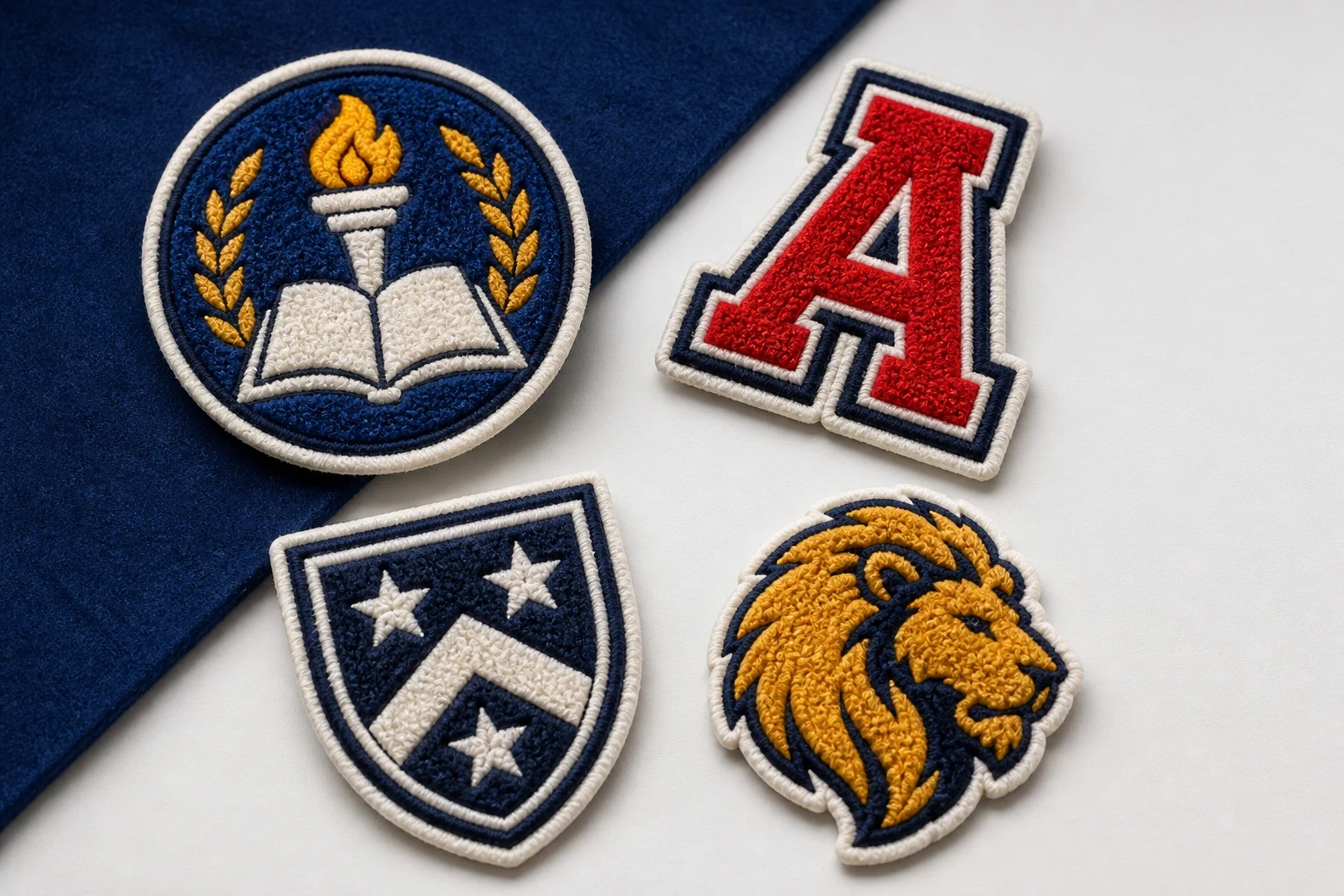
Schools and colleges choose chenille patches because their raised yarn surface gives house names, initials, team letters and achievement badges a distinctive varsity look. They work particularly well on wool coaches, hoodies, sweatshirts and jackets. The Customized Patches supplies UK orders from five pieces per design, with a free digital mockup usually sent within 12 hours.
Key takeaways
- Chenille patches give school and college clothing a raised, varsity-style finish that is easy to recognise from a distance.
- They are well suited to house names, large initials, sports letters, society badges, leavers’ hoodies and achievement awards.
- A 5-piece minimum applies per design, and The Customized Patches usually sends a free digital mockup within 12 hours.
- Backing, garment fabric, letter size and washing instructions should be agreed before production; patches are produced only after approval.
Schools and colleges are choosing chenille patches for their raised texture, bold lettering and traditional varsity appearance. They make house names, team letters, society initials and leavers’ designs look like a proper part of the garment rather than a flat printed transfer.
For a UK school or college, the main decision is not simply whether the patch looks good on screen. It must suit the garment, survive sensible wear, fit the available space and be practical for the person applying it. The Customized Patches has a 5-piece minimum per design, sends a free digital mockup usually within 12 hours, and produces only after approval.
Why chenille patches suit school and college identity
A school badge has to work at assembly, on the touchline and in a group photograph. Chenille does that through texture. The yarn pile catches light differently from the surrounding fabric, so a large letter or simple crest remains visible without needing a complicated design.
That is why chenille patches are often selected for house initials, prefect badges, rowing or rugby letters, debating societies, music groups and university club clothing. The finish has a familiar American varsity influence, but it also sits comfortably on British school and college garments, especially wool coaches, heavyweight hoodies and fleece-lined jackets.
There is a useful sense of permanence too. A printed logo can be precise and economical for a detailed image, but printed is flatter; that is the point. Chenille is chosen when the school wants a badge people can feel as well as see.
The designs that work best
- One or two large letters, such as H, S, R or a house initial.
- Short words such as HOUSE, CAPTAIN, PREFECT or LEAVERS.
- Simple shields, stars, crowns, laurel shapes and school-year numbers.
- College society initials with a contrasting border.
- Sports numbers or position labels on hoodies and warm-up jackets.
Fine text and tiny internal details need care. Chenille yarn is not a substitute for a miniature embroidered illustration. A simple outer shape with clear spacing normally gives a better result than trying to reproduce every line of a school crest.
The visual difference between chenille, embroidery and print
Schools usually compare chenille with standard embroidery first. A flat embroidered patch gives sharper small lettering, finer outlines and more freedom for detailed crests. Chenille gives a softer, taller pile and a larger visual presence, which is why it suits bold letters and traditional teamwear.
Our guide to chenille patches vs embroidered patches: Which Is Right for Your Project? goes into the visual and practical differences. The short version is simple: choose flat embroidery for detail and compact logos; choose chenille for texture, large lettering and a varsity-style finish.
A woven patch is flatter again and can hold small text more neatly than chenille, while a printed patch handles gradients, photographs and very fine artwork. A 3D embroidered patch adds raised stitching rather than a yarn pile. None is automatically better. The garment and artwork decide the sensible option.
| Patch type | Surface and appearance | Good choice for schools | Main trade-off |
|---|---|---|---|
| Chenille | Raised yarn pile with bold, soft-edged lettering | House initials, varsity letters, teamwear and leavers’ hoodies | Less suitable for very small text or intricate crests |
| Flat embroidered | Stitched thread surface with defined outlines | School badges, department logos and detailed emblems | Less tactile and less like a traditional varsity letter |
| Woven | Flat, tightly woven face with clean small details | Compact badges, labels and small lettering | Does not have chenille’s raised pile |
| Printed | Flat ink or printed image with broad artwork freedom | Photographic artwork, gradients and detailed illustrations | Flatter appearance and possible wear to the printed surface |
| PVC | Raised moulded rubber-like surface | Outdoor clubs, modern sportswear and wet-weather garments | A different visual style from traditional school lettering |
A school may also need more than one patch type. A detailed main crest could be made as flat embroidery, while a house letter on the back of a hoodie could be chenille. Using the same colours and border treatment keeps the range connected without forcing one production method to do every job.
Choosing the right chenille patch specification
The first useful measurement is the available garment space. A large back letter can be 8 to 12 inches high, while a chest badge may need to stay around 3 to 4 inches wide. Those are examples rather than fixed rules; the correct size depends on the garment, wearer and amount of lettering.
A patch for a wool coaches jacket can be larger and heavier than one intended for a lightweight nylon shell. Nylon shells can pucker or show stress if a dense, heavy badge is forced onto a narrow panel. We ask for the garment type and placement before confirming the recommendation.
Letter height and spacing
Large chenille letters need enough space around each character. If the letters are pressed too closely together, the pile can make the word look crowded. Short words are usually the easiest route, while longer house names may work better as a smaller flat embroidered line beneath a larger chenille initial.
Colour and border choices
Two or three strong colours are often more effective than a full school palette. A navy letter with a gold border, or a burgundy letter with a cream edge, can be read quickly on a sports jacket. Contrast matters more than having every colour represented.
If you are still choosing chenille, flat embroidery or print, send the artwork and tell us where it will sit. We will prepare a free digital mockup usually within 12 hours so the school can review size, colour and placement before production.
GET A FREE MOCKUPA merrowed crest has a stitched overlocked edge that gives the patch a framed finish. It works well for many embroidered shapes, although a chenille design may use a yarn border or a sewn edge depending on the artwork and requested construction. The mockup should show the intended outline clearly.
Backing for school garments
Sew-on backing is a dependable choice for blazers, wool jackets and garments that will be worn repeatedly. Iron-on backing is convenient for many hoodies and cotton garments, but it is not magic glue. Heat, steam and repeated washing can weaken the bond, and an iron-on that peels after a dryer cycle is a common avoidable failure.
Velcro is useful for cadet units, outdoor groups and garments with a removable panel. It lets staff or students swap a badge, but it adds thickness and requires the loop or hook side to be fitted correctly. A nylon shell may also need a sewn Velcro panel rather than an adhesive-only approach.
- Choose sew-on for long-term use on wool, blazers and heavy jackets.
- Choose iron-on only where the garment fabric and care instructions support it.
- Choose Velcro for removable team, rank or activity identifiers.
- Tell us if the patch is going onto nylon, fleece, cotton, denim or a wool coach jacket.
- Confirm whether the patch will be machine washed, tumble dried or dry cleaned.
Not sure whether thread, yarn or ink will hold the school logo in the right way? Send the artwork and the garment details. We can compare the suitable finish on a free digital mockup, usually within 12 hours, before you produce.
Where schools and colleges use chenille patches
The most familiar use is a house or sports letter on a hoodie, sweatshirt or varsity jacket. Colleges also use patches for societies, student union groups, accommodation teams and annual leavers’ clothing. A simple year number can turn a standard garment into something tied to a particular cohort.
They can work on staff clothing as well. A hospitality course may use a name or department patch on a jacket; a sports department may use a large team identifier; a music society may use a bold initial on a heavy overshirt. The best placement is the one that gives the patch a flat, supported area.
Common garment placements
- Left chest on a hoodie, sweatshirt or coach jacket.
- Centre back on a varsity jacket or heavyweight overshirt.
- Upper sleeve where the arm panel is broad and relatively flat.
- Front of a tote or kit bag, provided the bag material can support the weight.
- A removable Velcro panel on cadet, expedition or club equipment.
Avoid placing a large chenille piece directly across a thick zip, pocket opening or curved seam. It may look centred on a flat artwork file but sit off balance once the garment is worn. A quick photograph of the front and back of the garment gives our team far more useful information than a logo file alone.
For a traditional badge rather than a varsity letter, standard embroidered patches may be the better fit. For a motorcycle society or outdoor group, you can compare the construction used for biker and motorcycle club patches, though school garments usually need a lighter and softer presentation.
Ordering chenille patches in the UK
Start with the artwork, quantity, finished size, colours, garment type, placement and preferred backing. If several houses or teams need different letters, each letter or design is normally treated as its own design for the minimum quantity. The minimum is 5 pieces per design.
For example, five A patches, five B patches and five C patches are three designs, even if they share the same border and colours. Supplying that breakdown at quotation stage avoids confusion for a school office, uniform supplier or college society treasurer.
What happens after the quote
- Send the logo or lettering, quantity and approximate finished size.
- Tell us the garment fabric, placement and backing preference.
- Review the free digital mockup, usually received within 12 hours.
- Request changes if the letter height, border, colour or placement needs adjusting.
- Approve the final mockup and quotation.
- Production starts only after approval, followed by UK-wide dispatch when the order is ready.
Lead time depends on the design, quantity and construction, so it is sensible to order before a sports season, prize-giving ceremony, open day or leavers’ deadline. A mockup is not the finished patch and does not replace approval of the physical specifications. It is the point where the school can catch a spelling error, wrong house colour or unsuitable size.
The same applies to backings. Name sew-on, iron-on or Velcro on the quote rather than assuming the default will suit every garment. We show the intended back on the mockup or specification, and production starts only after approval.
Name sew-on, iron-on or Velcro on the quote and include the garment type, placement and deadline. We show the correct back and overall proportions on a free digital mockup usually within 12 hours, then produce only after approval.
GET A FREE MOCKUPFor cost planning, quantity, size, number of colours, edge, backing and artwork complexity all matter. A small run of five large, multi-colour chenille letters will not be priced in the same way as a larger run of one simple letter. Our guide to How Much Do chenille patches Cost in the UK? explains the main variables without pretending there is one universal price.
The Customized Patches serves customers across the United Kingdom, with UK-wide shipping available for approved orders. If the order is being coordinated through a school office, ask for one contact person and one final artwork version. That small bit of organisation prevents duplicate amendments and helps keep the production record clear.
Care, wear and realistic expectations
Chenille is a textured product, so it should be treated differently from a flat printed badge. Follow the garment’s care label, avoid unnecessary high heat and do not pull at loose yarn. If the patch is iron-on, repeated tumble drying can reduce the adhesive bond even where the garment itself is dryer-safe.
Sewn patches are generally the safer choice for a school blazer, wool coach jacket or garment expected to be used across several terms. The stitching can still need checking after heavy wear, especially around an edge that catches on desks, kit bags or changing-room hooks.
Mistakes worth preventing
- Ordering a detailed crest as chenille without checking whether the smallest features will read.
- Choosing a patch that is too large for the flat area of a nylon shell or sleeve.
- Assuming five pieces covers five different letters or house designs.
- Approving a screen colour without comparing it against the actual garment colour.
- Using iron-on on a garment that will be tumble dried frequently.
- Leaving the backing decision until after production artwork has been approved.
Our guide to Chenille patches Best Practices for schools and colleges covers artwork, garment choice and care in more detail. It is worth sharing with the person collecting student quantities, because many production problems begin with incomplete information rather than with the patch itself.
Are chenille patches right for your school?
Choose chenille if the priority is a raised, recognisable varsity finish for bold lettering, house identity or team clothing. It is especially convincing on substantial garments where the patch has room to sit flat and where the tactile surface is part of the appeal.
Choose flat embroidery if the design includes small text, a detailed crest or a compact chest badge. Choose print if the artwork depends on gradients or photographic detail. Choose PVC if the school or college wants a modern, weather-resistant sports or outdoor look. The right choice is the one that respects both the artwork and the garment.
For a wider look at materials and use cases, see Chenille patches: Everything UK Buyers Need to Know. You can also compare woven patches, printed patches and PVC patches before deciding.
The practical route is straightforward: confirm the design, state the quantity per design, identify the garment and backing, review the mockup, then approve. With those details settled, chenille patches can give a school or college clothing range a clear identity without making the badge more complicated than it needs to be.
Frequently asked questions
What are chenille patches used for in schools and colleges?
Chenille patches are commonly used for house initials, sports letters, society badges, leavers’ hoodies, prefect clothing, college clubs and varsity jackets. Their raised yarn surface suits bold lettering and simple shapes. Detailed crests or very small text may be better produced as flat embroidered or woven patches.
What is the minimum order for chenille patches?
The minimum order is 5 pieces per design. If a school orders five A patches, five B patches and five C patches, those are normally three separate designs. Share the quantity for each letter, house or artwork when requesting a quote.
How quickly can I receive a chenille patch mockup?
The Customized Patches usually sends a free digital mockup within 12 hours. The mockup shows the proposed size, colours, shape and finish for review. Production starts only after the customer approves the artwork and specifications.
Are chenille patches suitable for school blazers?
They can be suitable for school blazers when the size, weight and placement are appropriate. Sew-on backing is usually the practical choice for a blazer or wool garment. A detailed school crest may work better as a flat embroidered patch, while a large house letter is well suited to chenille.
Is sew-on or iron-on backing better for school clothing?
Sew-on backing is generally the safer long-term option for blazers, wool jackets and garments that will be washed repeatedly. Iron-on backing can be convenient for suitable cotton hoodies, but heat, steam and tumble drying may weaken the adhesive. Velcro is useful where the badge needs to be removed or changed.
Can a UK school order chenille patches in different house colours?
Yes. Ask for each house colour, design and quantity to be listed clearly on the quote. The 5-piece minimum applies per design, so different letters or substantially different house artwork may need to meet the minimum separately. A free digital mockup usually within 12 hours helps confirm colours before production.
Ready to produce custom patches for your UK team or brand?
GET A FREE MOCKUP