
Why outdoor and tactical brands Are Choosing PVC patches
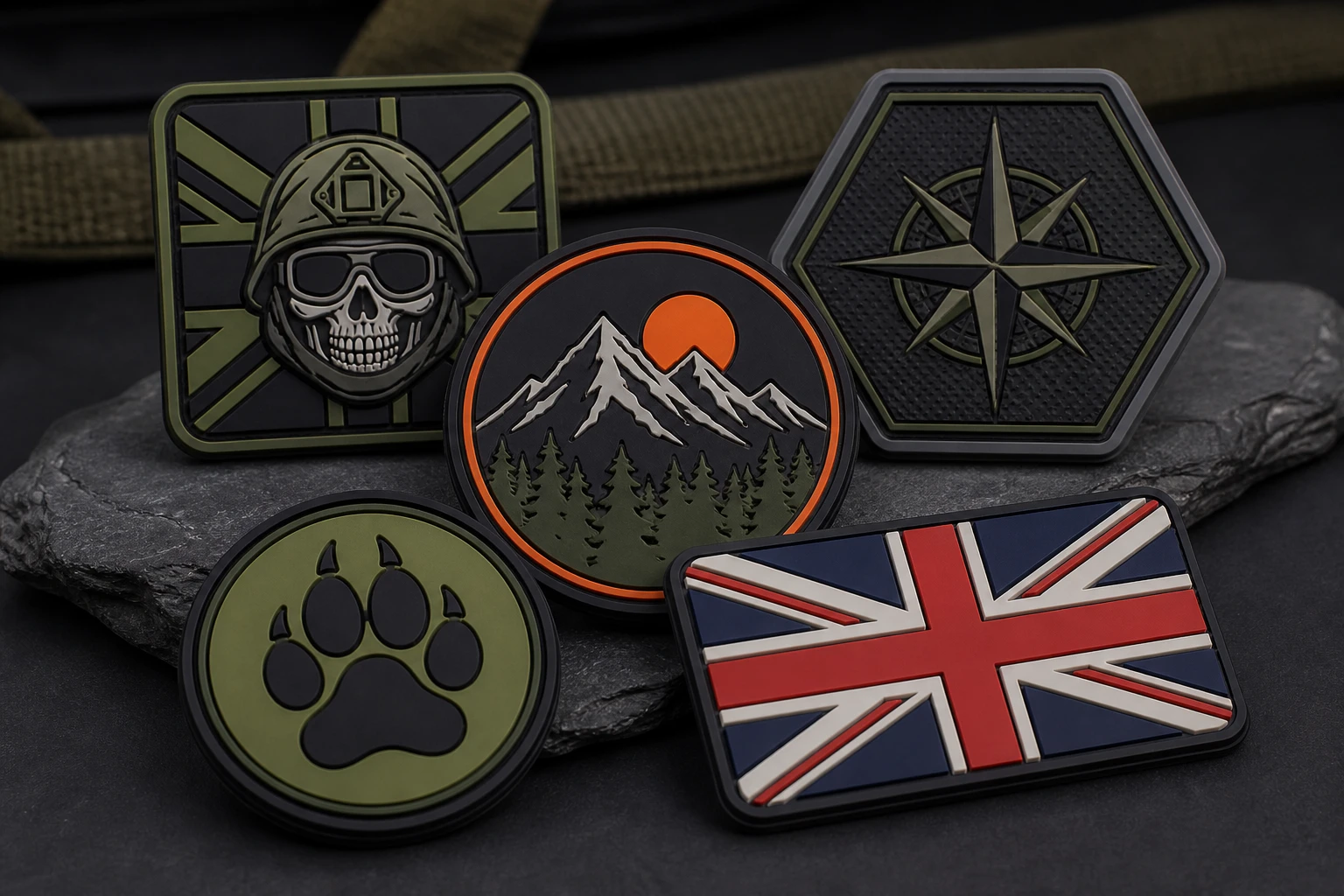
PVC patches suit outdoor and tactical brands because moulded PVC gives a raised, weather-resistant design that is easy to clean and works well on nylon shells, bags, caps and Velcro panels. They are practical for repeated use, but embroidered, woven or printed patches may suit softer garments or very fine artwork better.
Key takeaways
- PVC patches are a strong choice for wet, muddy and frequently handled kit because the moulded surface is easy to wipe clean.
- Raised PVC borders and lettering remain visible on nylon shells, rucksacks, caps, dog gear and Velcro panels.
- PVC is not automatically the best material: printed patches suit flat photographic artwork, while embroidered patches give a traditional textile finish.
- The Customized Patches has a 5-piece minimum per design, provides a free digital mockup usually within 12 hours and produces only after approval.
PVC patches are being chosen by outdoor and tactical brands because they cope well with rain, mud, regular handling and wipe-clean equipment. Their raised moulded surface keeps logos and symbols readable on nylon shells, rucksacks, caps, dog gear and Velcro panels.
The choice is not only about appearance. A tactical clothing supplier may need a patch that can be removed from a hook-and-loop panel, while an outdoor brand may need a badge that will not absorb water like a fabric surface. PVC can meet those needs, although embroidered, woven and printed patches still have clear advantages for the right garment and artwork.
Why PVC patches work on outdoor and tactical kit
A patch on a hiking shell or tactical rucksack is exposed to more than a football club crest on a warm-up top. It may be rained on, brushed against rough ground, placed in a muddy vehicle or cleaned after a long day outside. PVC has a closed, rubber-like surface, so dirt can usually be wiped away with a damp cloth rather than worked out of individual threads.
That makes the material useful for practical branding. Typical enquiries are for unit identifiers, equipment labels, morale patches, outdoor event badges and company logos for workwear. A PVC badge is also less likely to look out of place beside buckles, webbing, zips and coated fabrics than a delicate textile crest might.
- Water-resistant surface that suits wet British weather and outdoor storage.
- Raised details that can be felt as well as seen, giving a clear border around a logo.
- Simple cleaning with a cloth for most everyday dirt and dust.
- Good contrast on dark jackets, bags and tactical accessories.
- Useful compatibility with hook-and-loop panels when a removable patch is required.
- A consistent shape that works for shields, round badges, rectangles, tabs and custom outlines.
There is a practical distinction between weather resistance and total indestructibility. PVC is suitable for outdoor use, but no badge should be treated as a substitute for the garment manufacturer's care instructions. Heat, harsh chemicals, sharp abrasion and repeated tumble drying can affect the patch or the adhesive used with a particular backing.
The design details that make PVC patches readable
PVC artwork needs to be drawn with moulding in mind. A thin printed line on a screen can disappear when converted into a narrow raised channel. A small word may also become difficult to read if the overall patch is only 2 inches wide. Strong outlines, sensible spacing and a clear hierarchy usually produce a better result than trying to include every part of a complicated badge.
Raised and recessed detail
Many PVC patches use raised borders, lettering or symbols against a lower background. This gives the badge its recognisable tactile finish and helps separate colours. Recessed sections can also be used, but they need enough room to remain visible. Fine shading is usually better handled by printed patches or woven patches than by relying on several very narrow PVC levels.
Colour, contrast and small text
Outdoor and tactical logos often use black, olive, tan, grey, navy or subdued red. Those colours can look smart, but low contrast is a real production consideration. A dark green symbol on a black background may read well on a large badge and disappear on a small one. If a motto or location is essential, allow enough size for it to remain legible from normal viewing distance.
A free digital mockup is useful here because it shows the proposed shape, colours, backing and approximate layout before production. The Customized Patches sends a free digital mockup usually within 12 hours. Production begins only after the customer approves the design, so a team can check spelling, unit names and colour choices rather than relying on the original upload alone.
PVC patches compared with embroidered, woven and printed options
The right patch depends on the garment, artwork and use. PVC is often the sensible choice for a waterproof jacket or a removable equipment badge, but that does not make it a universal replacement for thread or ink. Printed is flatter; that is the point. It can reproduce gradients, photographs and small tonal changes that would be awkward in moulded PVC.
| Patch type | Best suited to | Main advantage | Trade-off to consider |
|---|---|---|---|
| PVC patches | Nylon shells, tactical clothing, bags, caps, outdoor equipment and Velcro panels | Raised, wipe-clean surface with strong shape definition | Can feel less traditional than thread and needs careful planning for tiny detail |
| Embroidered patches | Football kits, school blazers, wool coaches, uniforms and heritage-style branding | Textured thread finish with a familiar woven appearance | Thread can hold dirt and moisture more readily, and very small detail may merge |
| Woven patches | Fine lettering, compact logos and flat textile badges | Cleaner small detail than standard embroidery with a soft fabric face | Less tactile and usually less suited to a very wet or wipe-clean equipment surface |
| Printed patches | Photographic artwork, gradients, illustrations and detailed brand graphics | Flat artwork can preserve tonal changes and fine visual detail | Ink-based surfaces may not give the raised, equipment-focused look some tactical brands want |
| Leather patches | Lifestyle clothing, denim, workwear and premium heritage branding | Natural material and a distinctive understated finish | Not the first choice for repeated soaking, mud or frequent wet cleaning |
For a football club, a merrowed embroidered crest can look more at home on a tracksuit or blazer. For a photography-led outdoor brand, printed may reproduce the artwork more faithfully. For a waterproof shell with a hook-and-loop area, PVC usually has the more natural fit. If the choice is still unclear, our guide to PVC patches vs embroidered patches: Which Is Right for Your Project? sets out the practical differences.
This is also why we ask about the garment before suggesting a finish. An iron-on badge that looks fine on a cotton sweatshirt may peel after a dryer cycle or fail to bond properly to a coated nylon shell. A sew-on finish may be better for a permanent placement, while Velcro is more useful where teams swap identifiers between jackets and bags.
Backing choices for jackets, bags and Velcro panels
The patch face is only half of the specification. The backing determines how the badge is attached and whether it can be moved later. A sew-on backing is the dependable option for a permanent badge on a suitable fabric. It is commonly used on heavy cotton, canvas, wool and some workwear where a needle can pass through safely.
Sew-on PVC patches
Sew-on is often the sensible choice for an outdoor brand applying a badge to a bag, a canvas jacket or a long-term uniform. The stitching holds the patch directly to the garment, so there is no expectation that an adhesive layer will carry the whole load. It does require access to the inside of the garment and a suitable needle, particularly where the fabric is thick.
Iron-on PVC patches
Iron-on backing can be convenient for some compatible fabrics, but it needs care. Heat, pressure and the garment's surface all matter. Coated nylon, waterproof shells and heat-sensitive materials may not be suitable. It is common to see iron-on patches peel after a dryer cycle when the garment was not compatible or the care method was too hot. For valuable technical clothing, ask before ordering rather than assuming an iron will solve the attachment.
Not sure whether PVC, thread or ink will hold your logo on the intended kit? Send the artwork and garment details for a free digital mockup usually within 12 hours, then compare the finish before you produce.
GET A FREE MOCKUPHook-and-loop or Velcro backing
Hook-and-loop backing is a natural fit for tactical vests, plate carriers, kit bags, radio pouches and removable team identifiers. It lets a user change a name tab, role marker or morale badge without sewing a new patch onto the garment. The loop panel must be large enough and securely attached to the garment; the patch cannot compensate for a loose or undersized panel.
- Tell us if the patch will be permanent or moved between garments.
- State the garment fabric, such as nylon, canvas, cotton, wool or coated polyester.
- Measure the usable area rather than the whole jacket or bag.
- Check whether the garment already has a loop panel and confirm its usable dimensions.
- Ask about care instructions before selecting an iron-on finish.
- Specify if the back must remain low-profile under a pack strap or harness.
A PVC badge for a backpack shoulder strap has different requirements from one on the broad back panel of a jacket. The attachment must not catch on equipment, rub against the wearer or sit across a seam. Include a photograph or a simple measurement on the quote and the mockup can show the intended placement more accurately.
Where outdoor and tactical brands use PVC patches
The familiar use is a removable morale patch on a tactical vest, but enquiries come from a much wider range of UK organisations. Outdoor retailers use badges on caps, shell jackets and equipment bags. Walking groups and expedition organisers order event patches. Security, training and facilities teams may use PVC identifiers on workwear where a wipe-clean face is helpful.
- Outdoor clothing labels adding a logo to waterproof shells and fleeces.
- Hiking and camping groups marking rucksacks, caps and kit bags.
- Airsoft and tactical teams using removable role or team identifiers.
- Cadet units and training groups producing unit badges or morale designs.
- Biker and motorcycle clubs choosing a weather-conscious badge for jackets and vests.
- Dog-handling, search and rescue or working-dog teams labelling equipment.
- Trade and event brands creating durable merchandise for customers who spend time outdoors.
- Businesses adding a clear company mark to hard-wearing work bags and uniforms.
The use case affects the shape as well. A long rectangular name tab can make better use of a narrow loop panel than a round badge. A shield can support a crest and short location name. A wide back patch gives an outdoor brand more room for a landscape illustration, while a small sleeve or cap patch needs a simpler mark.
For motorcycle groups, the garment may be leather or heavy denim rather than technical nylon, so the attachment and edge finish need separate thought. Our guide to biker and motorcycle club patches covers that type of project. A PVC badge can work, but it should be specified around the vest material and the club's preferred placement.
Ordering PVC patches in the United Kingdom
A good quote starts with more than a logo file. Send the finished size in inches, quantity, preferred shape, colours, backing and the garment or equipment type. If you have several versions, identify which design is which. The minimum is 5 pieces per design, so a team can test a small run without committing to a large stock order.
The Customized Patches serves customers across the United Kingdom, with UK-wide shipping available. We review the artwork and specification, then provide a free digital mockup usually within 12 hours. The mockup is not a vague visual promise: it gives the customer a chance to check the outline, wording, colour arrangement and backing before production.
What affects the price
PVC patch pricing depends on the finished size, quantity, number of colours, levels of raised detail, shape, backing and any special requirements. A 2-inch single-colour badge and a 4-inch multi-level design are not the same job. More pieces can reduce the unit cost, but ordering more is only sensible if you know the design will be used.
For a fuller breakdown of sizes, quantities and specification choices, see How Much Do PVC patches Cost in the UK?. It is worth comparing the quote on like-for-like terms. A price that excludes the required Velcro back or uses a different finished size is not a useful comparison.
Lead time and approval
The free digital mockup is usually sent within 12 hours, but that is the artwork stage rather than a promise that finished goods arrive the next day. Production and dispatch depend on approval, quantity, design complexity and the selected specification. If a team needs patches for an event, send the artwork early and state the required date at the quotation stage.
Do not approve a design from memory. Check the spelling of a club name, the orientation of a symbol, the size of a loop panel and whether the chosen backing is suitable for the jacket. We produce only after approval, which gives the customer a clear point to correct those details.
Name sew-on, iron-on or Velcro on the quote rather than leaving the attachment open. We show the correct back on a free 12-hour mockup so the production specification matches the garment and the patch is not made with an unsuitable finish.
Common mistakes outdoor buyers can avoid
The most common problem is specifying the patch before checking the garment. A customer may request iron-on for a waterproof nylon shell, or choose a large rigid badge for a shoulder area that bends constantly. The material can be perfectly suitable and still fail to perform if the backing or placement is wrong.
Need a quote for five or more patches of one design? Send the artwork, finished size, quantity and garment type. We will prepare a free digital mockup usually within 12 hours, and production starts only after you approve it.
GET A FREE MOCKUP- Ordering a size that covers a zip, seam, pocket or pack strap.
- Using a detailed crest at a width too small for the lettering to remain readable.
- Choosing low-contrast colours because they look attractive on a bright computer screen.
- Assuming every waterproof jacket accepts heat from an iron.
- Forgetting that a Velcro patch needs a matching loop area on the garment.
- Approving a mockup without checking text, orientation and the final measurement.
- Comparing quotes that include different backings, quantities or patch sizes.
- Expecting a textile finish from PVC when the brief really calls for embroidered thread.
Our team can usually flag these issues before manufacture, but the clearest brief makes the process quicker. Our guide, Common Mistakes to Avoid When Ordering PVC patches, is useful if this is your first order or if several people need to sign off the design.
When PVC patches are not the best choice
PVC is a practical material, not a default answer. If the brand wants a soft, traditional crest for a wool coach jacket, an embroidered badge may be the better match. A school blazer usually benefits from a familiar merrowed textile edge, while a hospitality polo may look more natural with embroidery or a printed transfer depending on the branding and wash requirements.
Printed patches are often preferable for a photographic mountain scene, a detailed illustration or artwork with smooth gradients. Woven patches can work well for compact lettering where the customer wants a flatter fabric face. Leather can suit a heritage clothing label, although it needs a different approach to moisture and cleaning.
Choosing another material is not a failure. It is better to use the finish that fits the garment and visual brief than to force a PVC badge into a job designed for thread. The embroidered patches range is worth considering for club crests, uniforms and traditional branding, while 3D embroidered patches can add raised thread detail without changing to a moulded rubber-like surface.
A practical decision checklist
Before requesting a quote, answer these questions. They are the details we would ask over email or on our team because they prevent most avoidable revisions.
- What garment or equipment will carry the patch?
- Will it face rain, mud, salt, oil, frequent cleaning or heavy abrasion?
- Does the patch need to be removable from a Velcro panel?
- What finished width and height will fit the placement in inches?
- Does the artwork contain tiny text, gradients, photographs or fine lines?
- Would a raised PVC finish improve the design, or would flat printed detail be clearer?
- Do you need sew-on, iron-on or hook-and-loop backing?
- How many pieces are required for each design, remembering the 5-piece minimum?
- When is the patch needed, and has time been allowed for artwork approval?
- Who will approve the free digital mockup before production?
If you can answer those points, the quote should be much more useful. The team can assess the artwork at its intended size, recommend the backing around the garment and show the proposed result before anything is produced. That is especially helpful for UK teams ordering a first run for an event, new clothing range or seasonal outdoor campaign.
The practical answer for UK outdoor and tactical brands
Outdoor and tactical brands choose PVC patches because the material suits the jobs their clothing and equipment have to do. The wipe-clean face, raised detail and removable backing options make sense on wet-weather shells, rucksacks, kit bags and hook-and-loop panels. The design still needs sensible sizing, contrast and attachment planning.
The Customized Patches supplies PVC patches throughout the United Kingdom with a 5-piece minimum per design. You receive a free digital mockup usually within 12 hours, and we produce only after approval. If PVC is not right for the garment, we can also discuss embroidered, woven or printed alternatives rather than treating one material as suitable for every order.
For more background, read PVC patches: Everything UK Buyers Need to Know or review PVC patches Best Practices for outdoor and tactical brands. If you are ready to compare a design and backing, use the free mockup quote.
Frequently asked questions
Why are outdoor brands choosing PVC patches?
Outdoor brands choose PVC patches because the moulded surface is easy to wipe clean, handles wet conditions well and gives logos a raised, clearly defined finish. PVC also suits nylon jackets, rucksacks, caps and hook-and-loop equipment panels. The correct backing and size still depend on the garment.
Are PVC patches waterproof?
PVC patches have a water-resistant, non-absorbent surface that suits rain and outdoor use. However, the complete item is not automatically waterproof in every situation because stitching, adhesive, backing and the garment itself also affect water performance. Follow the care guidance for the jacket or equipment.
Can PVC patches go on a Velcro panel?
Yes. PVC patches can be made with hook-and-loop backing for suitable Velcro panels on tactical vests, bags, pouches and jackets. Confirm the usable panel size before ordering and state that removable backing is required. A free digital mockup usually within 12 hours can show the proposed back and dimensions.
What is the minimum order for PVC patches from The Customized Patches?
The minimum order is 5 pieces per design. A customer can use a small run to test a badge on equipment or supply a small team, while larger quantities may offer a lower unit price. Different designs should be listed separately when requesting a quote.
Are PVC patches better than embroidered patches?
Neither is always better. PVC patches suit wet, muddy and frequently handled equipment because they have a wipe-clean raised surface. Embroidered patches suit football crests, school blazers, wool jackets and traditional textile branding. Printed patches may be better for photographs and gradients, so the garment and artwork should guide the choice.
How long does it take to receive a PVC patch mockup in the UK?
The Customized Patches usually provides a free digital mockup within 12 hours. This is the artwork approval stage, not a guarantee of finished delivery within 12 hours. Production and UK-wide shipping depend on the approved design, quantity, backing, complexity and required date. Production starts only after approval.
Ready to produce custom patches for your UK team or brand?
GET A FREE MOCKUP