
PVC patches Best Practices for outdoor and tactical brands
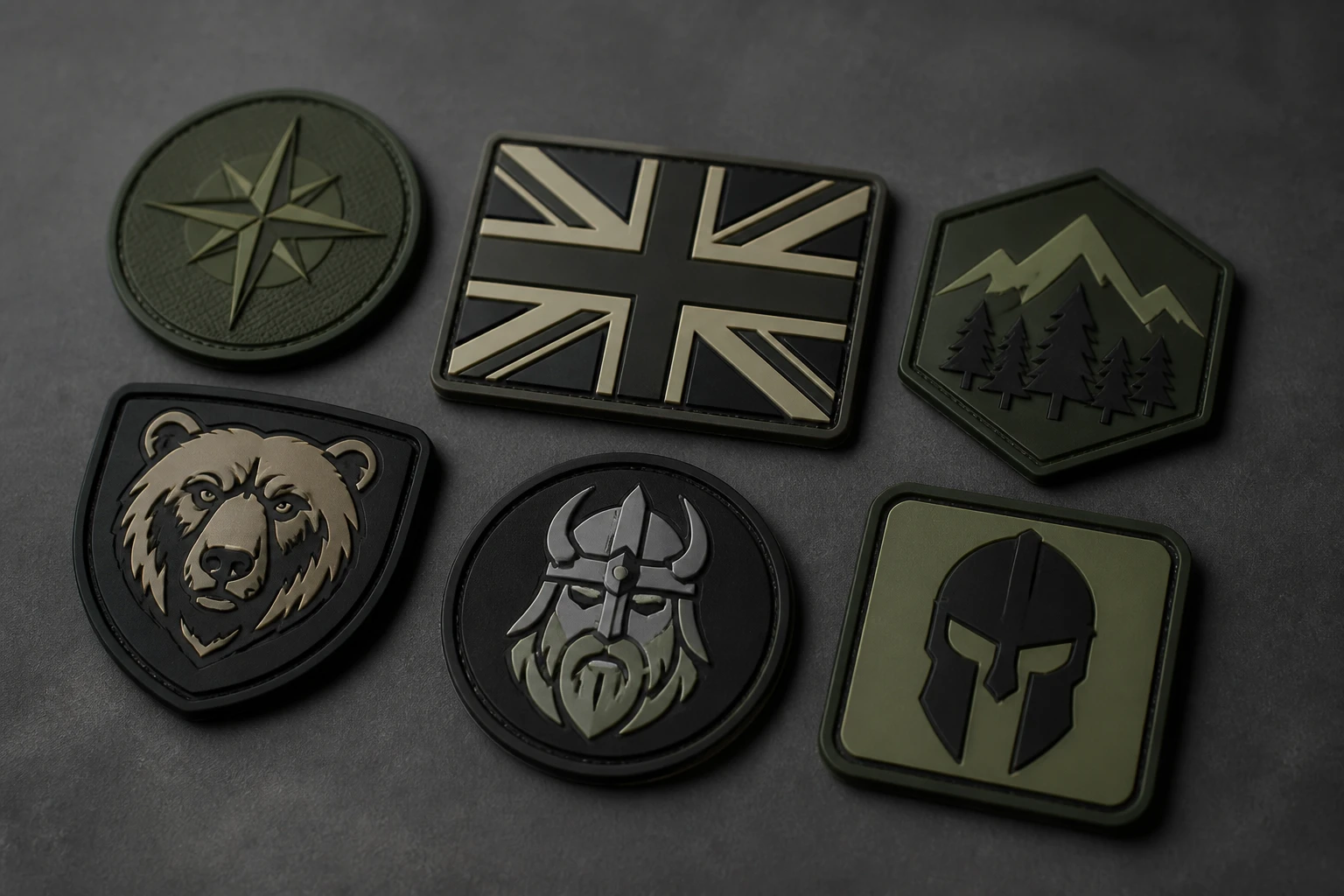
PVC patches suit outdoor and tactical brands because their raised rubber-like surface handles rain, mud and regular handling better than many fabric finishes. Use clear, bold artwork, specify the correct backing for the garment, and approve a free digital mockup before production. The Customized Patches accepts orders from five pieces per design.
Key takeaways
- PVC patches are a practical choice for rain-exposed kit, rucksacks, caps, workwear and removable Velcro panels, but they are not the best answer for every logo.
- Use fewer small details, stronger contrast and sensible lettering sizes so the finished patch remains readable at arm's length.
- Name the garment and attachment method at quote stage. A sew-on edge, iron-on backing and hook-and-loop panel have different uses and limitations.
- The Customized Patches has a five-piece minimum per design, provides a free digital mockup usually within 12 hours, and produces only after approval.
PVC patches are a strong choice for outdoor and tactical brands that need a badge to cope with rain, mud, abrasion and repeated handling. The best results come from bold artwork, a sensible size and the correct backing for the garment, rather than from adding every detail in the original logo.
For UK teams, brands, clubs and businesses, the practical order is straightforward: send the artwork and garment details, receive a free digital mockup usually within 12 hours, and check the proof before anything is made. The Customized Patches has a five-piece minimum per design and produces only after approval.
Why PVC patches work well on outdoor and tactical equipment
A PVC patch has a moulded, rubber-like face rather than stitched thread or printed ink on fabric. That gives it a clean raised profile and makes it easier to wipe after a muddy walk, training weekend or wet event. It also suits badges with simple blocks of colour, strong borders and a deliberately technical appearance.
We regularly quote patches for nylon shells, rucksacks, caps, dry bags, work jackets and tactical-style equipment. A patch on a backpack is knocked against walls and vehicle seats. One on a softshell may be exposed to rain and sweat. PVC is useful in those situations, although no patch should be described as indestructible: the garment, attachment method and care routine still affect its life.
The material also works well for removable identification. A hook-and-loop PVC patch can move between a training smock, a rucksack and a kit bag, provided the garment has a properly fitted loop panel. That is different from a sewn patch, which is intended to stay in one place.
Where the material is less suitable
PVC is not automatically the right answer for a heritage crest, a school blazer or a formal club badge. A merrowed embroidered crest has a softer, textile character that can sit better on wool coaches, jumpers and traditional uniforms. For fine shading, photographic artwork or a deliberately flat finish, printed patches may be the more honest recommendation. Printed is flatter; that is the point.
A very small PVC patch can also be a poor use of the material. Raised channels need room, and tiny lettering can close up visually. If your badge is below roughly 2 inches wide, send it for a mockup rather than assuming it will reproduce cleanly. The final recommendation depends on the artwork, not just the product name.
Artwork rules that keep PVC patches readable
Start with the viewing distance. A chest badge on a jacket may be read from several feet away, while a small identifier on a pouch might only need to show a symbol and two or three letters. Detail that looks fine on a monitor at 400 per cent may disappear once the patch is moulded and viewed at its real size.
- Use a clear outer shape. Shield, circle, rectangle, hexagon and custom silhouette shapes all work, but an irregular outline should have enough room around the artwork.
- Keep the main logo separated from the border. A narrow gap helps the design remain legible when colours are dark or the patch is viewed in poor weather.
- Limit tiny text. Short callsigns, initials and simple location names are safer than a full paragraph or a long web address.
- Use contrast deliberately. Black on dark green, navy on black and red on burgundy may look suitably tactical but can become difficult to read.
- Avoid hairline strokes, delicate gradients and closely packed outlines. Replace them with solid shapes or remove them.
- Tell the designer which elements need to be raised. A raised border, raised lettering or a raised emblem can change how the design reads and how thick the finished patch appears.
Colour matching deserves a practical conversation. Digital screens, PVC colour options and outdoor light do not behave in exactly the same way. If your brand has a specified colour, include the reference and identify which colour is most important. A brand mark used on five thousand pieces may need tighter consistency than a one-off expedition badge.
Do not send only a screenshot from social media if you can provide the original logo. Vector artwork is helpful, but a clear high-resolution PNG can still be assessed. If the supplied file needs redrawing or simplification, that should be discussed before the quote is treated as final.
Choosing the size and shape for real kit
Measure the usable area, not the whole garment panel. A jacket sleeve may have a seam, pocket, zip or curve that reduces the space available. On a rucksack, webbing and compression straps can cover part of an otherwise large panel. Put a paper version of the proposed patch on the item and look at it from normal standing distance.
| Typical use | Practical starting size | What to check | Likely attachment |
|---|---|---|---|
| Cap front | About 2.5 to 3.5 inches wide | Curved surface, crown seam and short lettering | Sew-on or iron-on, depending on the cap |
| Jacket chest | About 3 to 4 inches wide | Pocket, zip and body seam clearance | Sew-on or iron-on |
| Sleeve or arm panel | About 3 to 4 inches wide | Sleeve curve and movement | Sew-on or hook-and-loop |
| Rucksack or equipment panel | About 3 to 5 inches wide | Straps, buckles and existing loop area | Hook-and-loop or sew-on |
| Large back or event badge | About 5 to 10 inches wide | Weight, flexing and garment shape | Sew-on, with garment support |
These are starting points, not fixed product limits. A detailed badge may need to be larger, while a simple one-colour symbol can work smaller. The mockup should show the intended proportions, but a physical paper check is still useful because a screen does not show how the patch sits on a curved cap or soft nylon.
Raised levels, borders and edges
A raised border can protect the visual edge of a badge and give it a defined profile. A flat base with one raised feature often looks cleaner than several competing levels. Ask for the proposed treatment if the artwork contains overlapping icons, thin internal lines or text crossing a border.
The outside edge also affects the character of the patch. A clean moulded edge suits a technical outdoor label. An embroidered merrowed edge gives a different finish and may be better for a club crest. The right choice is partly practical and partly about how the brand wants to be seen.
If you are comparing materials, our guide to PVC patches vs embroidered patches: Which Is Right for Your Project? explains the visual and practical differences. You can also compare woven patches if your design has small lettering but still needs a fabric face.
Backing and attachment: sew-on, iron-on or Velcro
Backing is not a minor tick box. It determines how the patch behaves on the garment and how easy it is to replace. A sew-on patch is usually the dependable choice for a permanent badge, while hook-and-loop is useful for equipment that needs changing identification. Iron-on can be convenient, but it relies heavily on heat, pressure and the fabric underneath.
| Backing | Best suited to | Advantages | Points to check |
|---|---|---|---|
| Sew-on | Nylon jackets, rucksacks, workwear and permanent badges | Secure attachment and broad garment compatibility | Curved areas may need careful stitching; thick edges can require a strong needle |
| Iron-on | Suitable cotton or blended garments with a stable flat area | Quick fitting without visible stitches | Heat-sensitive nylon, coatings and repeated tumble drying can cause problems |
| Hook-and-loop | Plate carriers, bags, tactical-style jackets and removable identifiers | Easy to remove, swap and reposition | The garment needs a matching loop panel; loose stitching or poor alignment reduces grip |
Not sure whether a raised PVC finish, woven face or embroidered border will hold your logo best? Send the artwork and garment details for a free digital mockup, usually within 12 hours, so you can compare the proportion before production.
GET A FREE MOCKUPNylon shells need particular care. Some coatings and lightweight fabrics do not welcome high heat, so an iron-on backing may not be suitable even if it is requested for convenience. A sew-on patch may be safer, or a loop panel can be sewn onto the garment first. Tell us the fabric rather than simply saying jacket.
Iron-on that peels after a dryer cycle is a common complaint, but the cause is often a mismatch between the backing and the laundering routine. A hot wash, dryer, flexing seam or coated fabric can all reduce adhesion. If the kit will be washed frequently, used outdoors or passed between several people, sew-on or hook-and-loop usually deserves serious consideration.
For a school blazer or wool coaches jacket, stitching is normally more appropriate than a technical rubber badge. For a removable team identifier on a kit bag, Velcro can save time. We ask how the patch will be used because the same artwork can require a different backing on each garment.
PVC patches compared with other patch types
Outdoor and tactical brands often compare PVC with embroidery first, but there are other sensible options. The choice should follow the artwork, garment and expected use. A patch that looks impressive on a product page may be awkward on a thin sleeve or too detailed at the chosen size.
| Patch type | Surface and feel | Good for | Trade-off |
|---|---|---|---|
| PVC patches | Raised, moulded and wipe-clean | Outdoor kit, bags, caps, tactical-style panels and bold badges | Tiny detail and delicate typography need simplifying |
| Embroidered patches | Textured thread with a traditional fabric look | Club crests, uniforms, school blazers, jackets and heritage designs | Dense detail can become crowded; moisture and snagging should be considered |
| Woven patches | Flatter fabric face with fine woven detail | Small lettering, labels and clean linework | Less raised and less visibly technical than PVC |
| Printed patches | Flat printed image | Photographic artwork, gradients and detailed illustrations | Ink is not raised, so it has a different tactile and visual character |
| Leather patches | Natural or manufactured leather appearance | Lifestyle brands, bags, caps and premium casual products | Colour, edge and care requirements differ from rubber-like PVC |
| Chenille patches | Soft, high-pile yarn texture | Varsity clothing, sports clubs and bold collegiate lettering | Not intended to look like a low-profile technical badge |
A brand can also use more than one patch type across a range. A tactical equipment label may use PVC on rucksacks, woven labels on lightweight clothing and embroidery on a staff fleece. Consistency can come from the same icon, colours and wording rather than forcing every product into one material.
If your main need is a traditional crest, look at embroidered patches and 3D embroidered patches. If your logo contains shading or a detailed scene, review printed patches before deciding that a moulded finish is necessary.
Ordering details that prevent avoidable revisions
A useful quote includes more than a logo attachment. State the finished width or height in inches, the number of pieces, the backing, the base colour, the raised elements and the garment or equipment type. Tell the maker if two versions are required, because a navy badge and a black badge may count as separate designs.
- Quantity per design, remembering that the minimum is five pieces per design.
- Finished dimensions in inches, with width and height if the shape is not regular.
- Artwork file and any brand colour references.
- Base colour, border colour and the colours that must remain visually distinct.
- Backing type and whether a loop panel already exists.
- The intended garment, equipment or fabric, including nylon, cotton, fleece, wool or coated material.
- Any deadline, event date or required delivery location within the UK.
- Whether the design is a first order, a repeat order or a revised version of an existing badge.
The Customized Patches supplies UK-wide shipping and can quote for small club quantities as well as larger brand orders. A five-piece minimum makes it possible to test a new badge without committing to a large run, but the per-piece price may change with size, quantity, colours, backing and mould complexity.
A digital mockup is not the same thing as a photograph of a finished sample. It is a production visual that lets you check shape, wording, colour layout, backing notes and approximate scale before manufacturing. Treat it as a useful decision stage: ask questions while changes are still straightforward.
For cost planning, see How Much Do PVC patches Cost in the UK?. If this is your first order, PVC patches: Everything UK Buyers Need to Know covers the wider buying questions, including quantities and finishes.
Lead times, approval and UK delivery
Lead time depends on the design, quantity, backing, current production schedule and delivery address. It is unhelpful to promise one number before those details are known. A simple repeat badge and a new multi-level mould are different jobs, and a large run needs more production handling than five test pieces.
The approval point matters more than a rushed estimate. The Customized Patches usually sends a free digital mockup within 12 hours, and production begins only after the customer approves it. Check spelling, dates, unit numbers, dimensions, backing and colour layout before approval; a correction after production is not the same as a correction on the proof.
Give yourself room before a deployment, trade show, expedition, club event or seasonal launch. Include time to answer artwork questions, review the mockup and fit the patches to the garments. If the order is going on a new jacket range, request a quote early enough to account for garment arrival as well as patch production and UK-wide shipping.
If you need a removable badge, send a photograph of the loop area. A patch that is wider than the panel can catch on straps or overhang unevenly. A photograph also helps identify whether the panel is on a pocket, curved sleeve, rucksack flap or chest area.
Name sew-on, iron-on or Velcro on the quote. We show the correct back on a free 12-hour mockup so production matches the garment. The five-piece minimum applies to each design, and we make the patches only after the approved proof is confirmed.
Care and fitting advice for outdoor brands
Fitting should follow the backing and garment instructions. Sew-on patches need secure stitching around the edge, with extra attention at corners and points. Hook-and-loop patches need a clean, well-attached loop panel. Iron-on applications need the correct heat, pressure and cooling time for the specific garment, and some coated nylon items should not be ironed directly.
For washing, follow the garment label rather than assuming the patch changes the garment's care rating. Avoid unnecessary high heat, especially with coated outerwear and iron-on applications. Dry cleaning, harsh solvents and aggressive abrasion can affect the garment, adhesive or surface finish.
PVC is easy to wipe, which is one reason it suits muddy kit, but wiping is not the same as using strong chemicals. A damp cloth and mild cleaning approach are sensible starting points. Do not bend a large rigid patch sharply while it is attached to a thin fabric panel, as the garment may distort around it.
Name sew-on, iron-on or Velcro on the quote and include a photograph of the fitting area. We show the proposed backing on a free digital mockup, usually within 12 hours, before production starts.
GET A FREE MOCKUPStore spare patches flat and away from excessive heat. Keep hook-and-loop faces covered or separated from loose fabric and thread. For repeat orders, retain the approved mockup and order details so the next batch can be checked against the original specification.
Common mistakes
The first mistake is designing at screen size and forgetting the real garment. A detailed compass, mountain range or unit crest can look excellent as a large digital file but lose its internal lines at 2.5 inches. The second is choosing black artwork for a black jacket without allowing a border or contrast.
Another frequent problem is treating all Velcro panels as universal. Some are narrow, some are curved and some are positioned beneath a flap. Measure the loop panel and show it in a photograph. A patch that technically fits the width may still interfere with a zip or buckle.
- Ordering a different colourway without confirming that it is a separate design.
- Using long words or small slogans that cannot be read at the finished size.
- Requesting an iron-on back for a heat-sensitive coated shell.
- Leaving the backing undecided until after the artwork has been approved.
- Comparing prices without comparing size, quantity, raised levels and attachment method.
- Approving a mockup without checking dates, spelling, unit numbers or web addresses.
- Assuming a PVC patch will have the soft textile feel of embroidery.
- Waiting until the week of an event to begin artwork and fitting checks.
Our guide, Common Mistakes to Avoid When Ordering PVC patches, is useful if you are collecting several quotes. Our team can usually answer a question faster when the request includes the artwork, intended size, quantity and garment in the first message.
A sensible specification for your first PVC patch
For a first order, keep the specification disciplined. Pick one main shape, one clear border, a limited colour palette and a short identifier. Choose the fitting area before finalising the dimensions. This produces a useful test rather than a small version of an artwork that was designed for a website banner.
A sensible brief might read: 3.5-inch shield patch for a navy nylon shell, dark green base, bright orange raised compass, white three-letter identifier, sew-on backing, 25 pieces, UK delivery. That gives the maker enough information to discuss the design rather than guessing what the customer means by tactical patch.
For a removable version, change the last part to hook-and-loop and include the loop panel measurement. For a cap, mention the curved front. For a school or club garment, consider an embroidered finish instead. The most useful order is not necessarily the one with the most technical features; it is the one that matches the way the badge will be worn.
The Customized Patches can also point you towards biker and motorcycle club patches for larger back designs and club layouts, or to UK city pages for local ordering information. The same production principles apply across the United Kingdom: clear artwork, confirmed dimensions, suitable backing and approval before manufacture.
Final checklist before you approve
Read the mockup as a production document, not just as a nice picture. Check the outer shape, finished measurement, spelling, number placement, colour separation, border thickness and raised elements. Look at it both close up and at the distance where the wearer will normally be seen.
- Is the design intended for PVC rather than embroidery, woven or print?
- Is the finished size shown in inches and compatible with the available garment area?
- Can the smallest lettering and symbols be read at normal viewing distance?
- Are dark colours separated by a clear border or enough contrast?
- Does the chosen backing match the fabric, washing routine and need for removal?
- Does a Velcro version match the width and position of the loop panel?
- Is the quantity at least five pieces for this design?
- Are all colourways and artwork versions listed separately?
- Have you checked the delivery location and event date?
- Has the final mockup been approved in writing before production?
That last approval is the point at which the design becomes a confirmed production instruction. If something looks wrong, query it then. The Customized Patches produces only after approval, so this stage is there to protect both the customer and the production team.
Frequently asked questions
Are PVC patches suitable for outdoor clothing in the UK?
Yes, PVC patches are often suitable for outdoor clothing because the moulded surface is easy to wipe and works well for bold badges on shells, bags and caps. The backing still matters. Sew-on or hook-and-loop may be better than iron-on for coated nylon, frequent washing or removable equipment identification.
What artwork works best for PVC patches?
Simple, high-contrast artwork works best. Use clear shapes, a strong border, limited colours and short lettering. Tiny lines, delicate gradients and long slogans can lose clarity at the finished size, so request a mockup before production if the badge contains fine detail.
What is the minimum order for PVC patches from The Customized Patches?
The minimum order is five pieces per design. Different artwork or separate colourways may count as different designs, so list each version when requesting a quote. Quantity, size, backing, colours and mould complexity can all affect the final GBP price.
Can PVC patches have Velcro backing?
Yes, PVC patches can be made with hook-and-loop backing for suitable jackets, rucksacks, plate carriers, bags and other equipment with a matching loop panel. Measure the panel and send a photograph if possible, because a patch that overhangs can catch on straps, zips or flaps.
How quickly can I see a PVC patches mockup?
The Customized Patches usually provides a free digital mockup within 12 hours. Send the artwork, intended size, quantity, colours, backing and garment details for a useful proof. Production starts only after the mockup has been approved.
Are PVC patches better than embroidered patches for tactical brands?
Neither is universally better. PVC suits raised, wipe-clean, technical-looking badges on outdoor kit and removable panels. Embroidery gives a traditional textile surface that can suit uniforms, club crests and softer garments. The correct choice depends on artwork, size, garment, care routine and the look the brand wants.
Ready to produce custom patches for your UK team or brand?
GET A FREE MOCKUP