
Why brands with photorealistic designs Are Choosing sublimation printed patches UK
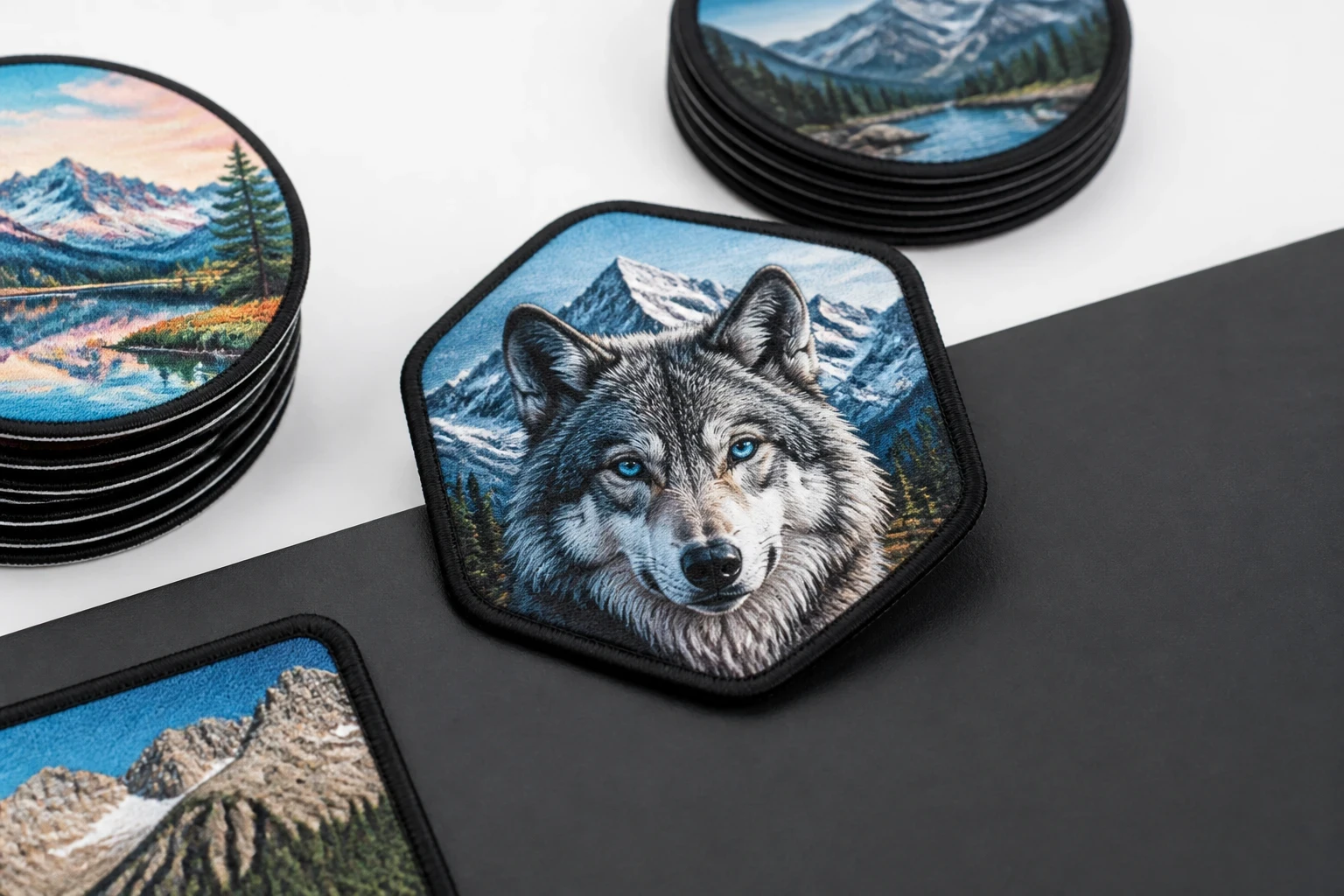
Brands choose sublimation printed patches UK because ink can reproduce photographs, gradients, shadows and fine colour changes more naturally than thread. The result is a flatter, detailed patch suited to logos and artwork that would lose detail in embroidery. The Customized Patches provides a free digital mockup, usually within 12 hours, with a 5-piece minimum per design.
Key takeaways
- Sublimation printed patches UK are suited to photographs, gradients, shadows and artwork with many colour changes.
- Printed patches are flatter than embroidered patches; that is useful when a design needs a clean image rather than raised thread.
- The Customized Patches has a 5-piece minimum per design and normally sends a free digital mockup within 12 hours.
- Production starts only after artwork and details have been approved, including size, edge and backing.
Brands are choosing sublimation printed patches UK because the process handles photographs, smooth gradients, shadows and detailed illustrations more faithfully than stitched thread. A football crest with a stadium background, a hospitality logo with a shaded bottle, or a motorcycle club image with a sunset can keep far more of its original character on a printed patch.
The Customized Patches makes these patches for UK teams, brands, clubs and businesses. There is a 5-piece minimum per design, and a free digital mockup is usually supplied within 12 hours. We produce only after the artwork, size, border and backing have been approved, so the patch made is based on an agreed version rather than an assumption.
Why sublimation printed patches UK suit photorealistic artwork
Embroidery builds a picture from thread colours and stitch directions. That gives a raised, tactile surface, but it also means a photograph must be simplified. Tiny changes between dark grey and black may merge, a face can lose expression, and a soft sky gradient usually becomes a few separate thread tones.
Sublimation printing applies the image to a suitable polyester face fabric using heat. The artwork remains an image rather than a collection of heavy stitches. This makes it a better fit for a detailed landscape, a product photograph, a shaded mascot or a logo that uses several close shades of the same colour.
- Photographs retain more visible tonal information than they normally would in standard embroidery.
- Gradients can transition gradually instead of stopping at the nearest thread colour.
- Small illustrated details can stay crisp when the patch is viewed at its intended size.
- Fine outlines do not need to be represented by a line of stitches, so the design can feel less crowded.
- A flat face can sit comfortably on shirts, polos, bags and lightweight outerwear.
Printed is flatter; that is the point. A brand may want a smooth image on a work polo rather than a raised crest catching on a seat belt. Another customer may want a traditional tactile finish on a wool coach jacket. Neither choice is automatically better, and the garment, artwork and use should decide it.
What the printing process can and cannot do
The design is printed onto a patch fabric prepared for colour transfer, then finished with the selected border and backing. The final result is still a proper patch, not merely a loose piece of printed cloth. Edge finishing, cut shape and the way it will be attached all matter to how professional it looks on the garment.
A digital print can show more colours than a simple thread palette, but it is not a way to make every screen colour appear identical on every garment. Your monitor may be bright or set to a different colour profile. Very fine text can also become unreadable if the complete patch is only 2 or 2.5 inches wide.
Photographs, gradients and fine lines
A photograph normally works best when the main subject has clear separation from the background. A close-up dog portrait, vehicle grille or mountain scene can read well. A low-contrast image with pale grey detail on a white background may still look indistinct, even though printing reproduces it more closely.
Ask for a mockup at the finished size, not only a large artwork preview. At 3 inches wide, a tiny brand strapline may disappear even if it looks perfectly clear on an A4 PDF. Our Sublimation printed patches UK Best Practices for brands with photorealistic designs guide covers contrast, cropping and artwork preparation in more detail.
Colour, edge and shape choices
A printed patch can use a shaped cut line around a logo, a regular rectangle, a circle, a shield or a custom silhouette. A border helps separate the image from the garment, especially on black nylon shells or dark denim. The border can be a clear visual frame rather than a thick embroidered line.
If the patch has a merrowed crest, that rounded overlocked edge gives a traditional badge appearance. A printed face with a merrowed border can be a useful middle ground: the image stays flat and detailed while the edge has a visible, finished outline. The right choice depends on the supplied artwork and the look you want.
| Design requirement | Why printing helps | What to check before approval |
|---|---|---|
| Photograph or portrait | Preserves more tonal changes and small image features than thread-based work | Use a sharp source image and check the crop at finished patch size |
| Sunset, smoke or sky gradient | Allows gradual colour movement across the image | Check that the lightest areas contrast with the patch fabric and garment |
| Several close brand colours | Keeps colour changes as part of the printed image | Request a digital mockup and compare it with your approved brand artwork |
| Small lettering | Avoids forcing every letter into a stitch structure | Increase the patch size or simplify text if it is below a readable size |
| Traditional badge appearance | Can be combined with a border or shaped edge | Confirm whether a clean cut edge or merrowed border suits the garment |
The practical test is not whether the design looks impressive at full resolution. It is whether the important subject, logo and wording remain clear on the actual garment from a normal viewing distance. That is why a production mockup is part of the decision rather than an optional decoration.
Printed versus embroidered patches for UK brands
The usual choice is not about printing being modern and embroidery being old-fashioned. It is about the physical result. Embroidery adds height, texture and visible stitch direction. Printing keeps the image flatter and is often more faithful when the artwork relies on photographic detail.
Typical enquiries cover football clubs that wanted a classic stitched crest, cadet units that needed a clear insignia, hospitality teams ordering patches for polos, and biker groups using large back patches on denim and leather. A shaded emblem may suit printing, while a simple one-colour unit badge may look stronger in embroidery.
| Feature | Sublimation printed patches | Embroidered patches |
|---|---|---|
| Visual surface | Flat, smooth and image-led | Raised, textured and stitch-led |
| Photographs | Generally the stronger option for preserving tonal detail | Usually needs simplification into thread colours |
| Gradients | Can show smooth colour changes | Usually represented by separate thread shades |
| Simple bold logos | Works well, especially with a clean border | Works well and adds a traditional badge texture |
| Fine small text | May remain clearer, subject to size and contrast | Can close up if lettering is too small or tightly spaced |
| Tactile effect | Limited because the face is flat | Strong because stitches create height and texture |
| Best visual match | Photo-rich artwork, illustrated scenes and tonal branding | Block lettering, simple crests and classic uniform badges |
For a direct side-by-side decision, see our guide to Sublimation printed patches UK vs embroidered patches: Which Is Right for Your Project?. If you prefer the traditional route, the embroidered patches range explains the textured finish and common uses.
Choosing a patch for real UK garments
The garment often settles the question. A smooth printed patch can work neatly on a hospitality polo, branded overshirt, gym bag or light cotton jacket. On a thick wool coach jacket, an embroidered patch may look more at home because the raised surface matches the weight and character of the garment.
Not sure whether thread or ink will hold your logo? Send the artwork and the intended garment to compare the finish before production. GET A FREE MOCKUP — a free digital mockup is usually supplied within 12 hours, and the minimum is 5 pieces per design.
GET A FREE MOCKUPNylon shells need more care. They can be slippery, coated or heat-sensitive, so do not assume an iron-on backing is suitable. A sewn patch or compatible hook-and-loop arrangement may be safer. We have also seen iron-on patches peel after a dryer cycle, usually because the heat, pressure, fabric or washing instructions were not suitable.
Sew-on, iron-on and Velcro panels
- Sew-on is the dependable choice for workwear, denim, wool and garments that will be washed regularly. It needs a clear sewing route around the edge.
- Iron-on can be convenient for suitable cotton or blended fabrics, but it is not suitable for every nylon shell, waterproof coat or heat-sensitive garment. It may also need stitching for demanding use.
- Hook-and-loop backing suits removable name panels, tactical-style kit and teams that change identifiers. The loop panel must be attached securely to the garment.
- A blank back or sew-on finish can make sense for unusual materials, leather, thick bags or items where adhesive heat is not wanted.
A biker vest brings a different requirement from a school blazer. Large back designs need a stable edge and enough contrast against leather or denim. A blazer badge may need to stay compact, sit flat and avoid a bulky backing. For club-specific examples, see our guide to biker and motorcycle club patches.
Velcro panels are useful when the same garment carries changing names, roles or event identifiers. They are less suitable if the design is intended to look like a permanent heritage crest. The best backing is the one that matches how the garment is worn, washed, removed and stored.
Size, readability and artwork preparation
Most patch problems begin before manufacturing. A customer sends a detailed logo intended for a large banner, then asks for it at 2 inches wide. The image may technically fit, but the wording, facial features or thin lines will not have enough visual room.
For a photorealistic design, decide what the viewer must notice first. It might be a person, vehicle, animal, product or central symbol. Remove background clutter if it competes with that subject. If a slogan matters, give it enough contrast and space rather than placing it over a busy photograph.
A practical artwork checklist
- Supply the highest-resolution artwork available, preferably as a vector logo or a clear high-resolution image.
- Identify the main subject and any detail that must remain visible after the patch is reduced.
- Check the design against the garment colour, not just a white artboard.
- Keep very fine text to a sensible size, or ask whether it should be removed from the patch.
- Confirm the finished width and height in inches, including any border.
- State the intended edge: clean cut, shaped edge or merrowed border.
- State the backing before approval, especially if the patch will go on nylon, leather, wool or a Velcro panel.
- Request a mockup showing the patch at realistic size and on the intended type of garment where possible.
A mockup is also the point to catch a backwards slogan, a cropped face, an overly dark background or a border that is too narrow to sew. Our guide to Printed patches Sizing and Backing Options Explained covers the measurements and attachment choices that are easy to overlook.
Ordering sublimation printed patches UK from a UK supplier
Start with four details: the artwork, finished size, quantity and garment. Add the backing and border if you already know them. If not, say where the patch will be used and how often the garment is washed. That gives our team useful information rather than leaving the most important choice blank.
The Customized Patches accepts a 5-piece minimum per design. If you need three versions of a logo, they are normally treated as separate designs because each requires its own setup and approval. Ask about the quantity clearly if you have several colourways, names or department badges.
What happens after you send the enquiry
- Send the artwork, quantity, approximate dimensions and delivery address in the United Kingdom.
- Describe the garment or item, such as a polo, school blazer, nylon shell, wool coach jacket, rucksack, denim vest or leather panel.
- Choose a preferred backing, or ask for a recommendation based on the garment and use.
- Review the free digital mockup, usually sent within 12 hours.
- Check wording, proportions, colours, border, backing and size on the mockup.
- Approve the final version or request a correction before manufacturing.
- Production begins only after approval, followed by dispatch for UK delivery according to the quoted schedule.
Lead time depends on the quantity, artwork complexity, backing, finishing and current production schedule. A small repeat order with confirmed artwork may move differently from a large club order with several versions. The mockup is usually quick, but the mockup turnaround is not the same as the full manufacturing and delivery time.
For price planning, read How Much Do sublimation printed patches UK Cost in the UK?. The main cost variables are size, quantity, edge, backing, number of designs and any special finishing. A very low quantity may have a different unit price from a larger run, even though the 5-piece minimum remains in place.
Common mistakes that affect the finished patch
The most common mistake is choosing a process from the artwork alone. A detailed file may suggest printing, but a rough outdoor garment may need a stronger attachment method. Conversely, a team may select embroidery because it is familiar, then find that its photographic sponsor artwork has become a dark, simplified block.
- Ordering before checking the artwork at the final size.
- Assuming every backing works on every fabric.
- Using a pale border on a pale polo and losing the patch outline.
- Putting too much small wording around a circular badge.
- Approving a colour from a phone screen without considering the garment beneath it.
- Treating a single image as several designs without explaining the variations.
- Washing or tumble-drying an attached patch without following the garment and backing guidance.
- Expecting a flat printed face to have the raised texture of embroidery.
Some of these issues are preventable with a proper proof. Our guide to Common Mistakes to Avoid When Ordering sublimation printed patches UK covers the questions worth settling before an order is confirmed.
Name sew-on, iron-on or Velcro on the quote, and tell us whether the garment is nylon, wool, denim, leather or a polo. GET A FREE MOCKUP — we show the proposed design and backing before production, normally within 12 hours.
GET A FREE MOCKUPCare also matters after delivery. Follow the garment manufacturer's washing advice, avoid unnecessary high heat and check the attachment regularly on hard-used workwear. No patch backing should be described as suitable for every material and every washing routine.
Where these patches work particularly well
A photorealistic patch can give a small brand a useful physical item without flattening its identity into a one-colour mark. It can go on staff clothing, event merchandise, bags, jackets or presentation kits. The image-led finish is especially useful when the design itself tells the story.
- Football and sports clubs using a stadium, player, mascot or match-day illustration.
- Cadet and outdoor units using mapped scenery, equipment or detailed insignia.
- Hospitality businesses placing a product image, venue illustration or chef-led brand mark on polos and overshirts.
- Biker and motorcycle clubs using a detailed machine, landscape or club scene.
- Small UK businesses turning a product photograph or illustrated character into a sew-on merchandise item.
- Schools and colleges using event artwork for leavers' jackets, trips or societies.
- Teams and organisers creating a commemorative patch for an event, expedition or anniversary.
A simple identity can still be better in embroidery. If your artwork is a bold shield, a short name and one or two strong colours, a 3D embroidered patches finish may add the raised lettering you want. For soft, textured club-style designs, chenille patches are another option.
If the main requirement is very fine woven lettering rather than a photographic image, compare woven patches. If the patch needs a hard, weather-oriented surface, PVC patches may be more suitable. The point is to match the construction to the job instead of forcing every logo into one format.
Why approval matters before production
A production proof protects both sides. It gives the customer a chance to spot an incorrect date, spelling issue or unsuitable crop. It gives the maker a confirmed reference for the size, border and backing. Once a batch is made, changing the artwork is no longer a simple screen adjustment.
The Customized Patches produces only after approval. That means the customer should check the full mockup, not just reply that it looks broadly right. Pay attention to the dimensions in inches, the position of the border, the garment colour shown, the backing and every line of text.
For a first order, five pieces can be a sensible way to check how the patch looks and attaches in real use, provided the project suits the minimum quantity. For a club or business uniform, ordering enough for the complete group may provide better consistency between garments and reduce the risk of mixing versions later.
The practical decision for your next patch order
Choose sublimation printed patches UK when the image needs to remain an image: a photograph, a shaded illustration, a multi-tone logo or a scene with gradual colour changes. Choose embroidery when the physical texture, raised thread and traditional badge appearance matter more than photographic detail.
If you are between the two, do not guess from a product photograph. Send the artwork, intended size and garment details for a production view. A free digital mockup usually arrives within 12 hours, the minimum is 5 pieces per design, and manufacturing starts only once the final version has been approved.
The free mockup quote is the simplest starting point for a UK team, brand, club or business. Include the finish you think you want, but say if you are open to alternatives. A short conversation about nylon, wool, Velcro, denim, leather or a polo can prevent a poor backing choice before the order reaches production.
Frequently asked questions
What are sublimation printed patches UK?
Sublimation printed patches UK are fabric patches made with a heat-transfer printing process that places detailed artwork onto a suitable patch face. They are useful for photographs, gradients, shaded illustrations and multi-colour logos because the image does not have to be rebuilt from separate embroidery stitches.
Are sublimation printed patches better than embroidered patches?
Neither is always better. Sublimation printed patches are usually the stronger choice for photorealistic artwork, smooth gradients and small tonal changes. Embroidered patches are often better for raised texture, bold lettering and traditional crests. The garment and intended appearance should decide the finish.
What is the minimum order for sublimation printed patches UK?
The Customized Patches has a 5-piece minimum per design. Different colourways, names or artwork versions may count as separate designs, so include all variations in your quote request. The quantity, size, backing and number of designs can affect the price.
How quickly can I see a mockup?
The Customized Patches usually provides a free digital mockup within 12 hours. This is the proof stage, not the full manufacturing or delivery time. You should check the artwork, size, border, backing and wording, then approve the final version before production begins.
Can printed patches go on nylon jackets or Velcro panels?
They can be made for different garments, but the backing must suit the material and use. Nylon shells can be heat-sensitive or coated, so sew-on or a properly specified Velcro arrangement may be more suitable than assuming iron-on will work. State the garment type when requesting a quote.
Do sublimation printed patches UK have a raised or textured finish?
The printed face is generally flatter and smoother than embroidery. That is useful for photographic and detailed designs, but it will not provide the raised thread texture of an embroidered crest. If texture is the priority, compare embroidered patches or other constructions before approving the order.
Ready to produce custom patches for your UK team or brand?
GET A FREE MOCKUP