
Which Patch Type Should You Choose? A Simple Decision Guide
Choose a patch type by matching its material to the artwork, garment and care routine. Embroidery suits bold badges, woven patches suit fine lettering, printed patches suit photographs and gradients, and PVC suits wet, muddy use. Chenille, leather and raised embroidery prioritise texture. Choose the attachment separately.
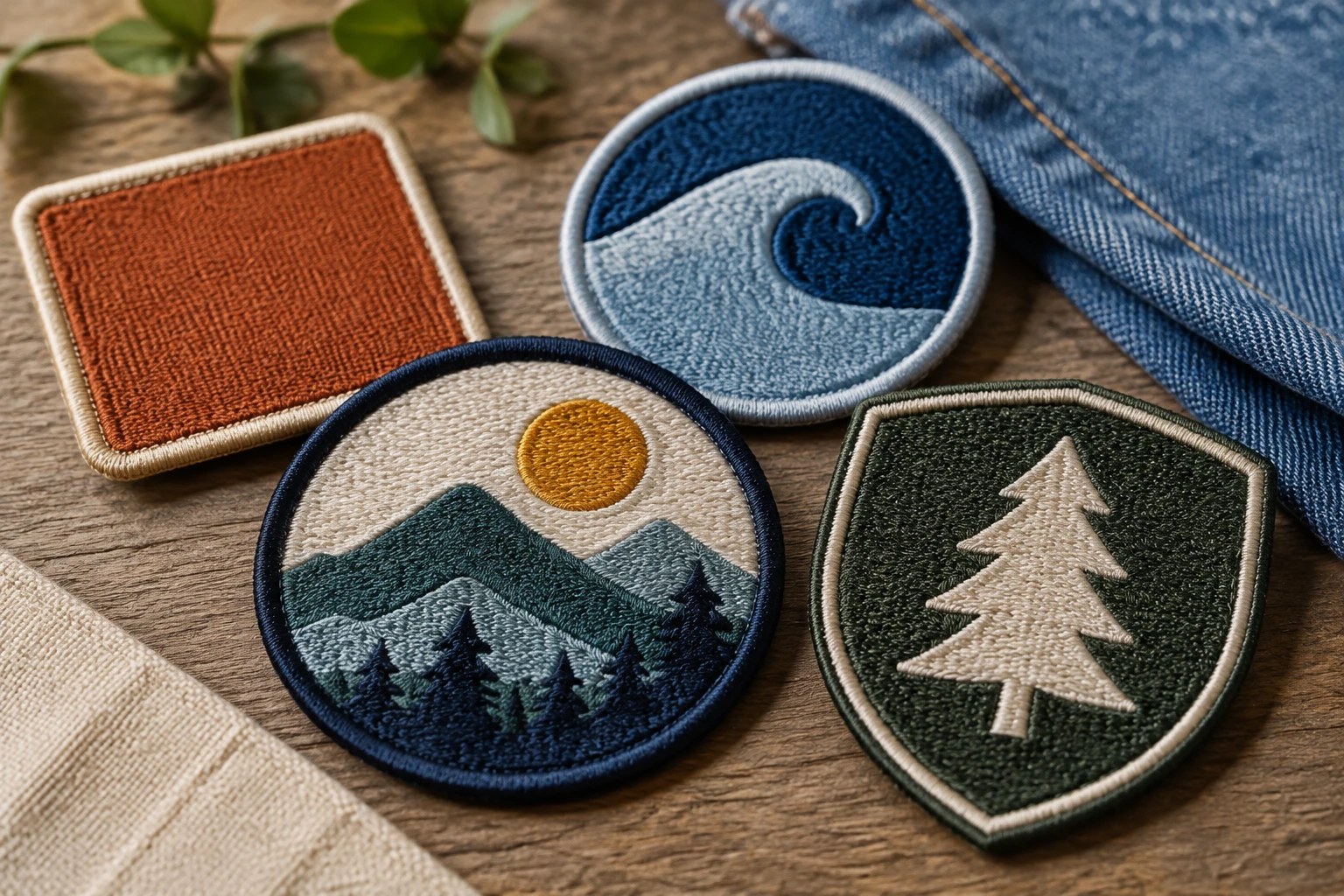
Key takeaways
- Embroidery suits bold badges; woven construction usually handles finer lettering.
- Printed patches reproduce photographs and gradients without converting them into thread areas.
- A waterproof PVC face does not make its attachment waterproof.
- The minimum is 5 pieces per design, and production starts only after approval.
Use this patch decision tree to choose embroidery for bold badges, woven for fine lettering, printed for photographs, or PVC for wet, muddy use. For fashion, chenille, leather and raised embroidery offer distinct textures. Then choose the backing to suit the garment and washing routine.
Material and attachment are separate decisions: an embroidered patch is not automatically iron-on, and a PVC patch does not make a jacket waterproof. Start with where the patch will go, what the artwork must retain and how the item will be cleaned.
A patch decision tree for your main use
Pick the closest use below, then follow the exception if your design needs it. The use suggests a starting material; small text, garment weight or cleaning requirements may change that choice.
- Uniform → start with embroidered patches for bold crests and names. Switch to woven if a detailed emblem or longer wording must fit a small area. On a polo, consider weight and stiffness as well as appearance.
- Merchandise → choose embroidery for a textured badge, woven for detailed illustrations, or printed patches for photographs and gradients. If buyers will attach patches themselves, explain the backing and garment restrictions rather than promising universal compatibility.
- Outdoor kit → consider PVC patches for a wipe-clean face on muddy bags or removable equipment labels. Choose woven if fine detail matters more than a moulded surface. Check attachment carefully on waterproof shells.
- Fashion → use chenille patches for large, soft varsity-style letters, leather for a restrained label look, or raised embroidery for bold dimensional shapes. Avoid these textures if tiny wording is the main feature.
If two options remain, decide what cannot change: the artwork detail, the surface texture or the garment’s behaviour. A photographic image points towards print; a traditional stitched crest points towards embroidery.
Compare what each material keeps—and loses
No patch material wins every comparison. Use this table to identify the compromise before you finalise the design, rather than choosing a finish and forcing unsuitable artwork into it.
| Patch type | Best starting point | Main trade-off |
|---|---|---|
| Embroidered | Bold uniform crests and club badges | Raised stitches add texture, but fine text can fill in. |
| Woven | Small lettering and detailed line artwork | Finer construction holds detail with less raised texture. |
| Printed | Photos, shading and colour gradients | Retains image detail without a stitched surface. |
| PVC | Wet, muddy equipment and bold moulded logos | Wipe-clean face; added thickness may overwhelm light fabric. |
| Chenille | Large letters on varsity-style garments | Soft pile needs space; unsuitable for intricate wording. |
| Leather | Simple labels on caps, bags and heavier garments | Finish and cleaning suitability need checking. |
| 3D embroidered | Bold raised lettering and simple marks | Needs broad shapes; fine strokes do not suit the raised effect. |
For a small, text-heavy badge, compare woven patches with embroidery at the same finished size. For a fashion label, compare leather patches and 3D embroidered patches for texture, but confirm that the chosen construction suits the garment’s care routine.
If two materials still fit, send the artwork and garment details so the trade-off can be checked at your intended size. We provide a free digital mockup, usually within 12 hours.
GET A FREE MOCKUPWhich backing suits the garment?
For frequently washed uniforms, sew-on is often the more dependable starting point where stitching is suitable. Iron-on relies on an adhesive bond; unsuitable application or washing conditions can cause the edges to lift.
- Sew-on: suitable for many stable fabrics, including canvas and heavier jacket cloth. Check access behind linings and avoid pulling lightweight fabric tight during stitching.
- Iron-on: use only where both the patch instructions and garment care label permit the required heat. Heat-sensitive nylon shells and coated fabrics need particular caution.
- Hook-and-loop: useful for removable identifiers, but the garment needs a matching receiving panel. Specify which side is required and whether a separate panel is needed.
Stitching through a waterproof jacket can create leak paths, even if the patch face is waterproof. Read Patches on Waterproof Jackets: How to Add One Without Leaks before choosing an attachment.
Check the surface, not just the fabric name
A canvas cap has curvature and seams; a wool jacket may have a lining you do not want to catch. Measure the usable attachment area and check inside the garment before specifying a large or stiff patch.
Will your artwork work at the finished size?
Print the design at its proposed dimensions and place it on the garment. A 75 mm (3 in) badge may look generous on screen but leave little room for a crest, border and two lines of wording.
Fine text can fill in on small embroidery, while narrow gaps can disappear between stitched areas. Simplify the design, enlarge it or switch construction; Best Fonts for Patch Lettering: Readability at Small Sizes explains the lettering checks.
Send your chosen material, dimensions, garment and required date through our [free mockup quote](#quote). We provide a free digital mockup, usually within 12 hours, so you can check the specification before approving production.
GET A FREE MOCKUPLeave room for the border
Keep essential detail away from the edge. A merrowed border is an overlocked finish suited to many simple outlines, but tight internal corners and intricate shapes may need a different edge treatment. Ask for the border and finished dimensions to be identified on the mockup.
What to send for a quote—and when production starts
The Customized Patches makes patches to order from your artwork, with a 5-piece minimum per design. Quotes start from £60, with free shipping across the United Kingdom; your specification determines the actual price.
- Send your clearest artwork file through our quote form, with quantity per design and finished width and height.
- Name the preferred material, garment, attachment method and washing needs. Include a placement photo if seams or linings restrict the area.
- Give the date you need the patches in hand and the delivery postcode. Ask for production and delivery timing before committing.
- Check the mockup’s wording, colours, dimensions, edge and backing. Approve only when those details are correct.
Our free 12-hour digital mockup service usually returns a visual within that window; it is not a production or delivery promise. We produce only after approval. A digital mockup shows the proposed layout, not a physical test of texture, colour or garment compatibility.
Frequently asked questions
What is the simplest patch decision tree?
Start with the artwork: bold stitched badge means embroidery, fine lettering suggests woven, and photographs or gradients suggest print. Then check exposure, garment weight and attachment. PVC is worth considering for wet, muddy equipment.
Which patch type is best for a uniform?
Embroidery suits bold uniform crests, while woven can preserve finer wording. For washable polos or work jackets, check patch weight, attachment and care compatibility rather than choosing by appearance alone.
Are PVC patches waterproof?
The PVC face is waterproof, but stitching holes and the attachment area can still admit water. A PVC patch should not be treated as a waterproof repair or a guarantee that the garment stays watertight.
Can a patch reproduce a photograph?
Printed patches are the appropriate starting point for photographs and smooth gradients. Embroidery and weaving translate artwork into threads, changing the image. See Can You Put a Photo or Gradient on a Patch? Printed and Sublimated Options.
Is iron-on suitable for every garment?
No. The garment must tolerate the application heat, and its surface must suit the adhesive. Coated fabrics and heat-sensitive synthetics need caution. Follow the garment care label and the patch application instructions.
Can I order five patches in different designs?
The 5-piece minimum applies per design, not across a mixed set. The free digital mockup is usually supplied within 12 hours, and we produce only after you approve it.
Ready to produce custom patches for your UK team or brand?
GET A FREE MOCKUP