
Patches on Waterproof Jackets: How to Add One Without Leaks
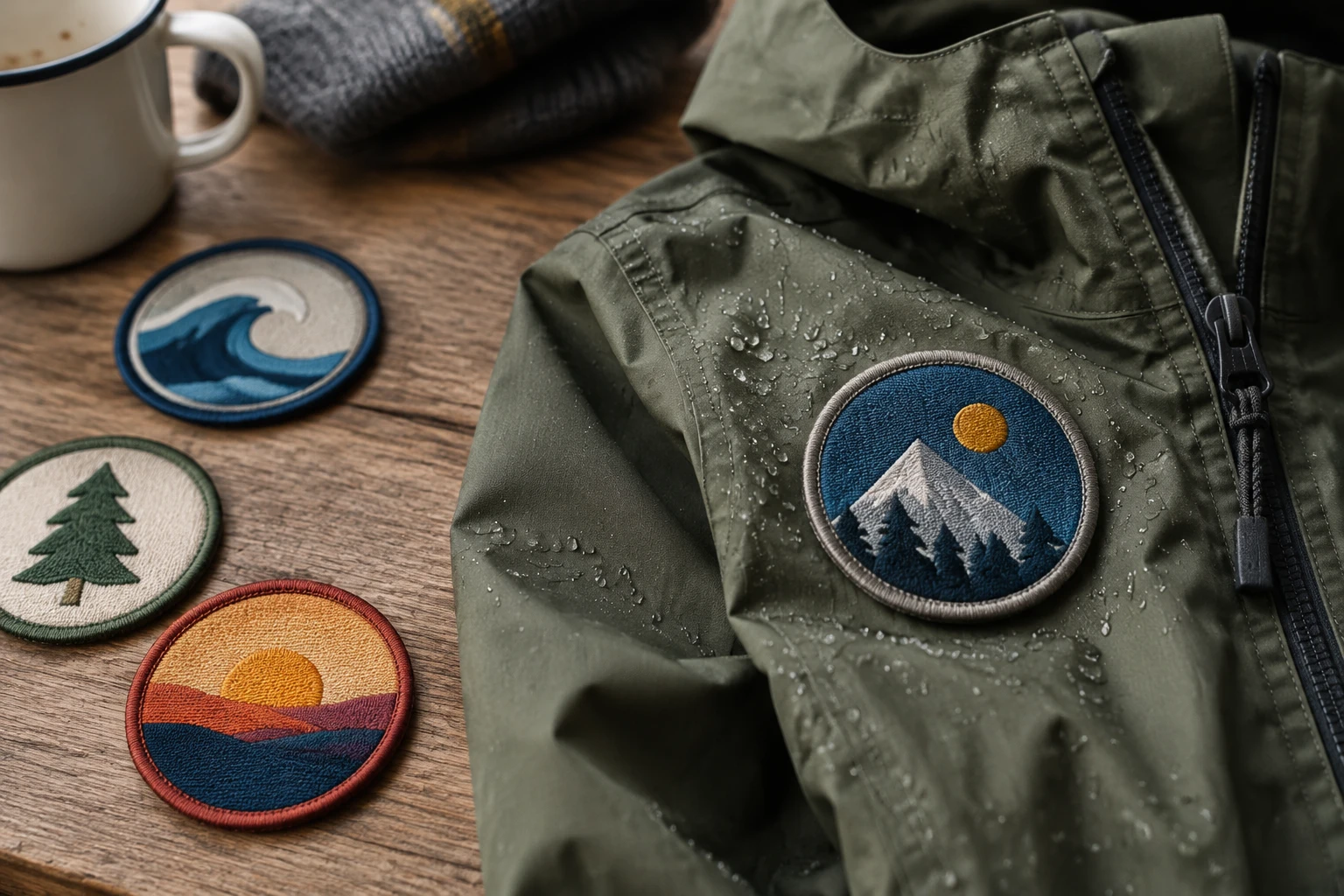
The safest way to attach a patch to a waterproof jacket is to use an existing manufacturer-fitted patch panel. Sewing through the waterproof layer creates potential leaks; ordinary iron-on backing can damage it. Adhesive attachment needs garment-specific approval, while stitched attachment requires compatible sealing of every puncture on the waterproof layer.
Key takeaways
- Stitching through a waterproof membrane or coating creates potential leak paths.
- Ordinary iron-on patch backing is not automatically suitable for waterproof shells.
- Seam tape and liquid sealants must be compatible with the jacket’s construction.
- A digital mockup confirms patch appearance, not attachment strength or waterproof performance.
The safest way to fit a patch on waterproof jackets is to use an existing manufacturer-fitted patch panel, without puncturing the shell. If there is no panel, ask the jacket maker about approved bonding or professional stitching and resealing. Ordinary sewing and iron-on backing cannot be assumed to preserve waterproofness.
A decorative badge is not a waterproof repair patch. Its attachment needs to survive bending, rain and the jacket’s care routine without damaging the membrane or coating underneath; a good-looking bond alone does not prove that.
Check what makes the jacket waterproof
A waterproof nylon or polyester shell usually relies on a membrane or coating, not just its outer fabric. The durable water-repellent finish, often called DWR, helps rain bead on the surface. Restoring that finish does not close needle holes.
Find the garment model, care label and decoration guidance before selecting a backing. On a lined jacket, the reverse of the waterproof layer may be hidden; sewing through everything can leave holes that cannot be reached for sealing without opening the lining.
For workwear, avoid covering reflective strips, safety labels or required markings. Check any restrictions on altering protective clothing with its supplier; our workwear patch guide covers the wider specification questions.
Which attachment suits a patch on waterproof jackets?
Choose the attachment before choosing the badge material. An existing hook-and-loop panel avoids new holes, but adding a loop panel to an unprepared jacket still requires a safe attachment method.
| Method | Main benefit | Limit on a waterproof shell |
|---|---|---|
| Existing manufacturer-fitted loop panel | Removable badge; no new shell punctures | Patch must fit the panel and use matching hook backing. |
| Garment-approved adhesive system | No needle holes | Bond depends on the surface finish, adhesive compatibility and care routine. |
| Sew-on with compatible seam sealing | Secure mechanical attachment | Every puncture through the waterproof layer needs sealing; rear access is essential. |
| Ordinary iron-on backing | Convenient on suitable heat-tolerant garments | Heat and pressure may damage coatings, membranes or existing seam tape. |
| General-purpose self-adhesive backing | Easy initial placement | Not evidence of a durable, washable bond on a treated shell. |
DWR and some shell materials can resist adhesives. Use only a system approved for the particular garment and patch substrate, following its preparation and curing instructions. Do not sand the shell or use aggressive solvents to force a bond.
Send the jacket model and its approved attachment method with your artwork so the backing specification is clear. We offer a free digital mockup, usually within 12 hours; it shows the design, not proof of waterproof performance.
GET A FREE MOCKUPFor the visible badge, embroidered patches provide raised thread detail; woven patches suit finer lettering, while printed patches accommodate gradients. None of these choices makes the attachment waterproof. Purpose-made repair tape is also not automatically suitable for bonding a decorative badge over it.
Can seam tape make a sewn patch watertight?
Compatible seam sealing can close stitch holes, but applying tape over the back is not a universal fix. Tape must suit the membrane, coating or inner textile surface, and its activation conditions must be safe for the garment.
Seal the waterproof layer, not the loose lining
A seal on a hanging lining does not close holes in the shell behind it. The sealing system needs to cover every puncture and bond continuously around the stitch line; wrinkles, corners and intersecting seams can make that difficult.
Liquid seam sealant is another possibility only where the manufacturer approves the chemistry and application. Products for silicone-treated fabrics and polyurethane-coated fabrics are not interchangeable by default. Do not substitute household glue.
If rear access, compatible materials or application settings are uncertain, ask a technical outerwear repair service before sewing. Resealing does not by itself demonstrate that the jacket retains its original waterproof rating.
Choose a size and position the shell can tolerate
Keep the badge within any existing attachment panel and away from zips, drawcord channels and high-flex areas. Shoulders and backpack strap contact points are poor candidates for an untested attachment because pressure and rubbing can stress the badge and shell.
Mark out the proposed size with paper rather than pins. A 70 mm (2.76 in) round patch is a useful layout example, not a universal recommendation: check logo readability, panel clearance and how the area bends. Our patch lettering guide explains why small text may need simplifying.
Check before fitting badges to a whole kit
- Confirm the jacket model, shell construction and approved decoration method with the garment supplier.
- Choose the patch dimensions and backing; check the position while wearing the jacket.
- Have the approved attachment fitted and allow any adhesive or sealant to cure fully according to its instructions.
- Inspect edges, flex the area gently and check for lifting or visible gaps. Follow the garment maker’s advice for checking water ingress.
- Assess the attachment after the permitted care cycle before repeating it across team garments.
Include your required date and confirmed attachment method so the quote addresses both the patch specification and timing. Get a free digital mockup, usually within 12 hours, before approving production.
GET A FREE MOCKUPWater beading on the outside is not proof that a stitch line is watertight. If the garment cannot be safely decorated, put the badge on a separate non-waterproof item; see adding a patch to a canvas bag or rucksack for that different construction.
What to include in your patch order
Send your artwork, quantity per design, dimensions in millimetres, preferred patch material and confirmed backing through our free mockup quote form. Include the jacket model, a photograph of the placement area and any decoration instructions. Keep the patch order separate from confirmation that someone can safely attach it.
The Customized Patches makes patches to order from your artwork, with a 5-piece minimum per design. Quotes start from £60, with free shipping throughout the United Kingdom. Final pricing depends on the specification.
Our free digital mockup is usually ready within 12 hours, and we produce only after approval. Check size, lettering, colours, edge and backing before approving; request production and delivery timings for your order, since mockup turnaround is not a dispatch promise.
Frequently asked questions
Can I iron a patch on waterproof jackets?
Only if the jacket manufacturer explicitly permits the required heat, pressure and adhesive. A low iron setting may fail to bond the patch, while higher heat may damage the waterproof construction.
Will sewing through a pocket avoid leaks?
Not necessarily. A pocket may sit outside the waterproof barrier, but stitching can catch the shell behind it. Confirm the construction and isolate the permitted layer before sewing.
Are PVC patches waterproof enough to protect the stitching?
PVC patches resist water, but the badge material does not seal needle holes around its edge. The garment attachment still needs its own approved waterproofing method.
Can I remove an adhesive badge later?
Do not assume clean removal. Adhesive can leave residue or lift a coating, and heat or solvents used for removal may damage the shell. Check the adhesive and garment guidance first.
Does waterproofing spray seal needle holes?
No. Reproofing products restore surface water repellency; they are not substitutes for compatible seam tape or seam sealant at punctures through the waterproof layer.
How should I wash a waterproof jacket after adding a patch?
Follow care instructions compatible with both the jacket and the attachment. If the patch requires care that conflicts with the garment’s instructions, choose another attachment method or another item to decorate.
Ready to produce custom patches for your UK team or brand?
GET A FREE MOCKUP