
PVC vs Woven Patches: Waterproof Rubber Against Fine Weave
PVC patches suit wet, muddy conditions and bold, raised designs; woven patches suit fine lettering, lighter garments and flat branding. PVC is a waterproof plastic, not rubber, despite its rubber-like feel. A waterproof patch does not waterproof its attachment: stitching can still create leak paths through a jacket.
Key takeaways
- PVC is waterproof, but stitching a PVC patch onto a shell can still create leaks.
- Woven patches generally hold finer lettering and sit flatter than moulded PVC.
- Backing and edge finish affect bulk, attachment and care as well as the face material.
- The minimum is 5 pieces per design; production starts only after artwork approval.
The choice in pvc vs woven patches is mainly between a waterproof, wipe-clean face and a thin badge that holds fine detail. Choose PVC for bold outdoor branding and woven for small lettering, uniform badges and lightweight fashion labels. Neither material makes the garment waterproof at the attachment point.
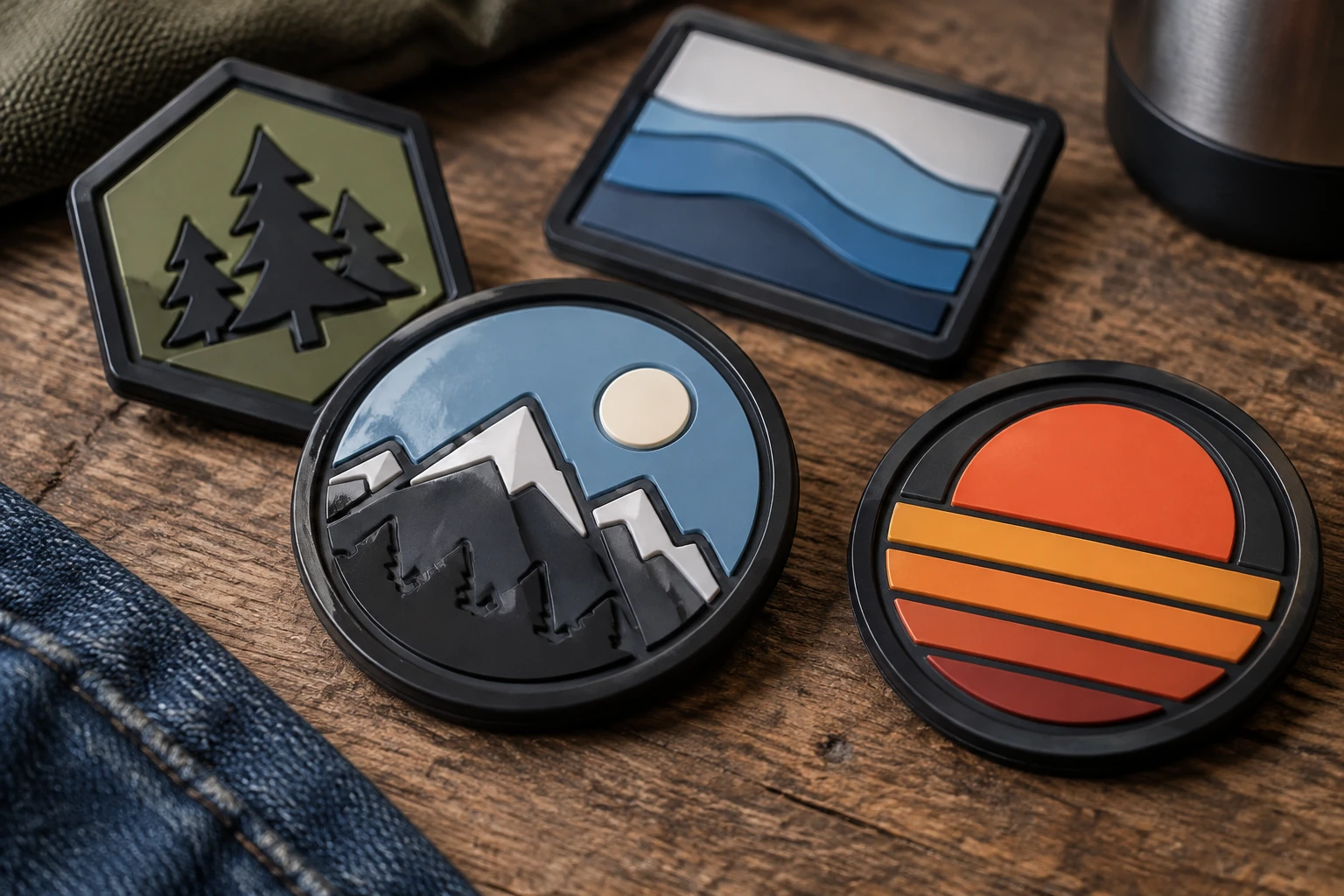
Although often called rubber patches, PVC patches are made from flexible polyvinyl chloride, a plastic. Woven patches form the design with interlaced threads rather than raised embroidery stitches. Their different construction affects thickness, cleaning, lettering and how the badge sits on clothing.
PVC vs woven patches: which suits your use?
Start with the garment and what happens to it during use. A badge on a muddy kit bag has different demands from a chest logo on a polo: the first benefits from easy wiping, while the second needs to bend comfortably with the fabric.
| Requirement | PVC | Woven |
|---|---|---|
| Wet or muddy use | Waterproof face; surface dirt usually wipes away | Not inherently waterproof; dirt can lodge between threads |
| Small lettering | Needs space for moulded lines and gaps | Generally better for fine text and narrow outlines |
| Appearance | Rubber-like surface with flat or raised areas | Flat textile finish with visible fine weave |
| Weight and flexibility | Usually thicker and heavier at comparable size | Usually thinner and lighter; backing adds stiffness |
| Outdoor kit | Good for bold badges on suitable bags and existing patch panels | Useful where low bulk and detail matter more than wipe-clean care |
| Uniforms | Suits bold identifiers on substantial garments | Suits detailed crests and names on polos or shirts |
| Fashion | Makes a pronounced, sculpted feature | Gives a flatter label-like finish |
| Main limitation | Tiny details may need simplification | Exposed threads can snag or abrade |
Neither option wins every durability test. PVC avoids exposed face threads, but its attachment can still fail; woven fabric can last well with suitable edges and care. Woven also differs from embroidered patches, whose thicker stitched texture can obscure very small lettering.
Will your logo work at the finished size?
Judge the artwork at its actual dimensions, not enlarged on a screen. For example, a hypothetical 70 mm (2.76 in) club badge with a long motto may favour woven construction, while a simple symbol at the same size may suit raised PVC.
Woven is not unlimited-resolution printing: tiny counters inside letters can still close up, and low-contrast text remains difficult to read. PVC needs enough separation between moulded features. There is no universal minimum lettering size that works for every font, outline and production method.
Specify the border as well as the face
- For PVC, identify which areas should be raised or recessed and leave room around lettering.
- For woven, ask which edge finish suits the shape; a merrowed stitched border adds a raised rim.
- On either type, allow attachment space without stitching through essential artwork.
Send your artwork, finished dimensions and garment so the proposed material suits the detail. Get a free digital mockup, usually within 12 hours, before approving production.
GET A FREE MOCKUPUse Best Fonts for Patch Lettering: Readability at Small Sizes to check the lettering before submitting it. For photographs or smooth gradients, consider printed patches instead. A digital mockup shows the proposed layout, but cannot prove physical texture, flexibility or exact colour matching.
Does waterproof PVC make a jacket badge leak-free?
No. PVC itself does not absorb water, but sewing through a waterproof nylon shell punctures the fabric and may puncture its membrane. Water can enter through those holes regardless of which patch covers them.
An existing factory-fitted hook-and-loop panel avoids making new holes when you attach a compatible removable badge. Adding the panel yourself is a separate attachment job. Adhesive also needs checking: coatings can resist bonding, while heat can damage shells or waterproof layers.
- Check the jacket maker’s guidance before sewing, heating or bonding anything to the shell.
- Do not assume domestic seam sealer will suit every membrane or coated fabric.
- If modification is unsuitable, put the badge on a bag or another non-waterproof garment.
Our guide to Patches on Waterproof Jackets: How to Add One Without Leaks explains the attachment problem separately from material choice. PVC’s advantage is its cleanable face, not a promise that the finished garment will stay watertight.
What works on uniforms and fashion garments?
A woven badge generally sits more naturally on a lightweight polo or shirt because it adds less bulk. A large PVC badge may pull or distort thin jersey. On a canvas cap or substantial bag, that extra structure can be less troublesome, although curvature still affects placement.
For fashion, choose the intended feel as well as the logo reproduction. Woven gives a flatter textile finish on a wool jacket; PVC creates a more pronounced feature. Check Patching Wool and Melton Jackets: Backings and Stitching That Work before selecting heat-based attachment.
Match the backing to washing and wear
- Sew-on: avoids relying on heat adhesive, but requires suitable fabric and secure stitching.
- Iron-on: confirm patch, adhesive and garment compatibility; unsuitable heat or repeated hot washing can cause lifting.
- Hook-and-loop: useful for removable identifiers, but adds thickness and needs a compatible receiving panel.
Include your backing choice and required arrival date with the artwork. Get a free digital mockup, usually within 12 hours, and check the specification before production.
GET A FREE MOCKUPFollow the most restrictive care instructions across the garment, patch and backing. Do not assume waterproof PVC tolerates hot tumble drying or aggressive cleaning chemicals. Remove detachable patches before washing where the care instructions recommend it.
What to include in your quote and approval
The Customized Patches makes patches to order from your artwork, with a 5-piece minimum per design. Quotes start from £60, but your specification determines the price; request comparable PVC and woven quotes rather than assuming one is always less expensive.
- Send clear artwork, quantity per design and finished width and height in millimetres.
- Name the garment fabric, placement and intended use, including rain exposure and washing.
- State the preferred material, backing and edge finish, and identify essential lettering.
- Check dimensions, spelling, colours, border and attachment details on the proposed specification.
- Give your required arrival date and ask for production and delivery estimates before approving.
We provide a free digital mockup, usually within 12 hours, and produce only after approval. That mockup window is not a manufacturing or delivery promise. Shipping is free across the United Kingdom; confirm the schedule for your specification and UK destination through our free mockup quote form.
Frequently asked questions
For pvc vs woven patches, which is better outdoors?
PVC generally suits muddy, wet use because its waterproof face is easy to wipe clean. Woven can still suit outdoor clothing where fine detail and low bulk matter more. Attachment determines whether adding either patch risks leaks.
Are PVC patches actually made of rubber?
No. PVC is polyvinyl chloride, a plastic. Flexible PVC feels rubber-like, which explains the common name, but it is not the same material as rubber or silicone.
Can woven patches reproduce small text?
Woven construction generally handles finer lettering than moulded PVC or conventional embroidery. Readability still depends on font, contrast, spacing and finished size. Ask for the design to be checked at its actual dimensions.
Can both materials use iron-on backing?
Do not assume so. Woven patches commonly use heat-activated backing, while PVC needs a specifically suitable construction and attachment method. Confirm availability and garment compatibility before ordering; waterproof shells are particularly sensitive to heat.
Are woven patches always less expensive than PVC?
No. Size, quantity, design complexity, backing and setup affect the quote. Compare identical quantities and dimensions, then check which specification preserves the artwork. The Customized Patches offers quotes from £60, not a fixed price for every design.
What is the minimum order, and when does production start?
The minimum is 5 pieces per design. A free digital mockup is usually provided within 12 hours, and production starts only after approval. Confirm manufacturing and delivery timing separately; free UK shipping does not mean a fixed arrival date.
Ready to produce custom patches for your UK team or brand?
GET A FREE MOCKUP