
Varsity chenille patches UK for Small Businesses: A Practical Guide
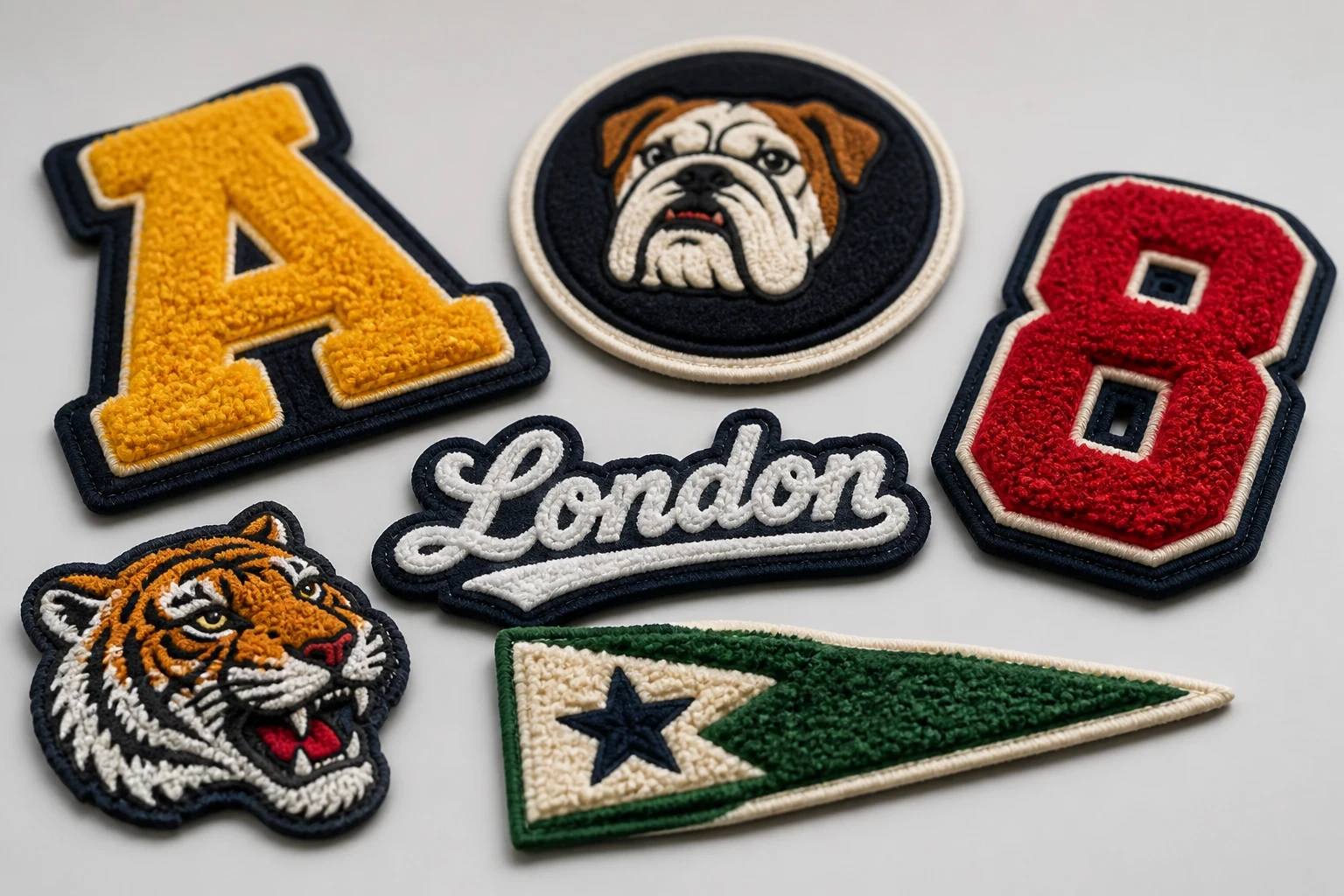
Varsity chenille patches UK are raised, textured patches made with chenille yarn and a stitched border, often used on jackets, clubwear, uniforms and branded workwear. Small businesses should confirm the finished size, artwork, backing and garment before ordering. The Customized Patches supplies a free digital mockup usually within 12 hours, with a 5-piece minimum per design.
Key takeaways
- Varsity chenille patches use raised chenille yarn for a soft, collegiate-style surface and a clear stitched border.
- A 5-piece minimum applies per design, which suits small launch runs, staff teams and pilot collections.
- A free digital mockup is usually supplied within 12 hours, and production begins only after the artwork and specifications are approved.
- Sew-on, iron-on and Velcro backings suit different garments, so the backing should be selected before the quote is accepted.
Varsity chenille patches UK are raised, textured patches made with chenille yarn and a stitched border. They give small-business jackets, clubwear, uniforms and branded workwear a clear collegiate look without requiring a large production run.
The Customized Patches supplies these patches across the United Kingdom with a 5-piece minimum per design. A free digital mockup is usually sent within 12 hours, and production begins only after you approve the artwork, colours, size and backing.
What makes varsity chenille patches different?
Chenille is the fuzzy, raised yarn surface that gives these patches their familiar varsity appearance. The border is normally stitched or merrowed around the edge, creating a defined outline that helps a letter, crest or simple emblem hold its shape. The result is tactile rather than flat.
That texture is the main reason a small business chooses chenille. A coffee roaster might use a large initial on a wool coach jacket. A five-a-side team might place a club badge on a tracksuit top. A bar, record shop or independent clothing label might use one bold word instead of trying to reproduce a detailed illustration that chenille cannot show cleanly.
Chenille is not the best answer for every logo. Fine lines, tiny text and photographic detail generally need a different construction. Embroidered patches handle more linework, while woven patches can suit small, flat lettering with a sharper surface. The better choice depends on what the patch must communicate at normal viewing distance.
Why small UK businesses use chenille patches
Small firms rarely need thousands of identical patches. They may be testing a clothing drop, kitting out six staff members, preparing a limited club run or adding a badge to a handful of jackets for a market stall. A 5-piece minimum per design makes that first test more manageable than a large bulk commitment.
- Independent clothing brands can apply a large initial, wordmark or collection name to jackets and overshirts.
- Hospitality teams can add a bold venue mark to wool coaches, aprons or staff outerwear where a soft raised badge suits the uniform.
- Football, rugby and social clubs can make a captain, anniversary or tournament patch in a small run.
- Barbers, tattoo studios and record shops can use chenille badges as staff identifiers or retail merchandise.
- Schools, colleges and cadet units can use simple crests, house letters and achievement badges on suitable garments.
- Biker and motorcycle clubs may prefer a more detailed construction for a back panel, but chenille can work for a smaller front emblem if the design is bold enough.
The point is not to make every item look like a school blazer. Colour, scale and garment choice change the character. A black patch with cream lettering on a navy wool jacket feels traditional; a bright orange badge on a black overshirt feels more like a streetwear product.
Choosing the right size, shape and lettering
Start with the available space, not the size you happen to see on another jacket. Measure the chest, sleeve, back panel or bag flap in inches. Leave room around zips, seams, pockets and curved edges. A 3-inch badge can look lost on the back of a heavy coach jacket, while a 9-inch design may overwhelm a polo chest.
Practical size guidance
| Use | Common finished width | What to watch |
|---|---|---|
| Small chest or cap-style emblem | 2.5–4 inches | Keep text short and avoid narrow interior gaps. |
| Front jacket letter or club badge | 4–7 inches | A strong border and simple shapes usually read well. |
| Large back wordmark | 8–12 inches | Check the jacket panel, seams and overall weight before approval. |
| Sleeve or trouser-leg mark | 2.5–4.5 inches | Confirm the patch will not restrict movement or sit over a seam. |
| Bag or accessory patch | 2–5 inches | Consider the material and whether the bag can take heat or stitching. |
Letter height matters more than many first-time buyers expect. A word can look perfectly legible on a computer screen but lose its clarity once reduced to a small patch. Large block lettering is generally safer than a thin script. If the business name is long, consider a monogram, abbreviation or separate line rather than forcing every character into one narrow badge.
Shape is part of the design. Round and shield patches suit crests. Rectangles suit names and team years. Arches work well above a central letter, while an irregular outline can follow a recognisable symbol. A merrowed edge gives a traditional finished border, but an overly complicated outline can add cost and make application awkward.
For more detail on dimensions and backing, see Chenille patches Sizing and Backing Options Explained. The practical test is simple: print the design at its proposed size, hold it against the garment and read it from the distance at which customers or team members will see it.
Backing choices for jackets, uniforms and workwear
Backing is not a minor finishing detail. It controls how the patch is fitted, how easy it is to remove and how well it suits the garment. Sew-on is usually the dependable option for heavy jackets, thick denim, wool coaches and items that will be washed or worn regularly.
Iron-on backing can be convenient for a controlled application, particularly on a suitable cotton or cotton-blend surface. It is less straightforward on nylon shells, coated fabrics, waterproof garments and heat-sensitive materials. An iron-on patch that looks secure on day one can peel after a dryer cycle if the heat, pressure or fabric is unsuitable.
| Backing | Good fit | Advantages | Limitations |
|---|---|---|---|
| Sew-on | Wool coaches, denim, blazers, heavy cotton and regular-use workwear | Secure, versatile and suitable for fabrics that should not receive direct heat | Takes longer to apply and leaves stitching when removed |
| Iron-on | Suitable cotton and cotton-blend garments with a stable surface | Quick application with no visible thread around the border | Can fail on nylon, coatings, textured fabrics or after unsuitable washing |
| Velcro | Removable uniforms, tactical-style garments and existing Velcro panels | Allows one patch to move between garments or be removed for washing | Needs matching hook-and-loop placement and can add bulk |
Velcro deserves a separate check. It is useful for a team that rotates names, roles or event badges, but the garment needs a properly positioned loop panel. Sewing hook tape directly to a delicate wool surface can damage the fabric, and a patch without the correct counterpart will not sit securely.
Tell our team what the patch will be attached to. “Jacket” is not enough information. A nylon shell, wool coach, cotton hoodie and school blazer each present different risks. If the item is expensive or difficult to replace, sew-on is often worth considering even when iron-on looks faster.
Artwork that works in chenille
The strongest chenille artwork is clear at a glance. Use a limited colour palette, bold outlines and enough open space for the yarn and border to show separately. Large initials, simple mascots, dates and short names usually translate well. Tiny interior details are where many first drafts become difficult to manufacture.
Not sure whether your lettering needs simplifying or enlarging? Send the artwork and garment details for a free digital mockup in 12 hours, so you can compare the proposed size before production.
GET A FREE MOCKUP- Supply vector artwork if available, preferably with text converted to outlines.
- State the intended thread or yarn colours rather than relying on an unlabelled screen preview.
- Keep narrow gaps open so they do not close visually in the finished patch.
- Check that the outer border is strong enough to frame the design.
- Separate essential elements from decorative details that can be removed if the patch is small.
- Tell the manufacturer which part of the logo must remain most prominent.
A clean PNG can still be useful for a quote, especially if it has a transparent background and good resolution, but it may need preparation before production. A screenshot from social media is rarely sufficient for accurate sizing. Our free mockup is the point at which the proposed construction, scale and colour arrangement can be checked before anything is made.
If your mark contains a fine slogan, a face, a landscape illustration or several small objects, compare the design with printed patches or 3D embroidered patches. Printed is flatter; that is the point. It can preserve fine imagery that a raised chenille surface would have to simplify.
Chenille compared with other patch types
There is no universal winner. The right construction follows the job. Chenille is chosen for its height, touch and varsity character, while embroidery is often selected for a denser stitched appearance and more conventional logo work.
| Patch type | Surface and appearance | Good for | Main trade-off |
|---|---|---|---|
| Varsity chenille | Raised, soft and textured with a stitched border | Large letters, crests, club badges and collegiate-style jackets | Fine text and detailed illustrations may need simplification |
| Embroidered | Stitched thread surface with flexible detail | Workwear logos, uniforms, names and traditional badges | Can look less bold or tactile than chenille for large lettering |
| Woven | Flat, tightly woven face | Small lettering, clean symbols and flatter garments | Does not provide the raised varsity texture |
| Printed | Flat ink or printed image | Gradients, photographs and fine artwork | Less tactile and may not give the heritage badge appearance |
| PVC | Moulded, rubber-like surface | Outdoor gear, sports bags and modern utility branding | Different visual language from traditional varsity patches |
| Leather | Natural or synthetic leather face | Premium labels, denim, bags and heritage branding | Colour and detail options differ from textile patches |
For a detailed side-by-side discussion, read The Difference Between varsity chenille patches UK and embroidered patches, Explained. You can also review PVC patches or leather patches if the garment is outdoor equipment, denim or a premium accessory rather than a traditional team jacket.
A small business should judge the patch at the point of use. A restaurant may need a logo that can be read across a counter. A clothing label may value texture and collectability more than tiny brand detail. A football club may need an affordable short run for one event. Those are different briefs, even if each asks for a custom patch.
Ordering varsity chenille patches UK without avoidable delays
A clear quote request includes the artwork, finished dimensions, quantity, backing, garment type, preferred colours and delivery postcode. Include the date the patches are needed, but allow time for questions and approval. A deadline is useful only if the production requirements are known.
- Send the artwork and explain what the patch will be attached to.
- Give the finished width or height in inches, plus any maximum space on the garment.
- Confirm the number of pieces per design; the minimum is 5 pieces per design.
- Choose sew-on, iron-on or Velcro backing.
- Review the free digital mockup, usually received within 12 hours.
- Check spelling, colours, border, dimensions and backing before approval.
- Approve the final specification so production can begin.
- Check the delivered patches against the approved design before applying them.
The approval stage matters because a mockup is not decorative paperwork. It is the last practical opportunity to spot a missing letter, incorrect year, weak contrast or patch that is too large for the intended panel. The Customized Patches produces only after approval, so changes should be raised at that point.
Lead time depends on the design, quantity, backing and current production schedule. Ask for the expected production and delivery timing with the quote rather than assuming that a small order is automatically next-day. UK-wide delivery details should also be confirmed for remote addresses, events and launch dates.
Cost factors for a small-business order
The price of a chenille patch is shaped by more than the number of pieces. Size, shape, number of colours, lettering, border construction, backing and quantity all affect the quotation. A simple 4-inch letter patch is a different job from a 10-inch back patch with several colours and an irregular edge.
- Larger patches use more material and may require more handling.
- Complex borders and multiple colour sections can increase production work.
- Small quantities may have a higher per-piece price than larger runs, even though the total spend is lower.
- Velcro can involve an additional matching panel or attachment requirement.
- Rush requirements may depend on the design and available production capacity.
- A revised design after approval can create extra work and may affect timing.
For a sensible comparison, request the same specification from each supplier: finished size, quantity, backing, number of colours and delivery location. Comparing a sew-on 5-inch badge with a Velcro 10-inch back patch will not tell you much about value. Keep a record of the approved mockup so future reorders use the same dimensions and colours.
A first run can be treated as a practical sample. Order enough for the intended launch, keep one spare for photography or replacement, and ask how a reorder will be matched. If the design is likely to change each season, avoid committing to a large quantity before the garment and application have been tested.
Garment examples and common failure points
A wool coach jacket is a natural home for chenille, but the surface may need careful stitching so the patch sits flat. Denim is generally more forgiving, although heavy borders can still pull if the patch is oversized for a narrow pocket area. On a school blazer, check the badge position against the pocket, lapel and existing school insignia.
Nylon shells are where rushed orders often become awkward. The fabric may be thin, coated or heat-sensitive, so an iron-on application can be a poor choice. A sew-on patch can work, but the owner should consider visible needle marks, waterproofing and the garment’s lining before proceeding.
Velcro panels solve a different problem. They suit uniforms where the wearer needs to swap a name, role or event badge, but they do not automatically suit a fashion jacket. The patch may feel bulky, catch on other fabric or look out of place if the loop panel is larger than the badge.
Name sew-on, iron-on or Velcro on the quote and tell us the garment. We will show the proposed backing on a free digital mockup, usually within 12 hours, before your 5-piece-or-more order enters production.
GET A FREE MOCKUP- Iron-on that peels after a dryer cycle because the garment was not suitable or the care instructions were ignored.
- A patch placed over a seam, zip or pocket so it cannot sit flat.
- Small text closing up because the artwork was reduced without checking legibility.
- A colour chosen from a screen that does not provide enough contrast against the garment.
- A crest made too large for the sleeve or chest area.
- A Velcro badge ordered without checking the size and position of the existing panel.
These are specification failures rather than reasons to avoid patches. Send a garment photograph, identify the material and ask questions before confirming the order. Our team would rather resolve an unsuitable backing on the quote than hear about a peeling badge after a uniform has been distributed.
Care, application and reorders
Apply the patch according to its backing and the garment manufacturer’s care guidance. For iron-on patches, test a hidden area or spare garment first, use the recommended heat and pressure, and allow the adhesive to cool before stretching the fabric. Never assume that a nylon or coated shell can tolerate the same treatment as a cotton sweatshirt.
Sew-on patches should be secured around the border with thread suited to the garment. Keep the stitches controlled rather than pulling the edge into waves. For removable Velcro patches, inspect the hook and loop regularly and remove the badge before washing if the garment instructions call for it.
Keep the approved mockup, final dimensions and colour notes with the order record. This makes a second run easier and reduces the chance that the same logo is reordered at a different width. If the business changes its branding, treat the update as a new design and check the 5-piece minimum per design.
A practical decision checklist
Before requesting a quote, write down what the patch has to do. Is it a permanent club mark, a removable staff identifier, a retail item or a one-off event badge? The answer narrows the choice of backing, size and construction quickly.
- What garment or accessory will carry the patch?
- What is the available area in inches?
- Will the patch be washed, dried, removed or moved between garments?
- Does the artwork rely on small text, gradients or fine lines?
- Which colour should dominate and which details are essential?
- How many pieces are needed per design, with at least 5 required?
- Is sew-on, iron-on or Velcro most appropriate?
- When are the patches required in the United Kingdom?
- Has the mockup been checked for wording, size, border and backing?
- Has production approval been given?
If you are comparing constructions, the embroidered patches product hub gives a useful alternative for detailed stitched logos. For a project connected with motorcycle clothing, see biker and motorcycle club patches. UK customers can also review the UK city pages for local delivery information and location-specific ordering context.
Final guidance for small businesses
Varsity chenille patches UK work best when the design is bold, the garment is chosen first and the backing is treated as part of the specification. They are particularly effective for initials, short names, club badges and simple symbols where the raised surface can be seen and felt.
Do not force a detailed logo into chenille simply because the style is popular. Printed is flatter; that is the point. Embroidery, woven, PVC or leather may provide a better result for a different garment or visual brief. A useful supplier will explain the trade-off rather than approve artwork that is likely to disappoint.
For a small UK launch, the sensible route is straightforward: send the artwork, state the garment and dimensions, choose the backing, review the free digital mockup within the usual 12-hour window, and approve only when the details are correct. With a 5-piece minimum per design, the first run can test the idea without requiring a large stock order.
Frequently asked questions
What are varsity chenille patches UK businesses commonly used for?
They are commonly used on wool coach jackets, denim jackets, school blazers, clubwear, staff outerwear, bags and branded merchandise. They suit bold initials, short names, crests, dates and simple symbols where a raised, textured surface is desirable.
What is the minimum order for varsity chenille patches UK?
The minimum order is 5 pieces per design. If you need two different badges, each design is counted separately, so the order would normally need at least 5 of the first design and 5 of the second.
How quickly can I see a mockup?
The Customized Patches usually provides a free digital mockup within 12 hours. Production starts only after you approve the mockup and confirm the size, colours, artwork, backing and quantity.
Which backing is best for a nylon jacket?
Sew-on is often the safer starting point for a nylon shell because nylon may be heat-sensitive or coated. Iron-on backing should only be considered after checking the garment and application guidance. A garment photograph helps the production team advise more accurately.
Can chenille patches include small lettering?
They can include lettering, but very small text may lose clarity because chenille uses raised yarn and a stitched construction. Use bold characters, adequate spacing and a suitable finished size. If fine wording is essential, embroidered, woven or printed patches may be more suitable.
How should a small business compare chenille with embroidered patches?
Choose chenille for a raised varsity texture, large lettering and a tactile jacket badge. Choose embroidered patches for more conventional stitched logos, finer linework and many workwear applications. Compare both using the same size, quantity, backing and garment details before deciding.
Ready to produce custom patches for your UK team or brand?
GET A FREE MOCKUP